Noah Parker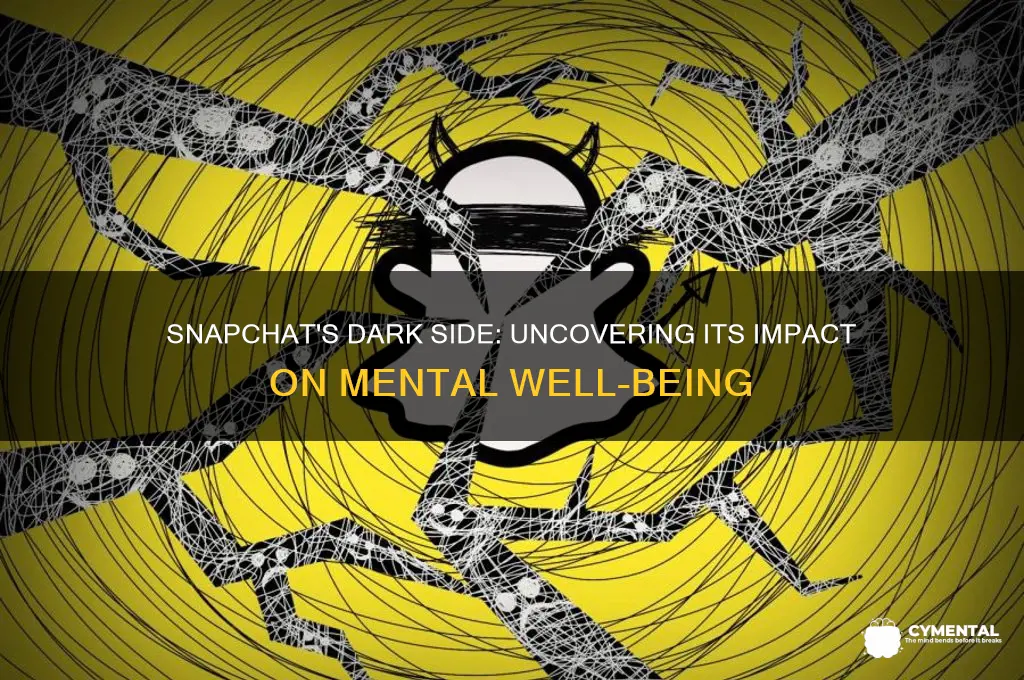
Snapchat, a popular social media platform known for its ephemeral content and curated filters, has been increasingly linked to mental health issues among its users, particularly adolescents and young adults. The app’s emphasis on constant sharing, streak maintenance, and comparison to others’ seemingly perfect lives can foster feelings of anxiety, inadequacy, and fear of missing out (FOMO). Additionally, the pressure to present an idealized version of oneself through filters and edited content can distort self-perception and contribute to body image issues and low self-esteem. The addictive nature of Snapchat, driven by its streak feature and notifications, further exacerbates these problems by disrupting sleep patterns and reducing real-life social interactions, ultimately impacting overall mental well-being.
Explore related products


What You'll Learn
- Constant Comparison: Snapchat's curated content fosters unrealistic comparisons, leading to low self-esteem and body image issues
- Fear of Missing Out (FOMO): Snap streaks and stories create anxiety about missing social events or connections
- Addiction & Distraction: Excessive use disrupts focus, sleep, and productivity, contributing to stress and burnout
- Cyberbullying & Harassment: Anonymous features and disappearing content enable bullying, causing emotional distress and trauma
- Validation Seeking: Reliance on likes and streaks for self-worth ties mental health to external approval

Constant Comparison: Snapchat's curated content fosters unrealistic comparisons, leading to low self-esteem and body image issues
Snapchat's curated content, with its filters, Stories, and Highlights, creates a highlight reel of users' lives, often omitting the mundane or imperfect moments. This carefully crafted presentation can lead to a phenomenon known as "constant comparison," where users measure their own lives against the seemingly flawless existence of others. A study published in the *Journal of Social and Clinical Psychology* found that young adults who spent more than two hours per day on social media, including Snapchat, were more likely to report poor self-esteem and body image issues. The platform’s emphasis on visual content exacerbates this, as users are bombarded with images that often reflect unrealistic beauty standards, filtered skin, and idealized lifestyles.
Consider the mechanics of Snapchat’s features: filters that smooth skin, whiten teeth, and enlarge eyes, coupled with Stories that showcase vacations, parties, and achievements. For a teenager scrolling through these snapshots, the message is clear—everyone else is happier, more attractive, and more successful. This constant exposure to curated perfection can distort reality, making users feel inadequate in comparison. A 2021 survey by the Royal Society for Public Health revealed that 60% of young people felt Snapchat negatively impacted their body image, with many reporting feelings of anxiety and depression when they couldn’t measure up to the standards they saw online.
To mitigate the effects of constant comparison, users can adopt practical strategies. First, limit daily Snapchat usage to 30 minutes or less, as studies suggest that reducing screen time can improve mental well-being. Second, diversify your feed by following accounts that promote authenticity and body positivity, such as influencers who share unfiltered photos or discuss their struggles openly. Third, practice mindfulness by questioning the reality behind the images you see—remind yourself that filters and editing tools create illusions, not truths. For parents and educators, initiating conversations about the curated nature of social media can help young users develop critical thinking skills and resilience.
The psychological impact of constant comparison extends beyond fleeting moments of insecurity. Over time, it can contribute to chronic low self-esteem, eating disorders, and even depressive symptoms. A longitudinal study by the University of Pennsylvania found that reducing social media usage, including Snapchat, led to significant reductions in loneliness and depression among participants. This underscores the importance of recognizing how the platform’s design—prioritizing visual perfection and instant gratification—can subtly erode self-worth. By understanding this dynamic, users can take proactive steps to protect their mental health while still engaging with the app.
Ultimately, Snapchat’s curated content is a double-edged sword—it fosters connection but also fuels unrealistic comparisons. The key lies in balancing engagement with awareness. Users must consciously challenge the narratives they consume, recognizing that what they see is often a polished version of reality. By doing so, they can reclaim their self-esteem and cultivate a healthier relationship with both the platform and themselves. As social media continues to evolve, so too must our strategies for navigating its psychological pitfalls.
Singulair and Mental Health: Frequency of Psychological Side Effects
You may want to see also
Explore related products


Fear of Missing Out (FOMO): Snap streaks and stories create anxiety about missing social events or connections
Snapchat's core features—Snap streaks and Stories—exploit a primal fear: the fear of missing out (FOMO). Streaks, which track consecutive days of chatting with a friend, create a gamified obligation. Users feel compelled to maintain these streaks, often at the expense of genuine connection or personal time. A missed day isn’t just a broken streak; it’s perceived as a fractured relationship. This digital scoreboard turns friendship into a chore, fostering anxiety rather than fostering bonds.
Consider the psychological mechanics: Stories, which disappear after 24 hours, create artificial scarcity. Users scroll through highlights of others’ lives—parties, vacations, achievements—feeling pressured to keep up or risk being left behind. A 2021 study published in *Computers in Human Behavior* found that excessive Snapchat use correlated with higher FOMO levels, particularly among teenagers aged 13–19. The platform’s design amplifies this by prioritizing streaks and Stories, making them the first thing users see upon opening the app.
To mitigate this anxiety, set boundaries. Limit Snapchat usage to specific times of day, and disable notifications to reduce the urge to check constantly. For streaks, have honest conversations with friends about their importance—often, both parties feel trapped but are too afraid to break the cycle. Prioritize real-time interactions over digital validation. For parents or educators, encourage teens to reflect on how Snapchat makes them feel and guide them in distinguishing between curated content and reality.
The takeaway? Snapchat’s FOMO-inducing features thrive on urgency and scarcity. By recognizing this manipulation and reclaiming control, users can transform the platform from a source of anxiety into a tool for genuine connection. Streaks and Stories don’t define relationships—actions and presence do.
COVID-19's Impact: Rising Mental Health Challenges Post-Pandemic
You may want to see also
Explore related products


Addiction & Distraction: Excessive use disrupts focus, sleep, and productivity, contributing to stress and burnout
Excessive Snapchat use rewires the brain’s reward system, fostering addiction through its streak-based mechanics and endless scroll of ephemeral content. Studies show that the average user spends 30 minutes daily on the app, with teens often exceeding 60 minutes. This habitual checking triggers dopamine release, creating a feedback loop where users crave the next notification or update. Over time, the brain prioritizes these micro-rewards over real-world tasks, making it harder to focus on work, studies, or even conversations. The result? A fragmented attention span that leaves users perpetually distracted and unable to engage deeply with anything outside the app.
Consider the impact on sleep, a cornerstone of mental health. Snapchat’s blue light exposure and the urge to check updates before bed disrupt circadian rhythms, with 67% of users admitting to using the app within an hour of sleep. Even a single 10-minute session can delay melatonin production by up to 30 minutes, reducing sleep quality. Chronic sleep deprivation, defined as less than 7 hours nightly, exacerbates stress, impairs decision-making, and increases the risk of burnout. For teens, whose brains require 8–10 hours of sleep, this disruption can have long-term cognitive and emotional consequences.
Productivity takes a hit as well. The average person checks their phone 96 times daily, with Snapchat being a frequent culprit. Each interruption, even if brief, requires 23 minutes to regain focus on the original task. For students, this translates to longer study times and lower retention rates. Professionals report similar effects, with 58% admitting social media distractions reduce their work efficiency. The cumulative effect is a sense of constant busyness without meaningful accomplishment, a key driver of burnout.
Breaking the cycle requires intentional boundaries. Start by enabling "Do Not Disturb" mode during work or study hours, and allocate specific times for Snapchat use—no more than 20 minutes per session. Use apps like Screen Time or Digital Wellbeing to monitor usage and set daily limits. For sleep, establish a "digital sunset" one hour before bed, switching to Night Mode to reduce blue light exposure. Prioritize real-world interactions and hobbies to rebuild focus and reduce reliance on the app’s instant gratification. Small changes, consistently applied, can reclaim attention, restore sleep, and revive productivity before burnout takes hold.
Silent Struggles: Mental Health Challenges in America's Shadow
You may want to see also
Explore related products




Cyberbullying & Harassment: Anonymous features and disappearing content enable bullying, causing emotional distress and trauma
Snapchat's anonymous features and disappearing content have inadvertently created a breeding ground for cyberbullying, leaving victims with emotional scars that often go unnoticed. The platform's design, while intended for playful and spontaneous communication, can be weaponized by bullies who exploit its ephemeral nature to harass others without fear of repercussions. Unlike traditional bullying, cyberbullying on Snapchat can occur 24/7, invading personal spaces and offering no escape, even in the supposed safety of one's home.
Consider the mechanics: Snapchat's "Snap" feature allows users to send photos or videos that disappear after being viewed, and its "Stories" vanish after 24 hours. Bullies leverage this to send threatening messages, humiliating images, or cruel comments, knowing their actions leave minimal digital footprints. For instance, a teenager might receive a degrading Snap from an anonymous account, only to have it disappear moments later, making it difficult to report or even prove the incident occurred. This transient nature not only emboldens perpetrators but also isolates victims, who may feel powerless to seek help.
The psychological impact of such harassment is profound. Studies show that adolescents who experience cyberbullying are at a higher risk of anxiety, depression, and even suicidal ideation. The anonymity of Snapchat exacerbates this, as victims often don’t know who is attacking them, leading to heightened paranoia and trust issues. For example, a 14-year-old girl might constantly question her friendships after receiving anonymous hate messages, fearing even her closest peers could be behind the harassment. This erosion of trust can have long-term consequences, affecting relationships and self-esteem well into adulthood.
To mitigate these risks, parents, educators, and users must take proactive steps. First, educate young users about the dangers of anonymous interactions and encourage them to report suspicious behavior immediately. Snapchat’s reporting tools, though limited, can help flag abusive accounts. Second, limit the use of anonymous features by adjusting privacy settings to restrict who can send Snaps or view Stories. For parents, monitoring app usage without invading privacy—such as setting screen time limits or discussing online behavior—can provide a safety net. Finally, fostering open conversations about mental health and cyberbullying can empower victims to speak up and seek support before the emotional distress escalates.
While Snapchat’s features are not inherently malicious, their misuse in cyberbullying highlights the need for greater accountability and user awareness. By understanding the risks and taking preventive measures, we can transform this platform from a tool of harassment into a safer space for connection and expression.
Understanding Stigma: How Society Treats Those with Mental Health Issues
You may want to see also
Explore related products

Validation Seeking: Reliance on likes and streaks for self-worth ties mental health to external approval
Snapchat's design thrives on instant gratification, and for many users, this translates into a constant quest for validation through likes and streaks. Each notification, each flame icon signaling a maintained streak, becomes a hit of dopamine, a digital pat on the back reinforcing the idea that we are seen, valued, and connected. This mechanism, while seemingly harmless, can subtly erode self-esteem, tying our sense of worth to the unpredictable whims of others' engagement.
A 2019 study published in the *Journal of Social and Clinical Psychology* found a direct correlation between time spent on social media platforms like Snapchat and increased feelings of social isolation and loneliness, particularly among young adults aged 18-25. This demographic, already navigating the complexities of identity formation, is especially vulnerable to the platform's validation-driven culture. The pressure to maintain streaks, to craft the perfect snap, to garner likes and comments, can create a feedback loop of anxiety and self-doubt.
Consider the act of sending a snap. The sender anxiously awaits the recipient's response, their self-worth momentarily hinging on whether the snap is opened, screenshotted, or replied to. This constant seeking of external approval can lead to a distorted sense of self, where one's value is measured not by intrinsic qualities but by the fleeting approval of others. Imagine a teenager meticulously curating their Snapchat story, obsessing over the perfect filter, the wittiest caption, all in the hopes of maximizing likes and views. This behavior, while seemingly harmless, reflects a deeper need for validation, a need that, when unmet, can lead to feelings of inadequacy and low self-esteem.
The solution lies not in abandoning Snapchat altogether, but in cultivating a healthier relationship with the platform. Here are some practical steps:
- Set boundaries: Allocate specific times for Snapchat usage and stick to them. Avoid mindless scrolling and constant checking for notifications.
- Focus on genuine connections: Prioritize meaningful interactions over chasing likes and streaks. Engage in conversations, share authentic moments, and connect with friends on a deeper level.
- Practice self-compassion: Recognize that your worth is not defined by online validation. Celebrate your achievements, acknowledge your strengths, and treat yourself with kindness and understanding.
- Seek offline validation: Engage in activities that boost your self-esteem outside the digital realm. Pursue hobbies, spend time with loved ones, and contribute to your community.
By implementing these strategies, users can break free from the cycle of validation seeking and cultivate a healthier, more balanced relationship with Snapchat, one that enhances their lives rather than controlling them.
Opioids and Mental Health: Unraveling the Devastating Psychological Impact
You may want to see also
Frequently asked questions
Yes, excessive Snapchat use can contribute to anxiety and depression due to factors like social comparison, fear of missing out (FOMO), and the pressure to maintain a perfect online image.
The streak feature can create stress and obsession, as users feel compelled to maintain daily interactions, leading to anxiety and disrupted sleep patterns.
Yes, constantly viewing filtered and idealized images on Snapchat can lower self-esteem, as users compare themselves to unrealistic standards, fostering feelings of inadequacy.