Madison Cole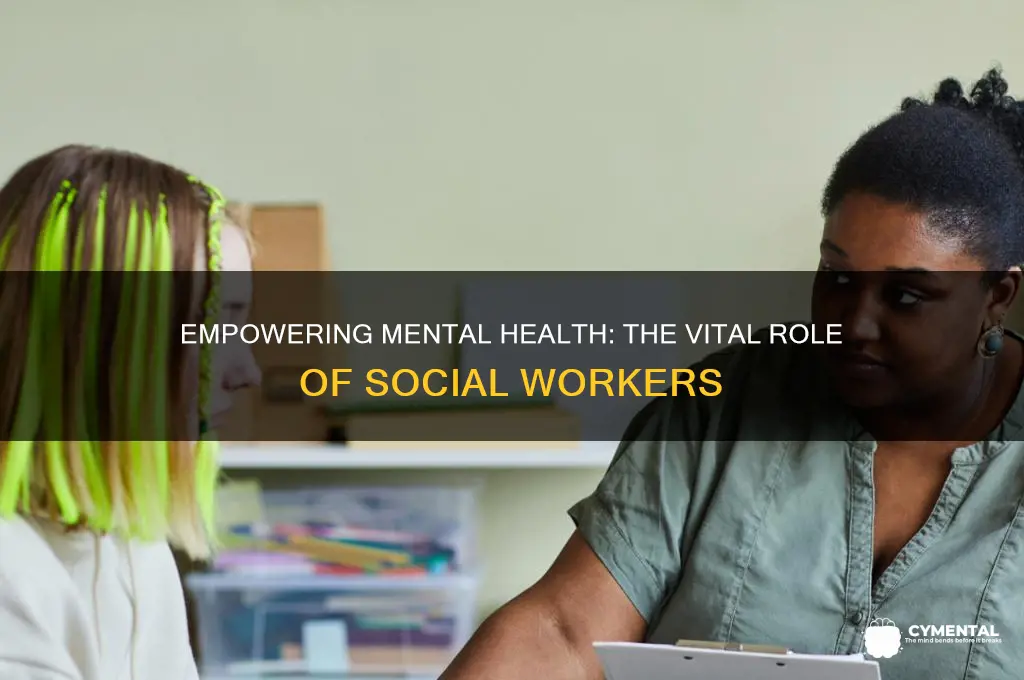
Social workers play a crucial role in supporting mental health by providing holistic, client-centered care that addresses both individual and systemic challenges. Through assessment, counseling, and advocacy, they help individuals navigate complex emotional and psychological issues while connecting them with essential resources such as therapy, housing, and financial assistance. Social workers also collaborate with interdisciplinary teams to create tailored treatment plans, promote resilience, and reduce stigma. By addressing social determinants of mental health, such as poverty, trauma, and discrimination, they empower clients to achieve stability and well-being, fostering long-term recovery and improved quality of life.
Explore related products


What You'll Learn
- Crisis Intervention: Provide immediate support during mental health crises, ensuring safety and stabilization
- Therapy & Counseling: Offer evidence-based therapies to address emotional and psychological challenges
- Resource Navigation: Connect individuals to mental health services, housing, and financial assistance
- Advocacy: Promote mental health awareness, reduce stigma, and advocate for policy changes
- Community Support: Build networks and programs to foster social connections and emotional well-being

Crisis Intervention: Provide immediate support during mental health crises, ensuring safety and stabilization
In the throes of a mental health crisis, every second counts. Social workers are often the first responders, providing immediate support to individuals experiencing acute distress. Their role is critical in de-escalating situations, ensuring safety, and stabilizing the individual until further treatment can be arranged. Crisis intervention is a specialized skill set that combines empathy, quick thinking, and a deep understanding of mental health dynamics.
Consider a scenario where a young adult is experiencing a severe panic attack in a public space. A trained social worker would first assess the environment to ensure physical safety, both for the individual and those around them. This might involve moving to a quieter location or removing potential hazards. Next, the social worker would employ de-escalation techniques, such as grounding exercises or deep breathing, tailored to the individual’s needs. For instance, a 20-year-old might respond well to a 4-7-8 breathing technique (inhale for 4 seconds, hold for 7, exhale for 8), while a 16-year-old might benefit from a tactile grounding exercise like naming five objects they can see. The goal is to reduce immediate distress and create a sense of control.
However, crisis intervention isn’t just about the moment. Social workers must also connect individuals to long-term resources. After stabilization, they might refer the person to a mental health clinic, provide contact information for a 24-hour crisis hotline, or help schedule an appointment with a therapist. For example, in cases of suicidal ideation, a social worker would ensure the individual has a safety plan in place, which might include identifying trusted contacts, removing access to lethal means, and knowing emergency protocols. This dual focus on immediate relief and future support is what sets social workers apart in crisis situations.
One cautionary note: crisis intervention requires a delicate balance between assertiveness and respect for autonomy. Social workers must act swiftly but avoid coercive tactics that could exacerbate distress. For instance, while it might be necessary to involve emergency services in high-risk situations, this decision should be communicated clearly and empathetically. Additionally, cultural competence is essential. A social worker assisting a 30-year-old immigrant might need to navigate language barriers or cultural stigma around mental health, adapting their approach to build trust and ensure understanding.
In conclusion, crisis intervention is a high-stakes, high-reward aspect of social work in mental health. It demands a blend of technical skills, emotional intelligence, and resourcefulness. By providing immediate support, ensuring safety, and laying the groundwork for ongoing care, social workers play a pivotal role in helping individuals navigate their darkest moments. Their ability to act decisively yet compassionately can make the difference between despair and hope.
Psychology's Role in Healing: Can Studying Minds Aid Mental Health Recovery?
You may want to see also
Explore related products


Therapy & Counseling: Offer evidence-based therapies to address emotional and psychological challenges
Social workers play a pivotal role in mental health by offering evidence-based therapies that address emotional and psychological challenges. These interventions, grounded in research and tailored to individual needs, provide a structured pathway to healing. Cognitive Behavioral Therapy (CBT), for instance, is a cornerstone of this approach. By identifying and challenging negative thought patterns, CBT helps individuals reframe their perspectives, reducing symptoms of anxiety and depression. A typical CBT program involves 12 to 20 sessions, each lasting 50 to 60 minutes, making it accessible for both adolescents and adults.
One of the strengths of evidence-based therapies is their adaptability. Dialectical Behavior Therapy (DBT), originally designed for borderline personality disorder, has proven effective for individuals struggling with self-harm, emotional dysregulation, and suicidal ideation. DBT combines individual therapy, group skills training, and phone coaching, offering a comprehensive support system. For example, a social worker might teach mindfulness techniques during group sessions, helping clients stay present and manage distressing emotions in real-time. This multi-modal approach ensures that clients receive both immediate relief and long-term coping strategies.
While these therapies are powerful, their success hinges on the therapeutic relationship. Social workers must foster trust, empathy, and collaboration, ensuring clients feel safe to explore their vulnerabilities. Motivational Interviewing (MI) is often integrated into this process, helping individuals resolve ambivalence and commit to change. For instance, a social worker might use MI to help a client struggling with substance abuse recognize the discrepancy between their current behavior and their long-term goals. This client-centered approach empowers individuals to take ownership of their recovery journey.
However, implementing evidence-based therapies is not without challenges. Social workers must stay updated on the latest research, ensuring their practices align with current standards. Additionally, cultural competence is essential, as therapies must be adapted to meet the unique needs of diverse populations. For example, a trauma-focused therapy like Eye Movement Desensitization and Reprocessing (EMDR) might require modifications when working with clients from collectivist cultures, where family dynamics play a significant role in healing. By addressing these nuances, social workers can maximize the effectiveness of their interventions.
In conclusion, therapy and counseling through evidence-based practices offer a robust framework for addressing mental health challenges. From CBT’s structured approach to DBT’s holistic model, these therapies provide tangible tools for emotional and psychological growth. Social workers, equipped with these methods and a commitment to individualized care, can make a profound impact on their clients’ lives. By blending science with compassion, they bridge the gap between research and real-world healing, fostering resilience and recovery.
Fasting's Surprising Impact: Boosting Mental Clarity and Emotional Well-being
You may want to see also
Explore related products


Resource Navigation: Connect individuals to mental health services, housing, and financial assistance
Social workers often serve as the bridge between vulnerable individuals and the resources they desperately need. One of their most critical roles is resource navigation, a process that involves connecting people to mental health services, stable housing, and financial assistance. This task requires a deep understanding of available community resources, the ability to assess individual needs, and the skill to advocate for clients who may feel overwhelmed or stigmatized. Without this support, many individuals struggling with mental health issues could fall through the cracks, exacerbating their conditions and isolating them further.
Consider the case of a 28-year-old single mother with untreated depression who is at risk of eviction. A social worker might first assess her immediate needs—stable housing and mental health care—then connect her to local housing assistance programs, such as Section 8 vouchers or emergency rental aid. Simultaneously, they could refer her to low-cost or sliding-scale therapy services, like community mental health clinics, and help her apply for Medicaid to cover treatment costs. This holistic approach not only addresses her mental health but also stabilizes her living situation, reducing stressors that could worsen her depression.
However, resource navigation is not without challenges. Social workers must stay updated on ever-changing programs, eligibility criteria, and waitlists. For instance, financial assistance programs like Supplemental Security Income (SSI) or Temporary Assistance for Needy Families (TANF) have strict income limits and application processes that can be daunting for someone already struggling with mental health. Social workers often act as advocates, helping clients gather necessary documentation, complete applications, and appeal denials. They may also need to educate clients about their rights and the services available to them, empowering them to take an active role in their own care.
A persuasive argument for the importance of this work lies in its long-term impact. By connecting individuals to mental health services, social workers can help prevent crises like hospitalization or homelessness. For example, a study by the Substance Abuse and Mental Health Services Administration (SAMHSA) found that access to stable housing and mental health treatment reduced emergency room visits by 37% among individuals with severe mental illness. Similarly, financial assistance programs can alleviate the stress of poverty, allowing individuals to focus on their recovery rather than survival. This proactive approach not only improves individual outcomes but also reduces the societal costs associated with untreated mental health issues.
In practice, resource navigation requires a combination of empathy, organization, and creativity. Social workers must build trust with clients, many of whom may have experienced trauma or systemic failures. They should also be prepared to think outside the box, such as connecting clients to peer support groups or faith-based organizations when traditional resources are unavailable. For instance, a social worker might help a client with anxiety join a local mindfulness group or secure a part-time job through a vocational rehabilitation program. These steps, while seemingly small, can be transformative, offering hope and a sense of belonging to those who feel isolated.
Ultimately, resource navigation is both an art and a science. It demands a deep commitment to social justice, as well as practical skills in assessment, advocacy, and collaboration. By mastering this role, social workers become indispensable allies in the fight against mental health disparities, ensuring that no one is left to navigate the complexities of the system alone. Their work not only changes lives but also strengthens communities, proving that with the right support, recovery is possible for everyone.
Effective Strategies to Help Others: A Comprehensive Guide to Support
You may want to see also
Explore related products


Advocacy: Promote mental health awareness, reduce stigma, and advocate for policy changes
Social workers are uniquely positioned to champion mental health advocacy, leveraging their direct client interactions and systemic understanding to drive meaningful change. By promoting awareness, challenging stigma, and pushing for policy reforms, they can address both individual and societal barriers to mental well-being. Here’s how they can make a tangible impact.
Step 1: Educate and Mobilize Communities
Start by organizing workshops, webinars, or community events that demystify mental health. Use evidence-based resources to dispel myths—for example, emphasizing that depression is not a sign of weakness but a treatable condition affecting 1 in 4 adults globally. Pair education with actionable steps: distribute crisis hotline numbers, teach stress-reduction techniques like deep breathing exercises (inhale for 4 seconds, hold for 4, exhale for 6), and connect attendees with local support groups. For youth, incorporate age-appropriate activities, such as role-playing scenarios to normalize conversations about emotions.
Step 2: Challenge Stigma Through Storytelling
Stigma thrives in silence. Encourage clients and community members to share their mental health journeys anonymously through blogs, podcasts, or art installations. Highlight success stories of recovery to humanize the issue. For instance, a campaign featuring a 35-year-old teacher who returned to work after managing anxiety with therapy and medication can inspire others to seek help. Pair narratives with data: share that 80% of individuals treated for mental illness show improvement, reinforcing that recovery is possible.
Step 3: Advocate for Policy Reforms
Identify gaps in mental health legislation and propose solutions. For example, push for mandatory mental health training in schools for teachers (ages 12–18) or advocate for insurance parity, ensuring mental health services are covered equally to physical health. Draft petitions, meet with lawmakers, and collaborate with organizations like the National Alliance on Mental Illness (NAMI) to amplify your voice. Use case studies: highlight how a state’s investment in community mental health programs reduced hospitalizations by 25% within two years.
Cautions and Considerations
While advocacy is powerful, it requires sensitivity. Avoid tokenizing clients’ stories without consent, and ensure efforts are culturally competent—for instance, tailoring messaging for immigrant communities facing language barriers. Beware of burnout: limit advocacy activities to 10–15 hours weekly to maintain balance. Finally, stay informed about political landscapes to time policy pushes effectively, such as aligning campaigns with legislative sessions.
By combining grassroots education, stigma-busting narratives, and systemic advocacy, social workers can create a ripple effect that transforms lives. Each workshop, shared story, or policy win not only helps individuals but also reshapes societal attitudes toward mental health. This work is demanding but indispensable—a testament to the profession’s commitment to justice and well-being.
Nature's Therapy: How Outdoor Recreation Boosts Mental Well-Being
You may want to see also
Explore related products



Community Support: Build networks and programs to foster social connections and emotional well-being
Social isolation is a silent epidemic, exacerbating mental health struggles across all demographics. Loneliness doesn't discriminate; it affects teenagers grappling with identity, adults navigating career pressures, and seniors facing retirement. Research shows a startling correlation: individuals with weak social connections are at a significantly higher risk for depression, anxiety, and even cognitive decline.
Social workers are uniquely positioned to combat this epidemic by weaving a safety net of community support.
Consider the power of a weekly community garden project. It's not just about planting seeds; it's about sowing connections. Participants, regardless of age or background, share a common goal, fostering a sense of belonging. The act of nurturing plants mirrors the process of nurturing mental well-being. Social workers can facilitate these programs, providing structure, encouragement, and a safe space for individuals to connect organically. Imagine a senior citizen sharing gardening tips with a teenager, bridging generational gaps and combating loneliness on both sides.
The beauty of community-based programs lies in their adaptability. From art workshops and book clubs to walking groups and cooking classes, the possibilities are endless. The key is to identify local needs and interests, ensuring programs are accessible and engaging.
However, building these networks requires more than just organizing events. Social workers must act as catalysts, fostering an environment of trust and inclusivity. This involves active listening, conflict resolution, and empowering participants to take ownership of the group's direction. It's about creating a space where individuals feel seen, heard, and valued, where vulnerability is met with empathy, and where shared experiences become a source of strength.
The impact of these initiatives extends far beyond the program itself. Strong social connections act as a buffer against stress, provide a sense of purpose, and encourage healthy coping mechanisms. By investing in community support, social workers are not just addressing immediate mental health concerns; they are building resilience, fostering hope, and creating a ripple effect of positive change that extends throughout the entire community.
Inpatient Mental Health Treatment: Benefits, Support, and Recovery Explained
You may want to see also
Frequently asked questions
Social workers provide holistic support by assessing needs, connecting individuals to resources, offering counseling, and advocating for access to mental health services. They also address social determinants of mental health, such as housing, employment, and relationships.
Social workers are trained to de-escalate crises, provide immediate emotional support, and connect individuals to emergency services or long-term care. They also help develop safety plans and follow up to ensure ongoing stability.
Yes, social workers offer family counseling, education about mental health, and strategies for coping. They also assist families in navigating systems like healthcare, schools, and legal services to ensure comprehensive support.
Social workers engage in community education, stigma reduction campaigns, and early intervention programs. They also collaborate with organizations to create supportive environments and policies that foster mental well-being.