Harper Lewis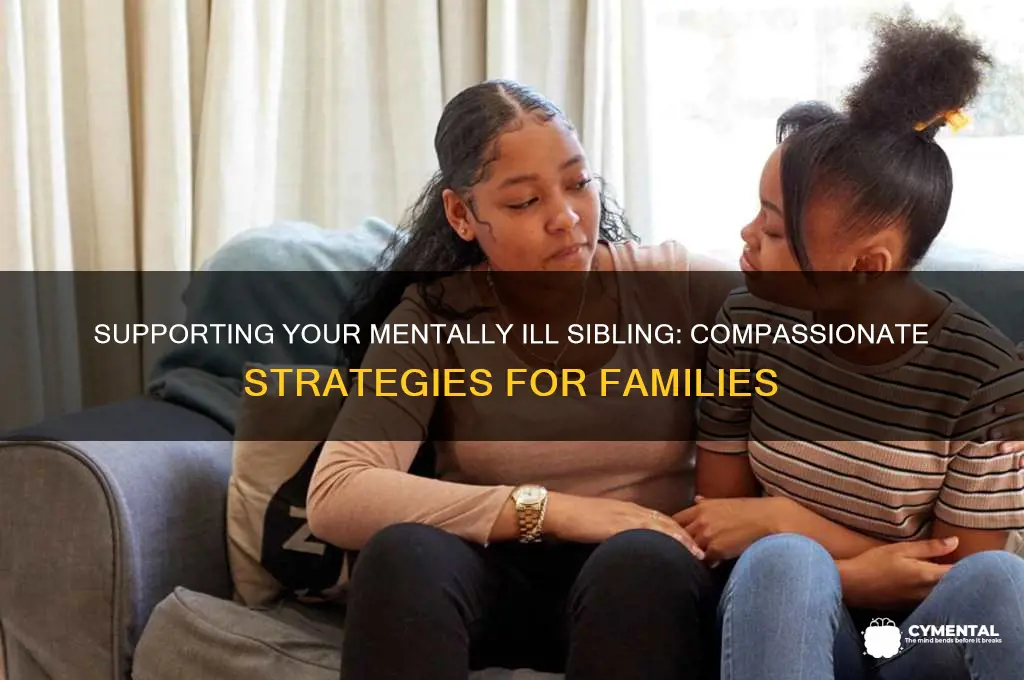
Supporting a mentally ill sibling can be both challenging and deeply rewarding, requiring patience, empathy, and a commitment to understanding their unique struggles. It begins with educating yourself about their specific condition to better comprehend their experiences and needs, while also fostering open communication to create a safe space for them to express their feelings without fear of judgment. Encouraging professional help, such as therapy or medication, is crucial, but it’s equally important to offer emotional support by being present, listening actively, and validating their emotions. Setting boundaries to protect your own mental health is essential, as is involving other family members or support networks to share the responsibility. Ultimately, showing unconditional love and patience, while acknowledging that recovery is a process, can make a significant difference in their journey toward healing.
Explore related products

$14.99 $15.99


$21.99


What You'll Learn
- Educate Yourself: Learn about their condition, symptoms, and effective coping strategies to better support them
- Communicate Openly: Use empathy, patience, and active listening to foster trust and understanding in conversations
- Encourage Treatment: Gently support therapy, medication, or other professional help without forcing decisions
- Set Boundaries: Protect your well-being while offering support to avoid burnout and resentment
- Promote Self-Care: Encourage healthy habits like exercise, sleep, and hobbies to improve their mental health

Educate Yourself: Learn about their condition, symptoms, and effective coping strategies to better support them
Understanding your sibling's mental health condition is the cornerstone of providing meaningful support. Imagine trying to navigate a foreign city without a map—you’d likely feel lost, frustrated, and ineffective. Similarly, without knowledge of their diagnosis, symptoms, and triggers, your efforts to help may fall short or even cause unintended harm. For instance, someone with generalized anxiety disorder may need reassurance, but too much can reinforce their fears, while a sibling with depression might benefit from gentle encouragement to engage in activities, but pushing too hard can lead to withdrawal. Start by researching their specific condition through reputable sources like the National Alliance on Mental Illness (NAMI) or the American Psychological Association (APA). Familiarize yourself with common symptoms, but remember that mental illness manifests uniquely in each person.
Once you grasp the basics, delve into the nuances of their experience. Ask open-ended questions like, “What does this feel like for you?” or “What helps you when you’re struggling?” This not only deepens your understanding but also communicates that you value their perspective. For example, a sibling with bipolar disorder might describe their manic episodes as feeling “electric” but overwhelming, while their depressive episodes leave them feeling “empty.” Knowing these specifics allows you to tailor your support—perhaps by helping them identify early warning signs or creating a calm environment during manic phases. Pair this with learning evidence-based coping strategies, such as mindfulness techniques for anxiety or mood tracking for bipolar disorder, to offer practical tools they can use.
A cautionary note: avoid becoming an armchair diagnostician or therapist. Your role is to support, not treat. While educating yourself is essential, it’s equally important to recognize the limits of your expertise. For instance, knowing that cognitive-behavioral therapy (CBT) is effective for obsessive-compulsive disorder (OCD) doesn’t qualify you to administer it. Instead, use your knowledge to encourage professional treatment and reinforce what they’re learning in therapy. Additionally, be mindful of your own biases or misconceptions. Mental illness is often misunderstood, and even well-intentioned beliefs can perpetuate stigma. For example, thinking someone with schizophrenia is “dangerous” or that depression is simply “feeling sad” can undermine your ability to provide compassionate support.
Finally, consider the practical steps you can take to integrate this knowledge into your daily interactions. For a sibling with PTSD, this might mean avoiding triggers like loud noises or crowded spaces during episodes. For someone with ADHD, it could involve creating structured routines or using visual reminders to help them stay organized. Small, informed adjustments can make a significant difference. For instance, if your sibling with social anxiety struggles with phone calls, offer to communicate via text or email instead. By educating yourself and applying what you learn, you become a more effective ally—one who not only understands their challenges but actively works to accommodate and support them in meaningful ways.
Australia's Innovative Mental Health Support: Initiatives and Impact
You may want to see also
Explore related products


$32.02 $39.99


Communicate Openly: Use empathy, patience, and active listening to foster trust and understanding in conversations
Effective communication with a mentally ill sibling begins with empathy—the ability to understand and share their feelings. Imagine your sibling is expressing overwhelming anxiety about a social event. Instead of dismissing it with a quick “just go, it’ll be fine,” try saying, “I can see how much this is bothering you. Tell me more about what’s making you feel this way.” This approach validates their emotions and creates a safe space for them to open up. Empathy isn’t about fixing the problem immediately; it’s about acknowledging their experience as real and significant. By mirroring their emotions without judgment, you build a foundation of trust that encourages them to share more freely.
Patience is the silent partner to empathy in these conversations. Mental illness often complicates communication, making it slow, fragmented, or repetitive. For instance, if your sibling struggles with depression, they might circle back to the same negative thought patterns. Resist the urge to rush or interrupt. Instead, allow pauses, and let them take their time. A practical tip: use nonverbal cues like nodding or maintaining eye contact to show you’re engaged, even if they’re struggling to find the right words. Patience communicates that you’re willing to meet them where they are, no matter how long it takes.
Active listening transforms these conversations from monologues into dialogues. It involves fully concentrating, paraphrasing what’s been said, and asking open-ended questions to deepen understanding. For example, if your sibling mentions feeling isolated, respond with, “It sounds like you’re feeling really alone lately. Can you tell me more about what that’s like for you?” This technique not only clarifies their perspective but also shows you’re genuinely invested in their well-being. A caution: avoid offering solutions unless asked. Active listening is about understanding, not fixing, and prematurely problem-solving can make them feel unheard.
Combining empathy, patience, and active listening fosters trust and understanding, but it’s not without challenges. You might feel frustrated or emotionally drained, especially if progress seems slow. To sustain this approach, practice self-care by setting boundaries and seeking support for yourself. For instance, schedule regular check-ins with your sibling but also carve out time for your own mental health. Remember, open communication is a two-way street; as you invest in understanding them, you also model healthy emotional expression, which can benefit both of you in the long run.
In conclusion, communicating openly with a mentally ill sibling requires intentional effort, but the rewards are profound. By embracing empathy, patience, and active listening, you create a safe, nonjudgmental space where they feel seen and heard. This not only strengthens your relationship but also empowers them to navigate their mental health journey with greater confidence. It’s a process, not a quick fix, but each conversation brings you closer to mutual understanding and support.
Boxing's Impact: Boosting Mental Health and Emotional Resilience
You may want to see also
Explore related products


Encourage Treatment: Gently support therapy, medication, or other professional help without forcing decisions
One of the most delicate yet crucial aspects of supporting a mentally ill sibling is navigating the conversation around professional treatment. Your sibling may resist therapy or medication due to stigma, fear, or a lack of insight into their condition. Instead of issuing ultimatums, frame treatment as a collaborative exploration. For example, "I’ve heard cognitive behavioral therapy can help with anxiety—would you be open to learning more about it?" This approach respects their autonomy while planting a seed of possibility. Avoid phrases like "You need to get help" or "This will fix you," which can trigger defensiveness. Instead, emphasize shared goals: "I want to see you feel better, and I think talking to someone could give us both new ideas."
Consider the stage of your sibling’s illness when encouraging treatment. Early intervention often yields better outcomes, but timing matters. If they’re in denial or acutely symptomatic, pushing too hard can backfire. For instance, a sibling experiencing psychosis may not recognize their need for antipsychotic medication, which typically starts at low doses (e.g., 2 mg of risperidone daily) and increases under medical supervision. In such cases, involve a trusted professional to mediate. Say, "Dr. Patel mentioned some options that might help—can we at least hear what she has to say?" This shifts the focus from your opinion to expert guidance, reducing personal conflict.
Practical barriers often hinder treatment more than resistance. Offer concrete assistance to remove obstacles. For example, research therapists who specialize in their condition, check insurance coverage, or accompany them to the first appointment. If medication is prescribed, help create a routine to manage side effects—like pairing antidepressants with a consistent bedtime to minimize drowsiness. For younger siblings (under 18), parental involvement is essential, but ensure their voice is heard: "Mom and I want to support you, but we also want to know what you’re comfortable with." For older siblings, respect their legal autonomy while expressing concern: "I know this is your decision, but I’m here if you want to talk through the options."
Finally, balance encouragement with patience. Recovery is nonlinear, and treatment decisions may evolve over time. Celebrate small steps, like attending an initial consultation or refilling a prescription, without pressuring for immediate results. If your sibling refuses help, focus on maintaining a supportive relationship while setting boundaries to protect your own mental health. Remember, your role isn’t to be their therapist but their ally. By approaching treatment conversations with empathy, practicality, and persistence, you can foster an environment where professional help feels less like a threat and more like a tool for healing.
Guiding Loved Ones to Professional Mental Health Support: A Compassionate Approach
You may want to see also
Explore related products


Set Boundaries: Protect your well-being while offering support to avoid burnout and resentment
Caring for a mentally ill sibling can blur the lines between support and self-sacrifice. Without clear boundaries, your well-intentioned efforts can morph into emotional exhaustion, resentment, and even physical illness. Think of it as flying a plane: you can’t assist others with their oxygen masks until yours is securely in place.
Step 1: Define Your Limits
Start by identifying non-negotiables—time, energy, and emotional capacity. For instance, if your sibling calls late at night during crises, establish a cutoff time (e.g., no calls after 9 PM unless it’s an emergency). Use concrete language: “I’m available to talk from 6–7 PM daily, but after that, I need to recharge.” Avoid vague promises like “I’ll always be there,” which set unrealistic expectations.
Step 2: Communicate Assertively
Boundaries are useless if unspoken. Use “I” statements to express needs without blame: “I feel overwhelmed when I’m the sole support person, so I’m going to involve a therapist or support group.” Practice active listening, but don’t let guilt-tripping erode your resolve. For example, if your sibling says, “You don’t care about me,” respond calmly: “I care deeply, which is why I’m setting these boundaries to ensure I can support you sustainably.”
Caution: Avoid Enabling Behaviors
It’s easy to slip into enabling under the guise of helping. For instance, repeatedly canceling plans to manage their crisis reinforces dependency. Instead, offer alternatives: “I can’t come over tonight, but I’ll help you contact your therapist or crisis hotline.” Remember: true support empowers, not disables.
Setting boundaries isn’t selfish—it’s self-preservation. By safeguarding your well-being, you ensure your support remains consistent and compassionate. Think of it as a marathon, not a sprint. Burnout helps no one, but a balanced approach sustains both you and your sibling in the long run.
Meditation Yoga: Enhancing Facial and Mental Health Naturally
You may want to see also
Explore related products


Promote Self-Care: Encourage healthy habits like exercise, sleep, and hobbies to improve their mental health
Mental health struggles often disrupt daily routines, leaving individuals vulnerable to neglect of basic self-care. For a sibling battling mental illness, encouraging healthy habits like exercise, sleep, and hobbies isn't just about physical health; it's about rebuilding structure, fostering a sense of accomplishment, and providing outlets for stress and emotion.
Imagine the feeling of lethargy and hopelessness that often accompanies depression. Now, picture the endorphin rush after a brisk walk, the sense of calm after a good night's sleep, or the satisfaction of creating something through a hobby. These seemingly small acts can be powerful tools in combating the darkness.
Exercise, for instance, isn't just about building muscle. Studies show that regular physical activity, even moderate activities like walking 30 minutes a day, can significantly reduce symptoms of anxiety and depression. It doesn't have to be a grueling gym session; suggest activities your sibling enjoys, whether it's dancing, swimming, or even a gentle yoga routine.
Sleep deprivation exacerbates mental health issues, creating a vicious cycle. Aim for a consistent sleep schedule, even on weekends. Encourage a relaxing bedtime routine: dim lights, avoid screens an hour before bed, and perhaps incorporate calming activities like reading or listening to soothing music. For adults, 7-9 hours of sleep is generally recommended, while teenagers may need closer to 8-10.
Hobbies provide a sense of purpose, distraction from negative thoughts, and a channel for self-expression. Encourage your sibling to explore activities they once enjoyed or try something new. Art, music, writing, gardening – the possibilities are endless. Start small, perhaps with a short online tutorial or a beginner's kit, and celebrate even the smallest achievements. Remember, the goal isn't perfection, but engagement and enjoyment.
It's crucial to approach this with sensitivity and patience. Avoid being overly pushy or critical. Offer gentle encouragement, join in activities when possible, and celebrate progress, no matter how small. Remember, you're not a therapist, but by promoting self-care, you're providing valuable support and helping your sibling build a foundation for better mental well-being.
Mental Health Support: A Key to Stable Housing Solutions
You may want to see also
Frequently asked questions
Set clear boundaries, prioritize self-care, and seek support for yourself through therapy, support groups, or trusted friends. Encourage professional help for your sibling while avoiding the role of their sole caregiver.
Gently encourage them to seek help, but avoid forcing them. Offer to accompany them to appointments or share resources. Focus on building trust and being a supportive presence while respecting their autonomy.
Use calm, non-judgmental language and actively listen without interrupting. Validate their feelings and avoid arguing or dismissing their experiences. If the situation escalates, take a break and revisit the conversation later.
Educate yourself about their condition, help them establish routines, and offer reminders for medication or therapy appointments. Be patient, show empathy, and celebrate small victories together.