Madison Cole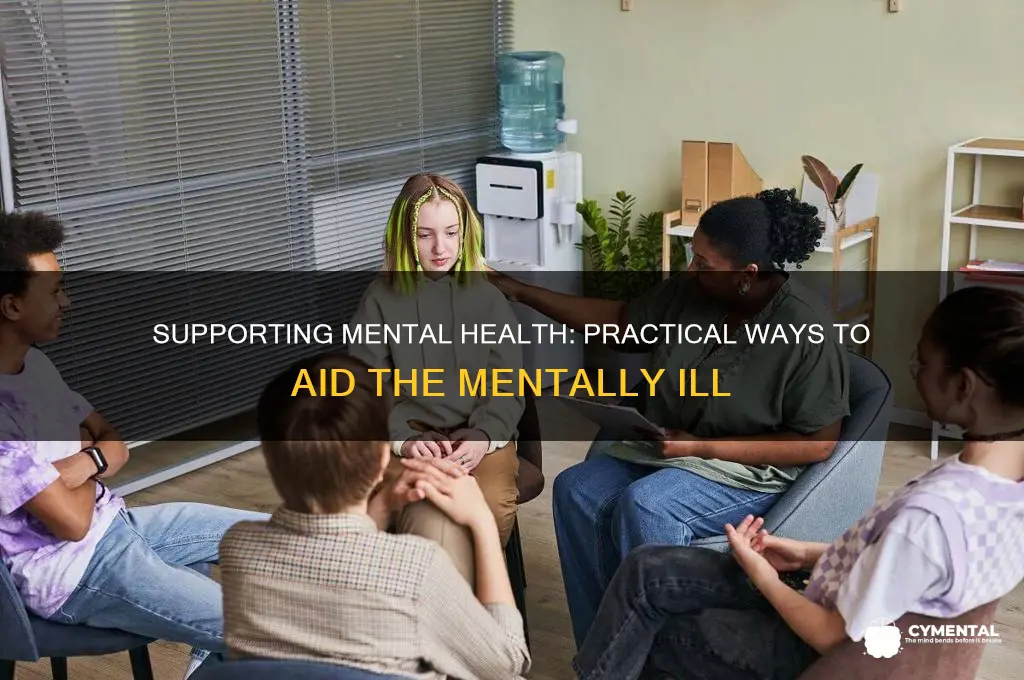
Helping individuals with mental illness requires a compassionate, informed, and multifaceted approach. It begins with raising awareness to reduce stigma, fostering an environment where those affected feel safe to seek help without fear of judgment. Providing access to professional mental health services, such as therapy and medication, is crucial, but support from friends, family, and communities plays an equally vital role. Educating oneself about mental health conditions and actively listening without judgment can make a significant difference. Additionally, advocating for policies that prioritize mental health resources and funding ensures that systemic barriers are addressed. By combining empathy, knowledge, and collective action, we can create a supportive network that empowers individuals to manage their mental health and thrive.
Explore related products


What You'll Learn
- Access to Affordable Care: Advocate for insurance coverage and low-cost mental health services for all individuals
- Reduce Stigma: Promote awareness campaigns to eliminate discrimination and encourage open conversations about mental health
- Community Support: Build local networks offering peer support, resources, and safe spaces for those struggling
- Early Intervention: Train educators, employers, and healthcare providers to recognize and address mental health issues promptly
- Crisis Resources: Expand availability of hotlines, emergency services, and crisis intervention teams nationwide

Access to Affordable Care: Advocate for insurance coverage and low-cost mental health services for all individuals
Mental health care remains prohibitively expensive for millions, with nearly 10% of Americans lacking insurance coverage altogether. This financial barrier often forces individuals to forgo treatment, exacerbating conditions that could be managed with timely intervention. Advocacy for comprehensive insurance coverage and low-cost mental health services is not just a moral imperative but a practical solution to reduce long-term societal costs associated with untreated mental illness, such as homelessness, unemployment, and increased healthcare utilization.
To effectively advocate for affordable care, start by understanding the gaps in current policies. Many insurance plans offer limited mental health coverage, capping therapy sessions or excluding certain treatments like intensive outpatient programs. Research and publicize these discrepancies to build a case for reform. For instance, highlight how the Mental Health Parity and Addiction Equity Act of 2008, though groundbreaking, is often unenforced, leaving patients vulnerable to higher out-of-pocket costs. Use data to illustrate how states with robust Medicaid expansion have seen significant reductions in untreated mental illness rates, providing a tangible example of policy impact.
Practical steps for advocacy include organizing community forums to amplify patient voices, drafting petitions to legislators, and leveraging social media campaigns to raise awareness. Encourage individuals to share their stories of financial struggles in accessing care, as personal narratives can humanize the issue for policymakers. Additionally, collaborate with local healthcare providers to offer sliding-scale fees or pro bono services temporarily, demonstrating the feasibility of low-cost models. For those with insurance, educate them on how to navigate their benefits, such as understanding copays, deductibles, and in-network providers, to maximize their coverage.
A cautionary note: while advocating for affordability, ensure the focus remains on quality care. Low-cost services should not equate to substandard treatment. Push for policies that mandate minimum standards for mental health providers, such as evidence-based practices and ongoing training. Similarly, be wary of for-profit entities exploiting the demand for affordable care by offering quick-fix solutions that lack clinical rigor. The goal is to create a system where cost is no longer a barrier to effective, compassionate treatment.
In conclusion, advocating for access to affordable mental health care requires a multi-faceted approach: policy reform, community engagement, and education. By addressing financial barriers systematically, we can ensure that mental health care becomes a right, not a privilege. This shift will not only improve individual lives but also foster a healthier, more productive society.
Recognizing the Signs: When to Seek Mental Health Support
You may want to see also
Explore related products


Reduce Stigma: Promote awareness campaigns to eliminate discrimination and encourage open conversations about mental health
Stigma silences. It transforms mental illness from a treatable condition into a source of shame, isolating those who suffer and preventing them from seeking help. Awareness campaigns act as megaphones, amplifying the voices of the silenced and challenging the harmful narratives that perpetuate discrimination.
Think of campaigns like "Time to Change" in the UK, which utilized powerful storytelling and celebrity endorsements to humanize mental illness. Their research showed a 5% decrease in discriminatory attitudes over five years, demonstrating the tangible impact of sustained, well-designed initiatives.
Effective campaigns don't just preach tolerance; they foster empathy. They employ strategies like sharing personal stories, using relatable language, and showcasing diverse faces of mental illness. Imagine a social media campaign featuring a series of short videos, each depicting a person from a different background sharing their experience with anxiety, depression, or PTSD. These stories, coupled with factual information and resources, dismantle stereotypes and encourage viewers to see themselves or loved ones reflected in the narratives.
Think of it as a ripple effect: one person's story shared openly can inspire countless others to seek help, challenge their own biases, and become advocates for change.
However, awareness alone isn't enough. Campaigns must be coupled with actionable steps. Providing clear information on where to seek help, how to support loved ones, and how to recognize signs of mental distress empowers individuals to move beyond awareness and into action. Imagine a campaign poster with a powerful image and a simple message: "You are not alone. Text 'HELP' to 741741 for free, confidential support." This direct call to action bridges the gap between awareness and access to resources.
Ultimately, reducing stigma is a marathon, not a sprint. It requires sustained effort, diverse voices, and a commitment to challenging ingrained beliefs. Awareness campaigns are powerful tools in this fight, but their success hinges on authenticity, inclusivity, and a clear call to action. By amplifying voices, fostering empathy, and providing tangible resources, we can create a world where mental illness is met with understanding, not judgment, and where seeking help is a sign of strength, not weakness.
Are Mental Health Diagnoses Helpful? Exploring Benefits and Limitations
You may want to see also
Explore related products


Community Support: Build local networks offering peer support, resources, and safe spaces for those struggling
Social isolation exacerbates mental health struggles, yet many communities lack structured networks to counteract this. Building local support systems can fill this gap by fostering connections, sharing resources, and creating environments where vulnerability is met with understanding, not judgment. These networks thrive on the principle that collective resilience is stronger than individual coping.
Consider the model of peer-led support groups, such as those facilitated by organizations like the National Alliance on Mental Illness (NAMI). These groups pair individuals with lived experience to provide empathy, practical advice, and a sense of belonging. For instance, a weekly meeting in a local library could offer a safe space for adults aged 18–65 to discuss anxiety management techniques, from deep breathing exercises to cognitive reframing. Pairing these meetings with a resource table—stocked with pamphlets on affordable therapy options, crisis hotlines, and self-help apps—amplifies their utility.
However, creating such networks requires intentional design. Start by identifying community hubs—churches, community centers, or cafes—willing to host gatherings. Train facilitators in active listening and boundary-setting to ensure conversations remain respectful and productive. For example, a facilitator might remind participants to use "I" statements and limit sharing to 3–5 minutes per person to keep the flow inclusive. Caution against over-reliance on untrained peers for crisis intervention; instead, establish partnerships with local mental health professionals who can provide occasional workshops or emergency referrals.
Contrast this approach with online support forums, which, while accessible, often lack the accountability and immediacy of face-to-face interaction. Local networks bridge this gap by combining the personal touch of in-person connection with the resource-sharing efficiency of digital platforms. For instance, a Facebook group could complement weekly meetings by sharing daily affirmations or links to free mindfulness webinars, ensuring support extends beyond scheduled gatherings.
The takeaway is clear: community support networks are not just nice-to-haves but essential lifelines. By embedding peer support, tangible resources, and safe spaces into the fabric of local life, these networks transform isolation into solidarity. Start small—a single meeting, a shared flyer, a willingness to listen—and watch as the ripple effects foster healing, one conversation at a time.
Empowering Minds: Effective Strategies to Support Mental Health Disorders
You may want to see also
Explore related products




Early Intervention: Train educators, employers, and healthcare providers to recognize and address mental health issues promptly
Mental health issues often manifest subtly, especially in early stages, making them easy to overlook. Educators, employers, and healthcare providers are uniquely positioned to notice these signs, yet many lack the training to recognize them. For instance, a teacher might dismiss a student’s persistent withdrawal as shyness, or a manager might attribute an employee’s decreased productivity to laziness. Early intervention hinges on equipping these gatekeepers with the knowledge to identify red flags—such as sudden changes in behavior, prolonged sadness, or unexplained irritability—and the confidence to act. Without this training, opportunities to prevent escalation are lost, delaying critical support for those in need.
Training programs for these professionals should be structured, evidence-based, and tailored to their roles. Educators, for example, could benefit from modules on adolescent mental health, focusing on signs like declining academic performance or social isolation. Employers might learn to spot workplace stressors contributing to anxiety or burnout, such as unrealistic deadlines or poor work-life balance. Healthcare providers, while already in a clinical setting, often require additional training to differentiate between physical symptoms and underlying mental health issues, like recognizing that chronic fatigue could stem from depression rather than a sleep disorder. Incorporating case studies, role-playing scenarios, and actionable steps ensures these programs are practical and memorable.
One effective model is the Mental Health First Aid (MHFA) program, which has been implemented globally. This 8-hour course teaches participants a 5-step action plan: assess risk, respectfully listen, give reassurance, encourage professional help, and promote self-help strategies. Studies show that MHFA-trained individuals are more likely to offer support and less likely to stigmatize mental illness. For educators, integrating MHFA into professional development days could be a feasible starting point. Employers could incentivize participation by offering it as part of wellness initiatives, while healthcare providers might incorporate it into continuing education requirements. Such programs not only build skills but also foster a culture of empathy and proactive care.
However, training alone is insufficient without systemic support. Educators and employers, in particular, may feel ill-equipped to handle disclosures of mental health struggles, fearing they might say the wrong thing or exacerbate the issue. Clear protocols must be in place, such as designated mental health liaisons in schools or employee assistance programs in workplaces, to ensure seamless referrals to professionals. Healthcare providers, meanwhile, need access to resources like screening tools and referral networks to act promptly. For example, a primary care physician trained to use the PHQ-9 depression screening tool can identify at-risk patients during routine visits and immediately connect them with therapists or psychiatrists.
The ultimate goal of early intervention is to normalize conversations around mental health and reduce the stigma that often prevents individuals from seeking help. When educators, employers, and healthcare providers are trained to recognize and address these issues, they become allies in a person’s journey toward recovery. A teacher who notices a student’s anxiety and connects them with counseling services, an employer who adjusts workloads for a stressed employee, or a nurse who screens a patient for depression during a checkup—these actions can alter the trajectory of someone’s life. By investing in such training, society not only improves individual outcomes but also reduces the long-term economic and social costs of untreated mental illness.
Sports and Mental Health: Boosting Well-Being Through Physical Activity
You may want to see also
Explore related products


Crisis Resources: Expand availability of hotlines, emergency services, and crisis intervention teams nationwide
Mental health crises don’t adhere to a 9-to-5 schedule, yet many crisis resources operate within limited hours or geographic boundaries. Expanding the availability of hotlines, emergency services, and crisis intervention teams nationwide ensures that individuals in distress can access immediate support whenever and wherever they need it. This isn’t just a matter of convenience—it’s a lifeline for those on the brink of self-harm, suicidal ideation, or severe psychological breakdown.
Consider the 988 Suicide & Crisis Lifeline, a critical resource launched in the U.S. in 2022. While it’s a step forward, its effectiveness hinges on local infrastructure. In rural areas, for instance, callers may still face long wait times or be redirected to distant facilities. Expanding crisis resources requires a two-pronged approach: increasing funding for 24/7 hotlines and training more crisis intervention teams (CITs) to respond in person. CITs, typically composed of law enforcement officers and mental health professionals, are trained to de-escalate situations without resorting to force, reducing the risk of trauma for individuals in crisis.
A practical example of successful expansion is the CAHOOTS (Crisis Assistance Helping Out On The Streets) program in Eugene, Oregon. This model pairs medics and crisis workers to respond to non-violent emergencies, diverting 911 calls away from police and into the hands of trained mental health professionals. Replicating such programs nationwide could alleviate the burden on emergency rooms and law enforcement while providing more compassionate care. However, scaling requires addressing staffing shortages and ensuring equitable distribution of resources across urban and rural areas.
Expanding crisis resources isn’t just about adding more hotlines or teams—it’s about integrating them into a seamless network. For instance, hotlines should have the capability to dispatch mobile crisis units in real time, ensuring that callers receive in-person assistance when needed. Additionally, public awareness campaigns are essential to educate communities about these resources. A study by the National Alliance on Mental Illness found that only 40% of adults could name a mental health crisis resource offhand. Increasing visibility through schools, workplaces, and social media could save lives by ensuring people know where to turn in a crisis.
Finally, sustainability is key. Expanding crisis resources requires long-term investment, not just one-time funding. Policymakers must prioritize mental health in budgets, and private organizations can partner with government agencies to fill gaps. For example, telehealth platforms could offer free crisis counseling in underserved areas, while corporations could sponsor CIT training programs. By combining public and private efforts, we can create a nationwide safety net that catches individuals before they fall through the cracks. The goal isn’t just to respond to crises—it’s to prevent them.
Naturopathic Approaches to Mental Health: Effective Support or Alternative?
You may want to see also
Frequently asked questions
Listen without judgment, educate yourself about their condition, encourage professional help, and offer practical support like helping with daily tasks or accompanying them to appointments.
Use empathetic and non-confrontational language, avoid minimizing their feelings, ask open-ended questions, and be patient and understanding.
Educate others about mental health, share accurate information, speak openly about mental health, and challenge stereotypes or misconceptions when you encounter them.
Stay calm, listen actively, encourage them to seek professional help, and if they are at risk of harm, contact emergency services or a crisis hotline immediately.
Set boundaries, seek support for yourself, practice self-care, and remember that you cannot fix their problems alone—encourage professional intervention when needed.