Madison Cole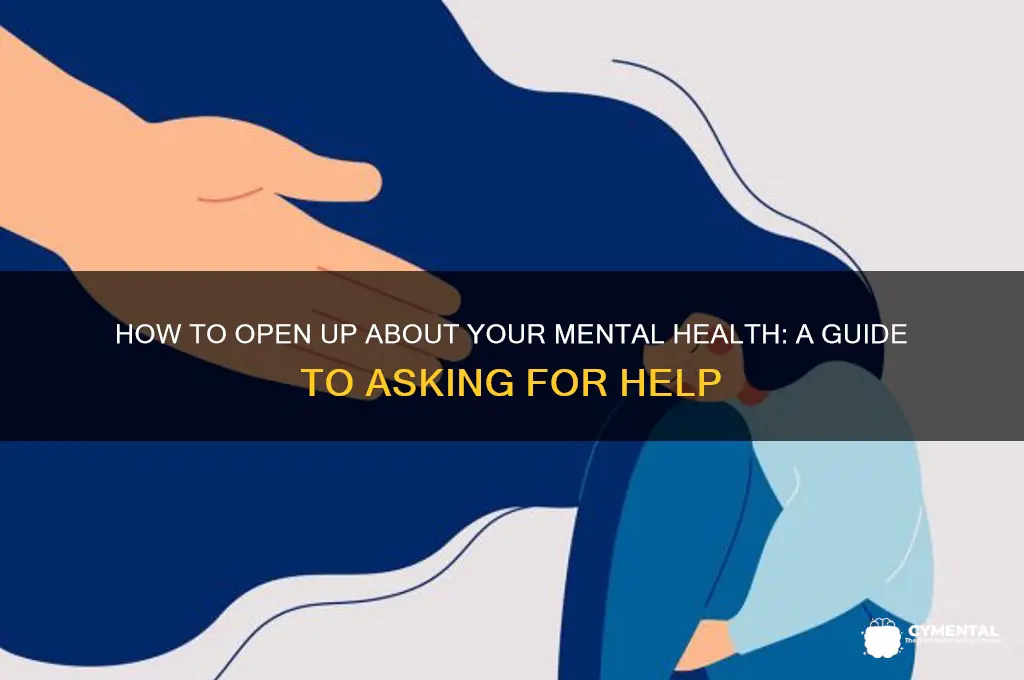
Reaching out for mental health support can feel daunting, but it’s a courageous and necessary step toward healing and well-being. Knowing how to tell someone you need help mentally involves being honest, clear, and specific about your feelings and struggles. Start by choosing a trusted person—whether it’s a friend, family member, or professional—and create a safe, private space to share. Use I statements to express your emotions without placing blame, such as, I’ve been feeling overwhelmed lately, and I think I need some help. Be prepared to suggest next steps, like seeking therapy or simply having regular check-ins. Remember, asking for help is a sign of strength, not weakness, and it’s the first step toward getting the support you deserve.
| Characteristics | Values |
|---|---|
| Choose the Right Person | Select someone trustworthy, empathetic, and non-judgmental (e.g., a close friend, family member, or therapist). |
| Timing and Setting | Pick a quiet, private moment when both parties are calm and undisturbed. |
| Be Direct and Honest | Use clear, straightforward language (e.g., "I’ve been struggling lately and need help"). |
| Specificity | Share specific feelings or symptoms (e.g., "I feel overwhelmed with anxiety" or "I’ve been having suicidal thoughts"). |
| Avoid Apologizing | Focus on expressing your needs without guilt or shame (e.g., "I need support right now"). |
| Ask for What You Need | Clearly state what kind of help you’re seeking (e.g., "Can we talk?" or "Can you help me find a therapist?"). |
| Use "I" Statements | Frame your feelings as personal experiences (e.g., "I feel" instead of "You make me feel"). |
| Be Patient | Understand that the person may need time to process and respond. |
| Follow Up | If the initial conversation doesn’t go as planned, revisit the topic later or seek another support system. |
| Professional Guidance | Encourage or seek professional help (e.g., therapy, counseling, or mental health hotlines). |
| Self-Compassion | Acknowledge that asking for help is a sign of strength, not weakness. |
Explore related products


What You'll Learn
- Recognize Your Struggles: Acknowledge your mental health challenges before seeking support from others
- Choose the Right Person: Select someone trustworthy, empathetic, and non-judgmental to confide in
- Be Clear and Direct: Use simple, honest language to express your feelings and needs
- Share Specific Examples: Provide concrete instances of how you’ve been feeling to help them understand
- Ask for What You Need: Clearly state the type of support you’re seeking, whether emotional or practical

Recognize Your Struggles: Acknowledge your mental health challenges before seeking support from others
Acknowledging your mental health struggles is the first step toward healing, yet it’s often the hardest. Many people delay seeking help because they haven’t fully accepted their own pain. This internal denial can stem from stigma, fear of judgment, or the belief that they “should” be stronger. However, recognizing your struggles isn’t a sign of weakness—it’s an act of self-awareness. Start by paying attention to persistent changes in your mood, energy, or behavior. Are you withdrawing from activities you once enjoyed? Do you feel constantly overwhelmed or disconnected? These aren’t just “bad days”; they’re signals from your mind and body that something needs attention.
To effectively acknowledge your challenges, create a safe space for self-reflection. Journaling can be a powerful tool; write down your thoughts and emotions without judgment. For example, instead of dismissing anxiety as “just stress,” note how often it disrupts your daily life. If you’re unsure where to begin, use structured prompts like, “What does my struggle look like on a typical day?” or “How has this affected my relationships?” This process isn’t about labeling yourself with a diagnosis but understanding the scope of your experience. Remember, clarity comes from honesty—with yourself first.
Once you’ve identified your struggles, validate them. It’s easy to minimize your pain by comparing it to others’ experiences, but mental health isn’t a competition. For instance, feeling depressed doesn’t require a “valid reason” to be real. Validation also means recognizing the effort it takes to cope, even if you’re not “falling apart.” Say to yourself, “This is hard, and it’s okay to feel this way.” This internal compassion lays the groundwork for seeking external support, as it shifts your mindset from “I should handle this alone” to “I deserve help.”
Practical steps can make this acknowledgment more actionable. Set aside 10–15 minutes daily for mindfulness or meditation to observe your thoughts without attachment. If you’re hesitant to label your struggles, start by describing them in neutral terms, like “I’ve been feeling drained lately” instead of “I’m broken.” Additionally, consider tracking your symptoms over time using apps or calendars to identify patterns. For teens and young adults, this might involve noting how often social media triggers anxiety. For older adults, it could mean monitoring how loneliness impacts sleep. These small, consistent actions turn abstract feelings into tangible data, making it easier to communicate your needs later.
Finally, acknowledging your struggles is a prerequisite for effective communication with others. If you approach a friend or therapist without clarity, your message may come across as vague or dismissible. For example, saying, “I’ve been feeling off lately, and it’s affecting my work and relationships,” is more actionable than, “I think something’s wrong with me.” By first recognizing and validating your own experience, you’ll be better equipped to articulate it to others. This isn’t about having all the answers but about showing up authentically, ready to receive the support you’ve already acknowledged you need.
Light Rail's Impact: Enhancing Mental Health Access and Well-being
You may want to see also
Explore related products


Choose the Right Person: Select someone trustworthy, empathetic, and non-judgmental to confide in
Sharing your mental health struggles requires more than just courage; it demands discernment. Not everyone is equipped to receive such vulnerability with the care it deserves. The wrong confidant can deepen your distress, while the right one can be a lifeline. Start by assessing your potential support network. Consider who has demonstrated reliability in the past—someone who keeps confidences, shows up during crises, and listens without interrupting. Trustworthiness isn’t just about secrecy; it’s about consistency in action and character. For instance, a friend who canceled plans during your last emergency might not be the best choice, even if they’re well-intentioned.
Empathy is the next non-negotiable trait. Look for someone who has shown the ability to step into your shoes, even when your perspective differs from theirs. This doesn’t mean they need to have experienced similar struggles, but they should validate your feelings without minimizing them. A simple litmus test: Recall a time you shared a minor worry with them. Did they brush it off with a quick “it’ll be fine” or did they ask follow-up questions and offer genuine concern? Empathy isn’t about having the right words; it’s about creating a safe space for your emotions to exist without judgment.
Speaking of judgment, this is where many well-meaning relationships falter. Avoid individuals who have a history of moralizing or offering unsolicited advice. For example, if a family member has ever responded to your stress with “you just need to pray more” or “stop overthinking,” they might not be the best candidate. Non-judgmental support means accepting your experience as valid, even if it doesn’t align with their worldview. A practical tip: Test the waters by sharing a small vulnerability first. If their response feels dismissive or preachy, they’re likely not the right person for deeper conversations.
Finally, consider the dynamics of the relationship. Is this someone you feel equal to, or does the power imbalance make you hesitant to speak freely? For instance, confiding in a supervisor might feel risky if job security is a concern. Similarly, choosing a close friend who’s currently dealing with their own crisis could burden them further. The ideal confidant is someone whose emotional bandwidth is sufficient to support you without becoming overwhelmed. If you’re unsure, observe how they handle others’ struggles—do they listen actively, or do they quickly shift the focus back to themselves?
In conclusion, choosing the right person is as critical as the decision to seek help itself. Trustworthiness, empathy, and non-judgmental attitudes aren’t just nice-to-haves; they’re essential for creating a safe space to share your mental health struggles. Take your time, assess carefully, and remember: the goal isn’t to find a perfect person, but someone who can meet you with the compassion and understanding you deserve.
Supporting Your Child’s Mental Health: A Guide to Evaluations in England
You may want to see also
Explore related products





Be Clear and Direct: Use simple, honest language to express your feelings and needs
Clarity breeds connection. When expressing mental health struggles, vague statements like "I’m not doing well" can leave the listener unsure how to respond. Instead, use precise language to bridge the gap. For instance, say, "I’ve been feeling overwhelmed with anxiety lately, and I’m struggling to manage it on my own." This specificity invites empathy and action, as it clearly communicates both the emotion and the need for support.
Honesty disarms stigma. Mental health conversations often falter under the weight of euphemisms or downplaying. Phrases like "I’m a bit stressed" might feel safer, but they dilute the urgency of your situation. Be direct: "I’ve been having suicidal thoughts, and I need someone to talk to." While this may feel vulnerable, it leaves no room for misinterpretation and ensures the listener understands the gravity of your request.
Structure your message for impact. Start with a clear statement of your feelings, followed by a specific ask. For example, "I’ve been battling depression, and it’s hard to get out of bed. Could we meet for coffee this week? I’d like to talk about it with you." This two-part approach—emotion + request—balances vulnerability with agency, making it easier for the other person to respond constructively.
Avoid over-explaining, but provide context. While simplicity is key, a brief context can help the listener understand your perspective. Instead of launching into a detailed history, say, "I’ve been dealing with panic attacks more frequently, especially at work. I’m reaching out because I think having someone to check in with would help." This gives just enough information to foster understanding without overwhelming the conversation.
Practice makes progress. If directness feels daunting, rehearse what you want to say. Write it down, record yourself, or role-play with a trusted friend. For example, start with, "I’ve been feeling really isolated, and I’d like your support. Could we talk about it?" The more you practice, the more natural it becomes to express your needs clearly and confidently.
End with an actionable step. After sharing your feelings, propose a next step to keep the conversation moving forward. For instance, "I’m seeing a therapist, but I’d appreciate it if you could check in with me once a week. Would that work for you?" This not only reinforces your need but also creates a tangible way for the other person to help, turning a difficult conversation into a collaborative effort.
Moving Out: A Mental Health Boost or Added Stress?
You may want to see also
Explore related products


Share Specific Examples: Provide concrete instances of how you’ve been feeling to help them understand
Sharing specific examples of how you’ve been feeling is like handing someone a map to your inner world. Instead of saying, “I’ve been feeling overwhelmed,” try, “Last week, I cried three times at work because I couldn’t keep up with deadlines, even though I stayed late every night.” This precision bridges the gap between abstract emotions and tangible experiences, making it easier for the listener to grasp the depth of your struggle. Vague statements often invite vague responses, but concrete details demand attention and foster empathy.
Consider the difference between “I’m anxious” and “I’ve been waking up at 3 a.m. every night, my heart racing, replaying conversations from the day in my head.” The latter paints a vivid picture, leaving no room for misinterpretation. When you provide specific instances, you also give the other person actionable insights. For example, if you mention, “I’ve stopped answering calls because the sound of the phone ringing makes me panic,” they can better understand your avoidance behaviors and tailor their support accordingly.
However, specificity requires vulnerability, and that’s where many hesitate. To ease into it, start with small, observable details rather than diving into deep emotional analysis. For instance, “I’ve been skipping meals because I forget to eat, even though I’m hungry” is less intimidating to share than “I feel worthless.” Over time, as trust builds, you can layer in more nuanced examples, like, “I’ve been canceling plans with friends because the thought of socializing exhausts me, even though I miss them.”
A practical tip: keep a journal to track patterns before the conversation. Note dates, times, and triggers. For example, “Every Monday morning, I feel a tightness in my chest when I open my work email.” This not only helps you articulate your experiences but also provides a timeline for the listener to follow. If journaling feels overwhelming, jot down just one sentence daily about how you felt or what happened. Even fragmented notes can become powerful evidence when shared.
Finally, remember that specificity isn’t about assigning blame or seeking solutions—it’s about being seen. When you say, “I’ve been rewatching the same show for hours because I can’t focus on anything else,” you’re not asking for advice; you’re inviting the other person to witness your reality. This act of sharing, when done with concrete examples, transforms a vague cry for help into a clear, relatable narrative that says, “This is what I’m going through, and I need you to understand.”
Social Interaction's Impact: Boosting Mental Health and Well-Being
You may want to see also
Explore related products




Ask for What You Need: Clearly state the type of support you’re seeking, whether emotional or practical
Asking for help is not a one-size-fits-all scenario. When it comes to mental health, the support you need might be as unique as your fingerprint. Imagine you’re in a dark room, searching for a light switch. You wouldn’t just shout, “Help me find the switch!” You’d describe its location—*“It’s on the left wall, near the door”*. Similarly, when you tell someone you need mental support, specificity is your ally. Are you seeking a listening ear, practical assistance, or a distraction? Naming the type of support you need increases the likelihood of receiving it. For instance, instead of saying, “I’m feeling overwhelmed,” try, “I’m feeling overwhelmed and could really use someone to talk to without judgment.” This clarity removes guesswork and ensures the person knows exactly how to step in.
Let’s break this down into actionable steps. First, identify the type of support you need. Emotional support might include active listening, validation, or encouragement, while practical support could involve help with tasks like cooking, running errands, or even just sitting with you during a panic attack. Second, use direct language. Vague requests like “I need help” often lead to confusion or inaction. Instead, say, “I’m having a hard time leaving the house. Could you come over and help me plan my day?” Third, be specific about boundaries. For example, if you want emotional support but not advice, clarify: “I’m not looking for solutions right now, just someone to listen.” These steps transform a nebulous ask into a clear, actionable request.
Consider the difference between emotional and practical support as two distinct tools in your toolbox. Emotional support acts like a balm, soothing frayed nerves and providing comfort. It’s the kind of help you might seek when you’re spiraling into negative thoughts and need someone to remind you of your worth. Practical support, on the other hand, is more like a scaffold—it helps you stand when you’re too exhausted to do it alone. For instance, if you’re struggling with depression, asking a friend to text you daily reminders to take your medication is practical support. Both types are valid, and often, you’ll need a combination of the two. The key is to recognize which one (or both) you need in the moment and communicate it clearly.
One common mistake is assuming others can read your mind or gauge your needs based on your mood. This often leads to frustration—yours and theirs. Take the case of Sarah, who would withdraw when she felt anxious, hoping her partner would notice and offer comfort. When he didn’t, she’d feel resentful, thinking, “Why doesn’t he care?” The truth was, he had no idea what she needed. Once she started saying, “I’m feeling anxious and could use a hug,” he was able to respond in a way that helped. This example underscores the importance of explicit communication. It’s not about making others guess; it’s about empowering them to help effectively.
Finally, remember that asking for what you need is an act of self-care, not selfishness. It’s easy to fall into the trap of believing you should handle everything alone, but mental health struggles are not a solo journey. By clearly stating your needs, you’re not only helping yourself but also fostering deeper connections with those around you. Think of it as a gift—you’re giving someone the opportunity to show up for you in a meaningful way. So, whether you need a shoulder to cry on or a hand to hold, say it plainly. The right support can make all the difference, but it starts with you flipping that switch and illuminating the path.
Supporting Your Wife: Navigating Mental Health Conversations and Care Options
You may want to see also
Frequently asked questions
Begin by choosing a trusted person and a comfortable setting. You can start with a simple statement like, "I've been feeling overwhelmed lately and could use some support." Be honest about your feelings and specific about the kind of help you need.
It’s natural to fear judgment, but remember that sharing your feelings with someone you trust can lead to understanding and support. Practice what you want to say beforehand, and remind yourself that seeking help is a sign of strength, not weakness.
It’s okay to not have all the answers. You can say something like, "I’ve been feeling off lately, and I’m not sure why. I just know I need some help figuring it out." Being open about your uncertainty can invite empathy and collaboration.
Not everyone will respond perfectly, but that doesn’t mean you’re not worthy of support. If the first person doesn’t react as you’d hoped, consider reaching out to someone else, like a mental health professional or a helpline. Your feelings are valid, and you deserve help.