Ava Ramirez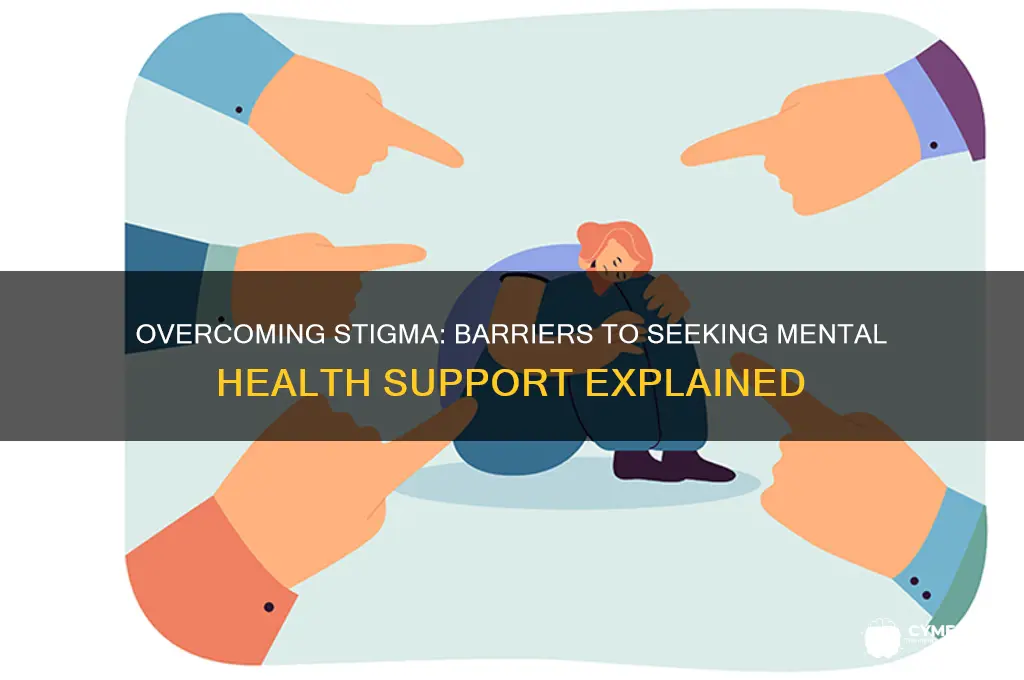
Seeking help for mental illnesses is often hindered by a complex interplay of barriers that discourage individuals from accessing the support they need. Stigma remains one of the most significant obstacles, as societal misconceptions and fear of judgment can lead to feelings of shame or embarrassment. Additionally, lack of awareness about available resources and the severity of one's condition can prevent people from recognizing the need for assistance. Practical barriers, such as financial constraints, limited access to mental health services, and long wait times, further exacerbate the issue. Cultural and personal beliefs, such as self-reliance or mistrust of healthcare systems, can also deter individuals from seeking help. Together, these barriers create a challenging environment that often leaves those struggling with mental health issues isolated and unsupported.
Explore related products


What You'll Learn

Stigma and Discrimination
To dismantle stigma, it’s essential to understand its roots. Stigma thrives on misinformation and stereotypes, perpetuated by media portrayals of mental illness as dangerous or incurable. For instance, sensationalized news stories often link mental health conditions to violence, despite research showing that individuals with mental illnesses are more likely to be victims than perpetrators. This misinformation fuels fear and prejudice, making it harder for those affected to disclose their struggles. Education is a critical antidote—sharing accurate data, personal stories, and expert insights can challenge these harmful narratives.
Discrimination compounds the problem by institutionalizing stigma. In workplaces, schools, and healthcare settings, individuals with mental illnesses often face unfair treatment. For example, a study published in *The Lancet* revealed that employees who disclosed mental health issues were 30% less likely to receive promotions compared to their peers. Similarly, insurance policies frequently limit coverage for mental health treatment, treating it as a secondary concern. Such systemic barriers not only discourage help-seeking but also reinforce the notion that mental health is less valid than physical health.
Practical steps can mitigate the impact of stigma and discrimination. First, normalize conversations about mental health in everyday settings. Incorporate mental health discussions into school curricula, workplace training, and community forums. Second, advocate for policy changes that ensure equal access to care and protect against discrimination. For instance, the Mental Health Parity and Addiction Equity Act in the U.S. mandates equal insurance coverage for mental and physical health—a model worth expanding globally. Finally, individuals can support peers by listening without judgment and amplifying their voices. Small actions, when multiplied, can shift cultural norms.
The takeaway is clear: stigma and discrimination are not inevitable; they are learned behaviors that can be unlearned. By addressing misinformation, challenging systemic biases, and fostering empathy, society can create an environment where seeking help for mental illnesses is met with compassion rather than condemnation. The journey is long, but every step toward understanding and acceptance brings us closer to a world where no one suffers in silence.
Supporting Mental Health: Practical Ways to Assist Someone in Distress
You may want to see also
Explore related products


Lack of Awareness and Education
Stigma and misinformation often overshadow the critical role that awareness and education play in mental health. Without a basic understanding of mental illnesses, their symptoms, and available treatments, individuals may not recognize their own struggles or know where to turn for help. This lack of awareness perpetuates a cycle of silence and suffering, leaving countless people untreated.
Consider this: A 20-year-old college student experiences persistent anxiety but dismisses it as "just stress." Their parents, unaware of the difference between everyday stress and generalized anxiety disorder, offer generic advice like "just relax." Meanwhile, their peers, equally uninformed, normalize the behavior as part of the college experience. This scenario illustrates how a lack of education at individual, familial, and community levels can delay or prevent intervention.
To break this cycle, targeted education is essential. Schools, workplaces, and community centers should integrate mental health literacy into their programs. For instance, adolescents aged 13–18 could benefit from workshops that teach emotional regulation techniques, stress management, and the signs of common mental health disorders. Adults, particularly those in high-stress professions, could participate in training sessions that demystify mental health and provide actionable steps for seeking help.
However, education alone is not enough. It must be paired with accessible resources. For example, a workplace might offer a mental health first-aid course but fail to provide employees with a list of affordable therapists or a confidential helpline. Practical tools, such as digital apps for mood tracking or local support group directories, can bridge the gap between awareness and action.
Ultimately, the goal is to shift societal norms so that seeking help for mental health is as routine as visiting a doctor for a physical ailment. This requires sustained effort, from policymakers funding public awareness campaigns to individuals sharing their stories to reduce stigma. By prioritizing education and awareness, we can dismantle one of the most pervasive barriers to mental health care and ensure that no one suffers in silence.
Exploring the Complex Link Between Illegal Drugs and Mental Health
You may want to see also
Explore related products


Financial and Resource Constraints
Financial constraints often force individuals to choose between mental health care and basic necessities like food or housing. For instance, a single therapy session can cost anywhere from $65 to $250, and psychiatric medications may run $50 to $1,000 monthly without insurance. When nearly 40% of Americans report they cannot cover a $400 emergency expense, the decision to prioritize mental health becomes a luxury many cannot afford. This economic reality perpetuates a cycle where untreated mental illness worsens, leading to job loss or reduced productivity, further limiting financial resources.
Consider the case of rural communities, where 77% of counties in the U.S. lack a single psychiatrist. Residents may need to travel hours for care, incurring transportation costs, lost wages, and childcare expenses. Even in urban areas, long wait times for affordable providers—often 2-3 months—delay treatment, allowing conditions to deteriorate. Telehealth emerged as a solution during the pandemic, but 14% of U.S. households still lack broadband access, disproportionately affecting low-income and minority populations. Without reliable internet or devices, this "solution" becomes another barrier.
To navigate these constraints, start by exploring sliding-scale clinics or community health centers, which adjust fees based on income. For example, a person earning $20,000 annually might pay $20 per therapy session instead of $100. Nonprofits like the National Alliance on Mental Illness (NAMI) offer free support groups, while apps like BetterHelp provide subscriptions starting at $60 weekly—still costly, but potentially more affordable than in-person care. For medications, ask providers about generic options (e.g., fluoxetine instead of Prozac) or patient assistance programs like RxAssist, which reduce costs by up to 75%.
However, reliance on these workarounds highlights systemic failures. Only 43% of adults with mental illness received treatment in 2022, with cost cited as the top barrier. Advocacy for policy changes, such as expanding Medicaid or capping insulin copays (as seen in recent legislation), must extend to mental health. Until then, individuals must cobble together imperfect solutions, balancing pragmatism with persistence. The takeaway? Financial barriers are not insurmountable, but addressing them requires creativity, research, and a willingness to demand more from the system.
Ohio Mental Health Crisis: Strategies to Encourage Treatment for the Unwilling
You may want to see also
Explore related products





Fear of Judgment or Shame
Stigma surrounding mental health issues often manifests as a deep-seated fear of judgment or shame, which can paralyze individuals from seeking the help they need. This fear is not merely imagined; it is rooted in societal attitudes that equate mental illness with weakness or personal failure. For instance, a 2019 study published in the *Journal of Mental Health* found that 60% of respondents avoided discussing their mental health concerns due to worries about being labeled or ostracized. Such statistics highlight how pervasive this barrier is, creating a silent struggle for many.
Consider the case of a young professional who experiences anxiety but hesitates to disclose it to colleagues or even friends. The internal monologue might sound like this: *"What if they think I’m not competent enough for my job?"* or *"Will they avoid me because they think I’m unstable?"* These questions reflect the tangible consequences individuals fear, from career repercussions to social isolation. The irony is that such fears often stem from misconceptions, yet they feel very real to the person experiencing them, reinforcing a cycle of silence.
To dismantle this barrier, it’s essential to reframe how we perceive vulnerability. Seeking help for mental health is not a sign of weakness but an act of courage. Practical steps include starting small—confiding in a trusted friend or family member rather than immediately seeking professional help, which can feel overwhelming. Additionally, leveraging anonymous resources, such as helplines or online support groups, can provide a safe space to express feelings without the risk of judgment. For example, the Crisis Text Line offers 24/7 support via text, allowing individuals to explore their emotions without revealing their identity.
Another effective strategy is to challenge the stigma head-on by normalizing conversations about mental health. Employers, educators, and community leaders can play a pivotal role by fostering environments where mental health is discussed openly and without shame. For instance, implementing workplace policies that encourage mental health days or hosting awareness workshops can signal that seeking help is not only acceptable but encouraged. Small changes in language—replacing *"suffering from depression"* with *"living with depression"*—can also reduce the stigma attached to mental health conditions.
Ultimately, overcoming the fear of judgment or shame requires both individual and collective effort. While it may feel daunting to take the first step, the long-term benefits of seeking help far outweigh the temporary discomfort of facing potential stigma. Remember, mental health is just as important as physical health, and prioritizing it is a sign of strength, not weakness. By addressing this barrier, we can create a society where seeking help is met with compassion rather than judgment.
Mental Hospitals: Effective Support for Suicidal Thoughts and Recovery?
You may want to see also
Explore related products


$12.99 $14.99


Cultural and Societal Beliefs
Consider the role of collectivist societies, where family honor and social harmony are prioritized over individual struggles. In many Asian cultures, openly discussing mental health issues is seen as bringing dishonor to the family or disrupting community cohesion. A young adult experiencing anxiety might be pressured to "tough it out" or avoid seeking help to prevent family embarrassment. This societal expectation can lead to internalized stigma, where individuals blame themselves for their struggles and fear judgment if they reach out for support. To address this, mental health campaigns must emphasize that seeking help is an act of strength, not a betrayal of cultural values.
Language and terminology also play a critical role in shaping societal attitudes toward mental health. In some Spanish-speaking communities, terms like *locura* (craziness) carry heavy negative connotations, discouraging open conversations about mental illness. Similarly, in many Indigenous cultures, the absence of direct equivalents for terms like "depression" or "anxiety" can make it difficult to articulate these experiences. Mental health professionals and advocates must work to develop culturally sensitive language and frameworks that resonate with diverse communities. For example, framing therapy as a form of "emotional healing" rather than "mental illness treatment" can make it more accessible to those wary of Western medical models.
Finally, societal beliefs about masculinity and femininity further complicate help-seeking behaviors. In many Western and Middle Eastern cultures, men are expected to be stoic and self-reliant, making it particularly challenging for them to admit vulnerability or seek mental health support. Conversely, women may face the stereotype of being "overly emotional" or "hysterical," leading their concerns to be dismissed or trivialized. Tailored interventions, such as gender-specific support groups or campaigns featuring male role models discussing mental health, can help challenge these norms. By addressing these gendered expectations, societies can create safer spaces for all individuals to seek the help they need.
In conclusion, cultural and societal beliefs are powerful forces that shape attitudes toward mental health, often erecting barriers to seeking help. By acknowledging these beliefs, developing culturally sensitive approaches, and challenging harmful stereotypes, we can foster environments where individuals feel empowered to prioritize their mental well-being. This requires collaboration between mental health professionals, community leaders, and policymakers to create inclusive, compassionate systems that respect and honor diverse cultural perspectives.
Supporting Adults with Mental Illness: Practical Strategies for Compassionate Care
You may want to see also
Frequently asked questions
Common barriers include stigma and shame, lack of awareness about mental health, financial constraints, fear of judgment, and limited access to mental health services.
Stigma creates a fear of being labeled, discriminated against, or judged, which discourages individuals from openly discussing their struggles or seeking professional help.
Many people are unaware of the signs of mental illness or available treatment options, leading them to ignore symptoms or believe they can handle their condition without professional help.
High costs of therapy, medication, and treatment, coupled with inadequate insurance coverage, make it difficult for many individuals to afford or access necessary mental health services.
Fear of being perceived as weak, "crazy," or a burden to others often stops individuals from reaching out for support, even when they desperately need it.


![Shame (The Criterion Collection) [Blu-ray]](https://m.media-amazon.com/images/I/81L-2w6IK0L._AC_UY218_.jpg)