Lucas Bennett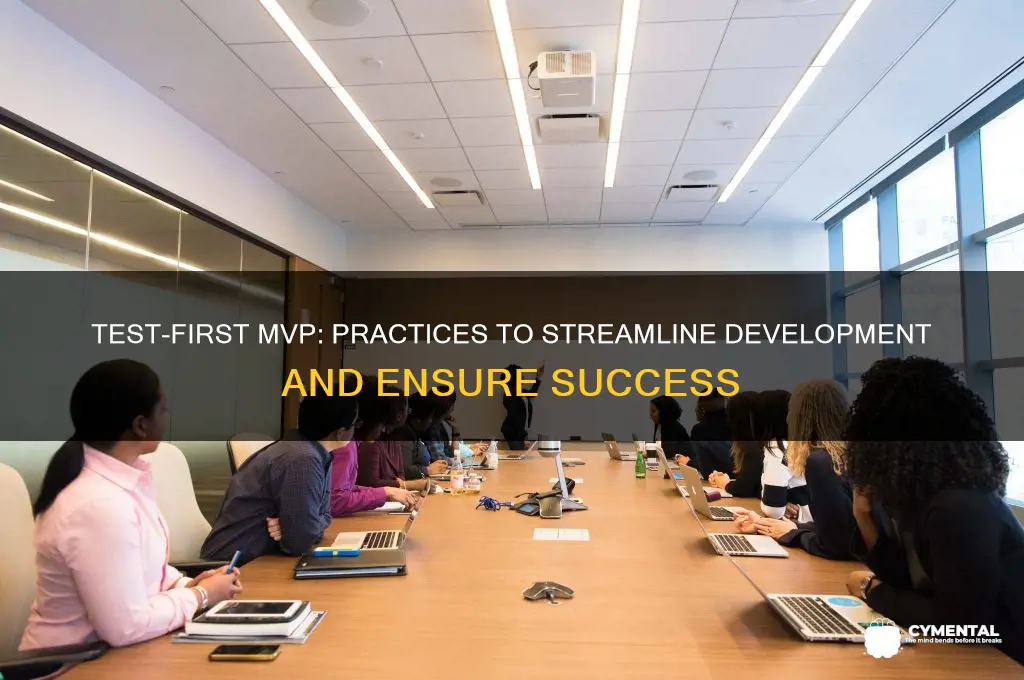
Adopting a test-first mentality in Minimum Viable Product (MVP) development is crucial for ensuring quality, reducing risks, and accelerating iteration cycles. One practice that significantly supports this approach is Test-Driven Development (TDD). TDD involves writing tests before writing the actual code, ensuring that the functionality meets specific requirements and behaves as expected. By starting with tests, developers gain clarity on the desired outcome, focus on essential features, and create a safety net for future changes. This practice aligns perfectly with the MVP philosophy, as it prioritizes delivering core value while maintaining a robust foundation for scaling and improvement. TDD not only fosters a test-first mindset but also encourages modular, maintainable code, making it an ideal companion for MVP development.
| Characteristics | Values |
|---|---|
| Focus on Core Functionality | Prioritizes essential features to deliver value quickly and validate assumptions. |
| Iterative Development | Builds and tests in small, incremental cycles to gather feedback and adapt. |
| Automated Testing | Relies heavily on automated unit, integration, and acceptance tests to ensure code quality and functionality. |
| Continuous Integration/Continuous Deployment (CI/CD) | Automates the build, test, and deployment process for rapid iterations and feedback. |
| Collaboration | Encourages close collaboration between developers, testers, and stakeholders for shared understanding and alignment. |
| Feedback Loop | Emphasizes frequent feedback from users and tests to guide development decisions. |
| Minimal Viable Product (MVP) | Delivers a basic version of the product with core features to learn and iterate. |
| Test-Driven Development (TDD) | Writes tests before writing code, ensuring code meets requirements and is testable. |
| Acceptance Criteria | Clearly defines what constitutes a successful feature, guiding development and testing. |
| Refactoring | Continuously improves code quality and design without changing functionality, enabled by a robust test suite. |
Explore related products


What You'll Learn
- Writing Clear Test Cases: Define precise, actionable tests before coding to validate MVP functionality
- Prioritizing Core Features: Focus on essential features first, ensuring tests cover critical user needs
- Iterative Development: Build, test, and refine in cycles to maintain MVP scope and quality
- Automation Tools: Use testing frameworks to streamline validation and ensure consistent results
- Feedback Loop: Continuously gather and integrate user feedback to align MVP with goals

Writing Clear Test Cases: Define precise, actionable tests before coding to validate MVP functionality
Writing clear test cases before coding is a cornerstone of a test-first mentality in MVP development. It ensures that the core functionality of your product is validated early, reducing rework and aligning development efforts with user needs. By defining precise, actionable tests upfront, you create a roadmap that guides coding, prevents scope creep, and fosters collaboration between developers, testers, and stakeholders.
Think of test cases as blueprints for your MVP’s functionality. Each test should clearly state the input, expected output, and conditions under which the feature should behave as intended. For example, if your MVP includes a login feature, a test case might read: "Given a valid username and password, when the user clicks 'Login,' the system should redirect to the dashboard and display a personalized greeting." This level of specificity leaves no room for ambiguity, ensuring everyone understands the expected behavior.
Crafting effective test cases requires a structured approach. Start by identifying the core user stories or features of your MVP. Break each feature into discrete, testable scenarios, considering both positive and negative outcomes. Use a consistent format, such as the "Given-When-Then" structure, to enhance clarity. For instance, "Given a user is on the registration page, when they submit an invalid email format, then the system should display an error message." Prioritize tests based on risk and impact, focusing on critical functionalities first. Tools like Gherkin syntax or simple spreadsheets can help organize and share test cases with your team.
While writing test cases upfront is powerful, it’s not without challenges. Overly rigid tests can stifle creativity or fail to account for evolving requirements. To mitigate this, strike a balance between precision and flexibility. Use placeholders for variables that may change, such as specific error messages or UI elements. Regularly review and update test cases as the MVP evolves, ensuring they remain relevant and aligned with user needs. Additionally, involve the entire team in test case creation to leverage diverse perspectives and catch potential edge cases early.
The payoff of writing clear test cases before coding is significant. It accelerates development by providing a clear target for developers, reduces bugs by catching issues early, and ensures the MVP meets its intended purpose. For instance, a startup building a fitness app might define test cases for tracking workouts, ensuring the app accurately records duration, calories burned, and exercise type. When coding begins, these tests serve as a validation framework, enabling quick iterations and confidence in the product’s functionality. By embedding this practice into your workflow, you transform testing from an afterthought into a strategic driver of MVP success.
Benzodiazepines and Mental Health: Effective Treatment or Risky Solution?
You may want to see also
Explore related products

$69.99


Prioritizing Core Features: Focus on essential features first, ensuring tests cover critical user needs
In the realm of Minimum Viable Product (MVP) development, a test-first mentality is crucial for ensuring that the product meets user needs while minimizing waste. Prioritizing core features is the linchpin of this approach, as it directs testing efforts toward the most critical aspects of the product. By focusing on essential features first, development teams can validate assumptions early, reduce risks, and deliver value incrementally. This strategy ensures that tests are not just comprehensive but also meaningful, covering the functionalities that matter most to users.
Consider a hypothetical SaaS platform designed for small businesses. Instead of building out a complex dashboard with advanced analytics, the team identifies that the core need is invoice generation and payment tracking. By prioritizing these features, they can create targeted tests that validate whether users can efficiently create invoices and monitor payments. This focused approach not only accelerates development but also provides immediate feedback on whether the MVP is solving the primary problem it aims to address. For instance, A/B testing could be employed to compare two invoice templates, ensuring the chosen design aligns with user preferences before additional features are added.
However, prioritizing core features requires a disciplined approach to avoid scope creep. A practical tip is to use the MoSCoW method (Must have, Should have, Could have, Won’t have) to categorize features. For users aged 25–40, who are likely to be tech-savvy small business owners, "Must have" features might include mobile responsiveness and cloud synchronization. Tests should then be designed to verify these functionalities across devices and platforms, ensuring a seamless user experience. Caution should be exercised against over-engineering; for example, integrating AI-driven insights at this stage could distract from the core value proposition.
Persuasively, this method aligns with the Lean Startup philosophy, emphasizing validated learning over exhaustive planning. By testing core features first, teams can gather actionable data on user behavior and preferences, which informs subsequent iterations. For instance, if 70% of users abandon the payment tracking feature due to complexity, the team can address this pain point before expanding the MVP. This iterative process not only reduces development costs but also increases the likelihood of market success by ensuring the product evolves in response to real user feedback.
In conclusion, prioritizing core features is not just a best practice—it’s a strategic imperative for MVPs with a test-first mentality. By concentrating on essential functionalities and designing tests that cover critical user needs, teams can build products that are both lean and impactful. This approach fosters agility, reduces risk, and ensures that every feature added delivers tangible value. For developers and product managers, the takeaway is clear: start small, test rigorously, and let user feedback guide the way.
Inpatient Mental Health Facilities: Effective Treatment or Temporary Relief?
You may want to see also
Explore related products



Iterative Development: Build, test, and refine in cycles to maintain MVP scope and quality
Iterative development is the backbone of a test-first mentality in MVP creation, ensuring that each feature is validated before moving forward. This approach breaks the development process into manageable cycles, where building, testing, and refining occur in rapid succession. Each cycle begins with a clear, prioritized goal, such as implementing a core user flow or enhancing a critical function. For instance, if your MVP is a fitness app, the first cycle might focus on creating a basic workout logging feature. Once built, it’s immediately tested with real users to identify pain points, such as confusing navigation or missing fields. This immediate feedback loop prevents over-engineering and keeps the scope tightly aligned with user needs.
The testing phase is where iterative development shines. Instead of waiting until the end to uncover issues, testing happens early and often. Use tools like A/B testing for UI decisions or automated unit tests for code quality. For example, if your MVP is an e-commerce platform, test the checkout process with a small group of users to catch bottlenecks like slow loading times or unclear payment options. Refinement follows testing, where feedback is translated into actionable changes. This might mean simplifying a workflow, adding a missing feature, or fixing bugs. The key is to focus on high-impact improvements without expanding the scope unnecessarily.
One practical tip for maintaining MVP scope is to set strict cycle durations, such as two-week sprints. This timeboxing forces prioritization and prevents feature creep. For instance, if a cycle is dedicated to improving user onboarding, limit refinements to the most critical feedback, like reducing the number of steps or clarifying instructions. Avoid the temptation to add non-essential features, even if they seem appealing. Another caution is to resist over-refinement. While quality is crucial, perfectionism can delay launch. Aim for "good enough" in each cycle, knowing that future iterations will address remaining issues.
Comparing iterative development to traditional waterfall methods highlights its efficiency. Waterfall’s linear approach often results in late-stage discoveries that require costly rework. In contrast, iterative cycles allow for continuous adaptation, reducing risk and ensuring the MVP remains user-focused. For example, a startup building a project management tool might discover during testing that users prefer drag-and-drop functionality over manual task assignment. With iterative development, this insight can be incorporated quickly, whereas a waterfall approach might miss it entirely until the final testing phase.
In conclusion, iterative development is not just a methodology but a mindset that fosters agility and responsiveness. By building, testing, and refining in cycles, teams can maintain MVP scope while delivering a high-quality product. Practical steps include setting clear cycle goals, leveraging early and frequent testing, and prioritizing refinements based on user feedback. This approach ensures that the MVP evolves in alignment with user needs, setting the stage for long-term success. Remember, the goal is not to build everything at once but to deliver value incrementally, learning and adapting along the way.
Empowering Your Friend: Overcoming Victim Mentality with Compassion and Support
You may want to see also
Explore related products


Automation Tools: Use testing frameworks to streamline validation and ensure consistent results
Adopting a test-first mentality in MVP development demands efficiency and reliability. Automation tools, particularly testing frameworks, are the linchpin for achieving this. These frameworks provide a structured environment to write, execute, and manage tests, ensuring that validation processes are not only faster but also consistent across different stages of development. Without them, manual testing becomes a bottleneck, prone to human error and inconsistent results, which can derail the iterative nature of an MVP.
Consider the practical steps to integrate testing frameworks effectively. First, select a framework that aligns with your tech stack—for instance, Jest for JavaScript, PyTest for Python, or JUnit for Java. Next, define clear test cases that cover core functionalities, edge cases, and potential failure points. Automate these tests to run as part of your CI/CD pipeline, ensuring every code commit is validated before deployment. For example, a team building a mobile app might use Appium to automate UI tests, catching layout issues on multiple devices without manual intervention.
However, automation isn’t without pitfalls. Over-reliance on frameworks can lead to brittle tests that break with minor code changes. To mitigate this, adopt the Page Object Model in UI testing or use mocking libraries to isolate dependencies. Additionally, maintain a balance between unit, integration, and end-to-end tests. Too many end-to-end tests can slow down feedback loops, while too few unit tests might miss critical logic errors. A rule of thumb: allocate 70% of tests to unit, 20% to integration, and 10% to end-to-end.
The persuasive case for automation lies in its ROI. Teams that implement testing frameworks report a 30-50% reduction in bug detection time and a 20-40% decrease in post-release defects. For instance, a fintech startup using Selenium for web automation reduced regression testing time from 8 hours to 45 minutes, freeing developers to focus on feature enhancements. This efficiency is crucial for MVPs, where rapid iteration and user feedback are paramount.
In conclusion, automation tools are not just a convenience but a necessity for a test-first MVP approach. They transform validation from a reactive, error-prone process into a proactive, reliable one. By choosing the right framework, structuring tests thoughtfully, and avoiding common pitfalls, teams can ensure consistent results and maintain the agility required to deliver value quickly. The investment in automation pays dividends in speed, accuracy, and ultimately, user satisfaction.
The Healing Power of Hugs: Boosting Mental Health Naturally
You may want to see also
Explore related products



Feedback Loop: Continuously gather and integrate user feedback to align MVP with goals
A feedback loop is the lifeblood of a test-first MVP, transforming it from a static product into a dynamic, user-centric solution. Imagine launching a fitness app with a basic step-tracking feature. Without feedback, you might assume users want more complex metrics like calorie burn or sleep tracking. A feedback loop reveals they actually crave social features like challenges and leaderboards. This real-world example highlights the power of continuous feedback: it uncovers hidden needs, prevents wasted development time, and ensures your MVP evolves in the right direction.
Implementing a feedback loop involves three key steps:
- Choose the Right Channels: Don't rely solely on app store reviews. Utilize in-app surveys, email follow-ups, social media polls, and even direct user interviews. Diversifying channels captures a wider range of perspectives.
- Ask the Right Questions: Avoid vague queries like "What do you think?" Instead, focus on specific aspects: "How easy was it to set up a challenge?" or "What features would you like to see added next?"
- Act on the Feedback: Feedback is worthless if it gathers dust. Prioritize actionable insights and implement changes iteratively. Even small tweaks based on user input demonstrate responsiveness and build trust.
Caution: Don't let feedback dictate every decision. Balance user input with your core vision and business goals. Not all feedback is created equal; prioritize insights that align with your target audience and overall strategy.
The beauty of a feedback loop lies in its iterative nature. Each cycle of feedback, implementation, and further feedback refines your MVP, making it increasingly valuable to users. Think of it as a conversation with your audience, where you listen, learn, and adapt, ultimately creating a product that truly resonates.
Seeking Support: Effective Ways to Get Help When You Need It Most
You may want to see also