Caleb Wright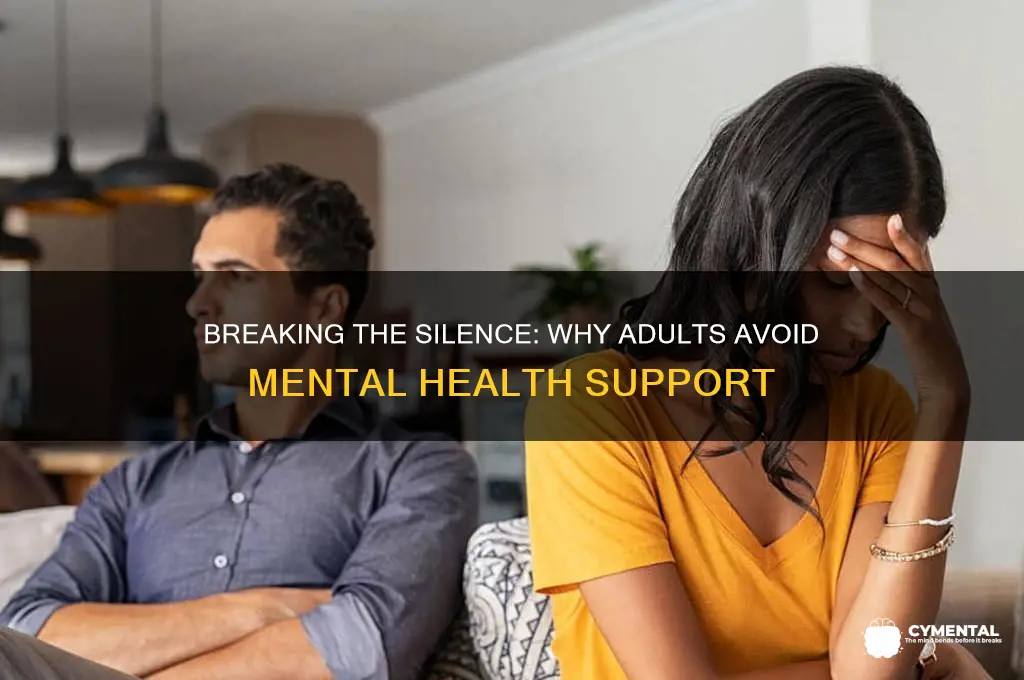
Many adults hesitate to seek help for mental health issues due to a complex interplay of societal stigma, fear of judgment, and a lack of awareness about available resources. Deep-rooted misconceptions about mental health often lead individuals to view seeking help as a sign of weakness or failure, while concerns about confidentiality and the potential impact on personal or professional relationships further deter them. Additionally, systemic barriers such as high costs, limited access to care, and long wait times for services create practical obstacles. Many also struggle to recognize their own mental health struggles, attributing symptoms to stress or temporary difficulties rather than underlying conditions. These factors collectively contribute to a culture where adults often suffer in silence, delaying or avoiding the support they need.
Explore related products


What You'll Learn

Stigma and shame surrounding mental health issues
Stigma and shame act as invisible barriers, preventing many adults from seeking mental health support. Consider this: a 2021 study by the American Psychological Association found that 40% of adults feared being labeled "weak" if they sought therapy. This fear isn’t baseless; societal narratives often equate mental health struggles with personal failure, perpetuating the myth that seeking help is an admission of inadequacy. Such stigma is deeply ingrained, reinforced by media portrayals, workplace cultures, and even family dynamics, creating a silent epidemic of suffering.
To dismantle this barrier, start by reframing the narrative. Mental health challenges are no different from physical ailments—both require treatment, not judgment. For instance, no one shames a diabetic for needing insulin, yet depression or anxiety often invites whispers of "just toughen up." Employers can play a pivotal role here by normalizing mental health days and offering confidential resources. Individuals can contribute by sharing their own experiences openly, challenging stereotypes one conversation at a time.
Shame thrives in secrecy, but it withers under the light of empathy and understanding. Take this practical step: if someone discloses their struggles, avoid platitudes like "it’s all in your head." Instead, validate their feelings with phrases like, "That sounds really hard. How can I support you?" For those hesitant to seek help, start small—join a support group, try a mental health app, or confide in a trusted friend. Remember, seeking help isn’t a sign of weakness; it’s a courageous act of self-care.
Finally, let’s compare the cost of silence to the benefits of action. Untreated mental health issues can lead to job loss, strained relationships, and even physical health decline. Conversely, therapy, medication, or lifestyle changes can improve quality of life dramatically. For example, cognitive-behavioral therapy has a 50-75% success rate for conditions like anxiety and depression. The choice is clear: confront stigma head-on, or let it dictate your well-being. The power to change lies in recognizing that mental health is health—period.
Mastering Self-Regulation: Empowering Mental Health and Emotional Resilience
You may want to see also
Explore related products


Fear of judgment or discrimination in personal/professional life
One of the most paralyzing barriers to seeking mental health support is the fear of being labeled as "weak" or "unstable." This stigma is particularly potent in professional settings, where employees worry that disclosing mental health struggles will jeopardize their career advancement. A 2021 study by Mind Share Partners found that 60% of respondents feared negative consequences at work if they sought mental health treatment. Imagine a mid-level manager, let's call her Sarah, who experiences debilitating anxiety. She knows her company offers an Employee Assistance Program, but she’s terrified her boss will view her as incapable of handling stress, derailing her chances for a promotion. This internal conflict illustrates how deeply ingrained workplace stigma can silence even the most urgent need for help.
The fear of judgment isn’t confined to the office; it permeates personal relationships as well. Adults often worry that friends or family will perceive them as burdensome or "too much" if they open up about their mental health struggles. Consider a 35-year-old man, John, who battles depression but avoids therapy because he fears his wife will see him as emotionally unreliable. This dynamic is exacerbated by societal expectations that men should be stoic and self-reliant. A 2019 survey by the American Psychological Association revealed that 35% of men avoid seeking mental health treatment due to concerns about being judged as less masculine. Such fears create a vicious cycle: the longer individuals delay treatment, the more their mental health deteriorates, reinforcing the very stigma they fear.
To dismantle this barrier, organizations and communities must take proactive steps. Employers can foster a culture of openness by sharing leadership stories of mental health resilience, offering anonymous support channels, and explicitly stating that seeking help is a sign of strength, not weakness. For instance, companies like Unilever and Deloitte have implemented mental health days and peer support programs, normalizing the conversation around mental well-being. On a personal level, individuals can start small by confiding in one trusted person, whether a friend, family member, or colleague, to test the waters and build confidence. It’s also crucial to reframe vulnerability as courage—a mindset shift supported by research showing that openness about mental health fosters deeper, more authentic relationships.
Ultimately, the fear of judgment or discrimination is a self-perpetuating myth that thrives in silence. By challenging this myth through collective action and individual bravery, we can create environments where seeking help is not only accepted but celebrated. Sarah, John, and countless others deserve to live without the weight of stigma. The first step is acknowledging that mental health is as valid a priority as physical health—and that seeking support is not a flaw, but a fundamental act of self-care.
Empowering Change: Simple Actions to Make a Positive Impact Today
You may want to see also
Explore related products



Lack of awareness about available mental health resources
A staggering number of adults struggling with mental health issues never reach out for help, not because they don't want to, but because they simply don't know where to turn. This lack of awareness about available resources acts as a silent barrier, leaving individuals feeling isolated and overwhelmed. Imagine navigating a dense forest without a map – that's the reality for many facing mental health challenges.
Public health campaigns often focus on destigmatizing mental illness, which is crucial, but they sometimes fall short in providing concrete information about accessible support systems. A 2021 study by the National Alliance on Mental Illness (NAMI) revealed that 56% of adults with mental illness reported not knowing where to go for treatment. This highlights a critical gap: awareness doesn't automatically translate to action without clear pathways to resources.
Consider the following scenario: Sarah, a 35-year-old working mother, experiences persistent anxiety and depression. She recognizes her struggles but feels paralyzed by the unknown. She's heard of therapy, but doesn't know how to find a therapist covered by her insurance. She's seen online resources, but feels overwhelmed by the sheer volume of information. Sarah's story is not unique. Many adults, especially those from marginalized communities or with limited access to technology, face similar hurdles.
The consequences of this lack of awareness are profound. Untreated mental health conditions can lead to worsening symptoms, impaired functioning, and even suicidal ideation. Conversely, accessing appropriate support can lead to significant improvements in quality of life, relationships, and overall well-being.
Bridging this awareness gap requires a multi-pronged approach. Firstly, public health initiatives need to move beyond general awareness campaigns and provide concrete information about local resources, including hotlines, community mental health centers, and online therapy platforms. Secondly, healthcare providers must actively screen for mental health concerns and offer clear referrals to appropriate services. Finally, workplaces and educational institutions can play a vital role by promoting mental health literacy and providing employees and students with accessible resources and support networks.
Seeking Support: Who is Turning to Mental Health Services Today?
You may want to see also
Explore related products



Financial barriers to accessing therapy or treatment
The cost of therapy can be a prohibitive factor for many adults seeking mental health treatment. A single session with a licensed therapist can range from $75 to $250, depending on location, therapist experience, and modality (individual, group, or couples therapy). For individuals without insurance or with high-deductible plans, this expense can quickly become unmanageable. A 2020 study published in the *Journal of Mental Health Policy and Economics* found that 40% of respondents cited cost as the primary reason for not seeking therapy. This financial barrier is particularly acute for low-income individuals, who are often priced out of the market entirely.
Consider the case of a 32-year-old freelance graphic designer earning $35,000 annually. After accounting for rent, utilities, groceries, and student loan payments, she has less than $500 per month for discretionary spending. Even at the lower end of the cost spectrum ($75 per session), weekly therapy would consume 75% of her remaining budget. For her, the choice between mental health care and financial stability is stark. This scenario illustrates how systemic economic disparities intersect with mental health access, creating a cycle where those most in need are least able to afford treatment.
To mitigate these financial barriers, individuals can explore several practical strategies. First, research sliding-scale therapists who adjust fees based on income. Platforms like Open Path Collective offer sessions ranging from $30 to $60, making therapy more accessible. Second, inquire about employer-sponsored mental health benefits or Employee Assistance Programs (EAPs), which often provide free or discounted counseling sessions. Third, consider online therapy platforms like BetterHelp or Talkspace, which offer monthly subscriptions starting at $65 per week, billed monthly. While not a replacement for in-person care, these options can be a viable alternative for those with limited budgets.
However, these solutions are not without limitations. Sliding-scale therapists often have long waitlists, and online therapy may lack the depth of traditional in-person sessions. Additionally, insurance coverage for mental health remains inconsistent, with many plans capping the number of sessions or requiring high copays. For instance, a Bronze-level ACA plan might cover only 60% of therapy costs after a $6,000 deductible, leaving patients to shoulder a significant financial burden. Policymakers must address these gaps by mandating comprehensive mental health coverage and increasing funding for community mental health programs.
Ultimately, the financial barriers to accessing therapy are a symptom of broader systemic issues—income inequality, inadequate insurance coverage, and underfunded public health systems. Until these root causes are addressed, individuals will continue to face impossible choices between their mental well-being and financial stability. In the meantime, a combination of proactive research, advocacy, and creative resource utilization can help bridge the gap, ensuring that more adults can access the care they need without sacrificing their economic security.
Supporting Strangers: Compassionate Steps to Aid Mental Health Struggles
You may want to see also
Explore related products


Belief in self-reliance or ability to handle problems alone
A pervasive cultural narrative glorifies self-reliance, portraying the ability to handle problems alone as a hallmark of strength and maturity. This mindset, while admirable in some contexts, can become a double-edged sword when it comes to mental health. Adults, particularly those raised in environments that equate asking for help with weakness, often internalize this belief, leading to a reluctance to seek professional support for their mental well-being.
Consider the case of John, a 45-year-old executive who prides himself on his independence. Despite experiencing chronic anxiety and insomnia, he dismisses the idea of therapy, convinced that he can "tough it out" and manage his symptoms through sheer willpower. This mindset, though understandable, can exacerbate mental health issues, as untreated conditions often worsen over time.
The belief in self-reliance can be particularly detrimental when it stems from a lack of understanding about the nature of mental health struggles. Many adults mistakenly view mental health challenges as a sign of personal failure or a character flaw, rather than a legitimate health concern that requires professional intervention. This misconception can lead to a cycle of self-blame and avoidance, as individuals attempt to cope with their symptoms in isolation, often relying on maladaptive strategies such as substance abuse or emotional suppression.
To counteract this tendency, it's essential to reframe the narrative around self-reliance and mental health. Rather than viewing seeking help as a sign of weakness, adults should be encouraged to see it as a proactive step towards self-care and personal growth. One practical strategy is to start small, by confiding in a trusted friend or family member about one's struggles, and gradually working up to seeking professional support. For instance, individuals can begin by taking an online mental health assessment or attending a support group, which can provide a sense of community and validation without the perceived vulnerability of one-on-one therapy.
A comparative analysis of self-reliance across cultures reveals that societies with a strong emphasis on collectivism, such as many Asian and African communities, often prioritize interdependence and mutual support over individual autonomy. In these contexts, seeking help for mental health concerns is frequently viewed as a natural and necessary aspect of community care. By contrast, individualistic cultures, like those prevalent in North America and Western Europe, tend to valorize self-sufficiency, which can create barriers to accessing mental health services. By acknowledging these cultural differences, adults can begin to challenge their assumptions about self-reliance and explore alternative models of support that prioritize connection and collaboration.
Ultimately, the key to overcoming the belief in self-reliance as a barrier to mental health care lies in education and awareness. Adults must be provided with accurate information about the prevalence, treatability, and legitimacy of mental health struggles, as well as practical guidance on how to access support services. This can include workplace initiatives, such as employee assistance programs (EAPs) that offer confidential counseling and referral services, or community-based resources like peer support groups and crisis hotlines. By fostering a culture that values vulnerability and connection, we can empower adults to prioritize their mental well-being and seek help when needed, without fear of judgment or shame.
Supporting a Friend’s Mental Health: Practical Steps to Show You Care
You may want to see also
Frequently asked questions
Many adults avoid seeking help due to stigma, fear of judgment, lack of awareness about available resources, or concerns about the cost of treatment.
Stigma creates a perception that seeking help is a sign of weakness or failure, leading adults to feel ashamed or embarrassed about their struggles, which deters them from reaching out.
Yes, financial barriers, such as high therapy costs, lack of insurance coverage, or limited access to affordable care, often prevent adults from pursuing mental health treatment.
Some adults may underestimate the severity of their mental health struggles, rely on self-coping mechanisms, or fear losing control by involving a professional, leading them to avoid seeking help.
Yes, many adults are unaware of available mental health services, such as therapy, support groups, or hotlines, which limits their ability to access the help they need.


![Shame (The Criterion Collection) [Blu-ray]](https://m.media-amazon.com/images/I/81L-2w6IK0L._AC_UY218_.jpg)