Caleb Wright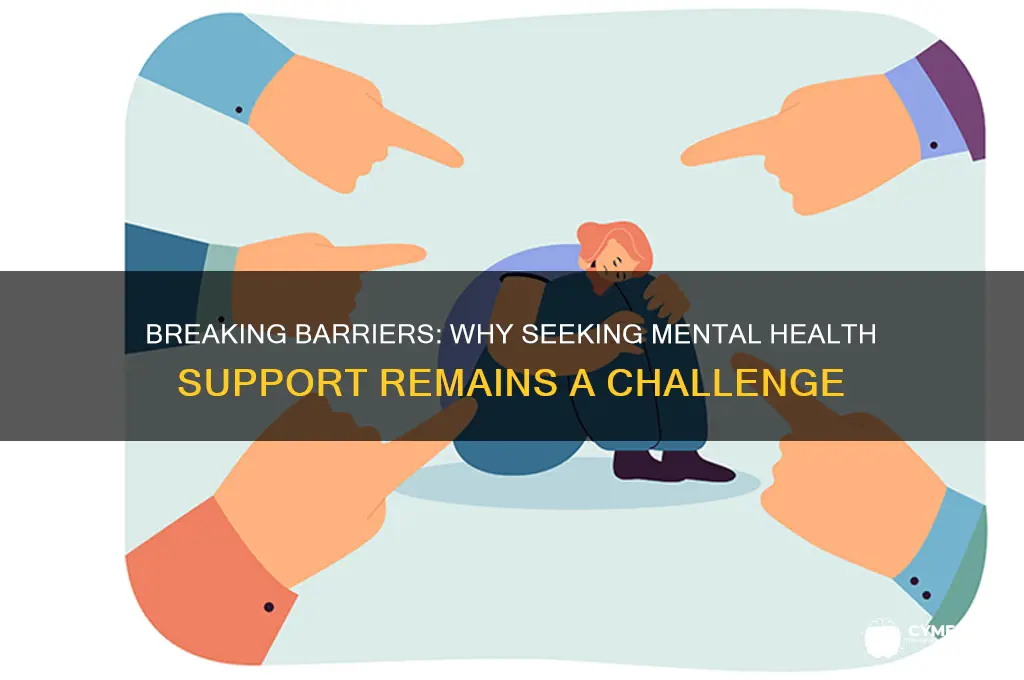
Accessing mental health support often feels like navigating a labyrinth of barriers, from societal stigma that labels seeking help as a sign of weakness to systemic issues like high costs, limited availability of services, and long wait times. Many individuals also struggle with self-stigma, fearing judgment or feeling undeserving of care, while others face logistical challenges such as lack of transportation or inflexible work schedules. Additionally, the fragmented nature of mental health systems and the shortage of trained professionals further complicate the process, leaving countless people to suffer in silence despite the urgent need for assistance. These intertwined obstacles make seeking mental health help a daunting and often discouraging endeavor.
Explore related products


What You'll Learn
- Stigma and Shame: Fear of judgment discourages seeking help, perpetuating silence around mental health struggles
- Access Barriers: Limited resources, high costs, and long wait times hinder access to care
- Lack of Awareness: Many don’t recognize symptoms or know where to seek help
- Cultural Barriers: Societal norms and beliefs often dismiss mental health as a valid concern
- Fear of Diagnosis: Anxiety about labels or long-term treatment prevents people from reaching out

Stigma and Shame: Fear of judgment discourages seeking help, perpetuating silence around mental health struggles
Stigma acts as an invisible barrier, trapping individuals in a cycle of silence and suffering. Consider this: a 2021 survey by the American Psychological Association found that 57% of adults experiencing mental health symptoms avoided seeking treatment due to concerns about being labeled or judged. This fear isn’t baseless; societal stereotypes often equate mental illness with weakness, instability, or even danger. Such misconceptions, perpetuated by media, cultural norms, and even well-meaning but misinformed individuals, create an environment where admitting to mental health struggles feels akin to confessing a personal failure. The result? People delay or forgo help, allowing treatable conditions to worsen.
Now, let’s break this down practically. Imagine a 28-year-old professional named Sarah, who experiences panic attacks but fears her colleagues will view her as "unreliable" if they find out. She avoids therapy, opting instead for self-isolation during episodes. Over time, her anxiety escalates, affecting her work performance—the very outcome she sought to prevent. This scenario illustrates how stigma doesn’t just deter help-seeking; it becomes a self-fulfilling prophecy, reinforcing the belief that mental health issues are something to hide rather than address.
To dismantle this cycle, start by challenging internalized stigma. Ask yourself: Would you judge a friend for breaking their leg? Likely not. Mental health deserves the same compassion. Next, reframe seeking help as an act of strength, not weakness. Research shows that therapy and medication can reduce symptoms by 50–70% in conditions like depression and anxiety, making treatment a proactive step toward recovery. For those hesitant to disclose struggles, begin with trusted confidants or anonymous support groups, gradually expanding your circle as comfort allows.
Here’s a caution: Avoid oversharing with individuals who’ve demonstrated judgmental attitudes in the past. Instead, seek out mental health advocates or professionals trained in empathy and confidentiality. Additionally, leverage digital tools like telehealth platforms, which offer discreet access to therapy without the stigma of walking into a clinic. Apps like Calm or Headspace provide evidence-based mindfulness exercises, a low-stakes way to begin prioritizing mental health.
In conclusion, stigma thrives on silence, but every conversation chips away at its power. By normalizing discussions about mental health, educating ourselves and others, and modeling vulnerability, we create a culture where seeking help is seen as a responsible, courageous act. Remember: You don’t have to wait until you’re "sick enough" to deserve support. Start small, stay consistent, and challenge the stigma one step at a time.
Socializing as Therapy: How Connections Aid Mental Health Recovery
You may want to see also
Explore related products


Access Barriers: Limited resources, high costs, and long wait times hinder access to care
Mental health care is a fundamental human need, yet accessing it often feels like navigating a labyrinth. Limited resources, high costs, and long wait times create formidable barriers, leaving many stranded in their darkest hours. Consider this: in the United States, over 110 million people live in areas with a shortage of mental health professionals. This scarcity forces individuals to travel long distances, wait months for appointments, or simply go without care. For those in rural areas, the situation is even more dire, with telehealth options often limited by poor internet connectivity.
Let’s break down the financial burden, a silent but potent deterrent. Therapy sessions can range from $65 to $250 per hour, and psychiatric evaluations often start at $300. Insurance coverage is inconsistent, with many plans capping sessions or excluding certain diagnoses. For a family living paycheck to paycheck, these costs are insurmountable. Even with insurance, high deductibles and copays can make regular care unaffordable. Compare this to physical health care, where emergency services are mandated by law to treat patients regardless of ability to pay. Mental health care lacks such protections, leaving vulnerable populations to fend for themselves.
Now, imagine you’ve finally found a provider who accepts your insurance. The wait time for an initial appointment averages 4 to 6 weeks, but in some regions, it stretches to 6 months or more. For someone in crisis, this delay can be catastrophic. Research shows that 60% of people seeking mental health care drop out before their first appointment due to wait times. Even after securing a spot, the struggle continues: follow-up appointments are often spaced weeks apart, leaving patients to manage symptoms with minimal support. This fragmented care model fails to address the urgency of mental health needs.
To address these barriers, practical solutions must be prioritized. First, governments and healthcare systems should invest in training and retaining mental health professionals, particularly in underserved areas. Incentives like loan forgiveness programs for providers working in rural or low-income communities can help bridge the gap. Second, insurance reforms are critical. Policies should mandate comprehensive mental health coverage, eliminate session caps, and cap out-of-pocket costs. For those without insurance, sliding-scale clinics and community health centers offer affordable options, though availability remains limited. Finally, telehealth must be expanded and subsidized to reach remote populations, with infrastructure investments to improve internet access in rural areas.
The takeaway is clear: access to mental health care is not just a matter of personal effort but systemic change. Until resources are expanded, costs reduced, and wait times shortened, millions will continue to suffer in silence. Advocacy, policy reform, and community initiatives are essential to dismantle these barriers and ensure that mental health care is truly accessible to all.
Supporting Mental Health: Challenges, Rewards, and Personal Growth in Helping Others
You may want to see also
Explore related products



Lack of Awareness: Many don’t recognize symptoms or know where to seek help
One of the most significant barriers to accessing mental health care is the inability to recognize symptoms in oneself or others. Unlike physical ailments, mental health issues often manifest subtly—mood changes, withdrawal, or persistent fatigue—that can be mistaken for temporary stress or personality quirks. For instance, a teenager’s irritability might be dismissed as a phase, while an older adult’s memory lapses could be chalked up to aging. This lack of awareness delays intervention, allowing conditions like depression or anxiety to worsen. Without clear, widely disseminated guidelines on what constitutes a mental health red flag, many remain in the dark, unaware they need help.
Compounding this issue is the widespread confusion about where to turn for assistance. Mental health resources are often fragmented, with no single, universally known entry point. Someone experiencing symptoms might not know whether to start with a primary care physician, a therapist, a crisis hotline, or an online platform. For example, a young adult might hesitate to approach a school counselor, fearing judgment, while an older individual might not realize telehealth options exist. This uncertainty paralyzes action, leaving people stuck in a cycle of suffering rather than seeking support.
Education plays a critical role in bridging this gap. Schools, workplaces, and community centers should integrate mental health literacy into their programs, teaching not only symptom recognition but also resource navigation. For instance, a workplace workshop could outline how to identify burnout in colleagues and provide a step-by-step guide to accessing Employee Assistance Programs (EAPs). Similarly, schools could incorporate age-appropriate lessons on mental health into health classes, ensuring students know how to reach out to school counselors or local mental health organizations.
Technology offers another avenue to combat this lack of awareness. Apps like Calm or Headspace normalize mental health discussions and provide tools for self-assessment, while platforms like 7 Cups connect users to peer support or licensed therapists. However, these resources must be actively promoted through public health campaigns, ensuring they reach underserved populations, including rural communities or older adults who may be less tech-savvy.
Ultimately, addressing this lack of awareness requires a multi-pronged approach: public education, clear resource mapping, and leveraging technology. Until recognizing mental health symptoms and knowing where to seek help becomes as commonplace as identifying a broken bone and heading to the ER, countless individuals will continue to suffer in silence. The first step to solving a problem is acknowledging it exists—and in mental health, that starts with awareness.
Transforming Lives: The Power of Treatment for Mental Health Recovery
You may want to see also
Explore related products



Cultural Barriers: Societal norms and beliefs often dismiss mental health as a valid concern
In many cultures, mental health struggles are seen as a sign of personal weakness or moral failing rather than a legitimate medical issue. This stigma often stems from deeply ingrained beliefs that prioritize self-reliance and emotional stoicism. For example, in some Asian communities, admitting to mental health problems can bring shame to the family, leading individuals to suffer in silence rather than seek help. Such societal norms create an invisible barrier, making it difficult for people to acknowledge their struggles, let alone pursue treatment.
Consider the role of language in perpetuating these barriers. In some cultures, there are no direct words to describe mental health conditions, forcing individuals to rely on vague or stigmatizing terms. For instance, in certain African societies, mental illness may be attributed to spiritual curses or ancestral displeasure, framing it as something to be feared or hidden rather than treated. This linguistic limitation not only isolates those affected but also reinforces the idea that mental health is not a valid concern deserving of professional attention.
To dismantle these cultural barriers, education and awareness are critical. Community leaders, educators, and healthcare providers must work together to reframe mental health as a universal human experience, not a taboo. Practical steps include incorporating mental health topics into school curricula, hosting workshops in culturally sensitive settings, and training local healers to recognize and refer cases to mental health professionals. For example, in India, initiatives like the National Mental Health Program have integrated traditional healers into the healthcare system, bridging the gap between cultural beliefs and modern treatment.
However, caution must be exercised to avoid cultural imperialism—imposing Western models of mental health care without considering local contexts. Instead, interventions should be tailored to respect and engage with existing cultural frameworks. For instance, in Indigenous communities, healing practices often involve collective rituals and spiritual guidance. Collaborating with elders and community members to incorporate these practices into mental health programs can foster trust and acceptance.
Ultimately, breaking down cultural barriers requires a shift in societal attitudes, from dismissal to empathy. By acknowledging the validity of mental health concerns and creating safe spaces for dialogue, communities can encourage individuals to seek help without fear of judgment. This cultural transformation is not immediate, but every step toward understanding and acceptance brings us closer to a world where mental health care is accessible to all.
Boost Your Mental Focus: Top Supplements for Enhanced Concentration
You may want to see also
Explore related products


Fear of Diagnosis: Anxiety about labels or long-term treatment prevents people from reaching out
The fear of being labeled with a mental health condition can be paralyzing. Imagine a young adult, let's call her Sarah, who experiences persistent sadness and anxiety. She recognizes her struggles but hesitates to seek help because she fears the potential diagnosis of depression or generalized anxiety disorder. This fear is not unfounded; a diagnosis can feel like a life sentence, a permanent mark that defines her identity. The stigma surrounding mental illness often leads individuals to believe that a diagnosis will limit their opportunities, affect their relationships, and change how others perceive them. As a result, they may choose to suffer in silence rather than risk the perceived consequences of a professional evaluation.
This anxiety is further exacerbated by the unknowns of long-term treatment. Mental health treatment is rarely a quick fix; it often involves therapy, medication, or both, requiring a significant time commitment. For instance, cognitive-behavioral therapy (CBT) typically spans 12 to 20 sessions, and medication adjustments can take months to find the right balance. The prospect of such a lengthy process can deter people from taking the first step. They may worry about the financial burden, the time away from work or studies, or the emotional toll of confronting their issues week after week. The fear of diagnosis, therefore, becomes a fear of commitment to a potentially daunting journey.
Consider the case of a 35-year-old professional, John, who suspects he has ADHD. He struggles with focus and impulsivity but avoids seeking a diagnosis because he fears the implications. A confirmed diagnosis might require him to disclose his condition to his employer, potentially affecting his career trajectory. He also worries about the side effects of stimulant medications, which are commonly prescribed for ADHD. The uncertainty of how his life might change post-diagnosis keeps him from reaching out for help, even as his symptoms impact his work and personal life.
To address this fear, it’s crucial to reframe the narrative around mental health diagnoses. A diagnosis is not a label that confines but a tool that clarifies. It provides a roadmap for treatment and a language to communicate one’s struggles. For example, understanding that Sarah’s symptoms align with depression can help her access evidence-based treatments like selective serotonin reuptake inhibitors (SSRIs) or CBT, which have proven efficacy. Similarly, John’s ADHD diagnosis could open doors to accommodations at work and targeted strategies to improve his productivity.
Practical steps can also alleviate the anxiety surrounding diagnosis and treatment. Start by researching mental health professionals who specialize in your concerns. Many therapists offer free consultations, allowing you to gauge their approach before committing. If medication is a concern, discuss non-pharmacological options or ask about medications with minimal side effects. For instance, bupropion, a non-stimulant, is sometimes prescribed for ADHD with fewer risks than traditional stimulants. Additionally, consider joining support groups or online communities where individuals share their experiences, normalizing the process and reducing fear.
In conclusion, the fear of diagnosis and long-term treatment is a significant barrier to seeking mental health help. However, by understanding the purpose of a diagnosis, exploring flexible treatment options, and seeking support, individuals can take control of their mental health journey. Remember, the first step is often the hardest, but it’s also the most crucial in moving toward healing and growth.
Group Therapy: A Powerful Tool for Mental Health Recovery
You may want to see also
Frequently asked questions
Affordable mental health care is often limited due to high costs, lack of insurance coverage, and a shortage of providers, especially in underserved areas. Many therapists do not accept insurance, and out-of-pocket expenses can be prohibitive for many individuals.
Stigma surrounding mental health persists in many cultures, leading people to fear judgment, weakness, or discrimination. Societal misconceptions about mental illness often make individuals hesitant to acknowledge their struggles or seek support.
The demand for mental health services often exceeds the supply of available providers, resulting in long wait times. Additionally, many therapists have full caseloads, and the process of finding a compatible provider can further delay access to care.
The mental health system can be overwhelming and confusing, with various types of providers, therapies, and resources available. Lack of clear guidance, limited awareness of options, and fear of making the wrong choice often leave people unsure of how to begin.


![Shame (The Criterion Collection) [Blu-ray]](https://m.media-amazon.com/images/I/81L-2w6IK0L._AC_UY218_.jpg)