Lucas Bennett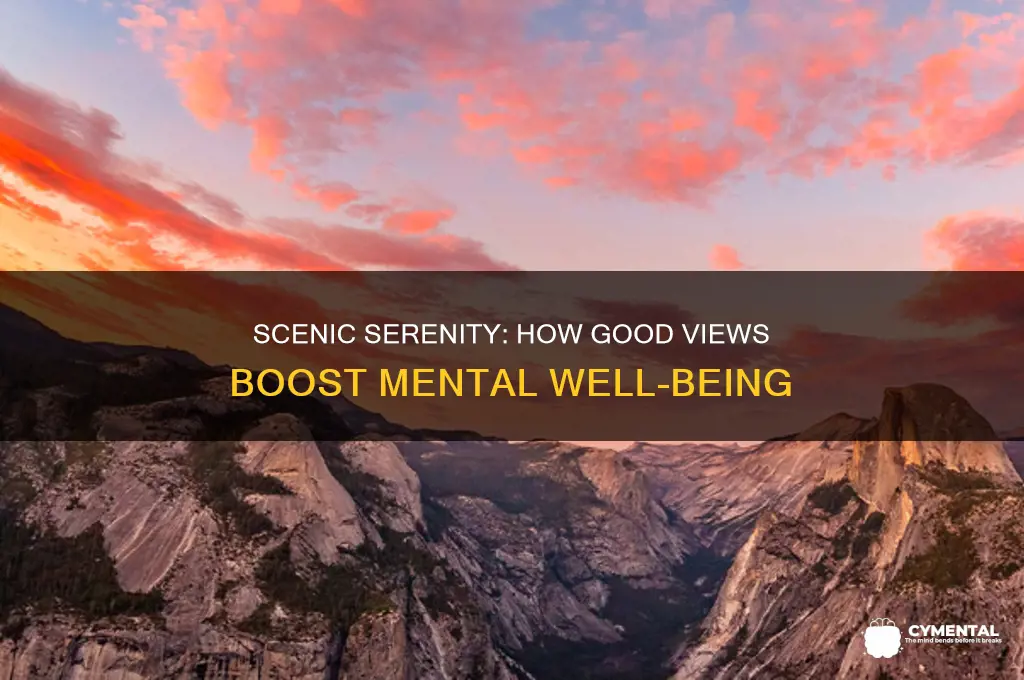
Good views, such as those of nature, urban landscapes, or aesthetically pleasing environments, have a profound impact on mental well-being. Exposure to visually appealing surroundings can reduce stress, anxiety, and fatigue by triggering the brain’s relaxation response, lowering cortisol levels, and promoting a sense of calm. Natural views, in particular, have been shown to enhance mood, improve focus, and foster a connection to the environment, which can alleviate symptoms of depression and enhance overall emotional resilience. Additionally, good views often encourage mindfulness and reflection, allowing individuals to disconnect from daily pressures and gain perspective. Whether through a scenic window, a park, or a thoughtfully designed space, the positive effects of good views on mental health underscore the importance of integrating beauty and nature into our daily lives.
| Characteristics | Values |
|---|---|
| Stress Reduction | Exposure to natural or aesthetically pleasing views triggers the parasympathetic nervous system, reducing cortisol levels and promoting relaxation. |
| Improved Mood | Scenic views increase dopamine and serotonin production, enhancing feelings of happiness and well-being. |
| Enhanced Cognitive Function | Natural environments improve attention, memory, and problem-solving skills by reducing mental fatigue. |
| Reduced Anxiety | Calm and open vistas, such as landscapes or water bodies, decrease symptoms of anxiety and promote a sense of peace. |
| Increased Creativity | Inspiring views stimulate the brain’s default mode network, fostering creativity and innovative thinking. |
| Better Sleep Quality | Exposure to natural light and soothing views during the day regulates circadian rhythms, improving sleep patterns. |
| Social Connection | Shared appreciation of beautiful views can strengthen social bonds and reduce feelings of loneliness. |
| Physical Health Benefits | Improved mental health from good views often correlates with lower blood pressure, reduced heart rate, and enhanced immune function. |
| Restoration of Attention | Natural views provide a restorative environment, helping to recover from mental exhaustion and improve focus. |
| Sense of Awe | Majestic or expansive views evoke awe, which is linked to increased life satisfaction and reduced stress. |
Explore related products


What You'll Learn
- Natural Scenery Reduces Stress: Green spaces and nature views lower cortisol, promoting relaxation and calmness
- Urban Views Boost Creativity: Dynamic cityscapes stimulate the mind, enhancing problem-solving and innovative thinking
- Water Views Improve Mood: Oceans, lakes, or rivers induce tranquility, reducing anxiety and increasing happiness
- Open Spaces Enhance Focus: Expansive views minimize mental clutter, improving concentration and cognitive clarity
- Aesthetic Beauty Inspires Positivity: Beautiful views trigger dopamine release, fostering optimism and emotional well-being

Natural Scenery Reduces Stress: Green spaces and nature views lower cortisol, promoting relaxation and calmness
Spending just 20–30 minutes in a green space daily can measurably lower cortisol levels, the body's primary stress hormone. Studies show that individuals who incorporate nature into their routine experience a 15–20% reduction in stress markers compared to those in urban environments. This isn’t just anecdotal—research from the University of Michigan found that even brief exposure to natural scenery can trigger physiological changes, such as slowed heart rate and reduced blood pressure, which signal relaxation. For maximum benefit, aim for environments with diverse flora, water features, or open skies, as these elements amplify the calming effect.
Consider the design of your living or working space to harness this effect. Position your desk or seating area to face a window with a view of trees, a park, or even potted plants. If outdoor access is limited, high-quality nature imagery or virtual reality simulations can serve as substitutes, though live greenery remains most effective. For urban dwellers, integrating micro-exposures—like walking through a tree-lined street or visiting a rooftop garden—can accumulate stress-reducing benefits over time. The key is consistency; make nature a non-negotiable part of your daily or weekly schedule.
Children and older adults, in particular, stand to gain significantly from nature’s stress-relieving properties. For kids, unstructured play in natural settings has been linked to improved emotional regulation and reduced anxiety. Seniors, meanwhile, report enhanced mood and cognitive function when exposed to green spaces. Schools and care facilities should prioritize outdoor areas with natural elements, while families can encourage intergenerational activities like gardening or nature walks. Even small changes, like adding indoor plants to a child’s room or a senior’s living space, can create a soothing environment.
While the benefits are clear, overloading on nature isn’t necessary—quality trumps quantity. A 10-minute walk in a well-maintained park can be more effective than an hour in a neglected green space. Avoid areas with high noise levels or pollution, as these counteract the positive effects. Pair nature exposure with mindfulness practices, such as deep breathing or silent observation, to deepen relaxation. Remember, the goal isn’t to escape stress entirely but to build resilience by regularly engaging with environments that naturally promote calmness. Start small, stay consistent, and let nature do the rest.
Mental Health Classes: A Path to Overcoming Meth Addiction?
You may want to see also
Explore related products


Urban Views Boost Creativity: Dynamic cityscapes stimulate the mind, enhancing problem-solving and innovative thinking
The human brain thrives on novelty, and urban environments are a feast of ever-changing stimuli. Unlike static natural landscapes, cities offer a dynamic tapestry of movement, color, and sound. This constant flux engages our attention, forcing our brains to process new information and make connections between seemingly unrelated elements. Imagine a bustling city square: the interplay of architecture, the rhythm of traffic, the diversity of faces – all these elements combine to create a cognitive playground that challenges and stimulates our minds.
Studies suggest that exposure to such complex environments can enhance cognitive flexibility, a key component of creativity.
To harness the creative potential of urban views, consider these practical steps. Dedicate 20-30 minutes daily to observing your cityscape, ideally from a vantage point that offers a panoramic view. Focus on the details: the patterns formed by windows, the flow of pedestrians, the interplay of light and shadow. Engage your senses – listen to the soundscape, feel the breeze, notice the smells. After your observation period, jot down any thoughts, ideas, or associations that arise. This mindful engagement with the urban environment can act as a catalyst for creative breakthroughs.
For maximum benefit, vary your observation locations. Explore different neighborhoods, seek out rooftop views, or simply change your route to work. This diversity of perspectives keeps the brain engaged and prevents habituation.
While the stimulating nature of urban views is generally beneficial, it's important to be mindful of potential drawbacks. Overstimulation can lead to cognitive fatigue, particularly for individuals sensitive to sensory input. If you find yourself feeling overwhelmed, take breaks in quieter, less visually cluttered spaces. Additionally, the constant flow of information in urban environments can make it difficult to focus on a single task. To counter this, incorporate periods of focused work in a controlled environment after your urban observation sessions. This allows you to process the stimuli and channel the creative energy into productive output.
The connection between urban views and creativity is not merely anecdotal. Research in environmental psychology suggests that complex, dynamic environments promote divergent thinking, a crucial aspect of creativity. By exposing ourselves to the ever-changing tapestry of the city, we train our brains to make unexpected connections, see patterns where others see chaos, and approach problems from novel angles. So, the next time you find yourself gazing out at the city skyline, remember: you're not just admiring the view, you're fueling your creative engine.
Nature's Healing Power: Boosting Mental Health Through Outdoor Connection
You may want to see also
Explore related products


$24.07 $29.99



Water Views Improve Mood: Oceans, lakes, or rivers induce tranquility, reducing anxiety and increasing happiness
The sound of lapping waves, the glint of sunlight on water, and the vast expanse of a horizon all contribute to a sense of calm that’s hard to replicate. Research in environmental psychology reveals that viewing bodies of water—oceans, lakes, or rivers—activates the parasympathetic nervous system, which slows heart rate and reduces cortisol levels. A study published in *Health & Place* found that individuals living within 1 kilometer of a coastline reported 17% lower psychological distress compared to those farther inland. This isn’t just anecdotal; it’s a measurable physiological response to the presence of water.
To harness this benefit, consider incorporating "blue space" into your daily routine. Spending at least 20 minutes a day near water—whether it’s a morning walk along a riverbank or a weekend visit to a lake—can significantly reduce anxiety. For those without easy access to natural water sources, even viewing high-quality images or videos of aquatic environments can provide a temporary mood boost. However, the sensory experience of being near water—the sound, smell, and movement—amplifies its therapeutic effects, making it a more potent remedy than visual exposure alone.
Comparatively, water views outperform other natural landscapes in inducing tranquility. While forests and mountains offer their own mental health benefits, water uniquely combines visual openness with dynamic movement, creating a sense of both stability and change. This duality resonates with the human psyche, offering a mental reset that’s particularly effective for individuals experiencing stress or burnout. For instance, a 2019 study in *Environmental Science & Technology* found that participants who walked along a beach reported greater improvements in mood and well-being compared to those who walked in urban or park settings.
Practical application of this knowledge can transform your living or working space. If relocating near water isn’t feasible, strategically placing a desk or seating area to face a window with a water view can yield benefits. For indoor environments, adding aquatic elements like a small fountain or fish tank can mimic the soothing effects of natural water. Even incorporating blue hues into decor—a color psychologically associated with calmness—can subtly enhance mood. The key is to create an environment that evokes the serenity of water, even in its absence.
Finally, it’s worth noting that the benefits of water views aren’t limited to adults. Children exposed to blue spaces exhibit lower levels of hyperactivity and improved focus, making water-adjacent play areas or classrooms particularly beneficial. For older adults, water views can mitigate symptoms of depression and loneliness, fostering a sense of connection to the natural world. Whether through intentional design or spontaneous visits to a nearby lake, integrating water into daily life is a simple yet powerful way to nurture mental well-being across all ages.
Supporting Your Girlfriend’s Mental Health: Practical Ways to Show You Care
You may want to see also
Explore related products


Open Spaces Enhance Focus: Expansive views minimize mental clutter, improving concentration and cognitive clarity
The human brain processes an estimated 11 million pieces of information per second, yet consciously handles only 40. In this constant barrage, mental clutter accumulates, fragmenting attention and dulling cognitive clarity. Expansive views of open spaces act as a reset button, offering a visual environment that reduces sensory overload. Research in environmental psychology shows that natural, unobstructed vistas engage the brain’s parasympathetic nervous system, promoting a state of calm focus. For instance, a study published in the *Journal of Environmental Psychology* found that participants exposed to wide landscapes demonstrated a 15% improvement in sustained attention tasks compared to those viewing confined spaces.
To harness this effect, incorporate deliberate exposure to open spaces into daily routines. Aim for 20–30 minutes of uninterrupted viewing time, ideally in environments like parks, waterfronts, or elevated vantage points. For urban dwellers, strategically placing a desk near a window with a broad view or using high-resolution nature imagery can simulate the effect. However, not all views are created equal: cluttered or chaotic scenes (e.g., busy streets) may negate benefits. Opt for scenes with minimal human-made elements and a sense of depth, such as rolling hills or expansive skies.
A comparative analysis reveals why open spaces outperform confined ones in enhancing focus. In closed environments, the brain must actively filter irrelevant stimuli, depleting cognitive resources. Expansive views, by contrast, provide a "soft fascination" effect—enough visual interest to hold attention without demanding mental effort. This aligns with Attention Restoration Theory, which posits that natural environments replenish directed attention, a finite cognitive resource. For example, office workers with desk views of nature report 10–15% higher job satisfaction and productivity, according to a study by the University of Oregon.
Practical implementation requires awareness of individual differences. Children and adults over 65, whose attentional systems are still developing or declining, respectively, may benefit from shorter, more frequent exposures (10–15 minutes, 2–3 times daily). Pairing view exposure with mindfulness practices, such as deep breathing or silent observation, amplifies cognitive benefits. Caution: over-reliance on virtual substitutes (e.g., screensavers) may yield diminishing returns; prioritize real-world experiences whenever possible.
In conclusion, expansive views are not merely aesthetic luxuries but functional tools for cognitive optimization. By minimizing mental clutter, they create a mental workspace conducive to sustained focus and clarity. Whether through urban planning, workplace design, or personal habit adjustments, integrating open spaces into daily life offers a low-cost, high-yield strategy for enhancing cognitive performance across age groups and lifestyles.
Supporting Grandpa: A Guide to Accessing Mental Health Care for Seniors
You may want to see also
Explore related products


Aesthetic Beauty Inspires Positivity: Beautiful views trigger dopamine release, fostering optimism and emotional well-being
The human brain is wired to respond to beauty, and this response goes beyond mere appreciation—it triggers a cascade of neurochemical reactions that enhance mental well-being. When we encounter a stunning landscape, a meticulously designed building, or even a vibrant work of art, our brains release dopamine, often referred to as the "feel-good" neurotransmitter. This dopamine surge not only elevates our mood but also fosters a sense of optimism and emotional resilience. Studies have shown that just 20 minutes spent in an aesthetically pleasing environment can significantly reduce stress levels and improve overall emotional well-being. For instance, a view of nature from a hospital window has been linked to faster recovery times for patients, demonstrating the tangible benefits of aesthetic beauty on mental health.
To harness this effect, consider incorporating beautiful views into your daily routine. Start by identifying spaces that inspire you—whether it’s a park, a museum, or even a well-curated corner in your home. For urban dwellers, a 10-minute walk in a green space or a few moments gazing at a piece of art can serve as a "dopamine dose." If access to natural beauty is limited, technology can be a useful tool: high-resolution images or videos of scenic landscapes can still trigger a positive response, though the effect is more pronounced with real-world experiences. For maximum benefit, aim to engage with aesthetic beauty at least twice a day, especially during transitions between tasks or moments of stress.
Comparing the impact of beautiful views to other mood-boosting activities reveals their unique advantage. While exercise and social interaction also release dopamine, aesthetic experiences require minimal effort and are accessible to people of all ages and physical abilities. For older adults or those with mobility issues, simply sitting by a window with a pleasant view can provide a significant mental health boost. Similarly, children exposed to visually stimulating environments, such as colorful classrooms or outdoor play areas, exhibit higher levels of creativity and emotional stability. This universality makes aesthetic beauty a powerful tool for improving mental health across diverse populations.
However, it’s important to note that not all beautiful views are created equal. The emotional response to aesthetic beauty is deeply personal and influenced by cultural, individual, and contextual factors. For example, someone raised in a coastal region may find ocean views particularly soothing, while another person might feel more inspired by mountain landscapes. To maximize the benefits, tailor your exposure to what resonates with you personally. Additionally, combining aesthetic experiences with mindfulness practices, such as deep breathing or journaling, can amplify their positive effects. By intentionally seeking out and engaging with beauty, you can cultivate a more optimistic outlook and strengthen your emotional well-being over time.
Seeking Mental Health Support: Non-Medication Strategies for Healing and Recovery
You may want to see also
Frequently asked questions
Good views, especially those of nature, have been shown to reduce stress, lower cortisol levels, and promote relaxation. They stimulate the parasympathetic nervous system, which helps calm the mind and improve mood, contributing to better mental well-being.
Yes, studies suggest that exposure to good views, particularly natural environments, can enhance cognitive function and concentration. They provide a mental break, reduce mental fatigue, and improve overall productivity by restoring attention and focus.
Good views often evoke positive emotions and trigger the brain’s reward system, releasing neurotransmitters like dopamine. They also foster a sense of connection to the environment, reduce feelings of isolation, and promote a more positive outlook on life.