Ava Ramirez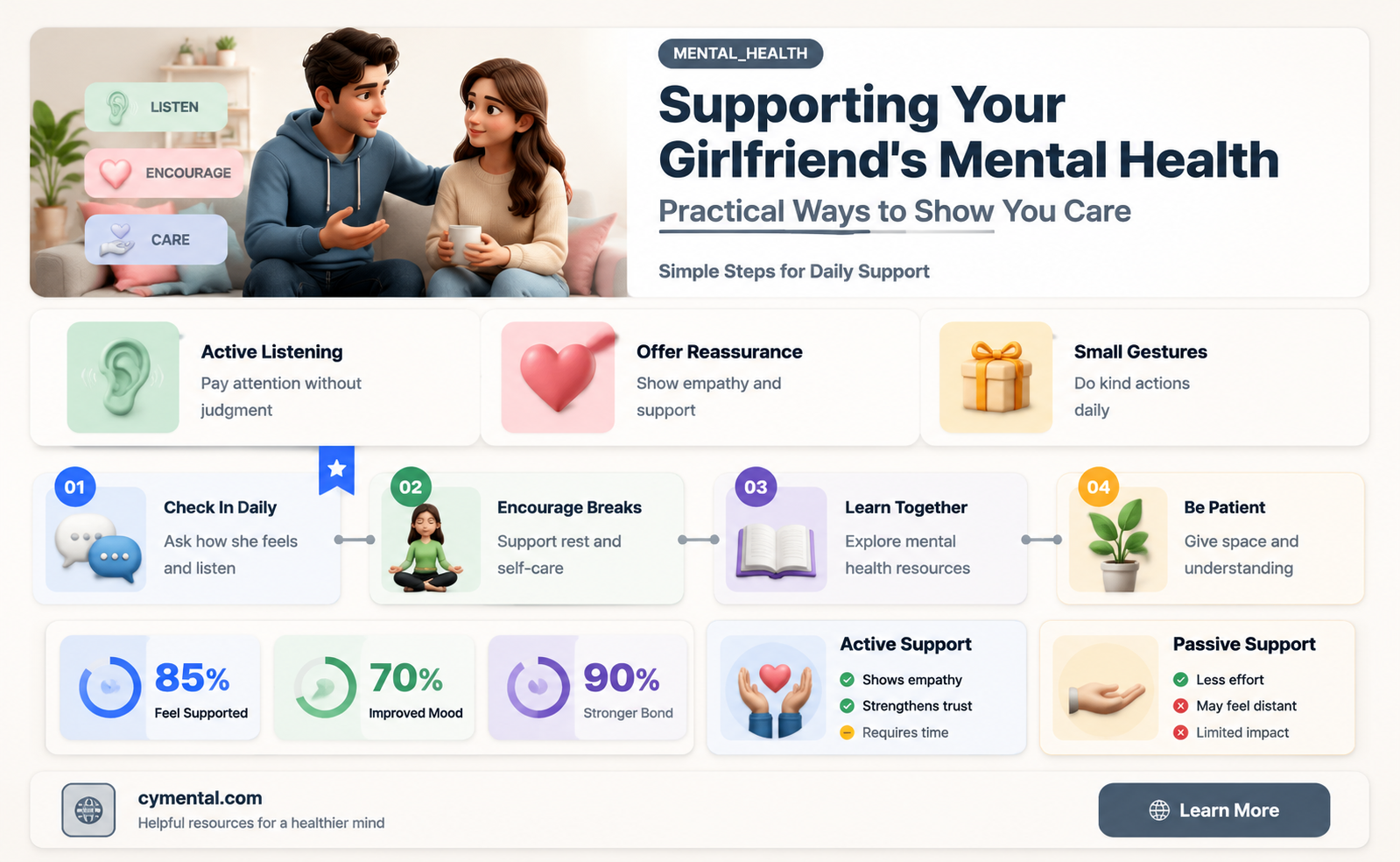
Supporting your girlfriend through her mental health struggles is a deeply caring and important role, but it requires empathy, patience, and understanding. Start by actively listening to her without judgment, validating her feelings, and letting her know she’s not alone. Educate yourself about her specific challenges, whether it’s anxiety, depression, or another condition, to better understand what she’s experiencing. Encourage professional help, such as therapy or counseling, while also being her ally in creating a supportive environment at home. Small gestures, like checking in regularly, planning relaxing activities, or simply being present, can make a significant difference. Remember, your role is to support, not fix, and it’s equally important to take care of your own mental health while being there for her.
Explore related products


What You'll Learn
- Listen Actively, Without Judgment: Create a safe space for her to express feelings openly
- Encourage Professional Help: Support her in seeking therapy or counseling if needed
- Promote Self-Care: Encourage healthy habits like exercise, sleep, and hobbies
- Educate Yourself: Learn about her specific struggles to better understand and assist
- Be Patient and Consistent: Mental health recovery takes time; stay supportive and reliable

Listen Actively, Without Judgment: Create a safe space for her to express feelings openly
One of the most powerful ways to support your girlfriend’s mental health is to listen actively and without judgment. This means creating a space where she feels safe to share her thoughts and emotions without fear of criticism, dismissal, or interruption. Active listening isn’t just about hearing words—it’s about understanding her perspective, validating her feelings, and showing genuine empathy. When she knows she can express herself freely, it fosters trust and deepens your connection, allowing her to process her emotions more effectively.
To practice active listening, start by giving her your undivided attention. Put away distractions like phones or laptops, maintain eye contact, and use nonverbal cues like nodding to show you’re engaged. Avoid the urge to offer solutions or advice unless she explicitly asks for it. Instead, reflect back what she’s saying to confirm your understanding. For example, if she mentions feeling overwhelmed, you might say, “It sounds like you’re carrying a lot right now, and that’s really heavy.” This shows you’re not just listening but also trying to grasp her emotional experience.
Creating a judgment-free zone is equally crucial. Mental health struggles often come with shame or self-doubt, so avoid phrases like “You shouldn’t feel that way” or “Just think positively.” Instead, validate her emotions by acknowledging their legitimacy. For instance, say, “It makes sense that you’d feel that way given what you’re going through.” This reassures her that her feelings are valid and that she’s not alone in her struggles. Remember, your role isn’t to fix her pain but to hold space for it.
A practical tip is to ask open-ended questions that encourage her to explore her feelings further. Questions like, “How has this been affecting you?” or “What do you think might help right now?” show you’re invested in her experience. Be patient if she struggles to articulate her thoughts—sometimes, just knowing someone is there to listen can be enough. Over time, this consistent support can help her feel more comfortable opening up and navigating her mental health challenges.
Finally, be mindful of your own reactions. If her feelings trigger your anxiety or frustration, take a moment to breathe and recenter yourself. Your goal is to remain calm and supportive, even if her emotions are intense. By consistently listening actively and without judgment, you’re not just helping her manage her mental health—you’re strengthening the foundation of your relationship, built on trust, empathy, and unconditional acceptance.
Supporting Your Boyfriend's Mental Health Through Nutrition and Diet
You may want to see also
Explore related products


Encourage Professional Help: Support her in seeking therapy or counseling if needed
Recognizing when your girlfriend might benefit from professional help is a critical step in supporting her mental health. Mental health struggles often manifest in subtle ways—changes in sleep patterns, withdrawal from social activities, or persistent feelings of sadness. If you notice these signs, it’s essential to approach the topic with sensitivity and empathy. Avoid framing therapy as a last resort or a sign of weakness; instead, position it as a proactive step toward well-being. For instance, you could say, "I’ve noticed you’ve been feeling overwhelmed lately, and I think talking to a professional could give you some new tools to manage this."
Encouraging professional help involves more than just suggesting therapy—it requires active support throughout the process. Research therapists or counselors together, considering factors like specialization, cost, and location. If she’s hesitant, offer to accompany her to the first appointment or help her prepare questions to ask the therapist. Practical steps, like verifying insurance coverage or finding sliding-scale options, can remove barriers and make the idea less daunting. Remember, your role is to empower her to take this step, not to push her into it.
One common misconception is that therapy is only for severe mental health issues. In reality, therapy can benefit anyone, regardless of the severity of their struggles. It provides a safe space to explore emotions, develop coping strategies, and gain perspective. For example, cognitive-behavioral therapy (CBT) is effective for managing anxiety and depression, while dialectical behavior therapy (DBT) focuses on emotional regulation. Sharing this information can help normalize therapy and highlight its versatility in addressing various concerns.
Finally, be patient and understanding if she resists the idea initially. Stigma, fear, or past negative experiences can make seeking help feel intimidating. Reassure her that your support is unconditional and that taking time to consider therapy is okay. Celebrate small steps, like scheduling an initial consultation, and avoid pressuring her to "fix" herself quickly. By fostering an environment of trust and encouragement, you can help her see professional help as a valuable resource rather than a sign of failure.
Do Mental Hospitals Truly Aid Recovery and Healing?
You may want to see also
Explore related products



Promote Self-Care: Encourage healthy habits like exercise, sleep, and hobbies
Physical and mental health are deeply interconnected, and fostering healthy habits can significantly impact your girlfriend’s overall well-being. Start by encouraging regular exercise, which releases endorphins, reduces stress, and improves mood. Aim for at least 30 minutes of moderate activity, like walking, yoga, or dancing, most days of the week. If she’s new to exercise, suggest starting small—a 10-minute walk or a gentle stretch routine—and gradually building up. Make it a shared activity by joining her, whether it’s a hike, a gym session, or a home workout, to create a supportive and motivating environment.
Sleep is another cornerstone of mental health, yet it’s often overlooked. Poor sleep can exacerbate anxiety, depression, and irritability. Help her establish a consistent sleep routine by encouraging a bedtime and wake-up time that allows for 7–9 hours of rest. Create a calming pre-sleep ritual together—dim the lights, limit screen time an hour before bed, and incorporate relaxation techniques like deep breathing or reading. If she struggles with insomnia, suggest limiting caffeine after noon and creating a sleep-friendly environment, such as keeping the bedroom cool, dark, and quiet.
Hobbies play a vital role in self-care by providing an outlet for stress, fostering creativity, and boosting self-esteem. Encourage her to explore activities she enjoys, whether it’s painting, gardening, writing, or cooking. If she feels overwhelmed or unsure where to start, suggest trying something new together—a cooking class, a photography workshop, or even a simple DIY project. The key is to help her carve out dedicated time for these activities, even if it’s just 20 minutes a day, to reconnect with her passions and find joy outside of daily responsibilities.
Finally, lead by example. Show her the value of self-care by prioritizing your own healthy habits. Share your experiences with exercise, sleep, or hobbies, and celebrate small victories together. By modeling consistency and enthusiasm, you’ll inspire her to embrace these practices as part of her routine. Remember, self-care isn’t selfish—it’s essential for mental health, and by promoting these habits, you’re helping her build resilience and find balance in her life.
Supporting Your Partner: Strategies to Combat Mental Exhaustion Together
You may want to see also
Explore related products


Educate Yourself: Learn about her specific struggles to better understand and assist
Understanding your girlfriend's mental health struggles begins with recognizing that knowledge is your most powerful tool. Mental health conditions are complex, often misunderstood, and highly individualized. What works for one person may not work for another, even if they share the same diagnosis. By educating yourself about her specific challenges—whether it’s anxiety, depression, PTSD, or another condition—you can avoid harmful assumptions and tailor your support to her unique needs. Start by asking her directly what resources or topics she finds helpful, and use reputable sources like the National Alliance on Mental Illness (NAMI) or the American Psychological Association (APA) to deepen your understanding.
One practical step is to familiarize yourself with the symptoms and triggers associated with her condition. For example, if she experiences panic attacks, learn the physiological signs (e.g., rapid heartbeat, shortness of breath) and common triggers (e.g., crowded spaces, specific stressors). This knowledge allows you to anticipate her needs and respond calmly and effectively. For instance, if you’re in a crowded area and notice her breathing quicken, you can gently suggest moving to a quieter space or use grounding techniques you’ve both discussed beforehand. Avoid phrases like, “Just calm down,” which can invalidate her experience, and instead opt for, “I’m here for you—let’s take this one step at a time.”
Comparing mental health struggles to physical illnesses can be a helpful framework. Just as you’d research diabetes or asthma to support a loved one, mental health conditions require similar diligence. For instance, if your girlfriend is managing depression, learn about the role of neurotransmitters like serotonin and dopamine, and how lifestyle factors such as sleep, diet, and exercise can influence her symptoms. This analytical approach not only demystifies her experience but also empowers you to suggest actionable steps, like encouraging a 30-minute daily walk or helping her track sleep patterns to identify disruptions.
However, educating yourself isn’t just about facts—it’s also about empathy. Dive into personal narratives, memoirs, or podcasts by individuals who share her struggles. These first-hand accounts provide insight into the emotional weight of her experiences, which statistics alone cannot convey. For example, listening to a podcast about living with generalized anxiety disorder might reveal how constant worry feels like a never-ending background noise, shaping her perspective in ways you hadn’t considered. This deeper understanding fosters patience and compassion, reducing the risk of frustration or miscommunication.
Finally, remember that education is an ongoing process. Mental health is not static; it evolves with time, circumstances, and treatment. Stay curious and open to new information, whether it’s attending a workshop on cognitive behavioral therapy (CBT) or reading about emerging research on mindfulness-based interventions. Regularly check in with your girlfriend to ask how her experiences are changing and what she currently finds most helpful. By committing to this journey of learning, you not only strengthen your ability to support her but also reinforce the message that her mental health matters to you—and that you’re in this together.
Encouraging Mental Health Support for Your Husband: Options and Limits
You may want to see also
Explore related products


Be Patient and Consistent: Mental health recovery takes time; stay supportive and reliable
Mental health recovery is a marathon, not a sprint. Your girlfriend’s journey will have setbacks, plateaus, and moments of progress that may seem small but are significant. Recognize that healing isn’t linear—some days will feel like two steps forward, one step back. Your role isn’t to fix her struggles but to provide a steady presence that reassures her she’s not alone. Consistency in your support, even when it feels repetitive or unacknowledged, creates a foundation of trust that fosters resilience over time.
Consider this analogy: if mental health recovery were a garden, patience is the time it takes for seeds to sprout, and consistency is the daily watering and weeding. You wouldn’t expect a flower to bloom overnight, nor should you expect your girlfriend’s mental health to transform instantly. Small, repeated actions—like checking in without prying, offering to accompany her to therapy, or simply sitting in silence when words fail—accumulate into meaningful change. Avoid the trap of measuring progress by grand gestures; it’s the quiet, unrelenting support that often makes the deepest impact.
Here’s a practical tip: establish routines that signal your reliability. For instance, set a weekly check-in time where you ask open-ended questions like, “How are you feeling this week?” rather than, “Are you feeling better?” The former invites honest reflection, while the latter can inadvertently pressure her to perform recovery. Similarly, if she’s on medication or therapy, help her track appointments or refill prescriptions without taking over—this shows you’re invested in her process, not just her outcome.
A caution: impatience can manifest as frustration or unsolicited advice, which may undermine her trust. Phrases like, “You just need to think positively,” or, “Why aren’t you better yet?” can feel dismissive, even if unintended. Instead, validate her experiences with statements like, “It makes sense you’re feeling this way,” or, “I’m here for you, no matter how long this takes.” Remember, your goal is to be a safe space, not a problem-solver.
In conclusion, patience and consistency aren’t passive acts—they’re deliberate choices that require emotional labor. By embracing the slow pace of recovery and showing up reliably, you become a stabilizing force in her life. Over time, this kind of support can help her rebuild confidence in herself and her ability to heal. It’s not about fixing her; it’s about walking beside her as she fixes herself.
Supporting Through Crisis: Effective Ways to Aid Mental Breakdown Recovery
You may want to see also
Frequently asked questions
Choose a calm, private moment and express your concern gently. Use "I" statements to avoid sounding accusatory, like, "I’ve noticed you seem stressed lately, and I’m here to support you."
Listen actively without trying to "fix" her problems, validate her feelings, and offer help in ways she finds comforting, such as spending time together or assisting with daily tasks.
Normalize therapy by sharing its benefits, offer to help her find a therapist, and emphasize that seeking help is a sign of strength, not weakness.
Communicate openly about how her struggles impact you, set healthy boundaries, and consider couples therapy to navigate challenges together.
Prioritize self-care, seek your own support system, and remember that you can’t pour from an empty cup—your well-being is essential for both of you.