Ava Ramirez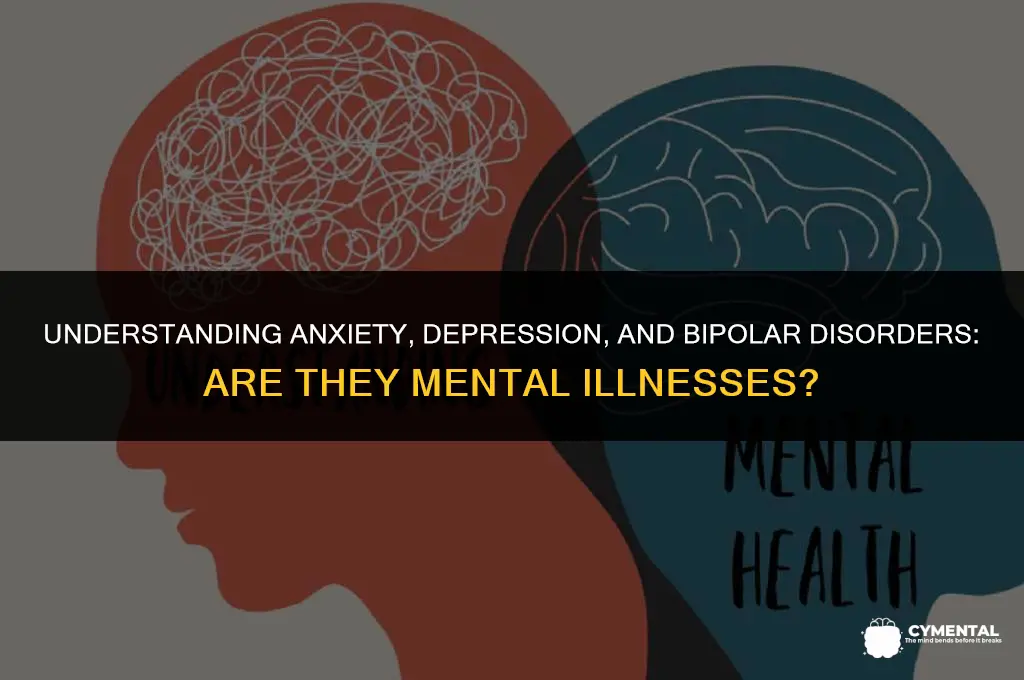
Anxiety, depression, and bipolar disorders are indeed classified as mental illnesses. These conditions are characterized by significant disturbances in mood, behavior, and cognitive functioning, which can severely impact an individual's daily life and overall well-being. Mental illnesses like these are recognized by various health organizations, including the World Health Organization (WHO) and the American Psychiatric Association (APA), and are often treated with a combination of psychotherapy, medication, and lifestyle changes. Understanding these disorders is crucial for reducing stigma and improving access to effective treatments.
Explore related products

$29.68 $32.99


What You'll Learn
- Definition and Classification: Understanding the criteria used to define and classify these disorders as mental illnesses
- Symptoms and Diagnosis: Exploring the symptoms associated with anxiety, depression, and bipolar disorders, and how they are diagnosed
- Prevalence and Statistics: Examining the prevalence of these disorders in different populations and any relevant statistical data
- Treatment Options: Discussing the various treatment options available, including therapy, medication, and lifestyle changes
- Social and Cultural Perspectives: Analyzing how these disorders are perceived and treated in different social and cultural contexts

Definition and Classification: Understanding the criteria used to define and classify these disorders as mental illnesses
Mental health professionals use specific criteria to define and classify disorders such as anxiety, depression, and bipolar disorder. These criteria are outlined in diagnostic manuals like the Diagnostic and Statistical Manual of Mental Disorders (DSM-5) published by the American Psychiatric Association. The DSM-5 provides a standardized set of guidelines for diagnosing mental illnesses, ensuring consistency across different healthcare settings.
To classify a condition as a mental illness, it must meet certain diagnostic criteria. For example, to be diagnosed with major depressive disorder, an individual must experience at least five symptoms from a list that includes persistent feelings of sadness, loss of interest in activities, changes in appetite or sleep, fatigue, feelings of worthlessness, and thoughts of death or suicide. These symptoms must be present for at least two weeks and must interfere with the individual's ability to function in daily life.
Similarly, anxiety disorders are characterized by excessive and persistent worry or fear that interferes with daily functioning. Bipolar disorder, on the other hand, involves distinct episodes of mania and depression. Mania is characterized by elevated mood, increased energy, and impaired judgment, while depression involves feelings of sadness and hopelessness.
The classification of these disorders as mental illnesses is based on their impact on an individual's thoughts, feelings, and behaviors. They are considered mental illnesses because they affect psychological processes and can significantly impair a person's ability to cope with the demands of everyday life. Understanding these definitions and classifications is crucial for accurate diagnosis and effective treatment.
It's important to note that the criteria for diagnosing mental illnesses are periodically reviewed and updated to reflect the latest research findings. This ensures that diagnostic practices remain current and that individuals receive the most appropriate care based on the best available evidence.
Understanding Self-Harm: A Complex Mental Health Issue
You may want to see also
Explore related products

$10.99 $18.99

$11.99


Symptoms and Diagnosis: Exploring the symptoms associated with anxiety, depression, and bipolar disorders, and how they are diagnosed
Anxiety, depression, and bipolar disorders are complex mental health conditions that can significantly impact an individual's daily life. Understanding the symptoms associated with each disorder is crucial for accurate diagnosis and effective treatment. Anxiety disorders often present with excessive worry, restlessness, and physical symptoms such as rapid heartbeat and sweating. Depression is characterized by persistent feelings of sadness, loss of interest in activities, and changes in appetite and sleep patterns. Bipolar disorder involves episodes of mania, marked by elevated mood and increased energy, as well as depressive episodes.
Diagnosing these disorders typically involves a combination of clinical interviews, psychological assessments, and sometimes medical tests to rule out underlying physical conditions. Mental health professionals use criteria outlined in the Diagnostic and Statistical Manual of Mental Disorders (DSM-5) to make a diagnosis. For anxiety disorders, this may include assessing the frequency and intensity of anxious symptoms and their impact on daily functioning. Depression is diagnosed based on the presence of specific symptoms over a two-week period, while bipolar disorder requires identifying both manic and depressive episodes.
It's important to note that these disorders can co-occur, making diagnosis more challenging. Additionally, symptoms can vary widely among individuals, and some may experience atypical presentations. Therefore, a comprehensive evaluation by a qualified mental health professional is essential for accurate diagnosis and appropriate treatment planning. Early recognition and intervention can significantly improve outcomes for individuals with these disorders.
Exploring the Complexities of Mental Health: Am I Faking It?
You may want to see also
Explore related products


$31.54 $59.99


Prevalence and Statistics: Examining the prevalence of these disorders in different populations and any relevant statistical data
Recent epidemiological studies indicate that anxiety disorders are among the most common mental illnesses globally, affecting approximately 260 million people. In the United States, around 40 million adults, or 18.1% of the population, experience an anxiety disorder each year. Women are more likely to be affected than men, with a lifetime prevalence of 30.5% compared to 19.2% in men.
Depression also has a significant global impact, with an estimated 3.8% of the population experiencing major depressive disorder. In the U.S., this translates to about 9.7% of adults, or roughly 24 million people, with women again being more affected than men (10.8% vs. 8.6%). The prevalence of depression tends to increase with age, peaking in the 45-64 age group.
Bipolar disorder is less prevalent than anxiety and depression, affecting approximately 2.8% of adults in the U.S., or about 7 million people. The disorder typically begins in late adolescence or early adulthood and affects men and women equally. However, women are more likely to experience rapid cycling and mixed episodes.
These statistics highlight the widespread nature of anxiety, depression, and bipolar disorder, underscoring the importance of understanding and addressing these mental health conditions. The data also reveals demographic patterns that can inform targeted interventions and resource allocation.
Unraveling the Joker's Psyche: A Deep Dive into His Mental State
You may want to see also
Explore related products


$22.95 $22.95


Treatment Options: Discussing the various treatment options available, including therapy, medication, and lifestyle changes
Cognitive-behavioral therapy (CBT) is a common and effective treatment for anxiety and depression. It involves working with a therapist to identify and challenge negative thought patterns and behaviors, and to develop coping strategies and problem-solving skills. CBT is typically conducted over several months, with weekly or bi-weekly sessions. It can be particularly helpful for individuals with mild to moderate symptoms, and can be used in conjunction with medication for more severe cases.
Medication is another key treatment option for anxiety and depression. Antidepressants, such as selective serotonin reuptake inhibitors (SSRIs), can help to regulate mood and reduce symptoms. Anti-anxiety medications, such as benzodiazepines, can provide short-term relief from anxiety symptoms. It is important to note that medication should be prescribed and monitored by a healthcare professional, and that it may take several weeks to see the full effects. Additionally, lifestyle changes can play a significant role in managing anxiety and depression. Regular exercise, a balanced diet, and adequate sleep can all contribute to improved mood and reduced symptoms. Mindfulness practices, such as meditation and yoga, can also be helpful in reducing stress and anxiety.
In the case of bipolar disorder, treatment typically involves a combination of medication and therapy. Mood stabilizers, such as lithium, can help to regulate mood swings, while antipsychotic medications can be used to treat acute manic or depressive episodes. CBT and other forms of therapy can also be beneficial in helping individuals with bipolar disorder to manage their symptoms and improve their overall functioning.
It is important to remember that treatment for mental illness is not one-size-fits-all, and that what works for one person may not work for another. A healthcare professional can help to determine the best course of treatment based on an individual's specific needs and circumstances. With the right treatment and support, it is possible for individuals with anxiety, depression, and bipolar disorder to manage their symptoms and lead fulfilling lives.
Exploring the Complex Relationship Between ADHD and Autism
You may want to see also
Explore related products


Social and Cultural Perspectives: Analyzing how these disorders are perceived and treated in different social and cultural contexts
In various social and cultural contexts, anxiety, depression, and bipolar disorders are perceived and treated differently, reflecting the diversity of human experiences and societal norms. For instance, in some cultures, mental health issues are viewed as a sign of weakness or a lack of faith, leading to stigmatization and reluctance to seek professional help. In contrast, other societies may regard these disorders as legitimate health conditions, worthy of medical attention and support.
The treatment approaches also vary widely. In Western countries, pharmaceutical interventions and psychotherapy are common, whereas in some Eastern cultures, traditional healing methods, such as acupuncture or herbal remedies, may be preferred. Furthermore, the role of family and community in supporting individuals with mental health issues can differ significantly, with some cultures emphasizing collective responsibility and others focusing on individual autonomy.
These differences in perception and treatment can have profound implications for individuals suffering from anxiety, depression, and bipolar disorders. For example, a person from a culture that stigmatizes mental illness may face social isolation and discrimination, exacerbating their symptoms and hindering their recovery. On the other hand, individuals from cultures that prioritize community support may benefit from a strong social network, which can aid in their healing process.
Understanding these social and cultural perspectives is crucial for developing effective, culturally sensitive mental health interventions. By acknowledging and respecting the diverse ways in which mental illness is perceived and treated, healthcare professionals can better tailor their approaches to meet the unique needs of their patients, ultimately improving outcomes and promoting greater well-being.
Understanding ADHD: A Mental Health Disorder or Not?
You may want to see also
Frequently asked questions
Yes, anxiety, depression, and bipolar disorders are all classified as mental illnesses. They are recognized by healthcare professionals and diagnosed using criteria outlined in the Diagnostic and Statistical Manual of Mental Disorders (DSM-5).
Common symptoms of depression include persistent feelings of sadness, loss of interest in activities once enjoyed, changes in appetite, sleep disturbances, fatigue, feelings of worthlessness, and thoughts of death or suicide.
Bipolar disorder is characterized by episodes of mania or hypomania, which are periods of elevated mood, increased energy, and impulsive behavior, in addition to episodes of depression. Depression, on the other hand, is characterized solely by persistent feelings of sadness and loss of interest.
Effective treatments for anxiety disorders include cognitive-behavioral therapy (CBT), medication such as selective serotonin reuptake inhibitors (SSRIs), and lifestyle changes like regular exercise, mindfulness practices, and stress management techniques.