Caleb Wright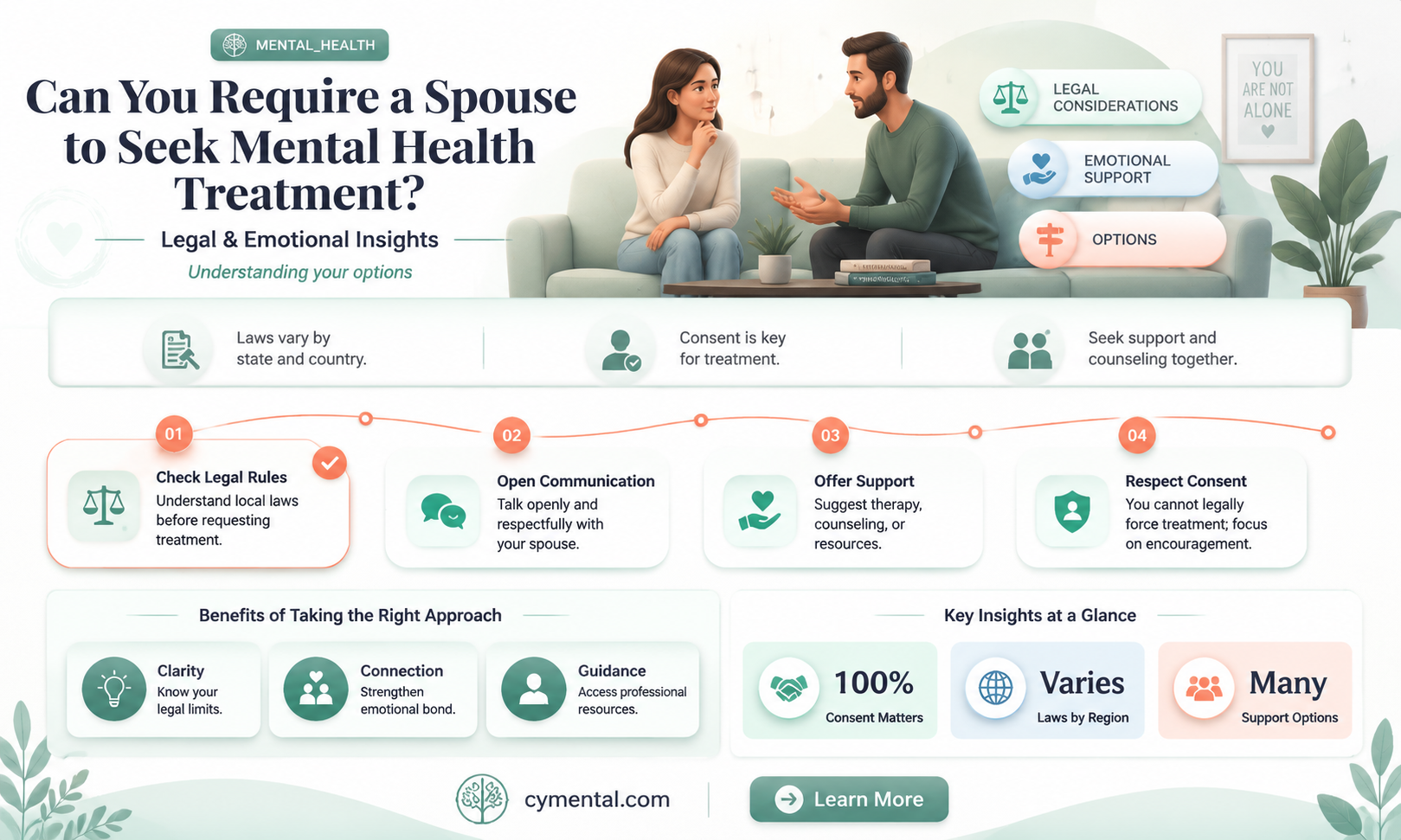
The question of whether one can require a spouse to seek mental health treatment is complex and multifaceted, touching on legal, ethical, and emotional considerations. While concern for a partner’s well-being is understandable, mandating mental health care raises issues of autonomy, consent, and the boundaries of a relationship. Legally, in most jurisdictions, adults cannot be forced into treatment unless they pose an immediate danger to themselves or others, and even then, it typically requires court intervention. Ethically, pressuring a spouse into therapy can strain trust and communication, potentially exacerbating the situation. Instead, fostering open dialogue, offering support, and encouraging voluntary engagement with mental health resources is often more constructive. Ultimately, balancing compassion with respect for personal agency is key in navigating this delicate issue.
Explore related products

$8.98 $17.99


What You'll Learn

Legal grounds for mandating treatment
In the United States, the legal framework for mandating mental health treatment for a spouse is complex and varies by state. Generally, courts prioritize individual autonomy and require substantial evidence of danger to self or others before compelling treatment. For instance, in California, the Lanterman-Petris-Short (LPS) Act allows for involuntary commitment if a person is deemed gravely disabled or a danger due to mental illness. However, this process typically involves a petition filed by a close relative, not automatically a spouse, and must be supported by a psychiatric evaluation. This underscores the delicate balance between protecting individuals and respecting their rights.
To initiate legal proceedings for mandating treatment, a spouse must follow specific steps. First, document instances of behavior that pose a risk, such as self-harm attempts or threats to others. Second, consult a mental health professional to assess the situation and provide a formal opinion. Third, file a petition with the local court, often requiring a hearing where evidence is presented. For example, in New York, a spouse can file an application for assisted outpatient treatment (AOT) under Kendra’s Law, but only if the individual meets strict criteria, such as a history of noncompliance with treatment leading to hospitalization or violent behavior. This process is not swift; it demands patience and persistence.
A critical caution is that mandating treatment can strain the marital relationship. Involuntary commitment may lead to resentment or distrust, potentially worsening the dynamics between spouses. Courts are also wary of misuse, particularly in contentious relationships, and may scrutinize petitions to prevent coercion. For instance, in Texas, a spouse cannot unilaterally force treatment without clear evidence of immediate danger, and even then, the court may opt for less restrictive alternatives like outpatient therapy. This highlights the importance of approaching this route as a last resort, after exhausting voluntary options.
Comparatively, some countries have more lenient laws regarding involuntary treatment. In the UK, the Mental Health Act 1983 allows for detention and treatment if a person has a mental disorder and poses a risk to themselves or others. However, this process involves approval from approved mental health professionals and regular reviews. In contrast, U.S. laws tend to be more protective of individual liberties, making it harder to mandate treatment. This disparity reflects differing cultural and legal perspectives on autonomy versus societal safety.
Ultimately, while legal grounds for mandating mental health treatment exist, they are narrowly defined and require compelling evidence. Spouses considering this route should weigh the potential benefits against the risks to the relationship and the individual’s autonomy. Practical alternatives, such as encouraging voluntary treatment through open communication or involving a mediator, may yield better outcomes. Legal intervention should be viewed as a tool of last resort, reserved for situations where immediate danger is undeniable and all other avenues have failed.
Finding Mental Health Support: A Guide to Accessible Resources and Services
You may want to see also
Explore related products


$13.95


Ethical considerations in forcing therapy
Forcing a spouse into therapy raises profound ethical dilemmas that intersect autonomy, consent, and the nature of mental health treatment. At its core, therapy relies on voluntary participation to foster trust, openness, and collaboration between therapist and client. Coercing someone into this process undermines these foundational principles, potentially sabotaging the therapeutic alliance before it begins. For instance, research shows that individuals who enter therapy involuntarily often exhibit higher levels of resistance, lower engagement, and poorer outcomes compared to those who seek help willingly. This raises a critical question: Can therapy be effective, or even ethical, when it violates a person’s autonomy?
Consider the legal and relational implications. While some jurisdictions allow court-mandated therapy for specific situations (e.g., domestic violence or child endangerment), applying this to a spouse in a non-criminal context is legally and ethically murky. Even if a spouse believes their partner’s mental health issues are harming the relationship, forcing therapy without consent can escalate conflict and erode trust. For example, a spouse might perceive the demand as a judgment of their character or a lack of faith in their ability to self-improve, deepening emotional distance. In such cases, the act of "helping" may inadvertently cause more harm than good.
From a practical standpoint, therapy is not a one-size-fits-all solution, and its success depends on the individual’s readiness to change. Mental health professionals often use stages-of-change models, such as the Transtheoretical Model, to assess a client’s willingness to engage in treatment. Forcing someone into therapy before they reach the contemplation or preparation stage can backfire, reinforcing their resistance. Instead, spouses can adopt strategies like motivational interviewing, which focuses on exploring ambivalence and building intrinsic motivation. For instance, a partner might say, "I’ve noticed you’ve been struggling lately, and I’m here to support you in whatever way feels right for you," rather than issuing ultimatums.
Ethical considerations also extend to the therapist’s role in such scenarios. Therapists are bound by codes of ethics that prioritize client autonomy and informed consent. If a therapist becomes aware that a client is attending therapy under duress, they must navigate a delicate balance between respecting the client’s autonomy and addressing the concerns of the referring spouse. In some cases, therapists may choose to involve both partners in couples therapy, shifting the focus from individual pathology to relational dynamics. This approach acknowledges that mental health issues often exist within a systemic context, influenced by communication patterns, power imbalances, and shared histories.
Ultimately, the ethical challenge of forcing therapy lies in reconciling the desire to help with the need to respect individual agency. While the intention may be noble, the means must align with principles of dignity, consent, and collaboration. Spouses concerned about their partner’s mental health should prioritize open dialogue, empathy, and non-coercive support. For example, offering to accompany a partner to an initial consultation or sharing resources about mental health services can be more effective than demanding change. By fostering an environment of trust and understanding, couples can navigate these complex issues in a way that honors both partners’ well-being.
Supporting Mental Health: Effective Ways to Help Someone in Need
You may want to see also
Explore related products





Impact on marital relationships
Marital relationships often bear the brunt of untreated mental health issues, creating a cycle of frustration, resentment, and emotional distance. When one spouse struggles with conditions like depression, anxiety, or bipolar disorder, the other may feel overwhelmed, becoming both caregiver and emotional anchor. This dynamic can erode intimacy, as the burdened partner may withdraw or lash out, while the affected spouse feels judged or misunderstood. For instance, a husband dealing with untreated PTSD might exhibit irritability, leading his wife to feel unsafe expressing her own needs, fostering a rift that deepens over time.
Addressing mental health within a marriage requires a delicate balance of empathy and assertiveness. Couples must navigate the tension between supporting their partner and setting boundaries to protect their own well-being. One practical strategy is to frame mental health treatment as a collaborative effort rather than an ultimatum. For example, suggesting couples therapy can provide a neutral space to discuss challenges and foster mutual understanding. However, it’s crucial to avoid enabling behaviors, such as shielding the spouse from consequences or neglecting personal self-care, which can perpetuate the problem.
The impact of untreated mental health on marital relationships often manifests in communication breakdowns. Misinterpreted behaviors, like withdrawal or anger, can lead to misunderstandings that spiral into chronic conflict. For instance, a wife with undiagnosed anxiety might constantly seek reassurance, which her husband may perceive as neediness, causing him to pull away. Implementing structured communication techniques, such as the “XYZ” statement (e.g., “When you do X in situation Y, I feel Z”), can help clarify emotions and reduce defensiveness, fostering a more constructive dialogue.
Ultimately, requiring a spouse to seek mental health help is less about coercion and more about fostering accountability and mutual growth. It’s essential to approach the conversation with compassion, emphasizing the shared goal of a healthier relationship. For example, instead of saying, “You need to get help,” try, “I’ve noticed we’re both struggling, and I think we could benefit from some professional guidance.” Pairing this with specific examples of how their behavior affects the relationship can make the request more actionable and less confrontational. While you cannot force someone to seek help, you can create an environment that encourages it, prioritizing the long-term health of both the individual and the marriage.
Supporting Mental Health: Practical Ways to Help Someone in Need
You may want to see also
Explore related products





Alternatives to compulsory mental health care
In many jurisdictions, compelling a spouse to seek mental health treatment against their will is legally complex and often infeasible unless they pose an imminent danger to themselves or others. Instead of resorting to coercion, fostering an environment of trust and understanding can encourage voluntary engagement with mental health services. For instance, couples therapy can serve as a non-confrontational entry point, addressing relationship dynamics while normalizing discussions about mental health. This approach leverages the partnership itself as a motivator, rather than external pressure.
One practical alternative is to focus on education and destigmatization within the home. Sharing accessible resources, such as TED Talks on mental health or books like *Feeling Good* by David Burns, can subtly shift perceptions without feeling accusatory. Additionally, modeling self-care behaviors—like attending therapy oneself or practicing mindfulness—can inspire reciprocal actions. For example, a spouse might be more open to counseling if they see their partner benefiting from it, creating a ripple effect of acceptance.
Another strategy involves leveraging community or peer support systems. Encouraging participation in local support groups or online forums can provide a sense of belonging and reduce resistance to professional help. For instance, organizations like the National Alliance on Mental Illness (NAMI) offer family education programs that equip spouses with tools to navigate mental health challenges collaboratively. These programs often emphasize communication skills, such as active listening and validating emotions, which can indirectly foster openness to treatment.
Finally, framing mental health care as a shared goal rather than a personal failing can be transformative. Collaborative goal-setting, such as planning a "wellness day" together or researching therapists as a team, shifts the focus from blame to partnership. Research shows that individuals are more likely to engage in treatment when they feel their autonomy is respected and their concerns are heard. By reframing the conversation, spouses can move from confrontation to cooperation, creating a pathway to healing that honors both parties' needs.
Gratitude's Power: Enhancing Mental Health and Emotional Well-being
You may want to see also
Explore related products


Role of court intervention in treatment
Court intervention in mental health treatment for a spouse is a complex and nuanced issue, often arising in high-conflict family law cases. While courts generally prioritize individual autonomy, they may step in when a spouse’s untreated mental health condition poses a demonstrable risk to themselves, their partner, or their children. For instance, in cases involving domestic violence, substance abuse, or severe neglect, judges can mandate psychological evaluations or treatment as part of protective orders or custody agreements. This intervention is not about forcing compliance but ensuring safety and stability within the family unit. However, the threshold for such mandates is high, requiring clear evidence of harm or imminent danger, as courts must balance public welfare with constitutional rights to privacy and self-determination.
The process of court-ordered treatment typically begins with a petition filed by the concerned spouse, often supported by affidavits, medical records, or testimony from mental health professionals. If the court finds sufficient grounds, it may order a psychiatric evaluation to assess the individual’s condition and treatment needs. Depending on the jurisdiction, this could involve outpatient therapy, medication management, or inpatient hospitalization. For example, in California, Family Code Section 213 allows courts to require counseling for parents in custody disputes if it’s deemed in the child’s best interest. However, such orders are rarely absolute; they often include provisions for periodic reviews to ensure compliance and assess progress, with non-compliance potentially leading to contempt of court charges or modifications in custody arrangements.
A critical challenge in court-mandated treatment is ensuring its effectiveness. Coerced therapy can be less productive than voluntary participation, as individuals may resist or disengage if they feel their autonomy is violated. To mitigate this, courts often pair treatment orders with incentives, such as temporary custody adjustments or reduced legal penalties upon completion. For instance, a spouse ordered to attend anger management classes might regain unsupervised visitation rights after demonstrating consistent attendance and progress. Additionally, courts may appoint neutral third parties, like guardians ad litem or mental health professionals, to monitor the treatment process and report back, ensuring accountability without overreach.
Comparatively, jurisdictions vary widely in their approach to court intervention in mental health treatment. In the U.K., the Mental Health Act 1983 allows for involuntary treatment only under strict criteria, such as when an individual is deemed a danger to themselves or others due to a mental disorder. In contrast, some U.S. states have broader statutes, like New York’s Kendra’s Law, which permits court-ordered assisted outpatient treatment for individuals with a history of non-compliance and hospitalization. These differences highlight the tension between individual rights and societal protection, underscoring the need for tailored, context-specific interventions rather than one-size-fits-all solutions.
Ultimately, the role of court intervention in treatment is a delicate balance of authority and empathy. While it can serve as a last resort to protect families from harm, it must be wielded judiciously to avoid infringing on personal freedoms. Practical tips for spouses seeking such intervention include documenting specific incidents of concern, consulting with legal and mental health experts, and framing the request as a means of preserving the family’s well-being rather than punishing the other party. Courts, in turn, must ensure that any mandated treatment is evidence-based, regularly reviewed, and paired with supportive measures to foster genuine healing rather than mere compliance. This approach not only upholds the law but also respects the humanity of all involved.
Finding Support: Where to Go for Help in Difficult Times
You may want to see also
Frequently asked questions
No, you cannot legally force your spouse to seek mental health treatment unless they pose an immediate danger to themselves or others, in which case legal intervention may be possible.
You can encourage them by expressing concern, offering support, and suggesting resources, but ultimately, the decision to seek help is theirs unless there are legal grounds for intervention.
No, courts generally cannot mandate mental health treatment as part of a divorce agreement unless it directly relates to child custody and the well-being of the children.
If your spouse is a threat to themselves or others, you can call law enforcement, who may initiate an emergency psychiatric evaluation under local laws.
Focus on open communication, educate yourself about their condition, and consider couples therapy or family support groups to create a supportive environment.