Noah Parker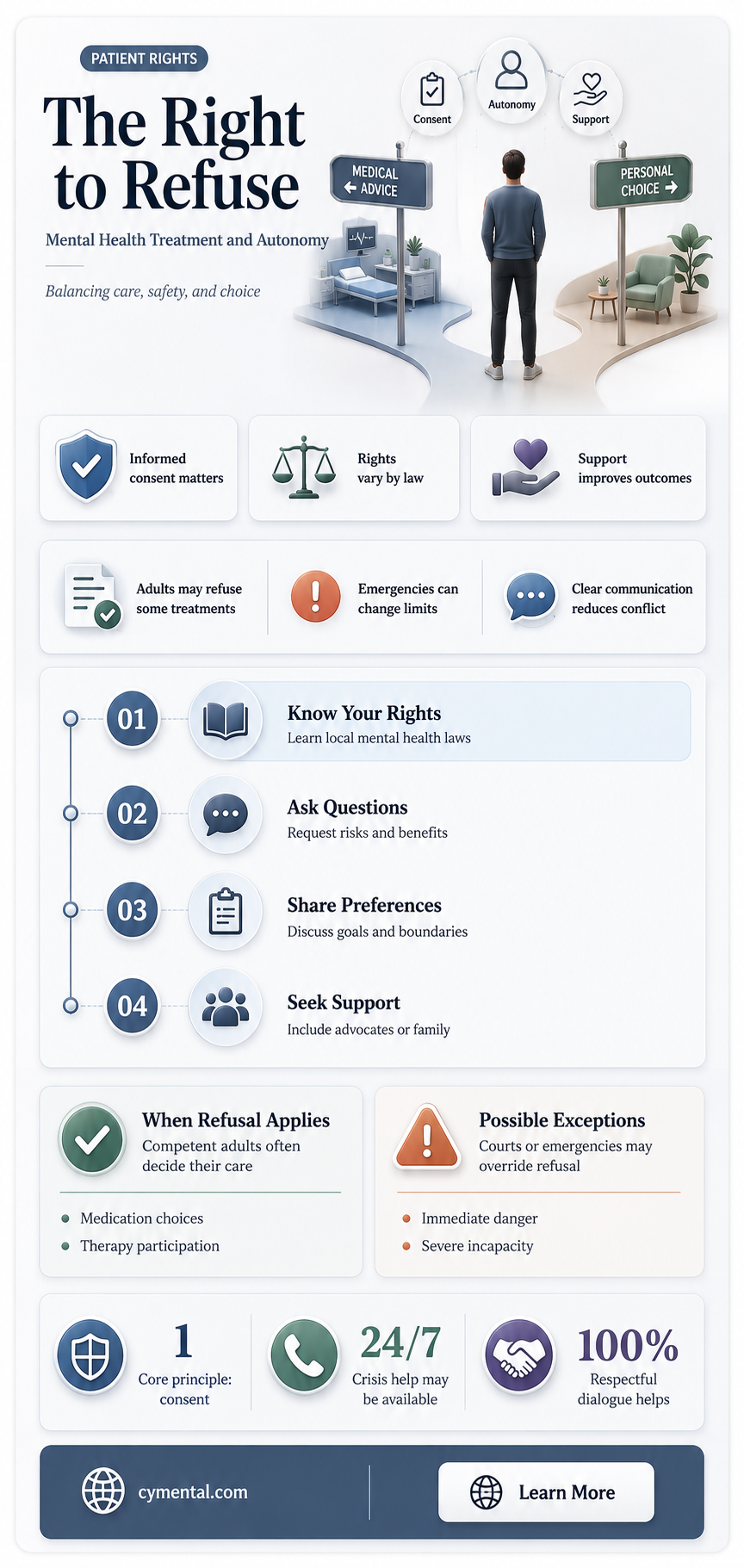
The question of whether individuals have the right to deny mental health treatment is a complex and contentious issue that intersects ethics, autonomy, and public welfare. On one hand, the principle of self-determination asserts that competent adults should have the freedom to make decisions about their own bodies and lives, including refusing medical or psychological interventions. This perspective aligns with broader human rights frameworks that prioritize individual agency. However, mental health challenges often impair judgment or insight, raising concerns about the capacity to make informed decisions. Additionally, untreated mental illness can pose risks not only to the individual but also to their community, complicating the balance between personal liberty and societal responsibility. This debate underscores the need for nuanced approaches that respect autonomy while ensuring access to care and support for those in need.
| Characteristics | Values |
|---|---|
| Legal Right to Refuse Treatment | In most countries, individuals have the legal right to refuse mental health treatment, even if it is recommended by professionals. This is protected under laws related to autonomy and informed consent. |
| Informed Consent | Individuals must be provided with adequate information about the nature, purpose, risks, and benefits of treatment to make an informed decision. Without informed consent, treatment cannot be forced. |
| Capacity to Make Decisions | The right to refuse treatment depends on the individual's capacity to make decisions. If a person is deemed incapable (e.g., due to severe mental illness), legal processes may allow treatment to be administered against their will in some jurisdictions. |
| Emergency Situations | In cases of immediate danger to self or others, involuntary treatment may be legally permitted under emergency provisions, even if the individual refuses. |
| Minors and Guardianship | Minors and individuals under guardianship may have limited rights to refuse treatment, as decisions are often made by parents, guardians, or legal representatives. |
| Cultural and Ethical Considerations | Cultural beliefs and ethical principles may influence attitudes toward refusing mental health treatment, varying widely across societies. |
| Voluntary vs. Involuntary Treatment | Voluntary treatment is based on the individual's consent, while involuntary treatment is imposed by legal or medical authorities, typically under specific conditions. |
| Mental Health Laws | Laws governing mental health treatment vary by country and region, affecting the extent to which individuals can refuse treatment. |
| Advocacy and Support | Advocacy groups often support the right to refuse treatment, emphasizing patient autonomy and the need for less restrictive alternatives. |
| Stigma and Barriers | Stigma surrounding mental illness and systemic barriers may discourage individuals from seeking help, even if they have the right to refuse treatment. |
Explore related products


What You'll Learn
- Autonomy vs. Safety: Balancing individual freedom with societal responsibility in mental health interventions
- Informed Consent: Ensuring individuals understand and voluntarily accept or refuse treatment options
- Capacity to Decide: Assessing mental competence to make decisions about care and support
- Ethical Boundaries: When does denying help become a violation of human rights
- Stigma Impact: How societal attitudes influence willingness to accept or reject mental health support

Autonomy vs. Safety: Balancing individual freedom with societal responsibility in mental health interventions
The tension between individual autonomy and societal safety in mental health interventions is starkly evident in cases of severe mental illness. Consider a 28-year-old with untreated schizophrenia who refuses medication, believing it to be government surveillance. While antipsychotics like olanzapine (10–20 mg/day) could stabilize their condition, forcing treatment violates their autonomy. Yet, untreated psychosis increases the risk of self-harm or harm to others, raising ethical questions about societal responsibility. This scenario underscores the challenge: how do we respect personal freedom while mitigating risks to public safety?
To navigate this dilemma, a structured approach is essential. Step 1: Assess Capacity. Use tools like the MacArthur Competence Assessment Tool for Treatment (MacCAT-T) to determine if the individual understands their condition, treatment options, and consequences of refusal. Step 2: Explore Alternatives. Offer less invasive interventions, such as cognitive-behavioral therapy or peer support groups, which respect autonomy while addressing needs. Step 3: Involve Support Systems. Engage family or caregivers in shared decision-making, balancing the individual’s wishes with practical realities. Caution: Avoid coercive measures unless there’s an imminent risk of harm, as forced treatment can erode trust and worsen outcomes.
A comparative analysis reveals differing global approaches. In the U.S., the *Lessard v. Schmidt* ruling emphasizes the right to refuse treatment unless a person is deemed a danger to self or others. In contrast, the UK’s Mental Health Act allows for involuntary treatment under specific criteria, prioritizing safety over autonomy in certain cases. These models highlight the cultural and legal nuances shaping the balance between individual rights and societal protection. For instance, a 35-year-old in the UK might be detained for treatment during a manic episode, while a similar case in the U.S. might prioritize their right to refuse unless they pose an immediate threat.
Persuasively, the argument for autonomy hinges on the principle of self-determination. Forcing treatment on competent individuals undermines their dignity and can exacerbate mental health struggles. However, societal responsibility cannot be ignored. A descriptive example: a 42-year-old with severe depression refuses therapy, isolating themselves for months. While respecting their choice, their deteriorating condition may eventually require intervention, such as a wellness check or involuntary hospitalization, to prevent tragedy. This illustrates the delicate line between honoring autonomy and fulfilling a duty of care.
In conclusion, balancing autonomy and safety in mental health interventions requires a nuanced, context-specific approach. Practical tips include fostering open communication, offering tailored treatment options, and involving multidisciplinary teams to ensure informed decisions. Ultimately, the goal is to empower individuals while safeguarding both their well-being and the community’s. This balance is not static but evolves with each case, demanding empathy, legal awareness, and a commitment to ethical practice.
ACA's Impact: Mental Health Care Access and Outcomes Explored
You may want to see also
Explore related products


Informed Consent: Ensuring individuals understand and voluntarily accept or refuse treatment options
Informed consent is the cornerstone of ethical medical practice, ensuring that individuals are fully aware of their treatment options and can make voluntary decisions about their care. This principle is particularly critical in mental health, where the stakes are high, and the line between coercion and support can blur. For instance, a person diagnosed with severe depression must understand the potential benefits and risks of antidepressants, such as SSRIs, which may include side effects like weight gain or suicidal ideation in young adults under 25. Without this knowledge, their decision to accept or refuse medication cannot be considered truly informed.
Consider the process of obtaining informed consent as a structured dialogue, not a mere formality. Healthcare providers must explain the diagnosis, proposed treatments, and alternatives in clear, non-technical language. For example, a therapist discussing cognitive-behavioral therapy (CBT) should outline its focus on changing thought patterns, the typical 12–20 session commitment, and its effectiveness for anxiety disorders. Equally important is disclosing the right to refuse treatment without penalty, such as the loss of insurance coverage or legal repercussions, except in cases of imminent harm to self or others.
A common pitfall in mental health is assuming that a person’s capacity to consent is compromised due to their condition. While severe psychosis or cognitive impairment may require additional safeguards, such as involving a guardian or court, many individuals with mental health issues retain decision-making capacity. For example, a person with schizophrenia who refuses antipsychotic medication (e.g., olanzapine, 10–20 mg daily) must be assessed for their understanding of the risks, such as relapse, rather than having their refusal dismissed outright. Respecting autonomy, even when it conflicts with clinical recommendations, is a hallmark of ethical care.
Practical tips for ensuring informed consent include using visual aids, written summaries, and follow-up questions to confirm comprehension. For instance, a psychiatrist prescribing lithium for bipolar disorder should provide a handout detailing its therapeutic range (0.8–1.2 mEq/L), the need for regular blood tests, and potential side effects like tremors or thyroid dysfunction. Additionally, offering a trusted support person to accompany the individual during discussions can enhance understanding and reduce coercion. Ultimately, informed consent transforms the patient-provider relationship from a directive interaction to a collaborative partnership, honoring the individual’s right to self-determination in mental health care.
Laughter Therapy: Unlocking Mental Health Benefits Through Joy and Humor
You may want to see also
Explore related products




Capacity to Decide: Assessing mental competence to make decisions about care and support
The capacity to decide whether to accept or deny mental health treatment hinges on a critical legal and ethical question: is the individual mentally competent to make such a decision? Mental competence, in this context, refers to the ability to understand the nature and consequences of one’s choices, to reason through options, and to communicate a consistent preference. Without this capacity, the right to refuse care may be legally overridden, often through mechanisms like guardianship or involuntary commitment. However, assessing competence is far from straightforward, requiring a nuanced evaluation that balances autonomy with protection.
Consider the case of a 35-year-old diagnosed with severe schizophrenia who refuses antipsychotic medication, believing it to be poison. A competence assessment might involve a psychiatrist evaluating whether the individual grasps the risks of untreated psychosis (e.g., hospitalization, self-harm) and the benefits of medication (e.g., symptom reduction). Practical tools like the MacArthur Competence Assessment Tool for Treatment (MacCAT-T) can guide this process, probing understanding, appreciation, reasoning, and expression of choice. If the individual fails to meet these criteria, a court may appoint a guardian to make decisions on their behalf. Yet, such interventions are not without controversy, as they prioritize safety over self-determination.
In contrast, a 60-year-old with mild depression who declines therapy may face a different assessment. Here, the stakes are lower, and the individual’s ability to weigh options (e.g., therapy, medication, or self-management) is more likely to be respected. Clinicians often use a proportionality principle: the more severe the condition and the higher the risk, the stricter the competence evaluation. For instance, refusing clozapine (a powerful antipsychotic requiring regular blood monitoring) might trigger a more rigorous assessment than declining cognitive-behavioral therapy. This tiered approach acknowledges that not all mental health decisions carry the same weight.
Assessing competence is not just a clinical task but a deeply human one, requiring empathy and cultural sensitivity. For example, a person from a community skeptical of Western medicine might express refusal based on cultural beliefs rather than impaired reasoning. Misinterpreting such cases can lead to unjust coercion. Best practices include involving cultural mediators, using plain language, and allowing ample time for the individual to process information. A rushed assessment risks eroding trust and exacerbating resistance to care.
Ultimately, the goal is to strike a balance between respecting autonomy and preventing harm. For practitioners, this means documenting the assessment process meticulously, involving multidisciplinary teams, and revisiting decisions as the individual’s condition evolves. For individuals, understanding their rights and the criteria for competence can empower them to engage in the process actively. While the right to deny mental health help is a cornerstone of autonomy, it is not absolute—its exercise depends on a delicate, context-specific evaluation of one’s capacity to decide.
Soothing Soaks: How Baths Boost Mental Health and Wellness
You may want to see also
Explore related products



Ethical Boundaries: When does denying help become a violation of human rights?
The principle of autonomy in healthcare is sacrosanct, yet it collides with ethical dilemmas when mental health is at stake. Individuals generally have the right to refuse treatment, rooted in the belief that personal sovereignty over one’s body and decisions is fundamental. However, this autonomy is not absolute. In cases where a person’s mental state poses an imminent risk to themselves or others—such as suicidal ideation or violent behavior—denying help can cross ethical boundaries. For instance, a 2018 study in *The Lancet* highlighted that 1 in 5 individuals with severe mental illness lack the capacity to make informed decisions during acute episodes, raising questions about when refusal becomes a violation of their right to protection.
Consider the legal frameworks that govern this tension. In the U.S., the *Tarasoff v. Regents of the University of California* case established a duty to protect potential victims if a patient poses a credible threat. Similarly, the UK’s Mental Health Act allows for involuntary treatment under specific conditions. These laws underscore a societal consensus: autonomy must yield when inaction endangers lives. Yet, the threshold for intervention varies widely. In Sweden, for example, involuntary treatment requires a court order and evidence of severe self-neglect, whereas in Japan, family consent often suffices. Such disparities reveal the challenge of balancing individual rights with collective safety.
From a practical standpoint, healthcare providers face a moral quandary when a patient refuses potentially life-saving mental health interventions. Take the case of a 28-year-old with untreated schizophrenia who declines medication, fearing side effects like weight gain or emotional numbing. While respecting their choice aligns with patient-centered care, allowing psychosis to worsen could lead to homelessness or self-harm. Clinicians must navigate this by employing strategies like motivational interviewing or offering lower-dose alternatives (e.g., 2.5 mg of olanzapine instead of 10 mg) to build trust without coercion. The goal is to honor autonomy while mitigating harm.
A comparative analysis of age groups further complicates the issue. Minors, for instance, often lack legal autonomy, yet forcing treatment can erode trust in the therapeutic relationship. A 16-year-old with depression who refuses therapy may be compelled by parents or courts, but this risks long-term disengagement from mental health services. Conversely, elderly patients with dementia may refuse care due to confusion or fear, yet their vulnerability demands intervention. The World Health Organization emphasizes that any restriction of autonomy must be proportionate, time-limited, and subject to review—a standard rarely met in resource-strapped systems.
Ultimately, the ethical boundary is crossed when denying help results in preventable suffering or death. While autonomy is a cornerstone of human rights, it is not a license to abandon those in peril. Policymakers, clinicians, and families must collaborate to create frameworks that respect individual choice while safeguarding well-being. This includes investing in early intervention programs, training professionals in crisis communication, and destigmatizing mental health care. The challenge lies in crafting solutions that honor humanity’s dual imperatives: freedom and compassion.
Ice Bucket Challenge: Uniting Communities, Raising Awareness, and Boosting Mental Health
You may want to see also
Explore related products


Stigma Impact: How societal attitudes influence willingness to accept or reject mental health support
Societal attitudes toward mental health act as a double-edged sword, shaping whether individuals embrace or reject support. Stigma, a pervasive force, often manifests as fear, shame, or judgment, deterring people from seeking help. For instance, phrases like “just snap out of it” or “it’s all in your head” trivialize struggles, making individuals feel their pain is invalid. This cultural dismissal embeds the belief that seeking help is a sign of weakness, not resilience. When such attitudes dominate, even those in dire need may prioritize avoiding judgment over accessing care, perpetuating cycles of suffering.
Consider the workplace, a microcosm of societal norms. Employees often hesitate to disclose mental health issues due to fear of being labeled “unreliable” or “overly emotional.” A 2021 study by Mind revealed that 56% of employees felt uncomfortable discussing mental health with their employer. This reluctance isn’t merely personal; it’s a response to systemic stigma. Organizations that fail to foster open conversations inadvertently reinforce the idea that mental health is a taboo, not a priority. Practical steps, like implementing mental health days or training managers to recognize signs of distress, can dismantle these barriers.
Contrast this with cultures that normalize mental health discussions. In countries like Sweden, where mental health is openly addressed, individuals are more likely to seek help without fear of judgment. For example, Sweden’s “allemansrätten” (the right to public access) extends metaphorically to mental health, emphasizing collective responsibility. Here, stigma is minimized through education and policy, proving that societal attitudes are not immutable. By adopting similar frameworks, communities can shift from stigmatizing to supporting mental health care.
Yet, even in progressive societies, stigma persists in subtle ways. Adolescents, for instance, often face peer pressure to appear “normal,” avoiding therapy to fit in. A 2020 survey by the National Institute of Mental Health found that 60% of teens feared being treated differently if they sought help. This highlights the need for targeted interventions, such as school-based programs that destigmatize therapy and encourage peer support. Parents and educators can play a pivotal role by modeling openness and providing resources like helplines or counseling services.
Ultimately, the impact of stigma on mental health acceptance is a call to action. It demands a shift from individual blame to collective responsibility. By challenging harmful narratives, implementing supportive policies, and fostering empathy, societies can create an environment where seeking help is not an act of desperation but a step toward healing. The right to deny mental health support exists, but so does the duty to ensure that stigma doesn’t force that choice.
Pets and Mental Health: How Furry Friends Boost Well-Being
You may want to see also
Frequently asked questions
Yes, individuals generally have the right to refuse mental health treatment, as long as they are deemed competent to make such decisions. This right is protected under laws and ethical guidelines in many countries.
In some cases, yes. If a person is considered a danger to themselves or others due to their mental state, legal systems may allow involuntary treatment under specific circumstances, often requiring a court order or medical evaluation.
Refusing treatment may have consequences, such as losing custody of children, being deemed unfit for certain responsibilities, or facing legal repercussions if the refusal leads to harm to oneself or others. However, these outcomes depend on local laws and individual circumstances.
Yes, exceptions exist, particularly in emergencies or when a person is deemed incompetent to make decisions due to severe mental illness. In such cases, treatment may be administered involuntarily to ensure safety and well-being.