Caleb Wright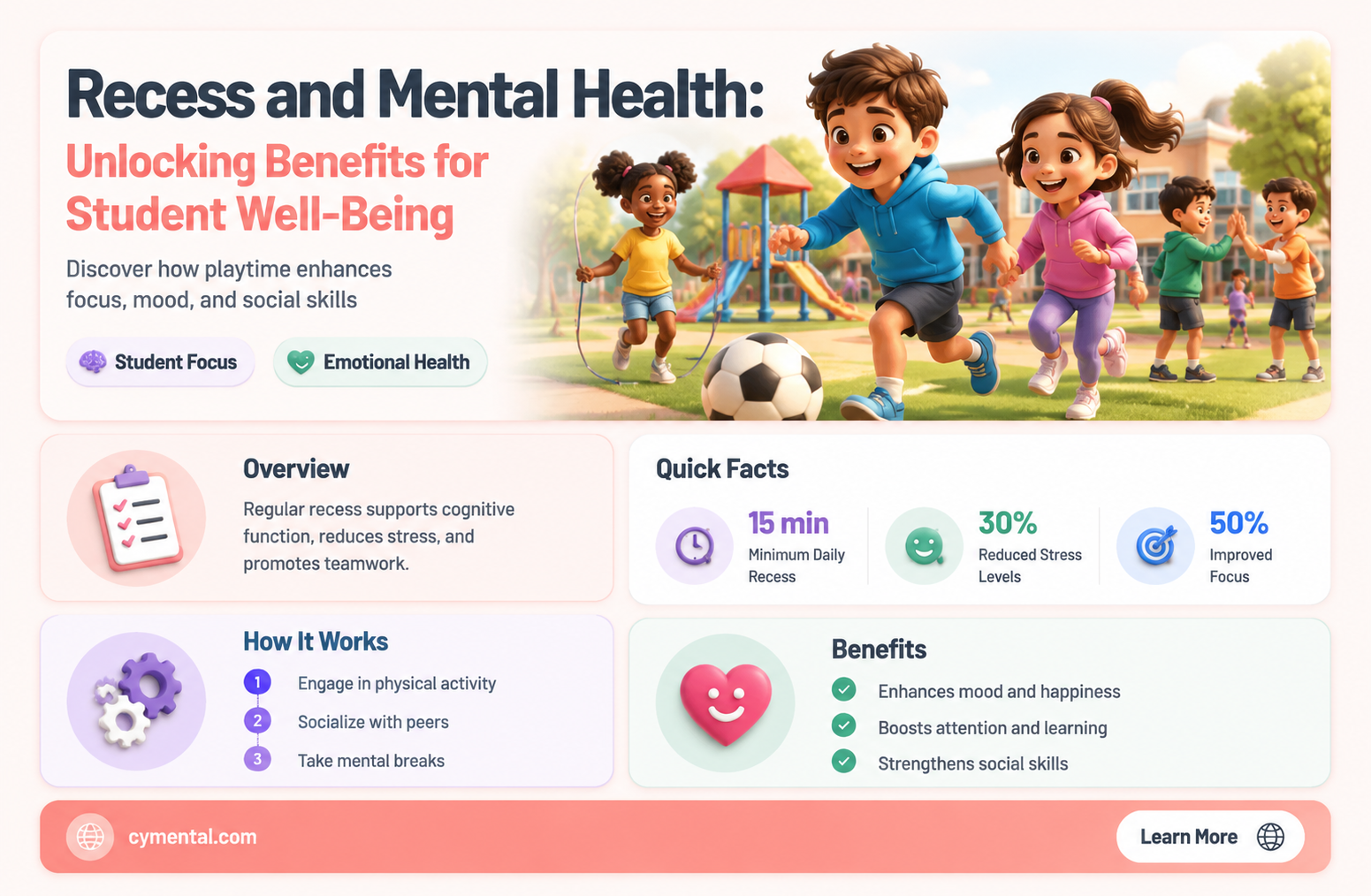
Recess, often seen as a brief break from academic activities, plays a significant role in supporting children’s mental health. Beyond its physical benefits, recess provides a crucial opportunity for social interaction, stress relief, and emotional regulation. During this unstructured time, children engage in play, which fosters creativity, problem-solving, and peer bonding, all of which are essential for emotional well-being. Additionally, recess allows students to recharge, reducing anxiety and improving focus, ultimately contributing to a healthier mental state. As mental health concerns among children rise, recognizing the value of recess as a simple yet effective intervention becomes increasingly important.
| Characteristics | Values |
|---|---|
| Stress Reduction | Recess provides a break from academic pressures, allowing students to relax and reduce stress levels. Studies show that physical activity during recess can lower cortisol (stress hormone) levels. |
| Improved Mood | Physical activity and social interaction during recess release endorphins, which enhance mood and reduce symptoms of anxiety and depression. |
| Social Skills Development | Recess fosters peer interaction, teamwork, and conflict resolution, contributing to better social-emotional health and reduced feelings of isolation. |
| Enhanced Focus and Academic Performance | Short breaks like recess improve attention span and cognitive function, leading to better classroom engagement and academic outcomes. |
| Physical Health Benefits | Recess promotes physical activity, which is linked to reduced risk of obesity, improved cardiovascular health, and better overall mental well-being. |
| Creativity and Problem-Solving | Unstructured play during recess encourages creativity, imagination, and problem-solving skills, which positively impact mental health. |
| Emotional Regulation | Recess provides an outlet for emotional expression and helps children learn to manage emotions in a healthy way. |
| Reduced Behavioral Issues | Schools with structured recess programs often report fewer disciplinary problems, as students have an outlet for excess energy. |
| Sense of Belonging | Inclusive recess activities can foster a sense of community and belonging, reducing feelings of loneliness and improving mental health. |
| Long-Term Mental Health Benefits | Regular physical activity and social interaction during childhood, including recess, are associated with lower rates of mental health disorders in adulthood. |
Explore related products


What You'll Learn
- Stress reduction through physical activity during breaks
- Social interaction boosts emotional well-being and peer connections
- Improved focus and cognitive function post-recess periods
- Playtime fosters creativity and problem-solving skills in children
- Reduced anxiety and depression symptoms with regular outdoor time

Stress reduction through physical activity during breaks
Physical activity during breaks, such as recess, serves as a powerful antidote to stress, particularly in children and adolescents. Research indicates that even short bursts of exercise, like a 10-minute game of tag or jumping rope, can trigger the release of endorphins, the body’s natural mood lifters. For instance, a study published in the *Journal of Pediatrics* found that elementary school students who engaged in moderate-to-vigorous physical activity during recess exhibited lower cortisol levels, a key stress hormone, compared to their less active peers. This suggests that structured or unstructured play during breaks isn’t just a pause from academics—it’s an active reset for the mind.
To maximize stress reduction, aim for at least 20–30 minutes of physical activity during daily breaks. This aligns with recommendations from the World Health Organization, which advises 60 minutes of daily physical activity for children, with breaks being an ideal time to contribute to this goal. Incorporate activities that combine aerobic exercise and social interaction, such as relay races or team sports, as these have been shown to enhance both physical and emotional well-being. For younger children (ages 5–8), focus on playful, non-competitive games, while older students (ages 9–12) may benefit from more structured activities that allow for skill-building and teamwork.
One practical tip for educators and parents is to create a variety of activity options during breaks to cater to different interests and energy levels. For example, designate zones for high-energy activities like soccer, quieter areas for yoga or stretching, and creative spaces for activities like hula hooping or obstacle courses. This approach ensures that all students can engage in physical activity in a way that feels enjoyable and manageable, reducing the stress of feeling forced into a single type of play. Additionally, incorporating mindfulness elements, such as a brief breathing exercise before or after physical activity, can amplify the stress-reducing benefits.
While physical activity during breaks is highly effective, it’s important to balance it with opportunities for rest and social connection. Overloading breaks with structured activities can negate their stress-reducing potential, as some students may thrive in quieter, less demanding environments. Observe students’ energy levels and preferences, and allow flexibility for them to choose how they spend their break time. For example, a student who feels overwhelmed by a busy morning might benefit more from a calm walk or drawing activity than a high-energy game. The goal is to provide options that support stress reduction in a way that feels personalized and sustainable.
In conclusion, physical activity during breaks is a simple yet impactful strategy for stress reduction, particularly when tailored to age, interest, and energy levels. By incorporating a mix of structured and unstructured activities, ensuring adequate duration, and allowing for individual choice, educators and parents can harness the mental health benefits of recess. This approach not only helps students manage stress but also fosters a positive attitude toward physical activity, setting the stage for lifelong healthy habits.
Yoga and Mental Health: Unlocking Inner Peace and Resilience
You may want to see also
Explore related products


Social interaction boosts emotional well-being and peer connections
Recess isn’t just a break from academics—it’s a daily opportunity for children to engage in unstructured social interaction, a cornerstone of emotional well-being. During these 15–30 minutes, students navigate conflicts, form alliances, and practice empathy, skills that directly translate to better mental health. Research shows that children who regularly participate in peer-driven play during recess report lower levels of anxiety and higher self-esteem. For instance, a 2019 study published in *Pediatrics* found that elementary students with daily recess exhibited greater emotional resilience compared to those with limited or no breaks. This isn’t coincidental; it’s a result of the natural social dynamics recess fosters.
To maximize these benefits, educators and parents should encourage inclusive activities that promote collaboration rather than competition. For example, games like tag or group storytelling require teamwork and communication, strengthening peer connections. Even quieter interactions, such as sharing snacks or discussing interests, contribute to a sense of belonging. For younger children (ages 5–8), structured icebreakers or guided group tasks can ease social anxiety, while older kids (ages 9–12) may benefit from open-ended activities that allow for negotiation and problem-solving. The key is to create an environment where social interaction feels safe and rewarding.
Critics might argue that recess can lead to bullying or exclusion, but these risks can be mitigated with proactive supervision. Teachers and recess monitors should intervene only when necessary, allowing children to resolve minor disputes independently. This approach teaches emotional regulation and conflict resolution, essential skills for long-term mental health. Schools can also implement peer mentoring programs where older students facilitate games or mediate disagreements, fostering a culture of support. When managed thoughtfully, recess becomes a training ground for healthy social dynamics rather than a source of stress.
The emotional benefits of recess extend beyond the playground. Children who develop strong peer connections during recess are more likely to seek support when facing challenges, reducing feelings of isolation. A study from the *Journal of School Health* revealed that students with close friendships formed during recess were 30% less likely to report depressive symptoms. This highlights the importance of prioritizing recess as a non-negotiable part of the school day, especially in an era where screen time often replaces face-to-face interaction. By viewing recess as a vital tool for emotional development, we invest in children’s mental health in a way that textbooks and lectures cannot.
Finding Mental Health Support: Where to Go for Help and Healing
You may want to see also
Explore related products


Improved focus and cognitive function post-recess periods
Recess isn’t just a break from academics—it’s a cognitive reset button. Studies show that after 15–20 minutes of unstructured play, children exhibit a measurable increase in attention span and task persistence. This isn’t idle time; it’s active restoration for the brain, allowing it to consolidate information and prepare for the next challenge. For instance, a 2018 study in *Pediatrics* found that elementary students who engaged in recess demonstrated improved executive function, the mental processes that govern focus, memory, and problem-solving.
To maximize these benefits, structure recess strategically. Aim for at least two 20-minute recess periods daily for children aged 6–12, ideally outdoors. Outdoor play, in particular, enhances cognitive gains by exposing children to natural stimuli, which have been shown to reduce mental fatigue. Avoid overscheduling this time with organized activities; free play fosters creativity and decision-making, both of which strengthen cognitive flexibility. For educators, consider pairing recess with challenging academic tasks—schedule math or reading immediately after the break to capitalize on heightened focus.
Critics might argue that recess disrupts the school day, but the data tells a different story. A comparative analysis in *Educational Psychology* revealed that students with consistent recess periods scored 10–15% higher on cognitive assessments than peers with limited or no breaks. The key lies in timing: recess acts as a buffer between intense learning sessions, preventing cognitive overload. Think of it as interval training for the brain—short bursts of activity followed by recovery, optimizing performance over time.
For parents and caregivers, mimic recess principles at home. Incorporate 15–20 minutes of unstructured play before homework sessions to enhance concentration. Limit screen time during breaks, as it doesn’t provide the same restorative benefits as physical activity. Instead, encourage activities like tag, drawing, or building, which engage multiple cognitive domains. By treating recess as a tool rather than a reward, you’re not just giving children a break—you’re sharpening their minds for what comes next.
Seeking Support: Navigating Mental Breakdowns and Finding Help
You may want to see also
Explore related products



Playtime fosters creativity and problem-solving skills in children
Unstructured playtime isn’t just a break from academics—it’s a laboratory for creativity and problem-solving. During recess, children encounter open-ended scenarios where rules are flexible and outcomes unpredictable. Building a fort from sticks, negotiating roles in a pretend game, or inventing a new sport with limited equipment forces them to think divergently. Research shows that this type of play activates the prefrontal cortex, the brain region responsible for complex decision-making and innovative thinking. For instance, a 2018 study in *Pediatrics* found that children who engaged in more free play demonstrated higher levels of creativity and adaptability in standardized tests.
To maximize these benefits, educators and parents can structure playtime environments to encourage problem-solving. Provide a mix of materials like blocks, ropes, and natural elements (e.g., leaves, rocks) that lack a single purpose, allowing children to reimagine their uses. For example, a cardboard box can become a spaceship, a time machine, or a pirate ship—each transformation requires spatial reasoning and imaginative leaps. For younger children (ages 3–6), introduce simple challenges like building a bridge for toy cars using only blocks. For older kids (ages 7–12), incorporate role-playing scenarios that require negotiation, such as dividing resources in a "survival game." The key is to minimize adult intervention, letting children experiment and fail without immediate correction.
Critics might argue that unstructured play lacks the rigor of structured learning, but this overlooks its unique value. Playtime fosters intrinsic motivation, a critical driver of problem-solving. When children pursue their own goals—whether stacking blocks higher than ever before or resolving a conflict in a group game—they develop resilience and a growth mindset. A 2020 study in *Child Development* revealed that children who engaged in self-directed play during recess were more likely to approach academic challenges with confidence and persistence. This contrasts with overly directed activities, where external rewards or adult guidance can stifle initiative.
Finally, consider the social dynamics of recess as a problem-solving incubator. Group play requires children to navigate disagreements, share resources, and coordinate actions—skills directly transferable to real-world challenges. For instance, a game of tag involves strategizing, predicting others’ movements, and adapting to changing rules. To enhance this, adults can introduce games with evolving rules, such as "Shark and Minnow" with shifting boundaries, or provide props like hula hoops and cones that require collaborative problem-solving. Aim for at least 30 minutes of uninterrupted play daily for children aged 5–12, as this duration allows for deeper engagement and more complex problem-solving sequences. By treating recess as a vital developmental tool, we nurture not just creativity, but the lifelong ability to tackle uncertainty with ingenuity.
Reading the Bible: A Path to Mental Health and Healing?
You may want to see also
Explore related products





Reduced anxiety and depression symptoms with regular outdoor time
Spending just 20–30 minutes outdoors daily can significantly lower anxiety and depression symptoms, particularly in children and adolescents. Research shows that exposure to natural environments—parks, forests, or even school playgrounds—activates the parasympathetic nervous system, reducing cortisol levels and promoting relaxation. For instance, a study published in *Frontiers in Psychology* found that students who engaged in outdoor recess had 15% lower stress markers compared to those confined indoors. This simple, cost-effective intervention leverages sunlight, fresh air, and physical activity to counteract the mental strain of academic and social pressures.
To maximize the mental health benefits of outdoor time, incorporate structured activities that encourage mindfulness and sensory engagement. For example, guided nature walks, outdoor games, or even silent observation of natural surroundings can enhance focus and emotional regulation. Parents and educators should aim for consistency, scheduling outdoor breaks at the same time each day to establish a routine. For younger children (ages 5–10), pair physical play with social interaction to foster both physical and emotional development. Adolescents (ages 11–18) may benefit from solo outdoor time, such as journaling in a quiet green space, to process emotions independently.
While the benefits are clear, barriers like inclement weather, lack of access to green spaces, or over-scheduled routines can hinder outdoor time. Practical solutions include investing in weather-appropriate clothing, identifying nearby parks or open areas, and prioritizing outdoor activities over screen time. Schools can play a pivotal role by extending recess duration or integrating outdoor learning into the curriculum. For families, weekend nature trips or even balcony gardening can supplement daily exposure. The key is to make outdoor time a non-negotiable part of the daily schedule, regardless of constraints.
Comparing indoor and outdoor environments highlights why the latter is particularly effective for mental health. Indoor spaces often come with distractions, artificial lighting, and limited physical movement, which can exacerbate feelings of restlessness or fatigue. In contrast, outdoor settings provide a dynamic, multi-sensory experience that distracts from negative thought patterns and encourages dopamine release through physical activity. A study in *Environmental Science & Technology* revealed that just 120 minutes of outdoor time per week—split into shorter, daily sessions—was enough to report improved well-being. This underscores the accessibility of this intervention, requiring no specialized equipment or training.
In conclusion, regular outdoor time is a powerful tool for reducing anxiety and depression symptoms, particularly in younger populations. By understanding the science behind its benefits and implementing practical strategies, individuals and institutions can harness nature’s therapeutic potential. Start small—a 20-minute walk, a game of tag during recess, or a quiet moment under a tree—and build from there. The goal isn’t perfection but consistency, ensuring that outdoor time becomes a sustainable habit that supports long-term mental health.
Gatorade and Mental Health: Hydration's Role in Cognitive Well-being
You may want to see also
Frequently asked questions
Yes, recess helps improve children's mental health by reducing stress, anxiety, and behavioral issues. It provides a break from structured learning, allowing kids to socialize, play, and release pent-up energy, which promotes emotional well-being.
Recess contributes to better focus and mental clarity by giving students a physical and cognitive break. Physical activity during recess increases blood flow to the brain, enhances mood through the release of endorphins, and helps students return to tasks with renewed attention and concentration.
Yes, recess can help address symptoms of ADHD and other mental health challenges by providing an outlet for excess energy and improving self-regulation. Structured or unstructured play during recess supports impulse control, social skills, and emotional resilience, which are beneficial for children with these conditions.