Madison Cole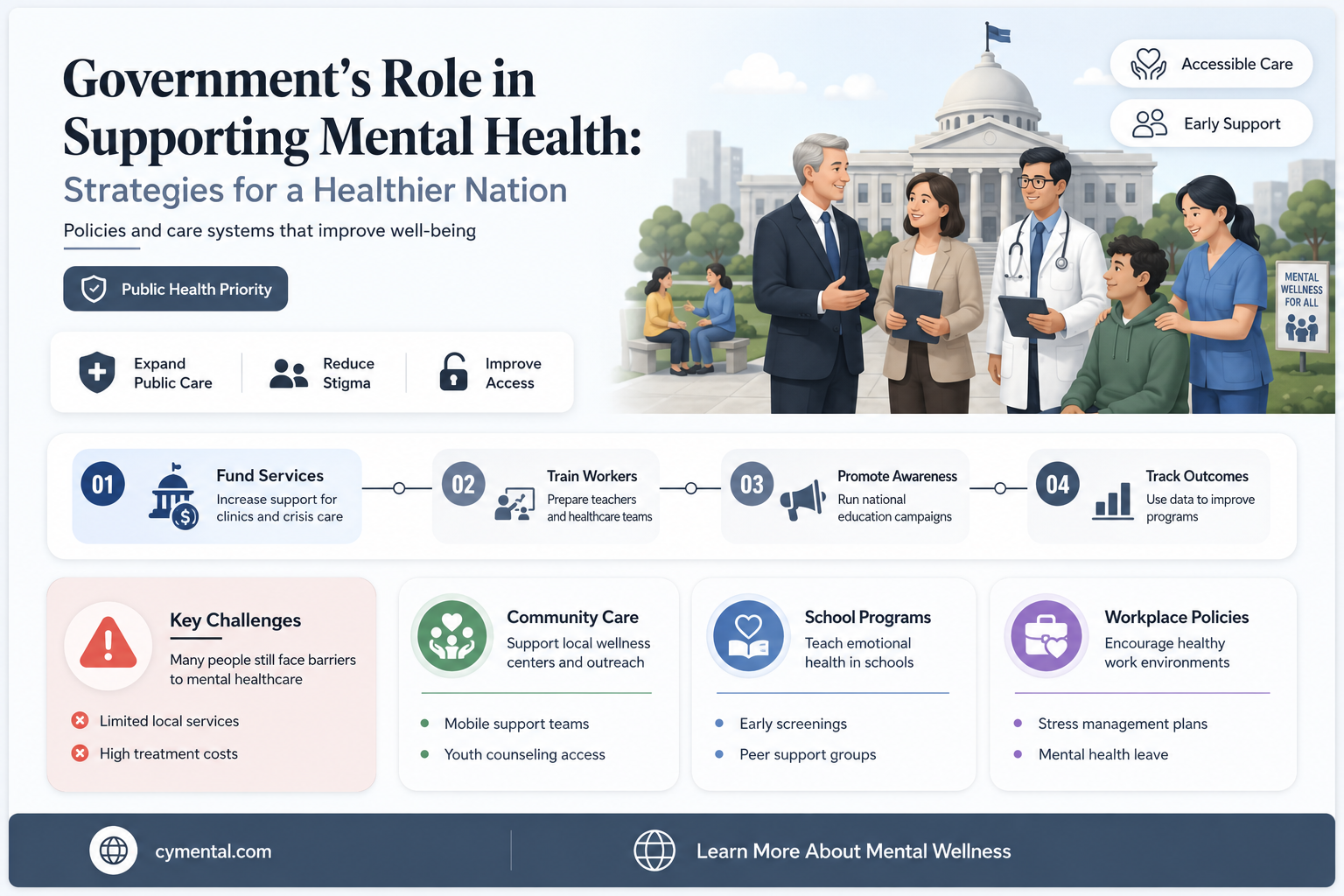
Governments play a crucial role in addressing mental health challenges by implementing policies and initiatives that promote awareness, accessibility, and support. Through increased funding for mental health services, governments can ensure that individuals have access to affordable and quality care, including therapy, counseling, and psychiatric treatment. Additionally, public awareness campaigns can reduce stigma, encouraging more people to seek help without fear of judgment. Governments can also integrate mental health education into school curricula, fostering early intervention and resilience. By prioritizing mental health in healthcare systems, offering workplace protections, and supporting research, governments can create a supportive environment that improves overall well-being and reduces the societal burden of mental illness.
| Characteristics | Values |
|---|---|
| Increase Funding for Mental Health Services | Governments can allocate more resources to mental health care, including therapy, counseling, and psychiatric services. This can help reduce wait times and improve access to care. According to the World Health Organization (WHO), governments should aim to allocate at least 5% of their health budgets to mental health (source: WHO, 2021). |
| Improve Access to Mental Health Care | Governments can work to reduce barriers to mental health care, such as cost, stigma, and lack of availability. This can include expanding telehealth services, increasing the number of mental health professionals, and providing financial assistance for those who cannot afford care. A report by the OECD (2020) highlights that only 30-50% of individuals with mental health disorders receive adequate treatment in high-income countries. |
| Implement Mental Health Education and Awareness Programs | Governments can invest in public education campaigns to raise awareness about mental health, reduce stigma, and promote help-seeking behaviors. The US Substance Abuse and Mental Health Services Administration (SAMHSA) reports that public awareness campaigns can increase help-seeking by up to 20% (source: SAMHSA, 2022). |
| Strengthen Mental Health Workforce | Governments can invest in training and education for mental health professionals, including psychiatrists, psychologists, and social workers. The WHO estimates a global shortage of 1.18 million mental health professionals, with low-income countries having the lowest ratio of mental health workers to population (source: WHO, 2021). |
| Develop and Implement Mental Health Policies | Governments can create comprehensive mental health policies that address prevention, treatment, and recovery. This can include policies related to workplace mental health, school-based mental health services, and community-based support. A study by the Lancet Commission (2018) found that countries with comprehensive mental health policies have better mental health outcomes. |
| Support Research and Innovation | Governments can fund research on mental health disorders, treatment, and prevention. This can lead to the development of new therapies, medications, and interventions. The National Institute of Mental Health (NIMH) in the US reports that every $1 invested in mental health research yields a return of $2.50 in improved health outcomes (source: NIMH, 2020). |
| Address Social Determinants of Mental Health | Governments can address social and economic factors that contribute to mental health disorders, such as poverty, unemployment, and social isolation. This can include policies related to housing, education, and social welfare. A report by the UK Government (2021) found that individuals living in poverty are twice as likely to experience mental health problems. |
| Promote Mental Health in Schools | Governments can implement school-based mental health programs, including counseling services, mental health education, and social-emotional learning. The American Psychological Association (APA) reports that school-based mental health programs can reduce mental health problems by up to 30% (source: APA, 2020). |
| Support Workplace Mental Health | Governments can encourage employers to prioritize workplace mental health, including providing mental health benefits, reducing stigma, and promoting work-life balance. The World Economic Forum (WEF) estimates that mental health problems cost the global economy $1 trillion per year in lost productivity (source: WEF, 2022). |
| Monitor and Evaluate Mental Health Outcomes | Governments can establish systems to monitor and evaluate mental health outcomes, including prevalence rates, treatment access, and recovery rates. This can inform policy development and resource allocation. The OECD (2020) highlights the importance of robust data collection and monitoring to improve mental health outcomes. |
Explore related products


What You'll Learn

Increase funding for mental health services
Mental health services in many regions are chronically underfunded, leading to long wait times, limited access to care, and inadequate support for vulnerable populations. Increasing government funding for mental health services is not just a moral imperative but a strategic investment in societal well-being. For instance, in the United States, the Substance Abuse and Mental Health Services Administration (SAMHSA) estimates that only 43.3% of adults with mental illness received treatment in 2021, highlighting a significant gap that funding could address. By allocating more resources, governments can expand the availability of therapists, psychiatrists, and community-based programs, ensuring that individuals receive timely and effective care.
One practical approach to increasing funding is to earmark a specific percentage of the national health budget for mental health services. For example, the World Health Organization (WHO) recommends that countries allocate at least 5% of their health budgets to mental health. However, many nations fall short of this target. Governments could also explore innovative financing mechanisms, such as taxing industries that contribute to mental health stressors (e.g., social media platforms) or redirecting funds from underutilized programs. These steps would not only address immediate needs but also signal a long-term commitment to mental health parity.
Critics may argue that increased funding alone won’t solve systemic issues like stigma or workforce shortages. While true, funding is a foundational step that enables the implementation of broader solutions. For instance, additional resources can be used to train more mental health professionals, particularly in underserved areas. Scholarships, loan forgiveness programs, and competitive salaries can incentivize individuals to pursue careers in mental health. Similarly, funding can support public awareness campaigns to reduce stigma, making it easier for people to seek help without fear of judgment.
A comparative analysis of countries with robust mental health systems, such as Australia and Canada, reveals that sustained investment yields measurable benefits. In Australia, the government’s *National Mental Health Strategy* has led to improved access to services and reduced suicide rates in targeted regions. Canada’s *Mental Health Action Plan* has similarly expanded telehealth services, making care more accessible in rural areas. These examples demonstrate that increased funding, when paired with strategic planning, can transform mental health outcomes on a national scale.
Finally, governments must ensure that increased funding is distributed equitably to address disparities in access. Low-income communities, racial and ethnic minorities, and rural populations often face the greatest barriers to mental health care. Allocating funds to community health centers, culturally competent programs, and mobile clinics can bridge these gaps. Additionally, investing in digital mental health platforms can provide affordable, scalable solutions for those who cannot access in-person care. By prioritizing equity, governments can ensure that no one is left behind in the pursuit of better mental health for all.
Designing Spaces: Architecture's Role in Enhancing Mental Well-being
You may want to see also
Explore related products


Expand access to affordable therapy and counseling
One in five adults in the U.S. experiences mental illness each year, yet nearly 60% of them don’t receive treatment, often due to cost barriers. Expanding access to affordable therapy and counseling isn’t just a policy goal—it’s a public health imperative. Governments can address this gap by subsidizing mental health services, ensuring that financial constraints don’t prevent individuals from seeking help. For instance, sliding-scale fee structures, where costs are adjusted based on income, can make therapy accessible to low-income populations. Similarly, integrating mental health coverage into public insurance programs, such as Medicaid, removes financial hurdles for millions. Without such interventions, untreated mental health issues will continue to strain healthcare systems, economies, and communities.
To implement this effectively, governments must take a multi-step approach. First, allocate funding to train and employ more mental health professionals, particularly in underserved areas. Second, incentivize providers to accept public insurance by offering loan forgiveness or tax breaks. Third, invest in telehealth platforms to reach rural or immobile populations, ensuring that geography isn’t a barrier to care. For example, the U.K.’s Improving Access to Psychological Therapies (IAPT) program demonstrates how government-funded initiatives can reduce wait times and increase treatment availability. Caution, however, must be taken to avoid overburdening existing providers; sustainable solutions require long-term workforce planning and infrastructure development.
A persuasive argument for this approach lies in its cost-effectiveness. Untreated mental health conditions cost the U.S. economy over $193 billion annually in lost earnings alone. By contrast, investing in affordable therapy yields a 4:1 return on investment, according to the World Health Organization. Governments can frame this as both a moral and economic imperative, appealing to diverse political constituencies. Public awareness campaigns can further destigmatize therapy, encouraging more people to seek help. For instance, Australia’s *Head to Health* initiative combines affordable services with community education, creating a holistic support system. Such programs prove that accessibility and affordability are achievable with strategic government intervention.
Comparatively, countries like Germany and Canada offer insights into successful models. Germany’s public health insurance system covers psychotherapy sessions without additional costs, while Canada’s recent investments in mental health include $5 billion for expanded access to counseling. These examples highlight the importance of comprehensive coverage and sustained funding. In contrast, the U.S.’s fragmented system often leaves gaps in care, particularly for marginalized groups. By studying these models, governments can tailor solutions to their contexts, ensuring that no one is left behind. The takeaway is clear: affordable therapy isn’t a luxury—it’s a necessity that governments must prioritize.
Finally, practical tips for implementation include leveraging technology to scale services. Mobile apps and online platforms can provide low-cost or free counseling, though they shouldn’t replace in-person care. Governments can partner with tech companies to develop these tools, ensuring they meet clinical standards. Additionally, schools and workplaces can serve as hubs for mental health services, reaching younger and working-age populations. For instance, New Zealand’s *Gumboot Friday* initiative provides free counseling sessions for children through schools. Such innovative approaches, combined with policy reforms, can create a mental health system that is both accessible and equitable. The challenge is significant, but the solutions are within reach—if governments act decisively.
Supporting Through Crisis: Texting Tips for Mental Breakdown Assistance
You may want to see also
Explore related products


Promote mental health awareness campaigns
Mental health awareness campaigns are a powerful tool for governments to combat stigma, educate the public, and encourage early intervention. By leveraging mass media, social platforms, and community events, these campaigns can reach diverse audiences, from schoolchildren to seniors. For instance, Australia’s *R U OK?* initiative prompts individuals to ask a simple question that can open conversations about mental health struggles. Such campaigns normalize seeking help and reduce the isolation often felt by those affected.
Designing effective campaigns requires a strategic approach. Governments should partner with mental health organizations, influencers, and survivors to craft messages that resonate. For example, incorporating relatable testimonials or data-driven infographics can increase engagement. Campaigns targeting youth might use TikTok challenges or Instagram stories, while older demographics may respond better to televised PSAs or local workshops. Tailoring content to specific age groups ensures relevance and impact.
One critical aspect often overlooked is the need for follow-up resources. Awareness alone is insufficient if individuals lack access to support services. Campaigns should include clear calls to action, such as helpline numbers, online therapy platforms, or local counseling centers. For instance, the UK’s *Every Mind Matters* campaign directs users to a personalized mental health action plan, bridging awareness with actionable steps. This integration ensures campaigns translate into tangible outcomes.
Measuring success is equally vital. Governments must track campaign reach, engagement, and behavioral changes through surveys, social media analytics, and service utilization data. For example, a 20% increase in helpline calls post-campaign could indicate heightened awareness and reduced stigma. Continuous evaluation allows for iterative improvements, ensuring campaigns remain effective and responsive to evolving needs.
In conclusion, promoting mental health awareness campaigns is not just about visibility—it’s about fostering a culture of empathy, understanding, and action. By combining creativity, inclusivity, and measurable strategies, governments can transform public perceptions and save lives. The investment in such campaigns is minimal compared to the societal benefits of a mentally healthier population.
Stretching for Serenity: Unraveling the Link Between Flexibility and Mental Health
You may want to see also
Explore related products




Integrate mental health into primary care systems
Mental health issues often manifest in primary care settings, with up to 70% of patients presenting with symptoms like fatigue, insomnia, or chronic pain that have underlying psychological roots. Yet, fragmented systems frequently fail to address these connections effectively. Integrating mental health services into primary care can bridge this gap, ensuring holistic treatment that recognizes the mind-body link. For instance, a patient complaining of persistent headaches might receive both a neurological assessment and a brief depression screening during the same visit, allowing for comprehensive care that addresses both physical and emotional contributors.
To operationalize this integration, governments can mandate co-location of mental health professionals within primary care clinics. This model, already piloted in countries like the UK and Australia, embeds psychologists, social workers, or psychiatric nurse practitioners alongside general practitioners. These specialists can provide immediate consultations, brief interventions, or referrals, reducing wait times that often deter patients from seeking mental health care. For example, a 15-minute consultation with an embedded psychologist could help a patient develop coping strategies for anxiety while awaiting more specialized treatment.
Funding models must also evolve to support this integration. Governments could implement blended payment systems that reimburse clinics for collaborative care, where primary care physicians and mental health providers share responsibility for a patient’s outcomes. For instance, a clinic might receive a bundled payment for managing a patient’s diabetes and co-occurring depression, incentivizing coordination between providers. Additionally, training programs for primary care staff should include mental health components, ensuring clinicians feel equipped to identify and manage mild to moderate conditions like anxiety or dysthymia.
However, integration is not without challenges. Primary care providers often face time constraints, and adding mental health responsibilities could exacerbate burnout. To mitigate this, governments should invest in digital tools like AI-driven screening platforms or telehealth services that allow mental health professionals to support patients remotely. For example, a chatbot could administer a PHQ-9 depression screening during a patient’s annual checkup, flagging results for the provider in real time. Such innovations free up clinicians to focus on complex cases while ensuring no patient slips through the cracks.
Ultimately, integrating mental health into primary care transforms the system from one that reacts to crises to one that proactively supports well-being. By normalizing mental health as a routine component of healthcare, governments can reduce stigma, improve access, and foster a culture of prevention. For instance, a teenager visiting their GP for a sports physical might also receive a brief resilience-building exercise, planting seeds for long-term mental health management. This approach not only improves individual outcomes but also reduces the economic burden of untreated mental illness, making it a win-win for societies worldwide.
Mental Health Classes: A Path to Overcoming Meth Addiction?
You may want to see also
Explore related products


Support workplace mental health initiatives
Workplace mental health initiatives are not just a moral imperative but a strategic investment in productivity and economic stability. Governments can play a pivotal role in fostering environments where employees thrive, not just survive. By mandating mental health training for managers, for instance, organizations can equip leaders with the skills to recognize early signs of distress and respond effectively. Such training should cover active listening, stress management techniques, and referral pathways to professional support. This proactive approach not only reduces absenteeism but also enhances employee engagement and retention.
Consider the example of Australia’s "Mentally Healthy Workplace Alliance," a government-backed program that provides free resources and toolkits for businesses of all sizes. These resources include step-by-step guides for implementing wellness programs, such as mindfulness sessions, flexible work schedules, and peer support networks. Governments can replicate this model by funding similar initiatives and offering tax incentives to companies that prioritize mental health. For small businesses, which often lack the resources for comprehensive programs, subsidies for employee assistance programs (EAPs) could be a game-changer. EAPs typically offer up to six counseling sessions per employee annually, addressing issues from burnout to personal crises.
However, policy alone is insufficient without cultural change. Governments must also tackle systemic barriers, such as stigma and fear of retaliation, that prevent employees from seeking help. Public awareness campaigns, like Singapore’s "Beyond the Label" initiative, can challenge misconceptions about mental health in the workplace. Pairing these campaigns with legislative protections, such as anti-discrimination laws, ensures employees feel safe disclosing their struggles. For instance, mandating that companies with over 50 employees provide confidential mental health support channels could normalize seeking help without fear of career repercussions.
A comparative analysis reveals that countries with robust workplace mental health policies, like Sweden and Denmark, consistently rank high in global happiness and productivity indices. These nations integrate mental health into occupational health and safety regulations, treating psychological well-being as a non-negotiable workplace standard. Governments can emulate this by requiring employers to conduct annual mental health risk assessments, identifying stressors like excessive workloads or poor communication. Mitigation strategies might include capping overtime hours, redesigning job roles, or introducing mental health days separate from sick leave.
In conclusion, supporting workplace mental health initiatives requires a multi-faceted approach: policy, resources, and culture. Governments must act as both enablers and regulators, providing tools while holding organizations accountable. By investing in mental health at work, societies can unlock not only healthier individuals but also more resilient economies. The question is not whether governments can afford to prioritize this—it’s whether they can afford not to.
Supporting Mentally Ill Homeless Relatives: Compassionate Strategies for Family Care
You may want to see also
Frequently asked questions
The government can improve access by increasing funding for mental health programs, expanding healthcare coverage to include mental health services, and supporting the integration of mental health care into primary care settings. Additionally, reducing wait times and increasing the availability of mental health professionals in underserved areas can make services more accessible.
The government can launch public awareness campaigns to educate the public about mental health, promote understanding, and challenge stereotypes. Funding research and initiatives that highlight the importance of mental well-being and normalizing conversations about mental health can also help reduce stigma.
The government can implement policies that require mental health education in schools, provide training for teachers and employers to recognize signs of mental health issues, and ensure workplaces have resources like Employee Assistance Programs (EAPs). Funding school-based mental health services and mandating mental health days as part of sick leave policies can also provide critical support.