Harper Lewis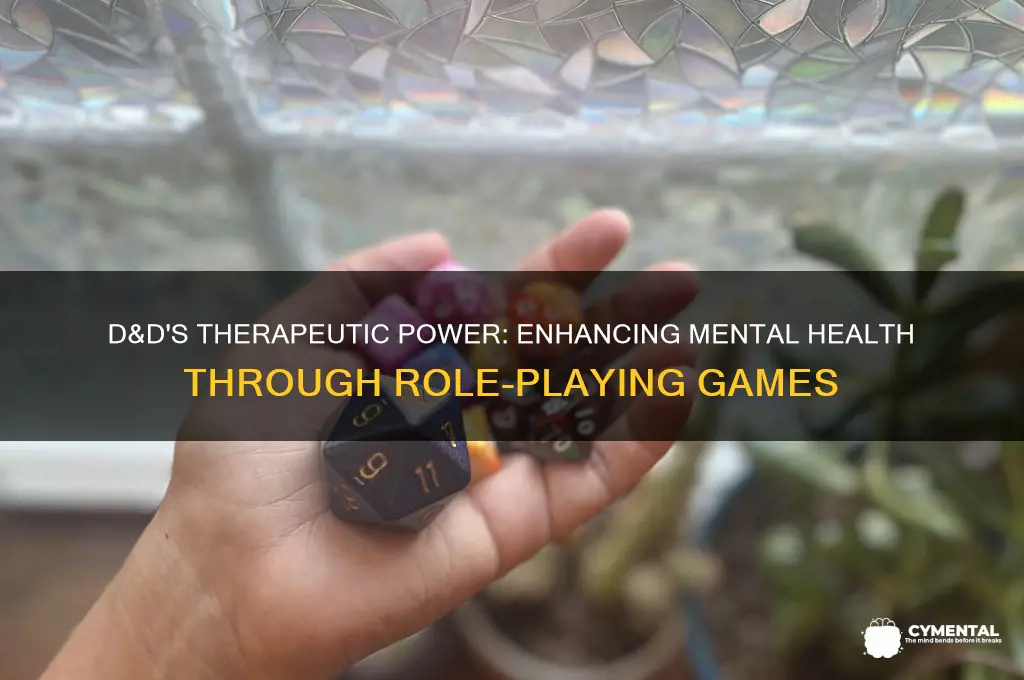
Dungeons & Dragons (D&D), a tabletop role-playing game, has emerged as a powerful tool for improving mental health and well-being. Through collaborative storytelling, players engage in creative problem-solving, social interaction, and emotional exploration within a safe, imaginative space. The game fosters empathy by encouraging players to embody diverse characters, promoting understanding of different perspectives and experiences. Additionally, D&D provides a structured yet flexible environment for managing stress, anxiety, and depression, as it allows individuals to confront challenges, build resilience, and experience a sense of accomplishment. The social aspect of the game combats loneliness by connecting players with like-minded individuals, while the act of crafting narratives can serve as a therapeutic outlet for processing emotions and trauma. By blending escapism with personal growth, D&D offers a unique and effective way to support mental health.
| Characteristics | Values |
|---|---|
| Social Connection | Encourages teamwork, communication, and bonding with fellow players, reducing loneliness. |
| Cognitive Stimulation | Enhances problem-solving, creativity, and strategic thinking through complex scenarios. |
| Escapism | Provides a temporary escape from real-life stressors by immersing players in a fantasy world. |
| Emotional Regulation | Helps players explore and process emotions through character role-playing and storytelling. |
| Goal Setting and Achievement | Promotes a sense of accomplishment through completing quests and character progression. |
| Mindfulness and Focus | Requires concentration, helping players stay present and engaged in the moment. |
| Stress Relief | Acts as a therapeutic outlet for stress and anxiety through creative expression and play. |
| Self-Expression | Allows players to explore different aspects of their identity through character creation. |
| Improved Communication Skills | Enhances verbal and non-verbal communication through collaborative storytelling. |
| Resilience Building | Teaches coping with failure and setbacks in a safe, controlled environment. |
| Structured Routine | Provides a consistent activity that can help individuals with mental health routines. |
| Supportive Community | Offers access to a like-minded community that can provide emotional support and understanding. |
| Creative Outlet | Fosters imagination and creativity through world-building and character development. |
| Reduced Symptoms of Depression/Anxiety | Studies suggest it can alleviate symptoms by providing purpose and engagement. |
| Adaptive Coping Mechanisms | Encourages healthy coping strategies through problem-solving and teamwork. |
Explore related products


What You'll Learn
- Stress Relief: Escapism through storytelling reduces anxiety, promotes relaxation, and fosters mindfulness during gameplay
- Social Connection: Group play builds camaraderie, combats loneliness, and enhances communication skills in a safe space
- Problem-Solving: Challenges in-game improve critical thinking, boost confidence, and encourage creative solutions to real-life issues
- Emotional Expression: Role-playing allows exploration of emotions, empathy development, and safe processing of feelings
- Achievement & Growth: Character progression provides a sense of accomplishment, motivation, and personal development over time

Stress Relief: Escapism through storytelling reduces anxiety, promotes relaxation, and fosters mindfulness during gameplay
In the realm of Dungeons & Dragons (D&D), players embark on epic quests, battle mythical creatures, and weave intricate narratives, all while seated around a table. This immersive experience offers more than just entertainment; it serves as a powerful tool for stress relief. The act of escapism through storytelling allows individuals to temporarily detach from their daily worries, providing a mental respite that is both therapeutic and engaging.
Consider the process of character creation, a fundamental step in D&D. Players craft alter egos, often vastly different from their real-life selves, enabling them to explore new identities and perspectives. This creative exercise is not merely a game mechanic but a form of self-expression that encourages introspection. For instance, a player struggling with social anxiety might design a charismatic bard, allowing them to vicariously experience confidence and social success. Such role-playing can lead to real-life insights and reduced anxiety, as players project their aspirations onto their characters.
The structured yet flexible nature of D&D gameplay further contributes to its stress-relieving properties. Each session is a guided journey through a collaborative story, where players make decisions that shape the narrative. This blend of agency and guidance fosters a sense of control and accomplishment, counteracting feelings of helplessness often associated with stress. For example, a player facing work-related pressure can find solace in solving an in-game puzzle or strategizing a battle, translating these small victories into a renewed sense of competence.
Moreover, the social aspect of D&D should not be overlooked. Gathering with a group of like-minded individuals to share in a collective story promotes a sense of community and belonging. Laughter, camaraderie, and shared excitement during gameplay release endorphins, the body’s natural stress fighters. Studies suggest that social support is a critical factor in managing anxiety, and D&D provides a unique platform for such interactions, especially for those who find traditional social settings challenging.
To maximize the stress-relieving benefits of D&D, consider these practical tips: schedule regular sessions to create a routine, encourage players to engage in character journaling for deeper immersion, and incorporate mindfulness techniques like deep breathing during gameplay transitions. For younger players (ages 12 and up), simpler storylines and shorter sessions can make the experience more accessible and enjoyable. By embracing the escapism and storytelling inherent in D&D, individuals can transform gameplay into a powerful tool for relaxation and mental well-being.
Can You Require a Spouse to Seek Mental Health Treatment?
You may want to see also
Explore related products


$14.99 $29.99

Social Connection: Group play builds camaraderie, combats loneliness, and enhances communication skills in a safe space
Human beings are inherently social creatures, yet modern life often leaves us isolated despite being more connected than ever digitally. Dungeons & Dragons (D&D) offers a unique antidote to this paradox by fostering genuine, face-to-face interaction in a structured yet imaginative setting. Unlike casual gatherings, D&D sessions require players to collaborate, negotiate, and problem-solve together, creating a shared purpose that transcends small talk. This structured social engagement is particularly beneficial for individuals who struggle with initiating or maintaining relationships, as the game provides a natural framework for interaction without the pressure of forced conversation.
Consider the mechanics of the game: players must communicate their character’s actions, discuss strategies, and react to the Dungeon Master’s narrative prompts. This dynamic not only sharpens verbal and nonverbal communication skills but also encourages active listening—a skill often neglected in today’s fast-paced world. For example, a player might need to persuade the group to follow their plan, requiring them to articulate their ideas clearly and adapt to feedback. Over time, these interactions build trust and understanding among players, fostering a sense of camaraderie that extends beyond the game table.
Loneliness, a silent epidemic affecting all age groups, can be particularly debilitating for mental health. D&D provides a safe, inclusive space where individuals can connect with others who share their interests, regardless of background or experience level. The game’s focus on storytelling and shared goals creates a sense of belonging, as players become part of a collective narrative. For instance, a shy teenager might find it easier to express themselves through their character, gradually building confidence to engage more openly with the group. Similarly, adults dealing with social anxiety may find the game’s structured format less intimidating than unstructured social situations.
To maximize the social benefits of D&D, consider these practical tips: start with a small, consistent group of 4–6 players to ensure everyone has a chance to contribute; establish clear boundaries and expectations at the outset to create a safe space; and encourage players to take on roles that challenge their communication styles, such as a charismatic bard or a diplomatic cleric. For younger players (ages 12–18), incorporating educational elements like vocabulary-building or critical thinking exercises can enhance both social and cognitive skills. Regular sessions—ideally weekly or biweekly—provide a routine that reinforces social connections and gives participants something to look forward to.
In contrast to solitary hobbies or passive entertainment, D&D actively combats loneliness by engaging players in meaningful social interaction. Its blend of creativity, collaboration, and structure makes it a powerful tool for building relationships and improving mental well-being. Whether you’re a seasoned player or a newcomer, the game’s emphasis on shared storytelling and problem-solving ensures that everyone has a role to play—both in the game and in each other’s lives. By fostering camaraderie, enhancing communication, and providing a safe space for connection, D&D proves that sometimes, the best way to face the dragons in our minds is alongside a party of allies.
Supporting Your Girlfriend’s Mental Health: Practical Ways to Show You Care
You may want to see also
Explore related products


Problem-Solving: Challenges in-game improve critical thinking, boost confidence, and encourage creative solutions to real-life issues
Dungeons & Dragons (D&D) presents players with complex, often unpredictable challenges that demand quick thinking and adaptability. Unlike linear puzzles, these scenarios rarely have a single solution, forcing players to weigh options, anticipate consequences, and make decisions under pressure. This mirrors real-life problem-solving, where ambiguity and uncertainty are the norm. A study published in *Psychology of Aesthetics, Creativity, and the Arts* found that engaging in role-playing games like D&D significantly enhances divergent thinking, a key component of creative problem-solving. By regularly navigating these in-game dilemmas, players train their minds to approach problems from multiple angles, a skill directly transferable to personal and professional challenges.
Consider a typical D&D session where the party encounters a bridge guarded by a troll demanding a toll they cannot pay. The solution might involve negotiating, using stealth, casting an illusion spell, or even distracting the troll with a riddle. Each player brings their unique perspective, shaped by their character’s abilities and backstory, contributing to a collaborative solution. This process not only sharpens critical thinking but also fosters a sense of accomplishment when the challenge is overcome. For individuals struggling with decision-making or self-doubt, this structured yet open-ended environment provides a safe space to experiment and build confidence.
To maximize the problem-solving benefits of D&D, Dungeon Masters (DMs) should design challenges that encourage creativity rather than relying on brute force or rote solutions. For instance, instead of a straightforward combat encounter, introduce a puzzle that requires combining party members’ skills—like a locked door that needs a rogue’s lockpicking, a wizard’s arcane knowledge, and a bard’s persuasion to convince a trapped spirit to reveal the code. Players aged 12 and up, particularly teenagers, can benefit from these scenarios as they develop executive functioning skills. Parents and educators can facilitate this by discussing the session’s problem-solving strategies afterward, linking them to real-life applications.
However, it’s crucial to balance challenge with accessibility. Overly complex puzzles or unsolvable problems can lead to frustration, undermining the confidence-building aspect. DMs should provide subtle hints or alternative paths if players become stuck, ensuring the experience remains engaging and rewarding. For younger players or those new to the game, start with simpler challenges and gradually increase complexity as their skills improve. This incremental approach mirrors the principles of scaffolding in education, where learners are supported at their current level before being encouraged to tackle more difficult tasks.
Ultimately, the problem-solving skills honed in D&D extend far beyond the game table. Players learn to think on their feet, collaborate effectively, and approach obstacles with resilience and creativity. These abilities are invaluable in managing stress, resolving conflicts, and navigating life’s uncertainties. By treating each in-game challenge as an opportunity for growth, players not only enhance their mental agility but also develop a mindset that empowers them to tackle real-world problems with confidence and ingenuity. Whether you’re a seasoned adventurer or a newcomer, D&D offers a unique and engaging way to sharpen your problem-solving toolkit.
Violet Ray Therapy: A Potential Aid for Mental Health Disorders?
You may want to see also
Explore related products


$9.79 $17.99


Emotional Expression: Role-playing allows exploration of emotions, empathy development, and safe processing of feelings
Role-playing in Dungeons & Dragons (D&D) offers a unique sandbox for emotional exploration, allowing players to inhabit characters whose feelings and reactions differ from their own. This detachment creates a safe psychological distance, enabling individuals to confront emotions they might suppress or struggle to articulate in real life. For instance, a player who finds it difficult to express anger might channel it through a bold, confrontational character, practicing assertiveness in a low-stakes environment. Similarly, embodying a compassionate healer can help someone cultivate empathy, as they navigate the emotional needs of both their character and their party members. This emotional proxy effect is particularly beneficial for those who find direct emotional expression overwhelming.
To maximize this benefit, consider structuring gameplay to encourage emotional depth. Dungeon Masters (DMs) can design scenarios that prompt introspection, such as moral dilemmas or character backstories that require players to confront loss, fear, or joy. For example, a quest to retrieve a fallen comrade’s artifact can evoke themes of grief and loyalty, prompting players to process these emotions through their characters. Players should also be encouraged to describe their characters’ emotional states during role-play, using tools like the "Feelings Wheel" to expand their emotional vocabulary. This practice not only enriches the game but also translates into greater emotional awareness outside the session.
While the benefits are clear, it’s crucial to establish boundaries to ensure emotional exploration remains safe and constructive. DMs should communicate with players beforehand to gauge comfort levels and set guidelines for triggering content. For instance, if a player has a history of trauma, certain themes (e.g., betrayal or violence) might need to be avoided or handled with sensitivity. Additionally, incorporating a "debrief" at the end of sessions can help players separate their character’s emotions from their own, ensuring the experience remains therapeutic rather than distressing. This is especially important for younger players (ages 12–18), who may still be developing emotional regulation skills.
Comparatively, traditional therapy often relies on verbal communication and reflection, which can feel abstract or intimidating. D&D’s immersive nature provides a concrete, narrative framework for emotional work, making it accessible to those who struggle with direct self-expression. For example, a player who finds it hard to articulate anxiety might demonstrate it through their character’s hesitant decision-making, sparking a conversation about stress management. This indirect approach can be particularly effective for neurodivergent individuals or those with social anxiety, as it reduces the pressure of self-disclosure while still fostering emotional growth.
In practice, integrating emotional expression into D&D requires intentionality but yields profound results. Start by incorporating character backstories that include emotional arcs, such as a rogue grappling with trust issues or a wizard overcoming self-doubt. Encourage players to role-play these internal conflicts, rewarding them with inspiration points or narrative payoffs. For DMs, weaving emotional themes into the campaign’s plot—such as a kingdom divided by fear or a village united by hope—can create opportunities for collective emotional processing. Over time, this practice not only enhances the game’s depth but also equips players with tools to navigate their own emotional landscapes, fostering resilience and empathy in the process.
Martial Arts and Mental Health: Unlocking Inner Peace and Resilience
You may want to see also
Explore related products



Achievement & Growth: Character progression provides a sense of accomplishment, motivation, and personal development over time
In Dungeons & Dragons, character progression is more than just leveling up—it’s a structured metaphor for personal growth. Each time a player’s character gains a new ability, overcomes a challenge, or unlocks a higher level, it mirrors the incremental achievements we strive for in real life. This system of measurable progress taps into the brain’s reward circuitry, releasing dopamine and fostering a sense of accomplishment. For individuals struggling with motivation or self-esteem, watching their character evolve from a novice to a hero can serve as a tangible reminder that growth, though gradual, is always possible.
Consider the mechanics of leveling up: players earn experience points (XP) by completing tasks, solving problems, and facing adversity. This mirrors real-world resilience, where challenges are not obstacles but opportunities for advancement. For instance, a player who successfully negotiates with a hostile NPC might gain XP not just for their character but also for themselves, reinforcing the idea that communication and strategy yield results. Over time, this process cultivates a growth mindset, encouraging players to view failures as stepping stones rather than dead ends. Practical tip: set small, achievable goals within the game (e.g., mastering a new spell or completing a side quest) to build momentum and confidence.
The narrative arc of a D&D campaign further amplifies this sense of achievement. Unlike linear games, D&D allows players to shape their character’s destiny through choices and actions. A fighter who starts as a lowly mercenary might end up leading an army, or a rogue could evolve from a thief to a master tactician. This agency fosters a deep sense of ownership and pride in one’s progress. For younger players (ages 12–18), this can be particularly impactful, as it aligns with their developmental need for autonomy and identity formation. Caution: ensure the campaign’s challenges are appropriately scaled to avoid frustration, which can undermine motivation.
Comparatively, real-life personal development often lacks such clear milestones. D&D provides a framework where progress is quantifiable—levels, skills, and abilities are all tracked and celebrated. This clarity can be especially beneficial for individuals with anxiety or depression, who may struggle to recognize their own growth. For example, a player who overcomes social anxiety by role-playing diplomatic interactions might translate that confidence into real-life conversations. Dosage: aim for 2–3 sessions per month to maintain engagement without overwhelming participants.
Ultimately, the beauty of character progression in D&D lies in its duality: it’s both a game mechanic and a tool for self-improvement. By investing time and effort into their character, players inadvertently invest in themselves. The sense of accomplishment from leveling up, the motivation to tackle the next challenge, and the personal development gained through problem-solving all contribute to improved mental well-being. Takeaway: use D&D as a structured, enjoyable way to practice goal-setting, resilience, and self-reflection, turning fantasy achievements into real-life growth.
Talking About Mental Health: A Powerful Tool for Healing and Hope
You may want to see also
Frequently asked questions
D&D encourages creativity, problem-solving, and social interaction, which can reduce stress, anxiety, and feelings of isolation. It provides a safe space to explore emotions, build confidence, and practice coping skills through role-playing.
Yes, D&D fosters teamwork and communication in a low-pressure, collaborative environment. Players gradually become more comfortable expressing themselves, which can translate to improved social skills and reduced anxiety in real-life interactions.
D&D can boost mood by providing a sense of accomplishment, purpose, and escapism. The game’s structure and storytelling elements can help players feel engaged and connected, offering a temporary reprieve from negative thoughts.
The immersive nature of D&D allows players to focus on the present moment, promoting mindfulness. Engaging in a fun, imaginative activity can distract from stressors and provide a healthy outlet for emotional release.