Noah Parker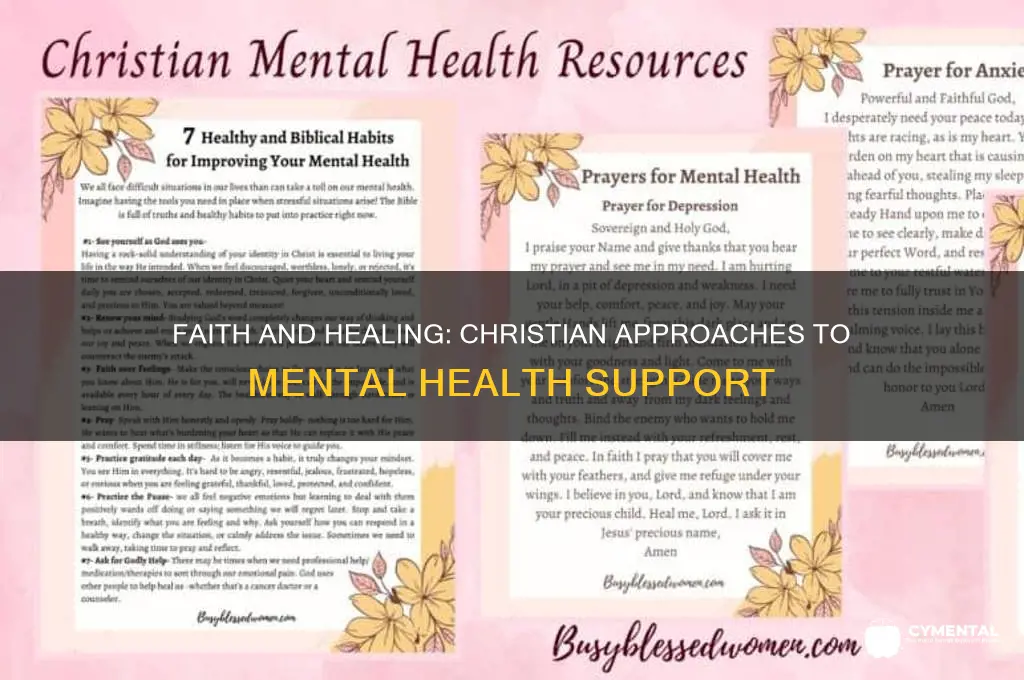
Christians often approach mental health through a combination of faith, community support, and practical care, rooted in the belief that holistic healing involves tending to both the soul and the mind. Many Christian communities emphasize the importance of prayer, counseling, and fostering safe spaces where individuals can share their struggles without judgment. Churches frequently offer support groups, pastoral counseling, and resources that integrate psychological principles with biblical teachings, encouraging individuals to seek professional help while also finding solace in spiritual practices. Additionally, Christians often emphasize compassion and service, actively working to reduce stigma around mental health issues and providing tangible assistance to those in need, reflecting their commitment to loving and caring for one another as commanded in their faith.
Explore related products



What You'll Learn
- Prayer & Support Groups: Communities offering spiritual comfort, shared experiences, and encouragement for mental health struggles
- Biblical Counseling: Faith-based guidance integrating Scripture to address emotional and psychological challenges
- Compassionate Listening: Providing non-judgmental, empathetic ears to those facing mental health issues
- Practical Assistance: Helping with daily tasks, resources, and access to professional mental health care
- Stigma Reduction: Promoting understanding and acceptance of mental health within Christian communities

Prayer & Support Groups: Communities offering spiritual comfort, shared experiences, and encouragement for mental health struggles
Prayer and support groups within Christian communities serve as vital sanctuaries for individuals grappling with mental health struggles. These groups blend spiritual comfort with practical support, creating spaces where faith and vulnerability coexist. Unlike clinical settings, they offer a unique blend of prayer, shared testimonies, and communal encouragement, addressing both emotional and spiritual needs. For instance, a study by the American Psychological Association highlights that faith-based support groups can reduce feelings of isolation and improve coping mechanisms among participants. This approach acknowledges that mental health challenges often intersect with spiritual questions, providing a holistic avenue for healing.
To participate effectively in such groups, individuals should seek out communities that prioritize confidentiality, empathy, and non-judgment. Start by identifying local churches or ministries with established mental health programs, often advertised as "prayer circles," "care groups," or "recovery ministries." These groups typically meet weekly, lasting 60–90 minutes, and may incorporate structured activities like guided prayer, Scripture reflection, or peer sharing. For those hesitant to speak openly, listening and observing initially can build comfort over time. Practical tips include bringing a journal to note encouraging verses or insights and committing to consistent attendance to foster deeper connections.
A key strength of these groups lies in their ability to normalize mental health struggles within a faith context. Members often share stories of anxiety, depression, or trauma, framed not as spiritual failures but as opportunities for God’s grace to be revealed. For example, a woman in a support group might recount how prayer helped her manage panic attacks, while another shares how group encouragement kept him from feeling abandoned by God during a depressive episode. This shared vulnerability fosters a culture of acceptance, countering stigma and promoting resilience. Research from the Journal of Religion and Health suggests that such communal support can enhance emotional well-being and reduce symptoms of anxiety and depression.
However, it’s crucial to balance spiritual support with professional care. Prayer and support groups should complement, not replace, therapy or medication. Leaders of these groups should be trained to recognize when members need additional resources, such as counseling or psychiatric intervention. Cautions include avoiding spiritual platitudes like "just pray harder" or implying that faith alone can cure mental illness. Instead, groups should emphasize that seeking professional help is an act of stewardship over one’s health, aligning with Christian principles of caring for the body and mind.
In conclusion, prayer and support groups within Christian communities offer a powerful blend of spiritual solace and communal solidarity for those facing mental health challenges. By fostering safe spaces for sharing, grounding struggles in faith, and encouraging holistic care, these groups provide a unique and effective form of support. For individuals seeking both spiritual and emotional healing, such communities can be a lifeline, reminding them that they are not alone in their journey toward wholeness.
Ginkgo Biloba: Enhancing Mental Function and Memory – Fact or Fiction?
You may want to see also
Explore related products





Biblical Counseling: Faith-based guidance integrating Scripture to address emotional and psychological challenges
Christians often turn to Biblical counseling as a means of addressing mental and emotional struggles through the lens of faith. This approach integrates Scripture, prayer, and spiritual principles to provide guidance and healing. Unlike secular therapy, Biblical counseling views emotional and psychological challenges as opportunities for spiritual growth, emphasizing the transformative power of God’s Word in renewing the mind and heart. By grounding interventions in biblical truths, counselors aim to address root issues rather than merely managing symptoms, offering a holistic approach that nurtures both soul and spirit.
One practical example of Biblical counseling involves the use of Scripture to combat anxiety. Counselors might guide individuals to meditate on verses like Philippians 4:6-7, which encourages prayer and gratitude as antidotes to worry. This is not merely a theoretical exercise but a disciplined practice. For instance, a counselor might instruct a client to spend 10 minutes daily journaling prayers and reflecting on God’s promises, gradually replacing anxious thoughts with faith-based affirmations. Over time, this practice can rewire thought patterns, fostering peace and trust in God’s sovereignty.
However, Biblical counseling is not without its cautions. While Scripture provides timeless wisdom, its application requires discernment. Counselors must avoid oversimplifying complex mental health issues or dismissing the need for professional medical intervention. For example, severe depression or anxiety disorders may necessitate medication or clinical therapy alongside spiritual care. Effective Biblical counselors recognize the limits of their approach and collaborate with mental health professionals when necessary, ensuring clients receive comprehensive support.
The persuasive power of Biblical counseling lies in its ability to offer hope rooted in eternal truths. For those grappling with despair or identity crises, Scripture provides a foundation for understanding their worth as children of God. Counselors often use narratives like David’s struggle with despair in Psalm 31 or Paul’s thorn in the flesh in 2 Corinthians 12 to illustrate how God meets individuals in their pain. These stories not only provide comfort but also model resilience and dependence on God, inspiring clients to navigate their challenges with faith.
In conclusion, Biblical counseling is a unique and powerful tool for addressing emotional and psychological challenges within a Christian framework. By integrating Scripture, prayer, and spiritual principles, it offers a transformative path to healing that goes beyond symptom management. Yet, its effectiveness depends on thoughtful application, recognizing when additional resources are needed. For those seeking faith-based guidance, Biblical counseling provides a roadmap to wholeness, anchored in the unchanging truths of God’s Word.
Exploring Cannabis: Mental Health Benefits, Risks, and Scientific Insights
You may want to see also
Explore related products


$18.79 $22.99


Compassionate Listening: Providing non-judgmental, empathetic ears to those facing mental health issues
Mental health struggles often leave individuals feeling isolated, misunderstood, and judged. For Christians seeking to support those facing these challenges, compassionate listening emerges as a powerful yet often overlooked tool. This practice, rooted in empathy and non-judgment, creates a safe space for individuals to express their pain, fears, and struggles without fear of condemnation or unsolicited advice.
By actively listening, Christians can embody the love and compassion of Christ, offering a beacon of hope in the darkness of mental illness.
Consider the parable of the Good Samaritan. The Samaritan didn't offer quick fixes or moral lectures; he listened to the wounded man's unspoken suffering, tended to his wounds, and provided practical support. Similarly, compassionate listening involves being fully present, acknowledging the other person's experience, and validating their emotions. This means setting aside personal biases, avoiding platitudes like "just pray harder" or "it's all in your head," and resisting the urge to offer solutions before truly understanding the depth of the struggle.
Instead, use open-ended questions like "How does that make you feel?" or "What's been most difficult for you lately?" to encourage the individual to share their story.
Cultivating compassionate listening requires intentionality and practice. Start by creating a safe and confidential environment, free from distractions and interruptions. Maintain eye contact, use active body language, and reflect back what the person has said to show you're truly engaged. Remember, the goal isn't to fix the problem but to bear witness to the person's pain and offer a sense of connection and understanding. This act of presence can be profoundly healing, reminding the individual that they are not alone in their struggle.
While compassionate listening is a powerful tool, it's crucial to recognize its limitations. It's not a substitute for professional mental health treatment. Encourage individuals to seek appropriate therapy or medication when needed, and be prepared to offer resources and support in navigating the mental health system. Remember, your role as a compassionate listener is to provide a safe space for expression, not to diagnose or treat mental illness. By combining compassionate listening with practical support and encouragement towards professional help, Christians can make a significant difference in the lives of those battling mental health challenges.
Sunlight and Mental Health: Unlocking Nature's Mood-Boosting Benefits
You may want to see also
Explore related products


Practical Assistance: Helping with daily tasks, resources, and access to professional mental health care
Christians often emphasize the importance of community and service, principles that align perfectly with providing practical assistance to those struggling with mental health disorders. For individuals facing conditions like depression, anxiety, or bipolar disorder, even mundane daily tasks can become overwhelming. Here’s how Christians can step in to offer tangible support: organizing meal trains for those who lack energy to cook, assisting with household chores like laundry or grocery shopping, or providing transportation to therapy appointments. These acts of service not only alleviate immediate burdens but also communicate care and solidarity, reinforcing the Christian value of "bearing one another’s burdens" (Galatians 6:2).
Consider the case of a single mother with severe anxiety who finds it difficult to leave her home. A church group could create a rotating schedule where members take turns picking up her children from school or delivering groceries to her doorstep. Such structured, consistent help ensures she isn’t overwhelmed by asking for assistance repeatedly. Additionally, providing resources like access to affordable childcare or connecting her with local food banks can address underlying stressors that exacerbate her condition. Practical help, when tailored to specific needs, becomes a powerful tool for stabilization and recovery.
While daily task assistance is vital, Christians can also play a pivotal role in connecting individuals to professional mental health care. Many churches now maintain directories of Christian counselors, psychiatrists, and support groups, ensuring that those in need can access faith-aligned professionals. For instance, a church might host a mental health fair where attendees can meet therapists, learn about medication management, or sign up for insurance navigation workshops. By demystifying mental health care and reducing barriers to access, churches can bridge the gap between spiritual support and clinical treatment.
However, it’s crucial to approach this role with sensitivity and awareness. Not all mental health professionals share the same faith perspective, and some individuals may prefer secular care. Christians should avoid imposing their beliefs but instead empower individuals to make informed choices. For example, a church volunteer could help someone research therapists by asking, "Would you prefer a provider who integrates faith into sessions, or one who focuses solely on clinical methods?" This approach respects personal autonomy while still offering guidance.
In conclusion, practical assistance from Christians can transform the lives of those with mental health disorders by addressing both immediate needs and long-term care. By combining acts of service with resource provision and professional referrals, churches can create holistic support systems that honor both the spiritual and practical dimensions of healing. Whether it’s folding laundry, sharing a meal, or handing over a list of trusted therapists, these actions embody the love and compassion at the heart of Christian teaching.
Supporting Mental Health: How Loved Ones Can Make a Difference
You may want to see also
Explore related products


Stigma Reduction: Promoting understanding and acceptance of mental health within Christian communities
Mental health stigma persists even in faith communities, often silencing those who suffer and hindering their access to support. Christian leaders and congregations can play a pivotal role in dismantling this stigma by fostering an environment of empathy, education, and open dialogue. One effective strategy is to integrate mental health awareness into sermons, Bible studies, and community events, framing it as a natural part of holistic well-being rather than a taboo subject. For instance, discussing biblical figures like Elijah, who experienced profound depression, can humanize mental health struggles and show that even those close to God faced such challenges.
To promote understanding, churches can host workshops or seminars led by mental health professionals who are also Christians. These sessions should focus on debunking myths, such as the idea that mental illness is a result of weak faith or demonic possession. Providing practical tools, like the "Mental Health Grace Alliance" resources, can equip congregants to offer informed support. Additionally, creating safe spaces for individuals to share their experiences without fear of judgment can normalize conversations about mental health. For example, a monthly support group led by a trained facilitator can provide a sense of community and reduce feelings of isolation.
Acceptance begins with language. Encouraging church members to use compassionate and accurate terminology when discussing mental health is crucial. Phrases like "praying away depression" or "just have more faith" can be harmful and dismissive. Instead, phrases such as "I’m here for you" or "How can I support you?" foster a culture of care. Churches can also implement policies that ensure individuals with mental health conditions are included in leadership roles, demonstrating that their contributions are valued.
Finally, collaboration with local mental health organizations can bridge the gap between faith and professional care. Churches can partner with therapists, counselors, or support networks to provide referrals and resources for congregants in need. Offering scholarships for therapy sessions or hosting low-cost counseling services on church premises can make professional help more accessible. By taking these steps, Christian communities can become beacons of hope, reducing stigma and offering a holistic approach to healing that honors both the spiritual and psychological dimensions of human experience.
Gaming's Surprising Benefits: Boosting Mental Health and Well-Being
You may want to see also
Frequently asked questions
Christians often approach mental health by combining prayer, pastoral counseling, and support groups with professional medical advice, emphasizing compassion, understanding, and the belief in God's healing power.
Faith provides hope, purpose, and a sense of belonging, while encouraging individuals to seek professional help and rely on spiritual practices like prayer, worship, and community support.
While many Christians believe in the power of prayer for healing, most also recognize the importance of integrating professional treatment, therapy, and medication as part of a holistic approach.
Churches often offer counseling services, mental health awareness programs, support groups, and resources to reduce stigma, fostering a safe and inclusive environment for those affected.