Madison Cole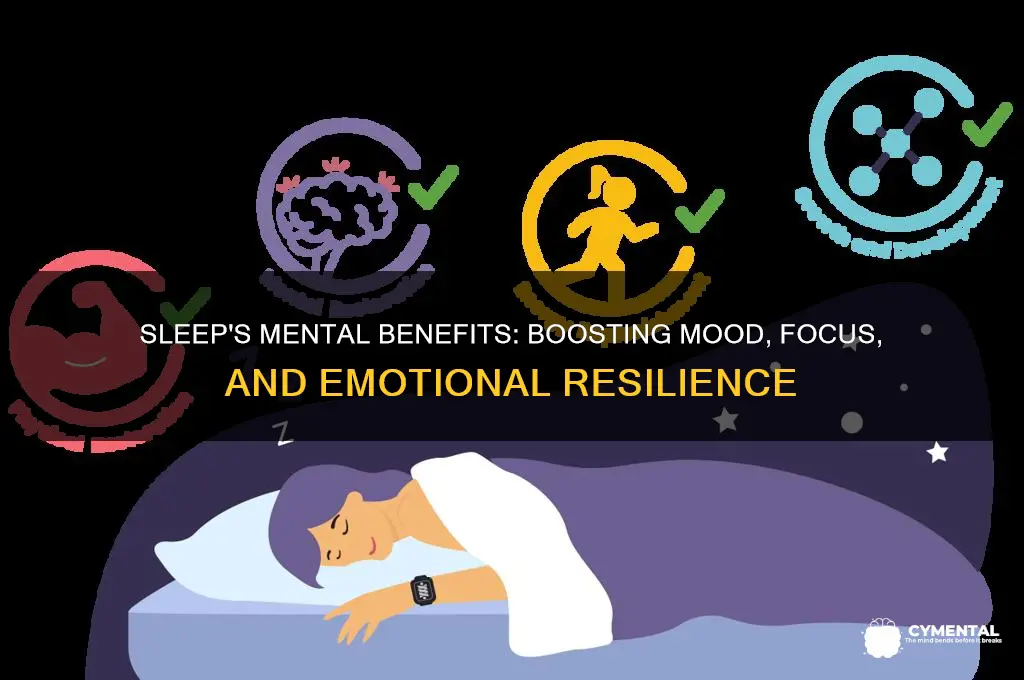
Sleep plays a crucial role in maintaining and enhancing mental health by allowing the brain to process emotions, consolidate memories, and restore cognitive functions. During sleep, the brain clears out toxins and strengthens neural connections, which supports learning, problem-solving, and creativity. Adequate rest also regulates mood by balancing neurotransmitters like serotonin and dopamine, reducing the risk of anxiety, depression, and irritability. Furthermore, sleep helps manage stress by lowering cortisol levels, promoting emotional resilience, and improving overall psychological well-being. In essence, quality sleep is essential for a healthy mind, enabling clearer thinking, better emotional regulation, and enhanced mental clarity.
| Characteristics | Values |
|---|---|
| Cognitive Function | Enhances memory consolidation, problem-solving, and decision-making abilities. Sleep helps in synaptic pruning, which strengthens neural connections essential for learning and creativity. |
| Emotional Regulation | Improves mood stability and reduces the risk of mood disorders like depression and anxiety. Sleep helps regulate the amygdala, the brain's emotional center. |
| Stress Reduction | Lowers cortisol (stress hormone) levels, promoting relaxation and resilience to stressors. |
| Mental Resilience | Boosts the ability to cope with challenges and adversity by supporting emotional and cognitive flexibility. |
| Attention and Focus | Enhances concentration, vigilance, and the ability to sustain attention on tasks. |
| Reduced Risk of Mental Disorders | Adequate sleep is linked to a lower risk of developing conditions like schizophrenia, bipolar disorder, and PTSD. |
| Neuroplasticity | Supports brain plasticity, allowing for better adaptation and recovery from mental challenges. |
| Clearing Toxins | During sleep, the glymphatic system clears waste products and toxins from the brain, maintaining mental clarity. |
| Hormonal Balance | Regulates hormones like serotonin and dopamine, which are crucial for mood, motivation, and overall mental well-being. |
| Improved Social Skills | Enhances empathy, communication, and the ability to interpret social cues, fostering better relationships. |
Explore related products





What You'll Learn
- Memory Consolidation: Sleep strengthens neural connections, enhancing memory retention and recall
- Emotional Regulation: Adequate sleep helps manage stress, anxiety, and mood stability
- Cognitive Performance: Rest improves focus, problem-solving, and decision-making abilities
- Stress Reduction: Sleep lowers cortisol levels, reducing mental tension and fatigue
- Creativity Boost: REM sleep fosters creative thinking and innovative problem-solving

Memory Consolidation: Sleep strengthens neural connections, enhancing memory retention and recall
Sleep isn’t just downtime for your brain—it’s an active period of reorganization and strengthening. During sleep, especially deep sleep, your brain replays and consolidates memories, transferring them from short-term to long-term storage. This process hinges on the strengthening of neural connections, a biological mechanism that ensures you retain and recall information more effectively. Without adequate sleep, these connections remain weak, and memories fade like unpreserved photographs.
Consider this: a student pulls an all-nighter to cram for an exam. Despite hours of studying, they struggle to recall key details the next day. Why? Because sleep deprivation disrupts memory consolidation. Research shows that even a single night of poor sleep can reduce memory retention by up to 40%. Conversely, a study published in *Nature Neuroscience* found that participants who slept after learning retained 85% of new information, compared to just 60% for those who stayed awake. The takeaway? Sleep isn’t optional for memory—it’s essential.
To harness sleep’s memory-boosting power, prioritize 7–9 hours of uninterrupted sleep per night, especially after learning new material. Aim for consistency, as irregular sleep patterns can hinder consolidation. For optimal results, incorporate a 20-minute nap after studying; this brief rest can enhance memory recall by 20%, according to a study in the *Journal of Sleep Research*. Avoid screens before bed, as blue light suppresses melatonin, the hormone that regulates sleep. Instead, create a calming bedtime routine—reading, meditation, or gentle stretching—to signal to your brain that it’s time to consolidate the day’s memories.
Compare this to how athletes train: just as muscles repair during rest, neural connections strengthen during sleep. Think of sleep as your brain’s recovery session, fine-tuning the day’s mental exertions. For older adults, whose sleep quality often declines, this is particularly crucial. A study in *Science* found that adults over 65 who improved their sleep quality through cognitive-behavioral therapy saw a 30% increase in memory performance. Age is no barrier—better sleep equals better memory, regardless of how many years you’ve lived.
Incorporate these habits, and you’ll transform sleep from a passive activity into an active tool for mental enhancement. By strengthening neural connections, sleep doesn’t just preserve memories—it sharpens them, ensuring you’re not just retaining information but recalling it with clarity and precision. The next time you’re tempted to skimp on sleep, remember: you’re not just resting; you’re building the foundation for a sharper, more resilient mind.
Nami's Impact: Empowering Mental Health Support and Awareness
You may want to see also
Explore related products


Emotional Regulation: Adequate sleep helps manage stress, anxiety, and mood stability
Sleep is the brain’s nightly reset button, and its role in emotional regulation is both profound and measurable. Studies show that during deep sleep, the amygdala—the brain’s emotional alarm system—cools down, while the prefrontal cortex, responsible for rational decision-making, strengthens its connections. This overnight recalibration is why a well-rested individual can approach a stressful situation with clarity rather than reactivity. For example, research published in the *Journal of Neuroscience* found that participants who slept after an emotionally charged event were 30% less likely to overreact to similar stimuli the next day compared to sleep-deprived individuals.
To harness sleep’s emotional benefits, aim for 7–9 hours of uninterrupted rest per night, particularly for adults. Adolescents, whose brains are still developing emotional regulation pathways, require 8–10 hours. Practical tips include maintaining a consistent sleep schedule, even on weekends, and creating a bedtime routine that signals to your brain it’s time to wind down. Avoid screens at least an hour before bed, as blue light suppresses melatonin, the hormone that regulates sleep. Instead, opt for activities like reading, journaling, or practicing deep-breathing exercises to reduce pre-sleep anxiety.
Consider the comparative impact of sleep on stress hormones. A single night of poor sleep can elevate cortisol levels by up to 37%, according to a study in *Psychoneuroendocrinology*. Over time, this chronic elevation contributes to heightened anxiety and irritability. Conversely, adequate sleep promotes the production of serotonin, a neurotransmitter linked to mood stability. For those struggling with anxiety, prioritizing sleep is as critical as any therapeutic intervention. A cautionary note: relying on sleep aids or alcohol to induce sleep can disrupt REM cycles, undermining the emotional regulation benefits of natural sleep.
Finally, view sleep as a proactive tool for emotional resilience. Just as athletes prioritize recovery to enhance performance, individuals can use sleep to fortify their mental health. For instance, a study in *Nature Communications* revealed that participants who consistently slept 7–8 hours per night reported a 40% reduction in mood disturbances over a six-month period. This isn’t about perfection—it’s about consistency. Even small improvements, like going to bed 30 minutes earlier, can yield noticeable emotional benefits. Treat sleep not as a luxury, but as a non-negotiable pillar of mental well-being.
Gardening for Mental Health: Cultivating Peace and Well-Being Naturally
You may want to see also
Explore related products


Cognitive Performance: Rest improves focus, problem-solving, and decision-making abilities
Sleep is the unsung hero of cognitive performance, sharpening focus, enhancing problem-solving, and refining decision-making abilities. During deep sleep, the brain consolidates memories and clears waste products, optimizing neural pathways for peak efficiency. Studies show that even a single night of adequate sleep (7–9 hours for adults) can improve attention span by up to 20%. Conversely, sleep deprivation disrupts these processes, leading to mental fog and impaired judgment. For students, professionals, or anyone facing complex tasks, prioritizing sleep isn’t a luxury—it’s a necessity for mental clarity.
Consider the practical implications of sleep on problem-solving. Research from the *Journal of Experimental Psychology* found that individuals who slept after encountering a challenging puzzle were twice as likely to solve it the next day compared to those who stayed awake. This phenomenon occurs because sleep strengthens the brain’s ability to recognize patterns and make connections, a critical skill for creative and analytical thinking. For instance, a programmer struggling with a bug in their code might find the solution more easily after a full night’s rest. The takeaway? When faced with a difficult problem, stepping away and sleeping on it isn’t just a saying—it’s science-backed advice.
Decision-making, another cognitive function heavily influenced by sleep, suffers dramatically under fatigue. A study published in *Sleep Medicine Reviews* revealed that sleep-deprived individuals are more likely to make impulsive decisions and struggle with risk assessment. This is because sleep deprivation impairs the prefrontal cortex, the brain region responsible for rational decision-making. For high-stakes decisions—whether in business, health, or personal life—ensuring adequate sleep can mean the difference between a sound choice and a costly mistake. Aim for a consistent sleep schedule, especially before important meetings or negotiations, to keep your decision-making sharp.
To maximize cognitive performance through sleep, adopt these actionable strategies. First, establish a bedtime routine that signals to your brain it’s time to wind down—dim lights, avoid screens, and incorporate calming activities like reading or meditation. Second, optimize your sleep environment: keep the room cool (60–67°F), dark, and quiet. Third, limit caffeine intake after 2 p.m. and avoid heavy meals or alcohol close to bedtime, as these disrupt sleep quality. Finally, for those with irregular schedules, strategic napping (20–30 minutes) can temporarily boost focus without interfering with nighttime sleep. Small adjustments to your sleep habits can yield significant improvements in mental acuity, making every hour of rest count.
Supporting Mental Health: Practical Ways to Help Someone in Need
You may want to see also
Explore related products


Stress Reduction: Sleep lowers cortisol levels, reducing mental tension and fatigue
Cortisol, often dubbed the "stress hormone," surges in response to mental and physical strain, preparing the body for fight or flight. Sleep acts as a natural regulator, dialing down cortisol production during its later stages, particularly in REM sleep. Studies show that adults who achieve 7-9 hours of uninterrupted sleep experience a 10-15% reduction in morning cortisol levels compared to those with fragmented or insufficient rest. This hormonal reset is critical, as chronically elevated cortisol impairs cognitive function, weakens the immune system, and exacerbates anxiety.
Consider the nightly ritual of sleep as a form of hormonal housekeeping. During deep sleep, the body suppresses the hypothalamic-pituitary-adrenal (HPA) axis, the system responsible for cortisol release. For individuals under constant stress—whether from work, relationships, or environmental factors—prioritizing sleep becomes a non-negotiable tool for recalibrating this axis. A practical tip: establish a "wind-down" routine 60-90 minutes before bed, avoiding screens and incorporating relaxation techniques like deep breathing or progressive muscle relaxation to signal to your body that it’s time to lower cortisol levels.
The link between sleep and cortisol is particularly evident in high-stress populations, such as healthcare workers or students. Research indicates that those who maintain consistent sleep schedules, even during peak stress periods, report lower perceived mental tension and fatigue. For instance, a study of medical residents found that those who slept 6-7 hours per night had cortisol levels 20% lower than colleagues averaging 4-5 hours. This highlights the compounding benefits of sleep: not only does it reduce cortisol, but it also enhances emotional resilience, making stressors feel more manageable.
To harness sleep’s stress-reducing power, focus on both duration and quality. Aim for 7-9 hours nightly, but also optimize your sleep environment—keep the room cool (60-67°F), dark, and quiet. Limit caffeine intake after 2 p.m., as it can disrupt cortisol rhythms and delay sleep onset. For those struggling with stress-induced insomnia, cognitive-behavioral therapy for insomnia (CBT-I) has proven effective, with 70-80% of patients experiencing improved sleep and reduced cortisol levels within 4-8 weeks.
Finally, view sleep as an active investment in mental health, not a passive activity. Just as you’d schedule a workout or meal, prioritize sleep as a daily stress-reduction strategy. Track your sleep patterns using a journal or app to identify trends and adjust habits accordingly. Remember, lowering cortisol isn’t just about feeling less stressed—it’s about safeguarding your brain’s ability to process emotions, solve problems, and maintain clarity in the face of life’s challenges.
Mind Over Pain: Mental Strategies to Ease Chronic Discomfort
You may want to see also
Explore related products


Creativity Boost: REM sleep fosters creative thinking and innovative problem-solving
Sleep isn't just downtime for your body; it's a powerhouse for your brain, particularly when it comes to creativity. During REM (Rapid Eye Movement) sleep, your brain consolidates memories, processes emotions, and makes connections between seemingly unrelated ideas. This stage of sleep, characterized by vivid dreaming, is where the magic happens for creative thinking.
Think of it like a mental defragmentation. While you're asleep, your brain sorts through the day's information, discarding the unnecessary and forging new pathways between concepts. This process allows for the emergence of novel ideas and solutions to problems that might have seemed insurmountable while awake.
Imagine you're a writer struggling with a plot twist. A good night's sleep, especially one rich in REM, can act as a creative catalyst. During REM sleep, your brain might connect a character's backstory to a news article you read weeks ago, sparking a breakthrough that seamlessly weaves the two together. This isn't just anecdotal; studies have shown that people who get enough REM sleep perform better on tasks requiring creative problem-solving and divergent thinking.
A 2004 study published in the journal "Nature" found that participants who slept after learning a complex task were significantly better at identifying hidden rules within the task compared to those who stayed awake. This suggests that REM sleep plays a crucial role in extracting meaning and patterns from information, a key component of creative thinking.
To harness the creative power of REM sleep, aim for 7-9 hours of uninterrupted sleep each night. This ensures you cycle through all sleep stages, including multiple REM periods. Avoid caffeine and alcohol close to bedtime, as they can disrupt sleep quality. Establish a relaxing bedtime routine to signal to your body that it's time to wind down. Reading, listening to calming music, or practicing deep breathing exercises can all help prepare your mind for a night of productive dreaming.
Media's Role in Shattering Mental Health Stigma: Strategies for Change
You may want to see also
Frequently asked questions
Sleep helps consolidate memories and clears out waste products in the brain, enhancing cognitive functions like attention, problem-solving, and decision-making. Lack of sleep impairs these abilities, leading to mental fog and reduced productivity.
Yes, sleep regulates the body’s stress response system. During deep sleep, the brain processes emotions and reduces cortisol (stress hormone) levels. Poor sleep can heighten anxiety and make it harder to cope with stress.
Absolutely. Sleep helps the brain process and regulate emotions by strengthening connections between the amygdala (emotion center) and prefrontal cortex (logic center). Sleep deprivation often leads to irritability, mood swings, and difficulty managing emotions.