Lucas Bennett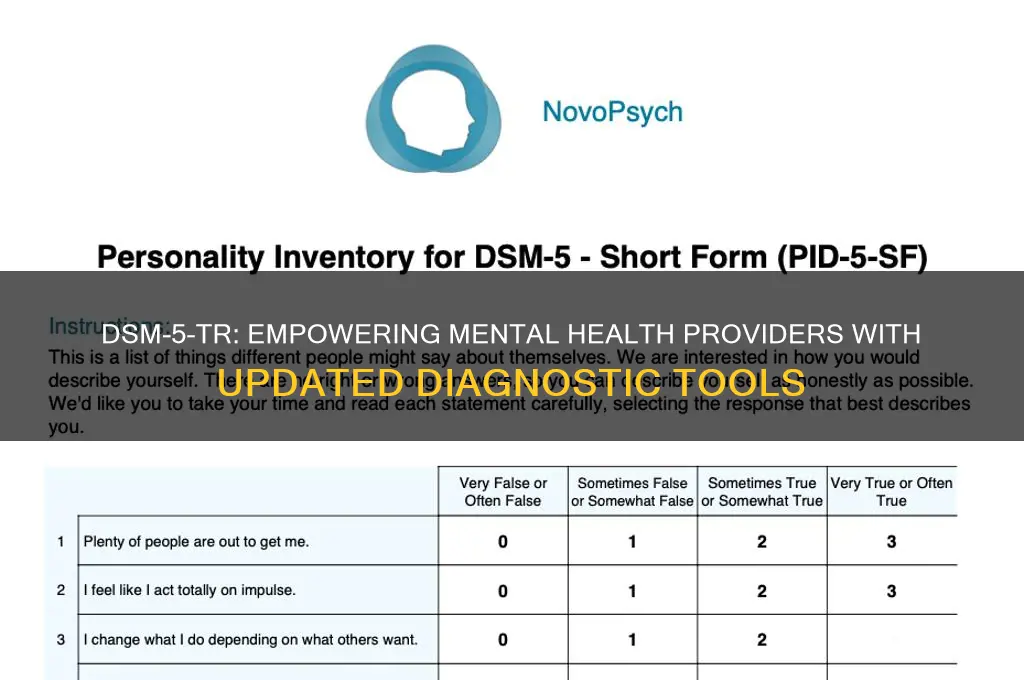
The DSM-5-TR (Diagnostic and Statistical Manual of Mental Disorders, Fifth Edition, Text Revision) serves as an indispensable tool for mental health providers by offering updated diagnostic criteria, clinical insights, and culturally sensitive guidelines. It enhances accuracy in diagnosing mental health conditions, ensuring providers align with the latest research and best practices. The manual’s structured framework facilitates consistent communication among professionals, improves treatment planning, and supports evidence-based interventions. Additionally, its inclusion of revised criteria and emerging trends helps clinicians address complex cases more effectively, ultimately improving patient outcomes and the overall quality of mental health care.
Explore related products


What You'll Learn
- Standardized Diagnosis: Provides consistent criteria for accurate identification of mental health conditions across providers
- Cultural Considerations: Enhances culturally sensitive assessments and treatment planning for diverse populations
- Updated Research: Incorporates latest scientific findings to improve diagnostic accuracy and treatment approaches
- Clinical Utility: Streamlines decision-making with clear guidelines and improved organization of disorders
- Interdisciplinary Use: Facilitates collaboration among professionals by offering a shared diagnostic language

Standardized Diagnosis: Provides consistent criteria for accurate identification of mental health conditions across providers
The DSM-5-TR (Diagnostic and Statistical Manual of Mental Disorders, Fifth Edition, Text Revision) serves as a cornerstone for mental health providers by offering standardized diagnostic criteria. This uniformity ensures that clinicians across diverse settings—from private practices to large hospitals—use the same benchmarks when assessing patients. For instance, a psychiatrist in New York and a psychologist in California will both refer to the same set of symptoms and severity thresholds when diagnosing major depressive disorder. This consistency minimizes discrepancies that could arise from subjective interpretations, fostering a shared language in mental health care.
Consider the practical implications of this standardization. Without it, a patient might receive conflicting diagnoses based on a provider’s training, experience, or theoretical orientation. The DSM-5-TR mitigates this risk by providing clear, evidence-based guidelines. For example, the criteria for generalized anxiety disorder specify that excessive worry must be present more days than not for at least six months, accompanied by symptoms like restlessness or difficulty concentrating. Such specificity helps providers differentiate between normal stress and a diagnosable condition, reducing the likelihood of over- or under-diagnosis.
However, standardization is not without challenges. While the DSM-5-TR provides a framework, it does not account for individual variability in symptom presentation. A 25-year-old with autism spectrum disorder may exhibit vastly different behaviors than a 60-year-old with the same diagnosis. Providers must balance adherence to criteria with clinical judgment, ensuring that the diagnosis reflects the patient’s unique experience. The DSM-5-TR acknowledges this by incorporating specifiers and severity ratings, allowing for nuanced assessments.
To maximize the utility of standardized diagnosis, providers should integrate the DSM-5-TR with other assessment tools. For instance, pairing diagnostic criteria with validated screening instruments, such as the PHQ-9 for depression, enhances accuracy. Additionally, ongoing training in DSM-5-TR updates ensures providers stay current with revisions, such as the inclusion of prolonged grief disorder in the latest edition. By combining standardization with clinical expertise, mental health professionals can deliver diagnoses that are both reliable and patient-centered.
Ultimately, the DSM-5-TR’s standardized approach empowers providers to identify mental health conditions with confidence and precision. It bridges gaps in communication, improves treatment planning, and supports research by ensuring consistency across studies. While it is not a one-size-fits-all solution, its structured criteria provide a vital foundation for effective mental health care. Providers who master its application can navigate the complexities of diagnosis with greater clarity, ultimately benefiting their patients.
Unplugging for Peace: How Less Social Media Boosts Mental Health
You may want to see also
Explore related products

![[New Update 2025 DSM 5 TR] Desk Reference to the Diagnostic Criteria from Dsm-5-Tr Paperback [Update 100 Clinical Cases]](https://m.media-amazon.com/images/I/51AImnE-sRL._AC_UY218_.jpg)


Cultural Considerations: Enhances culturally sensitive assessments and treatment planning for diverse populations
The DSM-5-TR acknowledges a critical truth: mental health is not a one-size-fits-all concept. Cultural background profoundly shapes how individuals experience, express, and cope with distress. This revised manual equips providers with tools to move beyond a Eurocentric lens, fostering more accurate diagnoses and effective treatment for diverse populations.
A key addition is the expanded Cultural Formulation Interview (CFI), a structured guide for exploring how cultural factors influence a patient's presentation. This isn't just about ticking boxes for ethnicity; it delves into beliefs about illness, family dynamics, and preferred communication styles. For instance, a provider might learn that a patient from a collectivist culture prioritizes family harmony over individual expression of distress, leading to somatic complaints rather than direct emotional disclosure.
This cultural lens is crucial for avoiding misdiagnosis. Symptoms like hearing voices, for example, might be interpreted as schizophrenia in a Western context, but in some cultures, they could be understood as spiritual experiences or ancestral communication. The DSM-5-TR encourages providers to consider these possibilities, preventing inappropriate medication and fostering culturally congruent interventions.
Imagine a Latino adolescent presenting with anxiety and sleep disturbances. A culturally insensitive approach might focus solely on individual coping mechanisms. The DSM-5-TR prompts the provider to explore family dynamics, acculturation stress, and potential discrimination experiences, leading to a more comprehensive understanding and potentially involving family therapy or community-based support systems.
However, the DSM-5-TR is a tool, not a magic bullet. Providers must actively engage with its cultural considerations, seeking ongoing training and supervision to avoid stereotypes and cultural incompetence. It's a starting point, a framework for a more nuanced and empathetic approach to mental health care that recognizes the richness and diversity of human experience.
Supporting Your Partner: Strategies to Combat Mental Exhaustion Together
You may want to see also
Explore related products


Updated Research: Incorporates latest scientific findings to improve diagnostic accuracy and treatment approaches
The DSM-5-TR, the latest update to the Diagnostic and Statistical Manual of Mental Disorders, serves as a critical tool for mental health providers by integrating the most recent scientific research. This incorporation of updated findings directly enhances diagnostic accuracy, ensuring clinicians can differentiate between conditions with overlapping symptoms more effectively. For instance, the revised criteria for Attention-Deficit/Hyperactivity Disorder (ADHD) now include age-specific symptom presentations, such as reduced hyperactivity in adults, which helps providers avoid misdiagnosing ADHD as a mood disorder or anxiety in older patients. This precision is vital, as accurate diagnosis is the foundation for effective treatment planning.
One of the standout features of the DSM-5-TR is its emphasis on evidence-based practice. By synthesizing the latest research, the manual provides clinicians with a robust framework to select appropriate interventions. For example, updated research on trauma-informed care has led to revised guidelines for diagnosing Post-Traumatic Stress Disorder (PTSD), including the addition of dissociative symptoms as a subtype. This refinement allows providers to tailor treatment plans, such as incorporating Eye Movement Desensitization and Reprocessing (EMDR) or trauma-focused cognitive-behavioral therapy, which have shown efficacy in randomized controlled trials. The manual’s focus on current research ensures that providers are not relying on outdated or ineffective methods.
Incorporating the latest scientific findings also addresses gaps in previous editions, particularly in culturally responsive diagnosis. The DSM-5-TR includes expanded cultural formulations, drawing from research on how mental health presentations vary across populations. For instance, studies have shown that depression in some cultures may manifest more somatically than emotionally. By acknowledging these differences, providers can avoid misdiagnosis and offer more culturally sensitive care. This is especially critical in diverse clinical settings, where a one-size-fits-all approach can lead to disparities in treatment outcomes.
Practical application of the DSM-5-TR’s updated research is further enhanced by its inclusion of dimensional assessments. For conditions like autism spectrum disorder, the manual now encourages clinicians to assess symptom severity across domains, such as social communication and restricted interests. This approach, backed by longitudinal studies, allows for a more nuanced understanding of a patient’s functioning and needs. For example, a child with mild social deficits but significant repetitive behaviors may benefit from targeted social skills training alongside behavioral interventions, a strategy supported by recent research on personalized treatment plans.
Finally, the DSM-5-TR’s commitment to updated research fosters a dynamic approach to mental health care, encouraging providers to stay informed about emerging findings. The manual includes provisional categories for conditions under ongoing study, such as prolonged grief disorder, which was added based on recent research validating its distinct clinical presentation. This forward-looking perspective ensures that providers are prepared to adapt their practices as new evidence emerges, ultimately improving patient outcomes. By grounding diagnosis and treatment in the latest science, the DSM-5-TR empowers clinicians to deliver care that is both accurate and innovative.
Mental Health Models: Empowering Communities Through Support and Awareness
You may want to see also
Explore related products





Clinical Utility: Streamlines decision-making with clear guidelines and improved organization of disorders
The DSM-5-TR (Text Revision) enhances clinical utility by providing mental health providers with a structured framework that simplifies diagnostic decision-making. Its clear guidelines reduce ambiguity, ensuring clinicians can confidently assess and categorize disorders. For instance, the revised criteria for Autism Spectrum Disorder (ASD) now explicitly address symptom presentation across different age groups, such as repetitive behaviors in children versus adolescents. This specificity helps providers tailor their evaluations to developmental stages, improving accuracy and reducing misdiagnosis. By organizing disorders into distinct categories with defined thresholds, the DSM-5-TR minimizes diagnostic overlap and streamlines the process, allowing providers to focus on treatment planning rather than deciphering criteria.
Consider the practical application of these guidelines in a clinical setting. A therapist evaluating a 12-year-old for anxiety disorders can refer to the DSM-5-TR’s detailed descriptions of separation anxiety versus generalized anxiety disorder. The manual specifies that separation anxiety is characterized by excessive fear or anxiety concerning separation from attachment figures, while generalized anxiety involves excessive worry about multiple events or activities. This clarity enables the therapist to differentiate between the two, ensuring the correct diagnosis and subsequent intervention. For example, cognitive-behavioral therapy (CBT) might be prioritized for generalized anxiety, whereas family-based interventions could be more effective for separation anxiety.
However, clinicians must exercise caution when applying these guidelines. While the DSM-5-TR provides a standardized approach, it is not a one-size-fits-all solution. Cultural, socioeconomic, and individual factors can influence symptom presentation, and providers should remain mindful of these nuances. For instance, a client from a collectivist culture might express anxiety symptoms differently than someone from an individualistic culture. The DSM-5-TR’s improved organization facilitates initial decision-making but should be supplemented with clinical judgment and contextual understanding to ensure holistic care.
Ultimately, the DSM-5-TR’s streamlined structure and clear guidelines serve as a powerful tool for mental health providers, fostering consistency and efficiency in diagnosis. By reducing diagnostic uncertainty, it empowers clinicians to allocate more time to treatment and client support. For example, a psychiatrist diagnosing major depressive disorder can quickly reference the manual’s criteria—such as persistent depressed mood or significant weight changes—to confirm the diagnosis and proceed with evidence-based interventions like selective serotonin reuptake inhibitors (SSRIs) at appropriate dosages (e.g., 20–40 mg/day for fluoxetine). This integration of clear guidelines and practical application underscores the DSM-5-TR’s role in enhancing clinical utility and improving patient outcomes.
Art Museums: Healing Spaces for Mental Well-Being and Self-Discovery
You may want to see also
Explore related products


Interdisciplinary Use: Facilitates collaboration among professionals by offering a shared diagnostic language
The DSM-5-TR serves as a Rosetta Stone for mental health professionals, bridging the gap between disciplines by providing a standardized diagnostic language. This shared vocabulary is crucial in a field where psychiatrists, psychologists, social workers, and nurses often collaborate on complex cases. Without it, a psychologist might describe a patient's symptoms as "anxious and avoidant," while a psychiatrist labels the same behavior as "consistent with generalized anxiety disorder." The DSM-5-TR's clear criteria ensure everyone is speaking the same language, fostering seamless communication and coordinated care.
Imagine a 35-year-old woman presenting with insomnia, fatigue, and difficulty concentrating. A primary care physician might suspect anemia, a psychologist might consider depression, and a neurologist might investigate sleep apnea. By referencing the DSM-5-TR's diagnostic criteria for Major Depressive Disorder, the team can quickly align their understanding, avoiding redundant tests and ensuring a comprehensive evaluation.
This shared language isn't just about avoiding misunderstandings; it's about optimizing treatment. Consider a child exhibiting aggressive behavior. A school counselor might focus on behavioral interventions, while a child psychiatrist might prescribe medication. The DSM-5-TR's criteria for Oppositional Defiant Disorder provide a common ground for discussion, allowing the team to develop a multifaceted treatment plan that addresses both environmental and biological factors.
Think of the DSM-5-TR as a map for a complex journey. Each professional brings their own expertise, but the map ensures everyone is navigating towards the same destination: effective treatment. By providing a standardized framework, the DSM-5-TR empowers interdisciplinary teams to work cohesively, ultimately leading to better outcomes for patients.
Teens Supporting Teens: Empowering Mental Health Through Peer Connections
You may want to see also
Frequently asked questions
The DSM-5-TR (Diagnostic and Statistical Manual of Mental Disorders, Fifth Edition, Text Revision) is an updated version of the DSM-5, incorporating the latest research, clinical insights, and changes in diagnostic criteria. It includes revised text, updated ICD-10-CM codes, and clarifications to improve accuracy and usability for mental health providers.
The DSM-5-TR provides standardized criteria and guidelines for diagnosing mental disorders, ensuring consistency across providers. It includes updated information on symptoms, severity, and cultural considerations, helping clinicians make more accurate and informed diagnoses.
The DSM-5-TR assists providers in developing tailored treatment plans by offering a clear understanding of a client’s diagnosis. It includes information on differential diagnosis, comorbidities, and evidence-based treatment recommendations, guiding clinicians in selecting appropriate interventions.
The DSM-5-TR emphasizes cultural sensitivity by providing updated cultural formulations and guidance on how cultural factors may influence symptom presentation and diagnosis. This helps providers avoid biases and ensure more accurate assessments across diverse populations.
The DSM-5-TR includes updated ICD-10-CM codes, which are essential for accurate billing and insurance reimbursement. It also provides clear diagnostic criteria and descriptors, helping providers maintain thorough and compliant documentation for legal and administrative purposes.