Ava Ramirez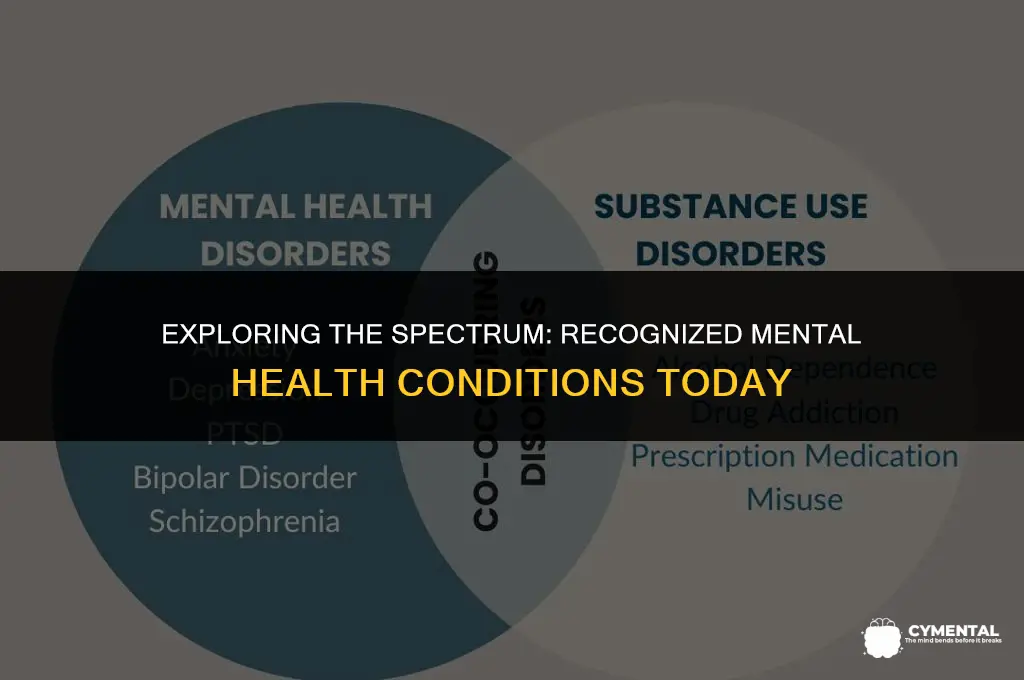
Mental health conditions encompass a broad spectrum of disorders that affect an individual's emotional, psychological, and social well-being. As of the latest diagnostic manuals and research, there are numerous recognized mental health conditions, each with its own set of criteria and symptoms. These conditions range from common disorders like depression and anxiety to more complex and less prevalent ones such as schizophrenia and dissociative disorders. The exact number of recognized conditions can vary depending on the source and the diagnostic framework used, but it is clear that mental health is a multifaceted field with a wide array of challenges that can impact people of all ages and backgrounds. Understanding and acknowledging these conditions is crucial for promoting awareness, reducing stigma, and ensuring that those affected can access appropriate care and support.
Explore related products


What You'll Learn
- Classification Systems: Explore the primary frameworks used to categorize mental health conditions, such as the DSM-5 and ICD-11
- Diagnostic Criteria: Discuss the specific symptoms and thresholds required to diagnose various mental health disorders
- Prevalence Rates: Examine the estimated frequency of different mental health conditions within populations worldwide
- Cultural Variations: Analyze how cultural differences influence the recognition and diagnosis of mental health disorders
- Emerging Conditions: Investigate newly identified or proposed mental health conditions not yet widely recognized

Classification Systems: Explore the primary frameworks used to categorize mental health conditions, such as the DSM-5 and ICD-11
The Diagnostic and Statistical Manual of Mental Disorders, Fifth Edition (DSM-5) and the International Classification of Diseases, 11th Revision (ICD-11) are the two primary frameworks used globally to categorize mental health conditions. The DSM-5, published by the American Psychiatric Association, is predominantly used in the United States and provides a detailed classification system for mental disorders, including criteria for diagnosis and codes for billing and research purposes. On the other hand, the ICD-11, developed by the World Health Organization, is used internationally and integrates mental health conditions into a broader classification system that includes physical health disorders.
One of the key differences between the DSM-5 and ICD-11 lies in their approach to classification. The DSM-5 uses a categorical approach, where each mental health condition is considered a distinct entity with specific diagnostic criteria. In contrast, the ICD-11 employs a dimensional approach, which allows for a more nuanced understanding of mental health conditions by considering the severity and impact of symptoms on an individual's functioning. This dimensional approach also facilitates a more personalized treatment plan, as it takes into account the unique characteristics of each patient's condition.
Both classification systems have undergone significant revisions over the years to reflect advances in research and clinical practice. The DSM-5, for example, introduced new disorders such as binge eating disorder and internet gaming disorder, while also reorganizing existing disorders into more coherent categories. Similarly, the ICD-11 has expanded its coverage of mental health conditions to include new disorders such as gaming disorder and has revised existing categories to better align with current clinical practice.
Despite their differences, the DSM-5 and ICD-11 share a common goal of providing a standardized framework for the diagnosis and treatment of mental health conditions. This standardization is crucial for ensuring that patients receive consistent and effective care, regardless of where they are located or which healthcare provider they see. Additionally, these classification systems play a vital role in research, allowing scientists to study mental health conditions in a systematic and comparable manner.
In conclusion, the DSM-5 and ICD-11 are essential tools in the field of mental health, providing clinicians and researchers with a structured approach to understanding and treating mental health conditions. While they have their differences, both systems contribute to the overall goal of improving mental health care and advancing our knowledge of mental disorders.
Navigating Mental Health Conversations in the Workplace
You may want to see also
Explore related products

$24.99 $24.99


![Mental Health and Mental Disorders: An Encyclopedia of Conditions, Treatments, and Well-Being [3 volumes]](https://m.media-amazon.com/images/I/81Rp9ZjDRZL._AC_UY218_.jpg)

Diagnostic Criteria: Discuss the specific symptoms and thresholds required to diagnose various mental health disorders
The Diagnostic and Statistical Manual of Mental Disorders (DSM-5) is the primary reference used by mental health professionals in the United States to diagnose mental health conditions. It outlines specific diagnostic criteria for each disorder, including symptoms, duration, and severity thresholds that must be met for a diagnosis to be made. For example, to diagnose Major Depressive Disorder, a patient must experience at least five symptoms, such as persistent sadness, loss of interest in activities, and changes in sleep or appetite, for a period of two weeks or more.
The DSM-5 also includes specifiers that can be added to diagnoses to provide more detailed information about the condition. For instance, a diagnosis of Schizophrenia can be specified as paranoid, disorganized, catatonic, undifferentiated, or residual, depending on the predominant symptoms. These specifiers help clinicians tailor treatment plans to the individual needs of patients.
In addition to symptom criteria, the DSM-5 often requires that symptoms cause significant distress or impairment in social, occupational, or other important areas of functioning. This ensures that diagnoses are not made for minor or transient symptoms that do not have a substantial impact on a person's life. For example, a diagnosis of Generalized Anxiety Disorder requires that the anxiety and worry are difficult to control and cause significant distress or impairment.
The DSM-5 is periodically updated to reflect new research and clinical practices. The most recent update, DSM-5-TR, was released in 2022 and includes revisions to several disorders, such as Autism Spectrum Disorder and Attention-Deficit/Hyperactivity Disorder. These updates aim to improve the accuracy and usefulness of diagnoses in clinical settings.
It is important to note that while the DSM-5 provides a standardized framework for diagnosing mental health conditions, it is not without controversy. Some critics argue that the manual is overly reliant on symptom checklists and does not adequately consider the social and cultural contexts in which symptoms occur. Others have raised concerns about the potential for overdiagnosis and the medicalization of normal human experiences. Despite these criticisms, the DSM-5 remains a widely used and influential tool in the field of mental health.
Exploring National Men's Mental Health Month: A Time for Awareness and Action
You may want to see also
Explore related products

$14.81 $15.95


Prevalence Rates: Examine the estimated frequency of different mental health conditions within populations worldwide
According to the World Health Organization (WHO), approximately 1 in 4 people worldwide will experience a mental health condition at some point in their lives. This statistic underscores the ubiquity of mental health issues across different populations and cultures. The prevalence rates of specific conditions can vary widely, influenced by factors such as genetics, environment, socioeconomic status, and access to healthcare.
Depression is one of the most common mental health conditions globally, with an estimated 264 million people affected. Anxiety disorders are also prevalent, impacting around 284 million individuals. These conditions often co-occur, and their symptoms can significantly impair daily functioning and overall well-being.
Schizophrenia, while less common than depression and anxiety, still affects approximately 20 million people worldwide. This chronic condition is characterized by symptoms such as delusions, hallucinations, and disorganized thinking, which can be debilitating without proper treatment.
In addition to these conditions, there are numerous other recognized mental health disorders, each with its own set of diagnostic criteria and prevalence rates. For example, bipolar disorder affects around 45 million people, while obsessive-compulsive disorder (OCD) impacts about 2.2 million individuals in the United States alone.
Understanding the prevalence rates of different mental health conditions is crucial for informing public health policies, allocating resources, and reducing stigma. By recognizing the widespread nature of these issues, societies can work towards providing better support and treatment options for those affected.
Understanding Inpatient Mental Health Stays: Duration and Factors
You may want to see also
Explore related products


Cultural Variations: Analyze how cultural differences influence the recognition and diagnosis of mental health disorders
Cultural variations significantly impact the recognition and diagnosis of mental health disorders. What may be considered a symptom in one culture might be viewed as a normal behavior in another. For instance, in some cultures, hearing voices is considered a spiritual experience rather than a sign of schizophrenia. This highlights the importance of cultural competence in mental health diagnosis.
The Diagnostic and Statistical Manual of Mental Disorders (DSM), widely used in the United States, has been criticized for its lack of cultural sensitivity. It often fails to account for how symptoms may manifest differently across cultures. This can lead to misdiagnosis and inappropriate treatment. For example, a person from a collectivist culture may express symptoms of depression differently than someone from an individualistic culture, potentially leading to an incorrect diagnosis.
To address these issues, some mental health professionals advocate for a more culturally informed approach to diagnosis. This includes considering the patient's cultural background, beliefs, and values when interpreting symptoms. Additionally, incorporating cultural consultants or using culturally adapted assessment tools can help improve the accuracy of diagnoses.
In practice, this means that mental health professionals should be trained to recognize and respect cultural differences. They should also be aware of their own cultural biases and how these may influence their diagnostic decisions. By taking a more nuanced and culturally sensitive approach, we can improve the recognition and diagnosis of mental health disorders across diverse populations.
Ultimately, understanding cultural variations is crucial for providing effective mental health care. It ensures that patients receive accurate diagnoses and appropriate treatments that are sensitive to their cultural contexts. This not only improves individual outcomes but also helps to reduce health disparities and promote mental health equity.
Nurturing Your Mind: A Guide to Mental Health Care
You may want to see also
Explore related products


Emerging Conditions: Investigate newly identified or proposed mental health conditions not yet widely recognized
The landscape of mental health is constantly evolving, with new conditions being identified and proposed as our understanding of the human psyche deepens. Emerging conditions, though not yet widely recognized, play a crucial role in shaping the future of mental health care. These conditions often arise from a confluence of factors, including advances in research, changes in societal norms, and the recognition of previously overlooked symptoms.
One such emerging condition is "eco-anxiety," a term used to describe the anxiety and stress experienced in response to environmental degradation and climate change. As the world grapples with the far-reaching consequences of global warming, eco-anxiety has become increasingly prevalent, particularly among younger generations. Symptoms may include feelings of helplessness, guilt, and fear about the future of the planet. While eco-anxiety is not yet officially recognized by major diagnostic manuals, mental health professionals are beginning to take notice of its impact and are developing strategies to address it.
Another example is "digital addiction," which refers to the compulsive and excessive use of digital devices and online platforms. This condition has gained attention in recent years due to the proliferation of smartphones, social media, and other digital technologies. Digital addiction can manifest in various forms, such as gaming addiction, social media addiction, and compulsive information seeking. Though it is not currently listed as a distinct mental health disorder, researchers are exploring its potential links to existing conditions like attention deficit hyperactivity disorder (ADHD) and obsessive-compulsive disorder (OCD).
The process of recognizing and diagnosing emerging mental health conditions is complex and multifaceted. It often involves a combination of clinical observation, research, and consensus-building among mental health professionals. The World Health Organization (WHO) and other international bodies play a key role in this process, working to standardize diagnostic criteria and promote awareness of new and emerging conditions.
In conclusion, emerging mental health conditions represent a dynamic and evolving area of study within the field of psychology. By investigating these conditions and understanding their implications, mental health professionals can better equip themselves to address the changing needs of their patients and promote overall well-being.
Unraveling the Symbolism: Paper Clip Necklace and Mental Health Awareness
You may want to see also
Frequently asked questions
The World Health Organization (WHO) recognizes over 300 mental health conditions in its International Classification of Diseases (ICD).
Some of the most common mental health conditions include depression, anxiety disorders, bipolar disorder, schizophrenia, and post-traumatic stress disorder (PTSD).
Yes, in recent years, conditions such as gaming disorder and burnout have been added to the list of recognized mental health conditions by various health organizations.
Health organizations like the WHO and the American Psychiatric Association (APA) use rigorous criteria and extensive research to determine which conditions should be officially recognized. This process involves evaluating the prevalence, impact, and scientific evidence supporting the existence of a condition.