Lucas Bennett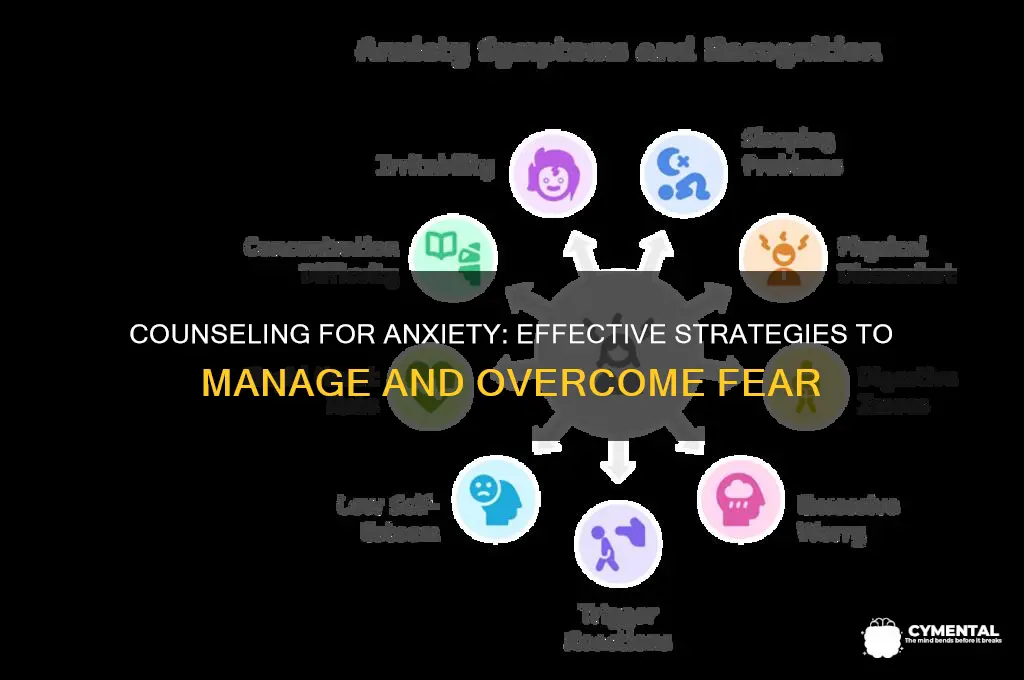
Mental health counseling plays a pivotal role in supporting individuals struggling with anxiety by providing them with tools, strategies, and a safe space to explore and manage their symptoms. Through evidence-based techniques such as cognitive-behavioral therapy (CBT), mindfulness, and relaxation exercises, counselors help clients identify and challenge negative thought patterns that fuel anxiety. Additionally, counseling fosters self-awareness, enabling individuals to understand the root causes of their anxiety and develop healthier coping mechanisms. The therapeutic relationship also offers emotional validation and support, reducing feelings of isolation and empowering individuals to regain control over their lives. By addressing both the psychological and emotional aspects of anxiety, mental health counseling promotes long-term resilience and improved overall well-being.
| Characteristics | Values |
|---|---|
| Provides Coping Strategies | Teaches practical tools like mindfulness, deep breathing, and cognitive reframing. |
| Identifies Triggers | Helps individuals recognize and understand the root causes of their anxiety. |
| Offers Emotional Support | Provides a safe, non-judgmental space to express feelings and concerns. |
| Improves Self-Awareness | Encourages introspection to better understand thoughts, emotions, and behaviors. |
| Develops Healthy Habits | Promotes routines like regular exercise, sleep hygiene, and balanced nutrition. |
| Challenges Negative Thought Patterns | Uses techniques like Cognitive Behavioral Therapy (CBT) to reframe unhelpful thoughts. |
| Enhances Problem-Solving Skills | Equips individuals with skills to tackle stressors and make informed decisions. |
| Reduces Symptoms of Anxiety | Alleviates physical and emotional symptoms such as panic attacks, restlessness, and worry. |
| Builds Resilience | Strengthens the ability to cope with future challenges and setbacks. |
| Improves Relationships | Helps individuals communicate effectively and resolve conflicts in personal and professional relationships. |
| Personalized Treatment Plans | Tailors counseling approaches to individual needs, ensuring effective and relevant care. |
| Encourages Goal Setting | Assists in setting achievable goals to foster a sense of purpose and progress. |
| Provides Education on Anxiety | Increases understanding of anxiety disorders, reducing stigma and self-blame. |
| Supports Medication Management | Collaborates with healthcare providers to monitor and adjust medication when necessary. |
| Long-Term Mental Health Benefits | Promotes sustained mental well-being beyond immediate symptom relief. |
Explore related products

$8.5 $19.99


$10.49 $21


What You'll Learn
- Understanding Anxiety Triggers: Identifying root causes to develop targeted coping strategies for long-term relief
- Cognitive Behavioral Techniques: Rewiring negative thought patterns to reduce anxiety symptoms effectively
- Mindfulness Practices: Teaching present-moment awareness to calm the mind and body
- Emotional Regulation Skills: Equipping individuals to manage intense emotions without overwhelm
- Building Support Networks: Encouraging connections to foster resilience and reduce isolation

Understanding Anxiety Triggers: Identifying root causes to develop targeted coping strategies for long-term relief
Anxiety doesn’t materialize in a vacuum; it’s often tethered to specific triggers rooted in biology, environment, or past experiences. Mental health counseling employs evidence-based techniques like cognitive-behavioral therapy (CBT) to systematically uncover these triggers. For instance, a person might notice their heart races during work presentations. Through guided reflection, a therapist could trace this back to childhood experiences of being criticized in front of others, revealing a deep-seated fear of judgment. Identifying such root causes transforms vague dread into actionable insights, shifting the focus from symptom management to cause resolution.
Consider the process as detective work, where the therapist and client collaborate to gather clues. Tools like journaling, mood tracking apps, or structured questionnaires (e.g., the Anxiety Sensitivity Index) help pinpoint patterns. For example, a 32-year-old client might discover their anxiety spikes after scrolling social media, linking it to unspoken comparisons and fear of missing out. Once identified, these triggers become targets for intervention rather than sources of helplessness. This clarity is the first step toward crafting coping strategies that address the core issue, not just its manifestations.
Not all triggers are obvious, and some may require professional guidance to unearth. A therapist might use techniques like exposure therapy to gradually confront feared situations, or mindfulness exercises to observe physiological responses in real-time. For instance, a client with generalized anxiety might learn their body tenses during conversations about finances, revealing an underlying fear of instability. Armed with this knowledge, they can develop targeted strategies—like budgeting workshops or grounding techniques—to dismantle the trigger’s power over their nervous system.
The ultimate goal isn’t just to manage anxiety but to disrupt its cycle at the source. For example, a teenager experiencing test anxiety might trace it to a history of being shamed for academic mistakes. Counseling could help reframe failure as a learning opportunity, while practical strategies like spaced repetition studying reduce performance pressure. Over time, this dual approach weakens the trigger’s emotional grip, fostering resilience rather than reliance on temporary fixes. By addressing root causes, counseling offers not just relief but liberation from anxiety’s recurring patterns.
Sleep's Mental Benefits: Boosting Mood, Focus, and Emotional Resilience
You may want to see also
Explore related products
$21.58 $25.95


Cognitive Behavioral Techniques: Rewiring negative thought patterns to reduce anxiety symptoms effectively
Anxiety often stems from automatic negative thoughts that distort reality, fueling a cycle of fear and avoidance. Cognitive Behavioral Therapy (CBT) disrupts this cycle by targeting these thought patterns directly. Unlike approaches that focus on past experiences, CBT is action-oriented, teaching individuals to challenge and replace distorted thinking in the present. This evidence-based technique has proven effective across age groups, from adolescents to older adults, with studies showing significant symptom reduction after 12-20 sessions.
"I’ll fail this presentation" becomes "I’ve prepared well and can handle any questions." This shift in thinking, practiced consistently, rewires neural pathways, diminishing anxiety's grip.
Consider a common scenario: public speaking. Someone with anxiety might catastrophize, thinking, "Everyone will judge me harshly." CBT encourages examining the evidence: "Have I been judged harshly before? Is it likely everyone will focus solely on me?" By questioning these assumptions, the individual learns to generate more balanced thoughts, like "Some may notice my nerves, but most are focused on the content." This process, repeated over time, weakens the power of automatic negative thoughts.
Practical tools like thought records and behavioral experiments solidify these changes. A thought record involves writing down the situation, emotion, automatic thought, evidence for and against it, and a more realistic alternative. Behavioral experiments test predictions: if someone fears social rejection, they might initiate a conversation and observe the actual outcome, often contradicting their initial fear.
While CBT is powerful, it's not a quick fix. It requires active participation and homework between sessions. Clients must be willing to confront their fears gradually through exposure exercises. For example, someone with social anxiety might start by making eye contact with strangers, then progress to small talk, and eventually engage in group discussions. This systematic desensitization retrains the brain's fear response.
The beauty of CBT lies in its empowerment. It equips individuals with a toolkit for managing anxiety throughout life. By learning to identify cognitive distortions like all-or-nothing thinking, fortune-telling, and mental filtering, people gain control over their emotional reactions. This newfound awareness allows them to respond to stressors with resilience rather than being overwhelmed by them. Studies show that CBT's effects are long-lasting, with many individuals maintaining gains years after treatment ends. It's a transformative process, offering not just symptom relief but a fundamental shift in how one relates to anxiety.
The Power of Connection: How Group Support Boosts Mental Health
You may want to see also
Explore related products


Mindfulness Practices: Teaching present-moment awareness to calm the mind and body
Anxiety often thrives on the mind’s tendency to dwell on the past or catastrophize the future. Mindfulness practices disrupt this cycle by anchoring individuals in the present moment, where threats are rarely immediate and worries lose their grip. By cultivating awareness of thoughts, sensations, and surroundings without judgment, mindfulness retrains the brain to observe anxiety as a passing experience rather than an inescapable reality. Research shows that consistent mindfulness practice reduces activity in the amygdala, the brain’s fear center, while strengthening the prefrontal cortex, which governs rational decision-making.
To begin, start with a simple breathing exercise: sit comfortably, close your eyes, and focus on the sensation of air entering and leaving your nostrils. When the mind wanders (which it inevitably will), gently guide attention back to the breath. Aim for 5–10 minutes daily, gradually increasing duration as focus improves. For those new to mindfulness, guided apps like Headspace or Calm can provide structure. Incorporating mindfulness into daily routines—such as eating slowly and noticing flavors or walking while observing the ground beneath your feet—amplifies its calming effects.
A common misconception is that mindfulness requires emptying the mind. Instead, it’s about observing thoughts without attachment. For instance, if anxiety arises during practice, acknowledge it with a phrase like, “I notice I’m feeling anxious,” then return to the breath. This non-reactive stance weakens anxiety’s hold over time. Studies indicate that 8 weeks of mindfulness-based stress reduction (MBSR) programs can significantly lower anxiety symptoms, with benefits lasting up to 6 months post-intervention.
For children and teens, mindfulness can be adapted through playful techniques. Body scans, where attention is moved systematically from head to toe, help younger individuals recognize physical tension linked to anxiety. Games like “5-4-3-2-1,” which involves naming five things seen, four touched, three heard, two smelled, and one tasted, ground them in the present. Schools incorporating mindfulness report reduced student anxiety and improved focus, highlighting its accessibility across age groups.
While mindfulness is powerful, it’s not a standalone cure for severe anxiety disorders. Combining it with cognitive-behavioral therapy (CBT) or medication, under professional guidance, often yields the best outcomes. Additionally, overdoing mindfulness—such as forcing hour-long sessions—can backfire, causing frustration or heightened self-criticism. Start small, be consistent, and approach the practice with curiosity rather than expectation. Over time, mindfulness becomes less of an exercise and more of a lens through which anxiety is seen—and managed—with clarity and compassion.
Supporting Mr. Robot: How Friends Can Aid Dissociative Identity Disorder
You may want to see also
Explore related products


$6.79 $14.99


Emotional Regulation Skills: Equipping individuals to manage intense emotions without overwhelm
Anxiety often manifests as a storm of overwhelming emotions, leaving individuals feeling powerless and consumed. Mental health counseling steps in as a beacon, offering tools to navigate this tempest. One of the most transformative tools is emotional regulation, a skill set that empowers individuals to observe, understand, and manage their intense emotions without being hijacked by them.
Imagine a dial controlling the volume of your emotions. Emotional regulation teaches you to turn down the blaring anxiety, allowing for clearer thinking and calmer responses. This isn't about suppressing emotions, but rather learning to relate to them in a healthier, more constructive way.
Counseling employs various techniques to cultivate emotional regulation. Mindfulness practices, for instance, train individuals to observe their emotions without judgment, like watching clouds pass in the sky. This detachment creates space between the emotion and the reaction, preventing impulsive decisions fueled by anxiety. Cognitive reframing, another powerful tool, helps individuals challenge negative thought patterns that amplify anxiety. By identifying and replacing distorted thoughts with more realistic ones, the emotional intensity diminishes.
For example, instead of catastrophizing a presentation as a guaranteed failure, a person might reframe it as an opportunity to share their knowledge, acknowledging potential nerves but focusing on their preparation.
The benefits of emotional regulation extend far beyond immediate anxiety relief. By learning to manage intense emotions, individuals build resilience, improve their relationships, and make better decisions. They become less reactive and more responsive, navigating life's challenges with greater equanimity. Think of it as building emotional muscle – the more you practice, the stronger and more adaptable you become.
It's important to remember that emotional regulation is a skill, and like any skill, it takes practice and patience. Consistency is key. Dedicate time each day to mindfulness exercises, journaling, or other techniques recommended by your counselor. Celebrate small victories, acknowledging progress even if it feels gradual. Remember, the goal isn't to eliminate emotions entirely, but to cultivate a healthier relationship with them, allowing you to live a more fulfilling and balanced life, even in the face of anxiety.
Crafting Calm: How Creative Hobbies Boost Mental Well-Being
You may want to see also
Explore related products


Building Support Networks: Encouraging connections to foster resilience and reduce isolation
Anxiety often thrives in isolation, where negative thoughts and fears can spiral unchecked. Mental health counseling recognizes this, emphasizing the power of building support networks to foster resilience and create a safety net against anxiety's grip.
Imagine a garden. A single plant, exposed to the elements, struggles to survive. But a garden, teeming with diverse flora, offers mutual support, shared resources, and protection from harsh conditions. Similarly, individuals battling anxiety flourish when surrounded by a network of understanding and supportive connections.
Counseling acts as a catalyst for this network building. Therapists guide individuals in identifying and nurturing existing relationships, encouraging open communication about their struggles. This might involve role-playing difficult conversations with loved ones or practicing assertiveness techniques to express needs effectively. For those with limited social circles, counselors can suggest community groups, support groups, or online forums tailored to anxiety management. These spaces provide a sense of belonging, allowing individuals to connect with others who understand their experiences, share coping strategies, and offer empathy.
Think of it as a scaffold, providing temporary support while the individual strengthens their own internal structure. Over time, as they develop healthier coping mechanisms and build confidence, the reliance on the scaffold diminishes, but the connections formed remain, offering ongoing support and a sense of security.
Building a support network isn't about amassing a large friend group; it's about cultivating meaningful connections. Quality trumps quantity. Even one or two trusted individuals who listen without judgment, offer encouragement, and provide a safe space for vulnerability can significantly impact anxiety levels. Remember, vulnerability is strength, not weakness. Sharing our struggles fosters deeper connections and allows others to offer genuine support. Counseling equips individuals with the tools to navigate these conversations with authenticity and boundaries, ensuring healthy and reciprocal relationships.
By encouraging connection and fostering a sense of belonging, mental health counseling empowers individuals to break free from the isolating grip of anxiety. These support networks become lifelines, offering understanding, encouragement, and a reminder that they are not alone in their journey towards resilience.
Talking Therapy: Unlocking Mental Health Benefits Through Conversation
You may want to see also
Frequently asked questions
Mental health counseling helps individuals manage anxiety by teaching coping strategies, identifying triggers, and challenging negative thought patterns. Therapists use evidence-based approaches like Cognitive Behavioral Therapy (CBT) to help clients reframe anxious thoughts and develop healthier responses to stress.
Yes, counseling often explores underlying causes of anxiety, such as past trauma, unresolved conflicts, or chronic stress. Therapists work with clients to uncover these roots and develop strategies to heal and move forward, reducing long-term anxiety.
A therapist provides a safe, nonjudgmental space for individuals to express their feelings and fears. They guide clients through personalized treatment plans, offer emotional support, and help build resilience, empowering them to navigate anxiety more effectively.
The duration varies depending on the individual and the severity of their anxiety. Some people notice improvements within a few sessions, while others may require longer-term therapy. Consistency and active participation in counseling are key to achieving lasting results.