Lucas Bennett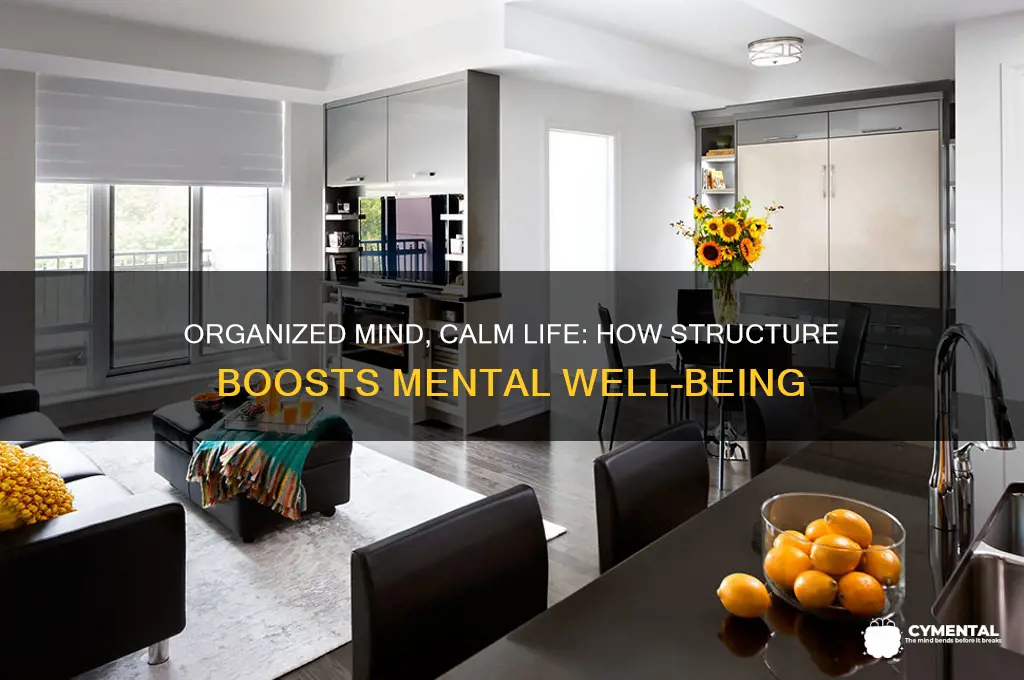
Organization plays a pivotal role in supporting mental health by reducing stress, enhancing clarity, and fostering a sense of control over one's environment and life. When spaces, schedules, and tasks are structured, individuals experience fewer overwhelming feelings and can focus on priorities more effectively. A well-organized routine, for instance, promotes consistency, which is crucial for managing anxiety and depression, while decluttering physical spaces can alleviate mental burden and improve mood. Additionally, organization encourages productivity and goal-setting, boosting self-esteem and a sense of accomplishment. By minimizing chaos and creating a predictable framework, organization empowers individuals to navigate challenges with greater resilience, ultimately contributing to improved mental well-being.
| Characteristics | Values |
|---|---|
| Reduces Stress | Organization minimizes clutter and chaos, which are known stressors. A structured environment helps reduce cortisol levels, promoting relaxation. |
| Enhances Focus | Organized spaces and schedules improve concentration by eliminating distractions, allowing for better task management and productivity. |
| Boosts Mood | Completing organizational tasks releases dopamine, a feel-good neurotransmitter, leading to improved mood and satisfaction. |
| Increases Sense of Control | Organization provides a sense of mastery over one's environment and tasks, reducing feelings of overwhelm and anxiety. |
| Improves Sleep Quality | A consistent organizational routine, including a tidy bedroom, promotes better sleep by reducing mental clutter and creating a calming atmosphere. |
| Encourages Mindfulness | Organizational practices often involve intentional actions, fostering mindfulness and presence in daily activities. |
| Reduces Decision Fatigue | Organized systems streamline decision-making by creating routines and reducing the need for constant choices, preserving mental energy. |
| Promotes Self-Efficacy | Successfully organizing tasks and spaces builds confidence and a belief in one's ability to manage challenges. |
| Supports Goal Achievement | Organization helps break down larger goals into manageable steps, making them more attainable and reducing feelings of inadequacy. |
| Fosters a Positive Environment | Organized physical and digital spaces create a welcoming and functional environment, positively impacting mental well-being. |
Explore related products


What You'll Learn
- Reduces Stress and Anxiety: Organized spaces and routines minimize overwhelm, promoting calmness and clarity in daily life
- Enhances Focus and Productivity: Structure improves concentration, helping prioritize tasks and achieve goals efficiently
- Boosts Confidence and Control: Accomplishing tasks through organization fosters a sense of achievement and self-worth
- Prevents Overwhelm and Burnout: Clear systems manage workload, reducing mental exhaustion and emotional strain
- Improves Sleep and Relaxation: Organized evenings and routines create a peaceful mindset, aiding restful sleep

Reduces Stress and Anxiety: Organized spaces and routines minimize overwhelm, promoting calmness and clarity in daily life
Cluttered environments and chaotic schedules bombard our senses, triggering a constant low-level stress response. Think of it as your brain on high alert, constantly scanning for the next misplaced item or forgotten deadline. This chronic stress, fueled by disorganization, contributes to elevated cortisol levels, the body's primary stress hormone. Over time, this can lead to anxiety, difficulty concentrating, and even physical health problems.
Studies show a clear link between cluttered spaces and increased stress. A 2010 study published in the *Personality and Social Psychology Bulletin* found that women who described their homes as cluttered or unfinished had higher levels of cortisol throughout the day.
Imagine this: You walk into a room where every item has its place. Your desk is clear, your clothes are neatly folded, and your schedule for the day is laid out. This visual order translates to mental order. Organized spaces provide a sense of control and predictability, calming the nervous system. Routines, similarly, create a framework for your day, reducing the mental burden of decision-making and minimizing the "what's next?" anxiety.
Think of organization as a form of preventative medicine for your mind. Just as you'd take vitamins to boost your immune system, implementing organizational strategies can fortify your mental resilience against stress and anxiety.
Start small. Dedicate 15 minutes each day to decluttering a specific area – a drawer, a shelf, or even your digital desktop. Utilize storage solutions like baskets, labels, and folders to create designated homes for your belongings. Establish daily routines for tasks like meal prep, laundry, and bedtime to reduce last-minute scrambling. Consider using time-blocking techniques to allocate specific time slots for different activities, minimizing multitasking and promoting focus. Remember, organization is a journey, not a destination. Celebrate small victories and be kind to yourself as you develop new habits.
Arrested or Assisted: Mental Illness and the Justice System's Dilemma
You may want to see also
Explore related products


Enhances Focus and Productivity: Structure improves concentration, helping prioritize tasks and achieve goals efficiently
A cluttered desk often mirrors a cluttered mind, leading to scattered thoughts and diminished productivity. When tasks pile up without a clear system, the brain struggles to prioritize, resulting in decision fatigue and procrastination. Implementing organizational structures—whether through digital tools, physical planners, or time-blocking techniques—creates mental clarity. For instance, the Pomodoro Technique, which divides work into 25-minute intervals with 5-minute breaks, has been shown to enhance focus by aligning with the brain’s natural attention span. By segmenting tasks and setting boundaries, organization transforms overwhelming workloads into manageable steps, allowing the mind to concentrate fully on one thing at a time.
Consider the act of organizing as a form of cognitive decluttering. When you allocate specific times for emails, meetings, and deep work, you reduce the mental load of task-switching. Studies show that multitasking decreases productivity by up to 40%, as the brain expends energy recalibrating between tasks. A structured schedule, however, minimizes this inefficiency. For example, using a bullet journal to categorize tasks by urgency and importance helps identify what truly needs attention, preventing the trap of busyness without accomplishment. This deliberate approach not only boosts output but also reduces stress by eliminating the constant mental juggling of unresolved to-dos.
The psychological benefits of organization extend beyond task completion; they foster a sense of control and purpose. When goals are broken down into actionable steps and visualized through tools like Kanban boards or habit trackers, progress becomes tangible. This visibility reinforces motivation, as the brain releases dopamine upon completing even small tasks. For instance, a study published in the *Journal of Personality and Social Psychology* found that crossing items off a list increases satisfaction and encourages persistence. By aligning daily actions with long-term objectives, organization transforms abstract aspirations into achievable milestones, turning productivity into a sustainable habit rather than a fleeting effort.
Practical implementation is key to reaping these benefits. Start by dedicating 10 minutes daily to organizing your workspace or digital files—consistency matters more than perfection. Use color-coding or labels to categorize tasks, and set realistic deadlines to avoid overcommitment. For those prone to distraction, apps like Forest or Focus@Will can complement organizational efforts by minimizing interruptions. Remember, the goal isn’t to eliminate chaos entirely but to create systems that channel it productively. Over time, this structured approach not only enhances focus but also cultivates a mindset of intentionality, where every action aligns with mental well-being and professional success.
Seeking Support: How Asking for Help Boosts Mental Well-Being
You may want to see also
Explore related products



Boosts Confidence and Control: Accomplishing tasks through organization fosters a sense of achievement and self-worth
Accomplishing tasks through organization isn’t just about crossing items off a to-do list—it’s a direct pathway to building confidence and reclaiming control over your life. When you break down overwhelming projects into manageable steps and systematically tackle them, each completed task becomes a tangible proof of your capability. This process rewires your brain to recognize your competence, countering self-doubt with evidence of your ability to succeed. For instance, a study published in the *Journal of Environmental Psychology* found that individuals who organized their workspaces reported higher levels of productivity and self-efficacy, a key component of confidence.
To harness this effect, start by prioritizing tasks based on urgency and importance. Use tools like the Eisenhower Matrix to categorize activities into four quadrants: urgent and important, important but not urgent, urgent but not important, and neither. Focus on completing tasks in the first quadrant first, as these yield the most immediate sense of accomplishment. For example, if you’re a student, organizing your study schedule to tackle high-stakes assignments before minor tasks can reduce anxiety and boost confidence as you see progress.
However, beware of perfectionism, which can sabotage this process. Organizing to boost confidence doesn’t mean every task must be flawless. Instead, aim for *progress over perfection*. Set realistic goals and celebrate small wins. For instance, if you’re decluttering your home, completing one drawer or shelf is a victory worth acknowledging. This mindset shift helps maintain momentum and prevents feelings of inadequacy.
The psychological impact of this approach is profound. Completing organized tasks triggers the release of dopamine, the brain’s “feel-good” neurotransmitter, reinforcing the behavior and fostering a positive feedback loop. Over time, this builds a reservoir of self-worth, making it easier to tackle larger challenges. For adults aged 25–40, who often juggle career, family, and personal goals, this method can be particularly transformative. A practical tip: allocate 15–30 minutes daily to organize and complete one task, no matter how small, to consistently experience this confidence boost.
In conclusion, organization isn’t merely a tool for efficiency—it’s a strategy for mental empowerment. By systematically accomplishing tasks, you not only gain control over your environment but also over your self-perception. This sense of achievement becomes a foundation for resilience, enabling you to approach future challenges with confidence and clarity. Start small, stay consistent, and watch as organization becomes a catalyst for lasting self-worth.
Healing PTSD: The Vital Role of Mental Health Nurses
You may want to see also
Explore related products



Prevents Overwhelm and Burnout: Clear systems manage workload, reducing mental exhaustion and emotional strain
Modern life bombards us with tasks, notifications, and expectations, creating a constant hum of mental noise. Without clear systems to manage this influx, our brains default to a state of hypervigilance, scanning for the next demand. This chronic overload fuels overwhelm and burnout, manifesting as fatigue, irritability, and a sense of drowning in responsibilities.
Clear systems act as mental scaffolding, transforming chaos into structure. They break down daunting workloads into manageable chunks, providing a sense of control and predictability. Imagine a cluttered desk versus a neatly organized one – the former induces anxiety, while the latter invites focus and productivity.
Consider the Pomodoro Technique, a time management system that divides work into focused 25-minute intervals followed by short breaks. This structured approach prevents mental fatigue by providing built-in rest periods and a clear endpoint for each task. Similarly, prioritizing tasks using the Eisenhower Matrix (categorizing them as urgent/important, not urgent/important, etc.) ensures you tackle high-impact activities first, reducing the mental burden of decision-making and preventing the feeling of being pulled in multiple directions.
Even simple systems like maintaining a daily to-do list or using color-coded calendars can significantly reduce mental strain. The key lies in consistency and personalization. Find systems that align with your cognitive style and work habits. Experiment with different methods, track your progress, and adjust as needed. Remember, the goal isn't perfection but creating a framework that minimizes mental clutter and maximizes your ability to thrive.
Think of clear systems as mental hygiene practices. Just as brushing your teeth prevents cavities, implementing organizational strategies prevents overwhelm and burnout. By proactively managing your workload, you conserve mental energy, reduce stress hormones like cortisol, and create space for creativity, relaxation, and meaningful connections. Investing time in establishing clear systems is an investment in your long-term mental well-being. It's not about doing more; it's about doing less with more intention and efficiency, ultimately leading to a calmer, more fulfilling life.
Tackling Stress: American Football's Mental Health Benefits Explained
You may want to see also
Explore related products




Improves Sleep and Relaxation: Organized evenings and routines create a peaceful mindset, aiding restful sleep
A cluttered evening routine often mirrors a cluttered mind, making it difficult to unwind and prepare for sleep. When your surroundings are disorganized, your brain remains in a state of mild alert, processing the visual and mental chaos. This heightened activity can delay the onset of sleep and reduce its quality. By contrast, an organized evening—where tasks are completed, spaces are tidy, and the next day’s priorities are clear—signals to your brain that it’s time to relax. This mental shift is crucial for transitioning into a restful state, allowing your body to produce melatonin and enter deeper sleep cycles more efficiently.
Consider this practical approach: establish a 30-minute "wind-down window" before bedtime. During this time, dim the lights, silence notifications, and engage in calming activities like reading, journaling, or gentle stretching. Pair this with a tidy environment—a made bed, organized nightstand, and clutter-free floor. Research shows that individuals who maintain a clean bedroom report better sleep quality and fewer nighttime awakenings. For those with busy schedules, a simple checklist can ensure consistency: charge devices away from the bed, lay out tomorrow’s outfit, and jot down any lingering thoughts to clear your mind.
The benefits of such routines extend beyond sleep. A structured evening reduces decision fatigue, a common culprit of late-night stress. When you’re not scrambling to find misplaced items or remember unfinished tasks, your mind remains calm and focused. This sense of control carries over into the next day, fostering productivity and emotional stability. For parents, modeling this behavior can also improve children’s sleep patterns, as kids thrive on predictability and calm environments. Start small—even organizing one area of your evening routine can yield noticeable improvements in relaxation and sleep.
However, beware of over-organizing to the point of rigidity. Flexibility is key to maintaining a sustainable routine. If unexpected events disrupt your evening, don’t view it as a failure; instead, adapt and return to your structure the following day. Additionally, avoid stimulating activities like intense exercise or heavy screen time within two hours of bedtime. Blue light from devices suppresses melatonin production, counteracting the benefits of an organized routine. Pairing organization with mindful habits creates a holistic approach to better sleep and mental well-being.
Incorporating organization into your evenings isn’t about perfection—it’s about creating a foundation for peace. By reducing environmental and mental clutter, you allow your body and mind to synchronize with natural sleep rhythms. Over time, this practice not only improves sleep but also enhances overall mental clarity and resilience. Start tonight: clear your space, plan your wind-down, and embrace the tranquility that follows.
AI's Role in Mental Health: Support, Challenges, and Future Potential
You may want to see also
Frequently asked questions
Organization helps reduce stress and anxiety by creating a sense of control and predictability. When tasks, spaces, and schedules are structured, it minimizes overwhelm and makes it easier to manage responsibilities, leading to a calmer mindset.
Yes, organization improves focus and productivity by eliminating distractions and streamlining workflows. A clutter-free environment and clear priorities allow the mind to concentrate better, reducing mental fatigue and enhancing overall well-being.
Organization fosters consistency and routine, which are essential for maintaining mental health habits. By setting systems for self-care, goal-setting, and time management, individuals can build sustainable practices that promote emotional stability and resilience.