Harper Lewis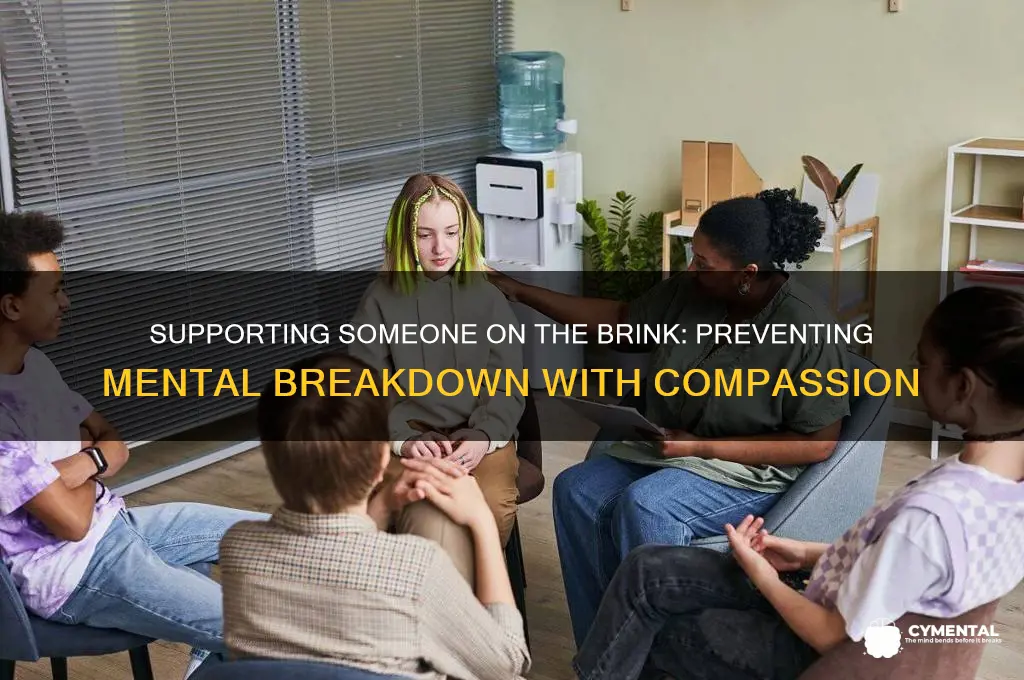
Helping someone on the verge of a mental breakdown requires empathy, patience, and a proactive approach. Start by creating a safe, non-judgmental space where they feel heard and understood, allowing them to express their feelings without fear of criticism. Encourage them to seek professional help, such as therapy or counseling, while offering to assist with finding resources or accompanying them to appointments. Validate their emotions and avoid minimizing their struggles, as this can deepen their sense of isolation. Provide practical support, like helping with daily tasks or ensuring they eat and rest, and gently remind them of coping strategies they’ve found helpful in the past. Above all, be present and consistent, letting them know they are not alone, while also taking care of your own well-being to avoid burnout.
Explore related products


What You'll Learn
- Listen Actively, Non-Judgmentally: Create safe space, focus on understanding, avoid interrupting or offering quick fixes
- Encourage Professional Help: Gently suggest therapy, hotlines, or mental health resources without forcing decisions
- Promote Self-Care: Support basic needs like sleep, hydration, and gentle activities to stabilize emotions
- Stay Calm and Patient: Avoid panic; maintain composure to provide reassurance and reduce overwhelm
- Remove Triggers: Identify and minimize stressors or environments contributing to their distress

Listen Actively, Non-Judgmentally: Create safe space, focus on understanding, avoid interrupting or offering quick fixes
Active listening is a cornerstone of supporting someone on the verge of a mental breakdown, yet it’s often misunderstood. It’s not about waiting for your turn to speak or crafting a response; it’s about fully immersing yourself in the other person’s experience. This means maintaining eye contact (when culturally appropriate), nodding in acknowledgment, and using verbal cues like "I see" or "Tell me more." Research shows that such nonverbal affirmations reduce cortisol levels in the speaker, creating a physiological sense of safety. Avoid the temptation to mirror their emotions excessively—this can feel insincere. Instead, focus on reflecting their core feelings: "It sounds like you’re feeling overwhelmed by everything piling up." This demonstrates engagement without appropriating their emotional space.
Creating a safe space requires more than a quiet room. It’s about signaling that no topic is off-limits, no emotion is "wrong," and no vulnerability will be weaponized. Start by explicitly stating boundaries: "You can share anything here, and I won’t judge or try to fix it." Then, *prove* this through your reactions. If they disclose self-harm tendencies, for example, resist the urge to gasp or lecture. Instead, say, "That must be incredibly hard to carry alone. Thank you for trusting me with this." Studies in crisis intervention show that perceived judgment (even unintentional) can shut down communication entirely, while consistent validation fosters deeper disclosure. Remember: safety isn’t built in one conversation—it’s a pattern of reliability.
Understanding someone’s experience doesn’t mean you must agree with their perspective, but it does require suspending your own. For instance, if they express anger at a situation you’d typically deem minor, avoid statements like, "But at least it’s not as bad as X." This minimizes their reality. Instead, ask open-ended questions: "What’s making this feel so heavy for you right now?" or "How has this been affecting your daily life?" These questions invite nuance and show genuine curiosity. A 2021 study in *Psychotherapy Research* found that individuals in distress are more likely to feel supported when listeners prioritize comprehension over problem-solving, even if the listener ultimately disagrees with their viewpoint.
Interrupting—whether to offer advice, share a similar story, or pivot the conversation—can derail trust faster than almost anything else. Quick fixes like "Have you tried meditation?" or "Just think positive" often backfire, as they imply the person hasn’t already considered (or struggled with) these solutions. Instead, acknowledge the complexity: "It seems like you’ve tried a lot already, and it’s still feeling this hard." If they ask for advice, respond with, "Would it be helpful if I shared some ideas, or would you rather just keep talking?" This respects their agency. The goal isn’t to solve their crisis but to accompany them through it, one uninterrupted moment at a time.
Finally, active, non-judgmental listening is a skill, not an innate talent—it requires practice and self-awareness. Notice when your mind starts drafting responses mid-sentence, or when you feel the impulse to "rescue" the conversation from discomfort. Take a silent breath to recenter. If you accidentally interrupt, own it: "I’m sorry, go ahead—I want to hear the rest." This models accountability. Over time, this approach not only helps the person feel seen but also strengthens your own capacity for empathy. As psychologist Carl Rogers noted, "When a person realizes they’ve been deeply heard, their walls subside." In the chaos of a mental breakdown, that safe space can be the first step toward rebuilding.
Tea's Soothing Power: Boosting Mental Health and Reducing Stress Naturally
You may want to see also
Explore related products


Encourage Professional Help: Gently suggest therapy, hotlines, or mental health resources without forcing decisions
Recognizing the signs of someone on the verge of a mental breakdown is only the first step; the next is guiding them toward professional support without overwhelming their already fragile state. One effective approach is to normalize the conversation around mental health, making it clear that seeking help is a sign of strength, not weakness. For instance, you might share a personal experience or a story of someone who benefited from therapy, framing it as a common and accessible resource. This method subtly shifts their perspective, reducing the stigma that often prevents individuals from reaching out.
When suggesting professional help, be specific yet non-intrusive. Instead of a vague "You should see someone," offer concrete options like, "There’s a therapist I’ve heard great things about, or the Crisis Text Line is available 24/7 if you need immediate support." Provide contact information or links to resources, but avoid pressuring them to act immediately. For example, you could say, "Here’s the number for a local counseling center—you can call whenever you feel ready." This approach respects their autonomy while planting the seed of possibility.
It’s crucial to tailor your suggestions to their comfort level and circumstances. For someone resistant to therapy, start with low-commitment options like mental health apps (e.g., Calm or Headspace) or online support groups. For those open to more structured help, recommend a free initial consultation with a therapist to ease their anxiety about the process. Remember, the goal isn’t to convince them overnight but to create a pathway they can follow when they’re ready.
Finally, model patience and empathy throughout the conversation. Avoid phrases like "You need to get help now" or "This is your only option," which can trigger defensiveness. Instead, use open-ended questions like, "How do you feel about exploring some resources together?" or "What kind of support do you think might help right now?" This collaborative tone reinforces that you’re there to support, not dictate, their journey toward healing. By encouraging professional help with sensitivity and specificity, you can be a guiding light without adding to their burden.
Seeking Mental Health Support: A Guide to Asking Your Doctor for Help
You may want to see also
Explore related products


Promote Self-Care: Support basic needs like sleep, hydration, and gentle activities to stabilize emotions
Sleep deprivation can exacerbate emotional instability, making it a critical area to address when supporting someone on the verge of a mental breakdown. Aim for a consistent sleep schedule, ideally 7-9 hours per night for adults, as recommended by the National Sleep Foundation. Encourage the individual to establish a relaxing bedtime routine, such as taking a warm bath, reading a book, or practicing deep breathing exercises. Limit exposure to electronic devices at least one hour before bedtime, as the blue light emitted can interfere with the production of melatonin, a hormone that regulates sleep. If the person struggles with insomnia, suggest natural remedies like valerian root or melatonin supplements, but always consult a healthcare professional for personalized advice.
Hydration is another fundamental aspect of self-care that is often overlooked. Dehydration can lead to fatigue, headaches, and mood swings, further destabilizing an already fragile emotional state. Encourage the individual to drink at least 8-10 cups (64-80 ounces) of water daily, adjusting for factors like age, weight, and activity level. Provide easy access to water by keeping a reusable water bottle nearby or setting reminders to drink water throughout the day. Incorporate hydrating foods like cucumbers, watermelon, and oranges into their diet, and limit consumption of diuretic substances like caffeine and alcohol, which can contribute to dehydration.
Gentle activities, such as yoga, tai chi, or light walking, can help regulate emotions by reducing stress and promoting relaxation. A study published in the Journal of Psychiatric Practice found that regular yoga practice can alleviate symptoms of anxiety and depression. Encourage the individual to engage in these activities for at least 20-30 minutes daily, starting with shorter sessions if necessary. Provide resources like online tutorials or local classes, and consider joining them to offer support and companionship. For older adults or individuals with physical limitations, modified exercises or seated activities can be just as effective in promoting emotional stability.
Consider the individual's unique needs and preferences when promoting self-care. For instance, a person with sensory sensitivities may benefit from a weighted blanket to aid sleep, while someone with a history of disordered eating may require extra support in maintaining a balanced diet. Be mindful of potential barriers, such as financial constraints or lack of access to resources, and offer practical solutions like community programs or low-cost alternatives. By addressing basic needs in a tailored and compassionate manner, you can help create a foundation for emotional stabilization and long-term mental health.
Incorporating self-care strategies into daily life requires patience, consistency, and self-compassion. Encourage the individual to view self-care as a priority, not a luxury, and to celebrate small victories along the way. Provide gentle reminders and positive reinforcement, but avoid being overly prescriptive or critical. Remember that everyone's journey is unique, and progress may be gradual. By fostering a supportive environment and modeling self-care behaviors, you can empower the individual to take an active role in their own emotional stabilization and overall well-being.
Anthropology's Role in Addressing the Mental Illness Crisis: Insights and Solutions
You may want to see also
Explore related products

$18.08 $32.99


Stay Calm and Patient: Avoid panic; maintain composure to provide reassurance and reduce overwhelm
In moments of crisis, your presence can either anchor or agitate. When someone is on the verge of a mental breakdown, their nervous system is already in overdrive, flooding their body with stress hormones like cortisol and adrenaline. Your calm demeanor acts as a non-verbal cue, signaling safety and reducing their physiological arousal. Mirror neurons in their brain will subconsciously pick up on your composure, helping to slow their racing heart and shallow breathing. To achieve this, focus on your own breath—inhale for a count of four, hold for four, exhale for six. This simple technique not only grounds you but also creates a rhythmic, soothing atmosphere for the person in distress.
Consider the contrast between two responses: one filled with urgency and another marked by deliberate calm. In the first scenario, frantic questions and rapid movements can amplify the individual’s sense of chaos, triggering a fight-or-flight response. In the second, measured speech and purposeful pauses communicate control, allowing their overwhelmed mind to latch onto something stable. For instance, instead of asking, “What’s wrong?” try, “I’m here, and we’ll figure this out together.” This shifts the focus from the problem to the solution, offering a mental lifeline. Remember, your goal isn’t to fix the situation immediately but to create a container of safety where healing can begin.
Patience is a practical tool, not a passive virtue. It involves recognizing that mental breakdowns often stem from a buildup of unresolved emotions, and processing these takes time. Avoid rushing the person through their experience with phrases like, “It’s not that bad” or “Just think positively.” Such statements invalidate their feelings and can deepen their isolation. Instead, use open-ended questions like, “How can I support you right now?” or simply sit in silence, which can be more comforting than words. Research shows that prolonged eye contact (3-5 seconds) and gentle physical touch (if consented) release oxytocin, the bonding hormone, fostering trust and reducing anxiety.
A cautionary note: staying calm doesn’t mean suppressing your own emotions or pretending everything is fine. Authenticity is crucial. If you feel overwhelmed, acknowledge it briefly but reassure the person that you’re committed to being there. For example, “I’m feeling a bit unsure of what to say, but I’m here and I care.” This honesty builds connection while maintaining the stability they need. Additionally, be mindful of your body language—avoid crossing your arms or fidgeting, as these can subconsciously communicate discomfort or impatience. Instead, adopt an open posture, leaning slightly forward to show engagement without intrusion.
In practice, combine these strategies with small, actionable steps. Offer a glass of water, as hydration can help regulate their nervous system, or suggest a brief grounding exercise like naming five things they can see, four they can touch, and three they can hear. These simple actions redirect their focus from internal turmoil to external sensations, providing immediate relief. Above all, remember that your calm presence is a gift—it doesn’t require expertise, just humanity. By holding space with patience and composure, you become a steady hand in the storm, helping them find their way back to solid ground.
Healthy Habits, Happy Mind: Boosting Mental Health Through Lifestyle Choices
You may want to see also
Explore related products

$8.81 $17.99

$12.99 $14.95

$27.32 $29.95



Remove Triggers: Identify and minimize stressors or environments contributing to their distress
Stressors, like chronic noise or a toxic workplace, act as kindling for a mental breakdown. Identifying and removing these triggers is crucial for creating a safe and calming environment. Start by observing patterns: Does their anxiety spike after certain interactions? Do specific tasks or places consistently overwhelm them? Keep a shared log of these triggers, noting details like time, location, and emotional response. This data becomes your roadmap for targeted intervention.
For instance, if social media comparisons fuel their self-doubt, suggest a digital detox. Limit screen time to 30 minutes twice daily, replacing it with offline activities like journaling or nature walks. If a cluttered workspace hinders focus, implement a "one-touch" rule: deal with items immediately instead of letting them pile up.
Not all triggers are external. Internal stressors like perfectionism or negative self-talk can be just as damaging. Encourage mindfulness practices like meditation or deep breathing exercises to cultivate self-awareness and challenge these destructive thought patterns. Apps like Headspace or Calm offer guided meditations specifically designed for stress reduction. Remember, this isn't about eliminating all stress, but about creating a manageable environment where they can begin to heal.
Removing triggers requires a delicate balance. Avoid being overly controlling or dismissive of their experiences. Instead, frame it as a collaborative effort, empowering them to take charge of their well-being. Offer suggestions, not ultimatums, and respect their boundaries. For example, instead of demanding they quit their job, explore options like flexible hours, remote work, or a conversation with HR about workload concerns.
Remember, removing triggers is an ongoing process, not a one-time fix. Be patient, adaptable, and celebrate small victories along the way. Each trigger eliminated is a step towards creating a more stable and supportive environment for their recovery.
Nurturing Your Mind: Practical Strategies for Mental Self-Care and Resilience
You may want to see also
Frequently asked questions
Signs include extreme stress, inability to cope with daily tasks, severe mood swings, withdrawal from social activities, insomnia, physical symptoms like headaches or fatigue, and expressions of hopelessness or suicidal thoughts.
Approach them calmly, privately, and with empathy. Use non-judgmental language, express concern, and let them know you’re there to listen without pushing them to talk if they’re not ready.
Respect their boundaries but let them know you’re available whenever they’re ready. Encourage small steps, like spending time together or suggesting professional resources, and avoid forcing the issue.
Offer emotional support, help them access professional help, and encourage healthy coping mechanisms like therapy, exercise, or mindfulness. Avoid taking on their responsibilities or shielding them from consequences.
Seek emergency help if they express suicidal or homicidal thoughts, engage in self-harm, or are unable to care for themselves. Call a crisis hotline or take them to the nearest emergency room immediately.