Harper Lewis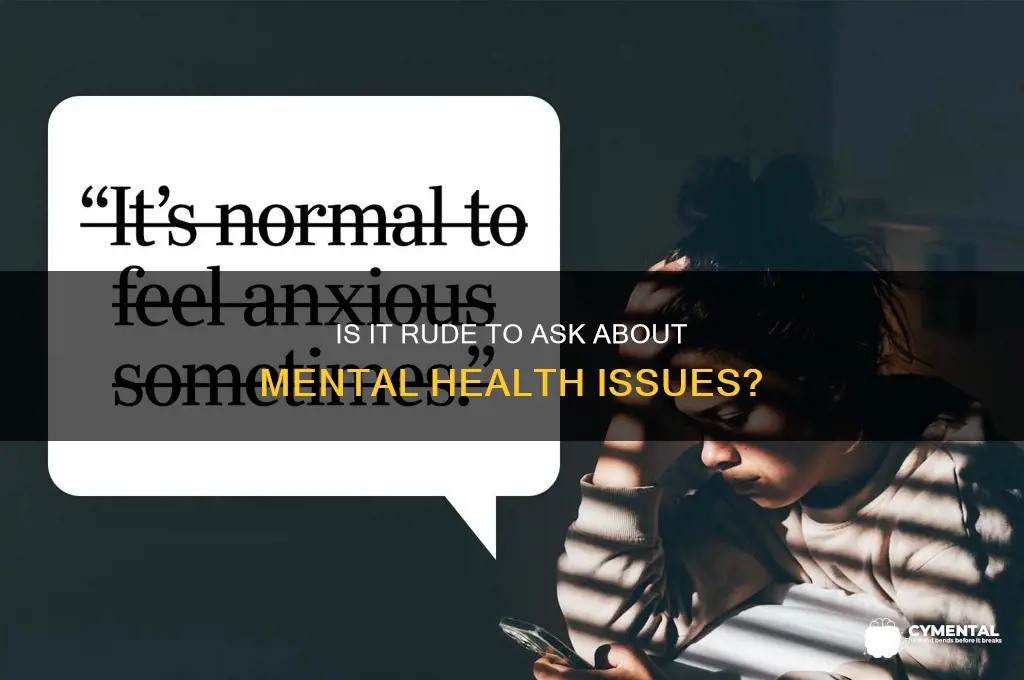
Discussing mental health can be a sensitive topic, and many people wonder whether asking someone if they have mental issues is inherently rude or inappropriate. The perception of such a question often depends on the context, tone, and relationship between the individuals involved. While some may view it as intrusive or judgmental, others might see it as a genuine attempt to offer support or understanding. Striking a balance between empathy and respect is crucial, as mental health stigma persists, and missteps can unintentionally cause harm. Ultimately, the key lies in approaching the conversation with sensitivity, ensuring the person feels safe and not pressured to disclose more than they are comfortable with.
| Characteristics | Values |
|---|---|
| Context Sensitivity | Highly dependent on the situation, relationship, and intent behind the question. |
| Perceived Stigma | Often seen as perpetuating stigma around mental health, especially if asked insensitively. |
| Intent | Matters greatly; asking out of genuine concern differs from curiosity or judgment. |
| Relationship Dynamics | More acceptable among close friends/family but can be intrusive in professional settings. |
| Tone and Phrasing | A gentle, empathetic approach ("How are you feeling lately?") is less rude than directness. |
| Cultural Differences | Varies by culture; some societies view mental health discussions as taboo. |
| Potential Impact | Can make the person feel judged, defensive, or exposed if not handled carefully. |
| Alternative Approaches | Encouraging open conversations about well-being without assumptions is preferred. |
| Legal/Professional Boundaries | In workplaces or formal settings, such questions may violate privacy or ethical guidelines. |
| Educational Awareness | Increasing awareness reduces rudeness by promoting understanding and empathy. |
Explore related products


What You'll Learn
- Cultural Sensitivity: How cultural norms influence perceptions of mental health discussions
- Intent vs. Impact: Importance of tone and purpose when asking about mental health
- Trust & Relationship: Role of established trust in sensitive mental health conversations
- Phrasing Matters: How wording can make the question respectful or offensive
- Personal Boundaries: Recognizing when it’s appropriate to ask about mental health

Cultural Sensitivity: How cultural norms influence perceptions of mental health discussions
In many Western cultures, openly discussing mental health is increasingly normalized, with campaigns encouraging people to "ask twice" or check in on friends. Yet, in collectivist societies like Japan or South Korea, such direct inquiries can breach privacy norms, where emotional struggles are often handled within family units or avoided to maintain social harmony. This contrast highlights how cultural values—individualism vs. collectivism—shape whether asking about mental health is seen as supportive or intrusive.
Consider the role of language. In some Indigenous communities, mental health is framed through spiritual or communal lenses, not as an individual "issue." Phrases like "How are you holding up?" might be more culturally appropriate than "Do you have mental health problems?" Understanding these linguistic nuances is critical for respectful dialogue. For instance, using metaphors or indirect questions can align with cultural communication styles while still showing concern.
Historical stigma also plays a part. In regions where mental illness was historically tied to supernatural causes or moral failing, such as parts of rural Africa or Latin America, direct questions can evoke shame or fear. Here, sensitivity involves acknowledging these roots while reframing the conversation. For example, partnering with local faith leaders or elders to initiate discussions can bridge traditional beliefs with modern understanding.
Practical tip: Before engaging in cross-cultural mental health conversations, research the local lexicon and taboos. In Germany, for instance, mental health discussions are private but professionalized, so offering resources like helpline numbers may be better received than personal questions. Conversely, in India, where family involvement is key, asking, "How is your family supporting you?" might be more culturally aligned than focusing solely on the individual.
Ultimately, cultural sensitivity in mental health discussions requires moving beyond one-size-fits-all approaches. It demands awareness of how historical, linguistic, and societal factors influence perceptions of such questions. By adapting inquiries to fit cultural contexts, we can foster empathy without inadvertently causing harm.
Pets and Mental Health: How Furry Friends Heal Minds
You may want to see also
Explore related products


Intent vs. Impact: Importance of tone and purpose when asking about mental health
The way we phrase questions about mental health can either foster trust or erect barriers. A well-intentioned inquiry like, "Are you struggling with something?" differs vastly from a blunt, "Do you have mental issues?" The former invites dialogue, while the latter risks judgment. This distinction highlights the critical interplay between intent and impact when broaching sensitive topics.
Consider the tone and purpose behind your question. Are you asking out of genuine concern, or is it fueled by curiosity or skepticism? A study by the National Alliance on Mental Illness (NAMI) found that 60% of individuals with mental health conditions feel more comfortable discussing their struggles when approached with empathy and understanding. Practical tips include using open-ended questions like, "How are you feeling lately?" and avoiding labels or assumptions. For instance, instead of asking, "Are you depressed?" try, "I’ve noticed you seem quieter lately—is everything okay?"
Contrastingly, a misaligned tone can deepen stigma. A 2021 survey revealed that 42% of respondents felt alienated when asked about their mental health in a casual or dismissive manner. For example, saying, "You seem off—are you on meds?" can feel intrusive and accusatory. The impact here outweighs the intent, even if the asker meant well. To mitigate this, focus on creating a safe space by signaling confidentiality and non-judgment. For younger audiences (ages 18–25), framing the conversation around shared experiences, like stress or anxiety, can make it less confrontational.
Finally, context matters. Asking a close friend about their mental health differs from inquiring with a colleague or acquaintance. Tailor your approach to the relationship and setting. For instance, a workplace conversation might begin with, "I’ve noticed you’ve been taking more breaks—is there something I can do to support you?" whereas with a friend, a simple, "You’ve been on my mind—how are you holding up?" can suffice. The key is aligning your intent with a tone that prioritizes compassion and respect, ensuring the impact is one of care, not offense.
Understanding the Severity of Mental Health Issues: A Comprehensive Overview
You may want to see also
Explore related products


Trust & Relationship: Role of established trust in sensitive mental health conversations
Trust is the bedrock of any meaningful conversation, especially when navigating the delicate terrain of mental health. Without it, even the most well-intentioned question can feel invasive or judgmental. Consider this: asking someone, “Do you have mental health issues?” can either be a compassionate inquiry or a rude intrusion, depending entirely on the trust between you. If trust is established, the question becomes a doorway to understanding and support. If not, it risks deepening isolation or defensiveness. Trust transforms the dynamic, turning a potentially awkward exchange into a safe space for vulnerability.
Building trust requires intentionality and time. It’s not about grand gestures but consistent, small actions that signal reliability and empathy. For instance, actively listening without interrupting, validating emotions rather than dismissing them, and respecting boundaries all contribute to a foundation of trust. When someone feels seen and heard, they’re more likely to open up about their struggles. A practical tip: start by sharing your own experiences or vulnerabilities (when appropriate) to model openness. This reciprocity fosters a sense of equality, making it easier for the other person to reciprocate.
Contrast this with a scenario where trust is absent. Imagine asking a colleague or acquaintance about their mental health without prior rapport. The question might come across as prying or even accusatory, triggering defensiveness or shame. In such cases, the lack of trust amplifies the sensitivity of the topic, turning a potentially supportive conversation into a minefield. The takeaway? Trust isn’t just a nice-to-have; it’s a prerequisite for broaching mental health with sensitivity and care.
To navigate this effectively, consider a three-step approach. First, assess the relationship: is there a history of mutual respect and openness? Second, frame the question thoughtfully. Instead of a direct “Do you have mental health issues?” try, “I’ve noticed you seem different lately—is there something you’d like to talk about?” This approach shows concern without assuming or labeling. Finally, respect their response. If they’re not ready to share, honor that boundary while leaving the door open for future conversations. Trust isn’t built in a single interaction but through consistent, respectful engagement.
Ultimately, the role of trust in mental health conversations cannot be overstated. It’s the difference between a question that wounds and one that heals. By prioritizing trust, we create environments where vulnerability is met with compassion, not judgment. This isn’t about avoiding difficult topics but approaching them with the care and respect they deserve. In relationships where trust thrives, even the most sensitive questions become opportunities for connection and support.
Empowering Connections: Strategies to Engage and Support Mental Health Struggles
You may want to see also
Explore related products




Phrasing Matters: How wording can make the question respectful or offensive
The way we frame a question about someone's mental health can either foster trust or erect barriers. Consider the stark contrast between, "Do you have mental issues?" and "Have you ever experienced challenges with your mental health?" The former, blunt and clinical, risks sounding accusatory, while the latter acknowledges the complexity of mental health and invites a nuanced response. This subtle shift in wording transforms the inquiry from a potential invasion of privacy to a gesture of genuine concern.
When crafting such questions, specificity can be a double-edged sword. Asking, "Are you depressed?" might feel too direct for some, but for others, it provides clarity and shows you’re informed. Pairing specificity with empathy—such as, "I’ve noticed you seem a bit down lately. Would you feel comfortable talking about how you’re feeling?"—creates a safe space for dialogue. The key is to balance precision with sensitivity, ensuring the person feels respected, not scrutinized.
Context plays a pivotal role in determining whether the question lands well. In a professional setting, a manager might ask, "How can I best support your well-being at work?" rather than, "Do you have a mental illness?" The former focuses on actionable solutions, while the latter could feel like an HR checklist question. Similarly, among friends, a casual but thoughtful, "How’s your headspace been lately?" can open the door for conversation without the weight of clinical terminology.
Finally, the tone and intent behind the words are just as crucial as the phrasing itself. A question asked out of curiosity or concern will naturally differ from one driven by judgment or skepticism. Practice active listening and observe nonverbal cues to ensure your approach aligns with the person’s comfort level. Remember, the goal is not to diagnose but to connect, and the right phrasing can bridge the gap between ignorance and understanding.
Compassionate Steps: Guiding Mental Health Admissions with Care and Understanding
You may want to see also
Explore related products


Personal Boundaries: Recognizing when it’s appropriate to ask about mental health
Navigating personal boundaries around mental health requires sensitivity and awareness. Asking someone about their mental health can be a delicate matter, and what may seem like a well-intentioned question could inadvertently cross a line. The key lies in understanding the context, your relationship with the person, and their comfort level. For instance, inquiring about a friend’s mental health during a casual conversation might feel intrusive if there’s no prior indication of openness on their part. Conversely, in a close, trusting relationship, such a question might be welcomed as a sign of care. The rule of thumb is to observe non-verbal cues and respect their response, whether it’s willingness to share or a polite deflection.
Consider the setting and timing when broaching the topic. A crowded room or a rushed moment is rarely appropriate for discussing sensitive issues. Instead, choose a private, calm environment where the person feels safe and unpressured. Phrasing also matters—instead of bluntly asking, “Do you have mental issues?” try a more empathetic approach like, “I’ve noticed you seem a bit down lately. How are you feeling?” This opens the door for them to share if they wish, without forcing the issue. Remember, the goal is to offer support, not to pry or diagnose.
A useful framework for determining appropriateness is the “trust and consent” model. Ask yourself: Do I have a trusted relationship with this person? Have they given me explicit or implicit consent to discuss their mental health? For example, a colleague who frequently shares personal struggles may have already signaled openness, while a new acquaintance likely hasn’t. If unsure, err on the side of caution and focus on general expressions of concern, such as, “I’m here if you ever need to talk.” This respects their boundaries while leaving the door open for future conversations.
Lastly, be mindful of your own biases and intentions. Sometimes, questions about mental health stem from genuine concern, while other times they may reflect curiosity or judgment. Reflect on why you’re asking and how it might impact the other person. For instance, asking a teenager about their mental health in front of peers could unintentionally stigmatize them, whereas a private, one-on-one conversation might foster trust. By prioritizing empathy, timing, and consent, you can navigate this sensitive topic with respect and care.
Empowering Compassion: Practical Ways to Support Mental Health Struggles
You may want to see also
Frequently asked questions
It can be perceived as rude if the question is asked insensitively or without context. Mental health is a personal topic, and asking directly may make the person feel uncomfortable or judged.
It’s appropriate to ask if there’s a genuine concern for their well-being, a pre-existing relationship of trust, and the question is phrased empathetically, such as, “How are you doing? I’ve noticed you seem a bit down lately.”
Focus on expressing care and support rather than making assumptions. Use open-ended questions like, “How are you feeling lately?” or “Is there anything you’d like to talk about?” instead of directly asking about mental health issues.
Apologize if they feel offended, validate their feelings, and respect their boundaries. Let them know you were asking out of concern and give them space to open up if and when they feel ready.