Ava Ramirez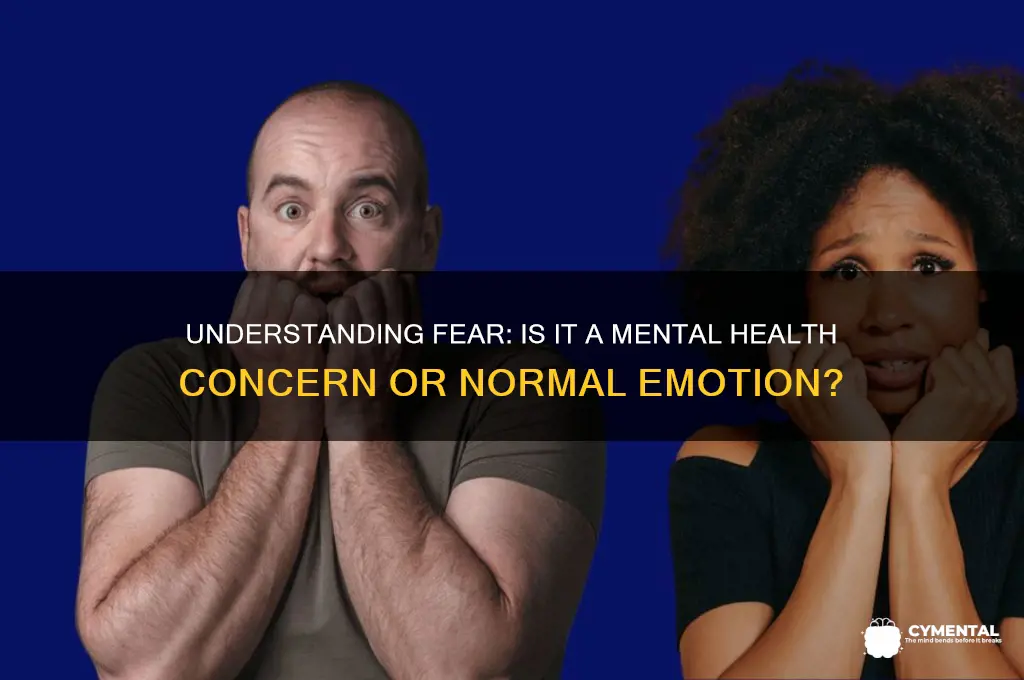
Fear is a fundamental human emotion, often serving as a protective mechanism in response to perceived threats. However, when fear becomes persistent, overwhelming, or disproportionate to the actual danger, it can significantly impact an individual’s mental well-being. While fear itself is not classified as a mental health issue, it can be a symptom of underlying conditions such as anxiety disorders, phobias, or post-traumatic stress disorder (PTSD). Chronic fear can lead to avoidance behaviors, impaired functioning, and reduced quality of life, raising questions about its role in mental health. Understanding whether fear crosses the line from a normal emotional response to a clinical concern is crucial for addressing its psychological implications and providing appropriate support.
| Characteristics | Values |
|---|---|
| Definition | Fear is a natural, emotional response to perceived threats or danger, not inherently a mental health issue. |
| Normal vs. Pathological | Normal fear is temporary and situation-specific; pathological fear (e.g., phobias, anxiety disorders) is persistent, excessive, and interferes with daily life. |
| Mental Health Connection | While fear itself is not a mental health issue, prolonged or intense fear can contribute to or exacerbate mental health conditions like anxiety disorders, PTSD, or depression. |
| Biological Basis | Fear activates the amygdala and triggers the fight-or-flight response, involving hormones like adrenaline and cortisol. |
| Treatment | Pathological fear is treatable through therapy (e.g., CBT), medication, or exposure therapy. |
| Prevalence | Specific phobias affect ~7-9% of the U.S. population; generalized anxiety disorder affects ~3%. |
| Impact on Life | Pathological fear can lead to avoidance behaviors, social isolation, and reduced quality of life. |
| Cultural Factors | Perception and expression of fear vary across cultures, influencing when it is considered a mental health issue. |
| Prevention | Early intervention and stress management can prevent fear from escalating into a mental health disorder. |
| Research Trends | Ongoing research focuses on neurobiological mechanisms of fear and improving treatment efficacy for fear-related disorders. |
Explore related products


$17.41 $24.95


What You'll Learn
- Fear vs. Anxiety: Understanding the difference and their impact on mental health
- Phobias: Specific fears as diagnosable mental health conditions requiring treatment
- Fear's Role in Trauma: How fear contributes to PTSD and related disorders
- Chronic Fear: Prolonged fear's effects on mental well-being and brain function
- Fear Management: Strategies to address fear as part of mental health care

Fear vs. Anxiety: Understanding the difference and their impact on mental health
Fear and anxiety, though often used interchangeably, are distinct emotional responses with different triggers, durations, and impacts on mental health. Fear is an immediate reaction to a perceived threat, real or imagined, activating the body’s fight-or-flight response. For instance, encountering a growling dog triggers fear, prompting a quick decision to flee or freeze. Anxiety, however, is future-oriented—a persistent worry about potential threats, often without a clear or immediate cause. Imagine feeling uneasy about a presentation weeks in advance; this prolonged anticipation is anxiety. Understanding this difference is crucial, as misidentifying one for the other can lead to ineffective coping strategies and exacerbate mental health challenges.
To illustrate, consider a teenager preparing for exams. If they experience fear, it might manifest as a rapid heartbeat during a difficult test question, a short-lived response tied to the present moment. Anxiety, on the other hand, could surface as weeks of sleepless nights, stomachaches, or constant rumination about failure. While fear is situational and time-bound, anxiety is pervasive and often disproportionate to the actual risk. This distinction matters because fear typically resolves once the threat passes, whereas anxiety can linger, draining energy and impairing daily functioning. For mental health professionals, distinguishing between the two informs treatment—fear may require exposure therapy, while anxiety often benefits from cognitive-behavioral techniques or medication like SSRIs (selective serotonin reuptake inhibitors) in severe cases.
From a practical standpoint, individuals can manage fear by grounding themselves in the present. Techniques such as deep breathing or progressive muscle relaxation can counteract the physiological symptoms of fear. For anxiety, mindfulness practices or journaling can help identify and challenge irrational thoughts. For example, a 30-year-old professional might use a thought record to reframe the belief, "I’ll lose my job if I make a mistake," into, "Mistakes are opportunities to learn and improve." However, caution is necessary: self-help strategies are not one-size-fits-all. A person with generalized anxiety disorder (GAD) may need professional intervention, as their anxiety is chronic and not tied to specific triggers.
Comparatively, fear is often adaptive, serving as a survival mechanism. It alerts us to danger, like avoiding a dark alley at night. Anxiety, however, can be maladaptive when it becomes excessive or unfounded. For instance, a child refusing to attend school due to separation anxiety may miss critical developmental milestones. The impact on mental health diverges here: fear, when appropriate, can be protective, while unchecked anxiety can lead to conditions like panic disorder or depression. Recognizing this, parents and caregivers should encourage gradual exposure to feared situations in children, paired with reassurance, to build resilience rather than avoidance.
In conclusion, while fear and anxiety overlap in their physiological symptoms—sweating, rapid heartbeat, or restlessness—their origins and trajectories differ significantly. Fear is a response to the now, while anxiety fixates on the what-if. By understanding this, individuals can tailor their coping mechanisms effectively. For fear, focus on immediate grounding techniques; for anxiety, address the underlying thought patterns. Mental health professionals emphasize that neither emotion is inherently problematic—it’s their intensity, frequency, and interference with life that determine whether intervention is needed. Armed with this knowledge, one can navigate these emotions with clarity and purpose, fostering better mental well-being.
Unraveling the Psychological Complexities Behind Nazi Leadership and Followers
You may want to see also
Explore related products


Phobias: Specific fears as diagnosable mental health conditions requiring treatment
Fear, in its most basic form, is a survival mechanism, a primal response to perceived threats. However, when fear becomes irrational, persistent, and debilitating, it transforms into a phobia—a diagnosable mental health condition that demands attention and treatment. Phobias are not mere quirks or preferences; they are clinically recognized disorders that can severely disrupt daily life. For instance, someone with arachnophobia doesn’t just dislike spiders—they experience paralyzing terror at the mere thought of one, often avoiding outdoor activities or even their own homes if they suspect a spider is present. This level of impairment distinguishes a phobia from ordinary fear.
Diagnosing a phobia involves specific criteria outlined in the *Diagnostic and Statistical Manual of Mental Disorders (DSM-5)*. The fear must be excessive, persistent for six months or more, and lead to significant distress or functional impairment. Treatment options are both effective and evidence-based. Cognitive-behavioral therapy (CBT) is a cornerstone, often involving gradual exposure to the feared object or situation in a controlled environment. For example, a person with a fear of flying might start by looking at pictures of planes, then progress to visiting an airport, and eventually taking a short flight. Medications such as selective serotonin reuptake inhibitors (SSRIs) or beta-blockers may be prescribed to manage symptoms, particularly in cases where anxiety is severe. It’s crucial to tailor treatment to the individual, as a one-size-fits-all approach rarely succeeds.
One of the most compelling aspects of phobias is their specificity. Unlike generalized anxiety disorder, which casts a wide net of worry, phobias are laser-focused. For instance, someone with agoraphobia fears open or crowded spaces, not just "being outside." This specificity allows for targeted interventions but also highlights the complexity of the human mind. A fear of heights (acrophobia) might stem from a childhood fall, while a fear of needles (trypanophobia) could be linked to a traumatic medical experience. Understanding the root cause can enhance treatment efficacy, though it’s not always necessary for successful outcomes.
Practical tips for managing phobias include mindfulness techniques, such as deep breathing exercises to reduce immediate anxiety, and lifestyle changes to improve overall mental resilience. For parents, early intervention is key: if a child shows signs of an irrational fear, addressing it promptly can prevent it from becoming a lifelong phobia. Adults should avoid self-diagnosis and seek professional help, as untreated phobias can worsen over time. Support groups can also provide valuable peer encouragement, reminding individuals they are not alone in their struggles.
In conclusion, phobias are more than just fears—they are diagnosable conditions that require targeted treatment. With the right approach, individuals can regain control over their lives, turning what once felt like an insurmountable obstacle into a manageable challenge. Recognizing the difference between fear and a phobia is the first step toward healing.
Understanding Stigma: How Society Treats Those with Mental Health Issues
You may want to see also
Explore related products


Fear's Role in Trauma: How fear contributes to PTSD and related disorders
Fear, an innate survival mechanism, becomes a double-edged sword when it intertwines with trauma. In the context of Post-Traumatic Stress Disorder (PTSD) and related disorders, fear doesn’t merely signal danger—it *becomes* the danger, reshaping the brain’s response to perceived threats long after the original trauma has passed. This hypervigilance, a hallmark of PTSD, is rooted in the amygdala’s overactivity, which hijacks rational thought and keeps the body in a perpetual state of fight-or-flight. For instance, a combat veteran might experience panic at the sound of fireworks, their brain unable to distinguish between past battlefield explosions and present-day noise. This illustrates how fear, once adaptive, can mutate into a chronic disruptor of mental health.
To understand fear’s role in trauma, consider the neurobiological pathways involved. During a traumatic event, the body releases stress hormones like cortisol and adrenaline, which prime the brain to encode the experience with heightened intensity. Over time, this encoding can lead to conditioned fear responses, where neutral stimuli (e.g., a smell, location, or sound) become triggers. For example, a car accident survivor might develop a phobia of driving, even if they were uninjured. This conditioned response is not a choice but a rewiring of the brain’s fear circuitry, often resistant to logic or reassurance. Therapies like exposure therapy aim to retrain this circuitry by gradually desensitizing individuals to their triggers, but success depends on consistent practice and professional guidance.
Fear’s contribution to PTSD extends beyond individual symptoms to systemic impacts on daily life. It erodes trust in one’s environment, making it difficult to form secure relationships or engage in routine activities. For children, this can stunt emotional and social development, as fear-driven avoidance limits their ability to explore and learn. Adults may experience occupational setbacks, as hypervigilance and flashbacks interfere with concentration and performance. A practical tip for managing this is to create a "fear inventory"—a list of triggers ranked by intensity—and pair it with grounding techniques, such as deep breathing or tactile stimulation (e.g., holding a cold object), to interrupt fear responses in the moment.
Comparatively, fear in PTSD differs from generalized anxiety or phobias in its origin and persistence. While anxiety disorders often stem from genetic predispositions or chronic stress, PTSD is explicitly tied to a traumatic event. However, the fear mechanisms overlap, suggesting that interventions for one condition may benefit another. For instance, mindfulness-based stress reduction (MBSR) has shown efficacy in reducing fear responses across disorders by fostering present-moment awareness. Unlike medication, which may only manage symptoms, MBSR addresses the underlying fear circuitry, offering a sustainable path to recovery.
Ultimately, fear’s role in trauma underscores the need for targeted, trauma-informed care. Recognizing fear not as a personal failing but as a symptom of a treatable condition is the first step. For those supporting individuals with PTSD, patience and education are key—understanding that fear-driven behaviors are not intentional but manifestations of a wounded brain. By combining evidence-based therapies with practical coping strategies, it’s possible to disentangle fear from trauma, restoring a sense of safety and control. This process is neither quick nor linear, but with persistence, fear can be transformed from a prison to a pathway toward healing.
Supporting Loved Ones: Navigating Mental Health Challenges in Family Dynamics
You may want to see also
Explore related products


Chronic Fear: Prolonged fear's effects on mental well-being and brain function
Fear, when persistent and unaddressed, rewires the brain’s architecture. Chronic fear activates the amygdala, the brain’s alarm system, causing it to enlarge and become hyper-responsive. Simultaneously, the prefrontal cortex, responsible for rational decision-making, weakens under prolonged stress. Studies using MRI scans reveal these structural changes in individuals with generalized anxiety disorder, illustrating how chronic fear isn’t merely emotional—it’s neurological. This imbalance disrupts the brain’s ability to differentiate between real threats and perceived ones, trapping individuals in a cycle of heightened vigilance.
Consider the body’s stress response system, designed for short-term survival. When fear becomes chronic, cortisol—the stress hormone—floods the system, leading to physical and mental exhaustion. Over time, elevated cortisol levels impair memory, reduce immune function, and increase the risk of depression. For instance, a 2018 study published in *Nature Neuroscience* found that prolonged exposure to fear-inducing stimuli in rats led to a 20% reduction in hippocampal neurons, a region critical for memory and emotional regulation. Translating this to humans, chronic fear doesn’t just alter mood—it erodes cognitive resilience.
To mitigate these effects, practical interventions are essential. Mindfulness-based stress reduction (MBSR) has shown promise in recalibrating the fear response. A meta-analysis in *JAMA Psychiatry* (2020) found that 8 weeks of MBSR practice reduced amygdala activity by 15% in participants with anxiety disorders. Pairing mindfulness with aerobic exercise, which lowers cortisol levels, amplifies these benefits. For adults over 40, incorporating 30 minutes of moderate exercise 4–5 times weekly can counteract fear-induced brain atrophy. Children and adolescents, however, may benefit more from structured play and creative outlets, which foster emotional regulation without the intensity of formal exercise.
Yet, not all fear management strategies are created equal. Avoidance, a common coping mechanism, exacerbates chronic fear by reinforcing the brain’s threat perception. Instead, gradual exposure therapy, guided by a mental health professional, retrains the brain to tolerate fear triggers. For example, a person with social anxiety might start by initiating small talk with a cashier, progressing to larger group interactions over time. This method, rooted in cognitive-behavioral therapy (CBT), has a 60–90% success rate in reducing fear-related symptoms, according to the American Psychological Association.
The societal implications of untreated chronic fear cannot be overstated. In workplaces, it stifles creativity and productivity, while in communities, it fosters isolation and mistrust. Schools, particularly, must integrate fear literacy into curricula, teaching students to recognize and address fear before it becomes chronic. Parents and educators can model healthy fear responses by acknowledging their own anxieties and demonstrating adaptive coping strategies. By treating chronic fear as a public health priority, we not only safeguard individual well-being but also cultivate a more resilient society.
Developmental Delays and Mental Health: Understanding the Connection
You may want to see also
Explore related products

$12.99 $12.99


![Fear [Blu-ray]](https://m.media-amazon.com/images/I/71tGFLZLfEL._AC_UY218_.jpg)
![Fear [DVD]](https://m.media-amazon.com/images/I/61LzOQIFXmL._AC_UY218_.jpg)
Fear Management: Strategies to address fear as part of mental health care
Fear, when persistent and overwhelming, can indeed be a mental health issue, often manifesting as anxiety disorders, phobias, or trauma-related conditions. However, fear itself is a natural human response, and managing it effectively is crucial for mental well-being. Fear management strategies are not about eliminating fear entirely but about reducing its impact and restoring a sense of control. Here’s how to approach it systematically.
Step 1: Identify the Source of Fear
Begin by pinpointing the specific triggers of fear. Is it social situations, uncertainty, past trauma, or something else? Journaling can be a practical tool for adults and teens, while younger children may benefit from drawing or verbalizing their feelings. For example, a 12-year-old afraid of public speaking might identify the fear as rooted in a past embarrassing moment. Once the source is clear, the fear becomes more manageable, as it shifts from an amorphous threat to a concrete problem.
Step 2: Practice Grounding Techniques
When fear escalates, grounding techniques can interrupt the cycle of panic. The 5-4-3-2-1 method—naming five things you see, four you can touch, three you hear, two you can smell, and one you can taste—is effective across all age groups. For children, simplify this to a favorite toy or a comforting texture. Adults might incorporate deep breathing exercises, inhaling for four seconds, holding for four, and exhaling for six, repeated for two minutes to activate the parasympathetic nervous system.
Step 3: Cognitive Restructuring
Fear often thrives on distorted thinking. Cognitive-behavioral techniques challenge these patterns. For instance, someone fearing failure might replace "I’ll never succeed" with "I can learn from this experience." Therapists often use Socratic questioning to guide clients: "What evidence supports this fear? What’s the worst that could happen, and how likely is it?" This approach is particularly effective for adolescents and adults, as it fosters critical thinking and emotional resilience.
Caution: Avoid Overgeneralization
While fear management strategies are powerful, they are not one-size-fits-all. For severe cases, such as PTSD or panic disorder, professional intervention is essential. Self-help methods should complement, not replace, therapy or medication. For example, exposure therapy—gradually facing feared situations—must be conducted under expert guidance to prevent retraumatization. Additionally, mindfulness practices, though beneficial, may not suit individuals with dissociative tendencies.
Fear management is a skill, and like any skill, it improves with practice. Incorporate small, consistent actions: a daily gratitude list to shift focus from threats to positives, or a weekly "fear challenge" to build confidence. Apps like Calm or Headspace offer guided exercises for all ages. Remember, the goal isn’t to live without fear but to ensure it doesn’t dictate your life. By addressing fear proactively, you reclaim agency over your mental health.
Empathetic Strategies for Supporting Customers with Mental Health Challenges
You may want to see also
Frequently asked questions
Fear itself is a natural emotional response to perceived threats and is not inherently a mental health issue. However, when fear becomes excessive, persistent, or irrational, it may indicate an anxiety disorder or other mental health condition.
Yes, fear can develop into a mental health problem if it interferes with daily functioning, causes significant distress, or persists without a clear or proportional threat. Conditions like phobias, generalized anxiety disorder, or PTSD often involve unhealthy fear responses.
If your fear is overwhelming, uncontrollable, or disrupts your life (e.g., avoiding situations, constant worry, physical symptoms like panic attacks), it may be a mental health issue. Consulting a mental health professional can help determine if your fear is beyond normal limits.
Treatments include therapy (e.g., cognitive-behavioral therapy, exposure therapy), medications (e.g., anti-anxiety or antidepressants), and lifestyle changes (e.g., mindfulness, exercise). A mental health professional can recommend the best approach based on the specific condition.