Caleb Wright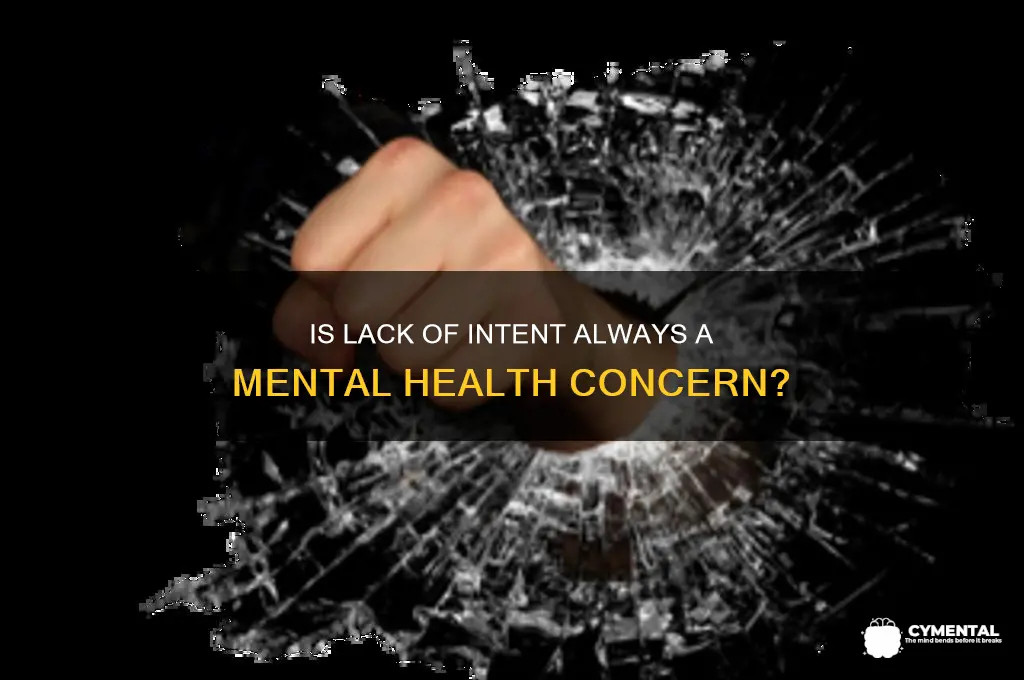
The question of whether the inability to form intent is always a mental issue is a complex and multifaceted one, intersecting law, psychology, and ethics. While mental health conditions such as severe cognitive impairments, psychosis, or developmental disorders can indeed hinder an individual's capacity to form intent, not all cases of diminished intent stem from diagnosable mental illnesses. Factors like extreme intoxication, neurological damage, or situational pressures (e.g., duress or panic) can also impair intent formation without necessarily indicating an underlying mental health disorder. Legal systems often grapple with distinguishing between these scenarios, as the implications for culpability and punishment differ significantly. Thus, understanding the root causes of impaired intent requires a nuanced approach that considers both psychological and contextual factors, challenging the assumption that it is always a mental issue.
| Characteristics | Values |
|---|---|
| Definition | Inability to form intent refers to a situation where an individual cannot formulate the purpose or resolve to carry out a specific action. |
| Mental Health Connection | Not always a mental health issue. While it can be associated with certain mental health conditions, it may also stem from other factors. |
| Associated Mental Health Conditions | - Schizophrenia - Severe depression - Dissociative disorders - Certain personality disorders - Neurocognitive disorders (e.g., dementia) |
| Other Potential Causes | - Neurological disorders (e.g., brain injuries, tumors) - Substance abuse or intoxication - Extreme stress or trauma - Developmental disabilities - Certain medications or medical conditions |
| Legal Implications | In legal contexts, inability to form intent may affect criminal responsibility, as it can be a factor in determining mens rea (guilty mind). |
| Assessment Methods | - Psychological evaluations - Neurological assessments - Medical history review - Behavioral observations |
| Treatment Approaches | - Therapy (e.g., cognitive-behavioral therapy) - Medication management - Supportive interventions - Addressing underlying causes (e.g., substance abuse treatment) |
| Prognosis | Varies depending on the underlying cause. Some conditions may be manageable or reversible, while others may be chronic. |
| Prevalence | Not well-documented as a standalone condition, but associated disorders (e.g., schizophrenia, dementia) have known prevalence rates. |
| Research Gaps | Limited research specifically on "inability to form intent" as a distinct phenomenon, often studied within broader diagnostic categories. |
Explore related products


What You'll Learn
- Role of Cognitive Impairment: How cognitive deficits impact intent formation in legal and psychological contexts
- Voluntary vs. Involuntary Actions: Distinguishing between intentional acts and those driven by external factors
- Childhood and Intent Formation: Developmental stages and their influence on understanding and forming intent
- Intoxication and Intent: Effects of substance abuse on decision-making and legal responsibility
- Cultural and Social Influences: How societal norms shape perceptions of intent and mental capacity

Role of Cognitive Impairment: How cognitive deficits impact intent formation in legal and psychological contexts
Cognitive impairment, whether stemming from neurological disorders, traumatic brain injury, or degenerative conditions, fundamentally disrupts the ability to form intent. In legal contexts, intent—or *mens rea*—is a cornerstone of criminal liability. For instance, a person with advanced Alzheimer’s disease may lack the cognitive capacity to understand the consequences of their actions, rendering them incapable of forming the intent required for criminal responsibility. This raises critical questions about accountability when cognitive deficits are present.
Psychologically, intent formation relies on executive functions such as planning, reasoning, and decision-making, all of which are compromised in conditions like dementia, schizophrenia, or severe ADHD. For example, a patient with frontal lobe damage due to a stroke may exhibit impulsive behaviors without the ability to foresee outcomes. This isn’t merely a "mental issue" in the traditional sense but a specific cognitive deficit that disrupts the neural pathways necessary for intent. Understanding this distinction is crucial for both legal and therapeutic interventions.
In legal practice, courts often grapple with cases involving cognitive impairment, relying on neuropsychological assessments to determine capacity. For instance, a defendant with moderate to severe traumatic brain injury (TBI) might require a detailed evaluation of their ability to understand cause and effect, a key component of intent. If cognitive testing reveals deficits in these areas, it could mitigate criminal liability, shifting focus from punishment to rehabilitation or guardianship.
From a psychological perspective, interventions for individuals with cognitive deficits must address the root cause of impaired intent formation. Cognitive-behavioral therapy (CBT) adapted for neurocognitive disorders, such as simplified goal-setting or visual aids, can help individuals with mild dementia regain some functional autonomy. For more severe cases, caregivers and legal systems must prioritize protective measures, such as structured environments or legal guardianship, to prevent harm while respecting the individual’s dignity.
The interplay between cognitive impairment and intent formation underscores the need for a nuanced approach in both legal and psychological domains. While not all cognitive deficits are mental illnesses, they share a common thread: the disruption of processes essential for intentional behavior. Recognizing this distinction allows for more equitable legal outcomes and targeted psychological support, ensuring that individuals with cognitive impairments are treated with both justice and compassion.
Is It Rude to Ask About Mental Health Issues?
You may want to see also
Explore related products


Voluntary vs. Involuntary Actions: Distinguishing between intentional acts and those driven by external factors
The distinction between voluntary and involuntary actions is crucial in understanding human behavior, particularly when assessing the role of intent. Voluntary actions are those we consciously decide to perform, driven by our desires, goals, or moral judgments. For instance, choosing to donate to a charity or deciding to exercise daily are acts of volition, rooted in personal agency. Involuntary actions, on the other hand, are often triggered by external factors beyond our control, such as reflexes (e.g., blinking when an object approaches the eye) or physiological responses (e.g., shivering in cold weather). While involuntary actions are typically automatic, they do not necessarily imply a lack of mental capacity. However, the inability to form intent—a hallmark of voluntary action—raises questions about whether this is always a symptom of a mental issue.
Consider the case of individuals under extreme duress or coercion. A person held at gunpoint and forced to commit a crime lacks the freedom to act voluntarily, even though their actions appear intentional. Here, the external factor (coercion) overrides their ability to form genuine intent. Similarly, individuals with certain neurological conditions, such as Tourette syndrome, may exhibit involuntary tics that resemble intentional movements but are, in fact, driven by neurological impulses. These examples illustrate that the absence of intent is not always tied to mental illness but can result from situational or physiological constraints.
To distinguish between voluntary and involuntary actions, one must examine the presence of conscious decision-making and the influence of external factors. A practical approach involves asking: *Was the individual aware of their actions, and did they have the capacity to choose otherwise?* For instance, a person with severe dementia may struggle to form intent due to cognitive decline, whereas a sleepwalker’s actions are driven by subconscious processes. In both cases, the inability to form intent is not a matter of mental illness in the traditional sense but rather a result of cognitive or neurological limitations.
From a legal and ethical standpoint, this distinction has significant implications. Legal systems often differentiate between crimes committed with intent (e.g., premeditated murder) and those resulting from external pressures or diminished capacity. For example, the insanity defense hinges on whether a defendant could understand the nature of their actions or form the intent to commit a crime. Similarly, in medical ethics, understanding the voluntariness of a patient’s consent is critical, especially when external factors like coercion or misinformation are present.
In conclusion, the inability to form intent is not always indicative of a mental issue. It can arise from external coercion, physiological conditions, or cognitive limitations. By carefully analyzing the context and mechanisms behind actions, we can better differentiate between voluntary and involuntary behavior. This distinction is essential for fair legal judgments, ethical medical practices, and a nuanced understanding of human agency. Practical steps, such as assessing awareness and choice in decision-making, can help clarify whether an action is truly voluntary or driven by external forces.
Prevent Mental Health Issues: Practical Strategies for a Healthier Mind
You may want to see also
Explore related products


Childhood and Intent Formation: Developmental stages and their influence on understanding and forming intent
The ability to form intent is not innate but develops through distinct childhood stages, each marked by cognitive and emotional milestones. Infants, for instance, operate primarily on reflex and instinct, lacking the prefrontal cortex maturity needed for intentional planning. By ages 3–5, children begin to exhibit goal-directed behavior, such as stacking blocks or sharing toys, though their intent remains impulsive and context-limited. This progression underscores that early childhood inability to form intent is a developmental norm, not a mental issue.
Consider the preschooler who "intentionally" knocks over a sibling’s tower. While the act appears deliberate, the child’s understanding of consequences is rudimentary. Piaget’s preoperational stage (ages 2–7) explains this: children think egocentrically, struggling to foresee outcomes beyond immediate desires. This isn’t a mental deficit but a stage where intent formation is still tethered to present impulses. Parents and educators can scaffold this by narrating consequences ("If you knock it down, your sister might feel sad") to gradually build intent complexity.
Middle childhood (ages 6–12) introduces concrete operational thinking, where intent becomes more calculated. A 9-year-old might plan a lemonade stand, weighing variables like pricing and location. However, abstract reasoning remains elusive until adolescence. Here, the inability to form intent in complex scenarios—like long-term academic goals—reflects cognitive immaturity, not pathology. Interventions like visual planners or step-by-step goal-setting exercises can bridge this gap, fostering intent formation without pathologizing normal development.
Adolescence complicates the picture, as emerging abstract thinking collides with emotional volatility. A 14-year-old might intend to study but succumb to social media distractions, not due to mental illness but because the prefrontal cortex is still refining impulse control. This stage demands patience and structured environments—for example, limiting screen time during study hours or using apps like Forest to gamify focus. Misinterpreting such struggles as mental issues risks stigmatizing typical developmental challenges.
In summary, childhood’s inability to form intent is a staged journey, not a static condition. From reflexive infants to abstract-thinking teens, each phase has unique intent-forming capacities. Recognizing this spares children from misdiagnosis while offering targeted strategies—narrative scaffolding, visual tools, or environmental structuring—to nurture intent formation at every age.
Excessive Cleaning: A Mental Health Concern or Harmless Habit?
You may want to see also
Explore related products


Intoxication and Intent: Effects of substance abuse on decision-making and legal responsibility
Substance abuse significantly impairs the ability to form intent, raising critical questions about legal responsibility. Alcohol, for instance, disrupts cognitive functions at blood alcohol concentrations (BAC) as low as 0.05%, affecting judgment and impulse control. At 0.08%, the legal limit in many jurisdictions, decision-making becomes severely compromised, often leading to actions devoid of rational intent. This biochemical reality challenges legal systems to differentiate between voluntary intoxication and genuine incapacity, as the line between choice and impairment blurs.
Consider the case of voluntary intoxication as a defense in criminal law. While some jurisdictions reject it outright, others acknowledge that extreme intoxication can negate the specific intent required for certain crimes. For example, a defendant charged with burglary (requiring intent to steal) might argue that intoxication rendered them incapable of forming such intent. However, this defense rarely absolves liability for general intent crimes like assault, where mere voluntary action suffices. This distinction highlights the legal system’s struggle to balance accountability with the neurological effects of substance abuse.
From a neurological perspective, chronic substance abuse alters brain structures critical for decision-making, such as the prefrontal cortex. Studies show that long-term alcohol use reduces gray matter volume in this region, impairing the ability to weigh consequences and form deliberate intent. Similarly, opioids and stimulants hijack the brain’s reward system, prioritizing immediate gratification over long-term goals. These changes suggest that repeated substance abuse can create a semi-permanent state of diminished intent-forming capacity, complicating notions of free will and responsibility.
Practical implications arise in legal and rehabilitative contexts. For instance, courts increasingly mandate substance abuse treatment as part of sentencing, recognizing the role of impairment in criminal behavior. However, this approach raises ethical questions: Is treatment a form of accountability or an acknowledgment of diminished capacity? Additionally, individuals under 25, whose brains are still developing, are particularly vulnerable to substance-induced intent impairment. Tailored interventions, such as cognitive-behavioral therapy and dosage monitoring (e.g., limiting alcohol intake to below 0.05% BAC), can mitigate risks while fostering responsibility.
Ultimately, the interplay between intoxication and intent demands a nuanced approach. While voluntary intoxication does not excuse criminal behavior, its effects on decision-making warrant consideration in legal and rehabilitative frameworks. By integrating scientific insights into law and policy, society can better address the complexities of substance abuse, ensuring justice without overlooking the profound impact of impairment on human agency.
Healing Minds: Practical Strategies to Address and Overcome Mental Illness
You may want to see also
Explore related products


Cultural and Social Influences: How societal norms shape perceptions of intent and mental capacity
Societal norms act as invisible architects, shaping how we perceive intent and mental capacity. In collectivist cultures, where group harmony is paramount, an individual’s inability to form intent might be interpreted as a failure to align with communal expectations rather than a mental issue. For instance, in some East Asian societies, a person struggling to make decisions independently may be seen as lacking maturity or social awareness, not necessarily as mentally impaired. Conversely, in individualistic cultures like the United States, the same behavior could trigger immediate concern about cognitive or psychological deficits. This divergence highlights how cultural frameworks dictate whether inability to form intent is medicalized or contextualized.
Consider the legal system, where intent is a cornerstone of culpability. In Western jurisdictions, the "insanity defense" hinges on proving a defendant’s inability to understand the nature of their actions due to mental illness. Yet, in some Indigenous legal traditions, restorative justice prioritizes community healing over individual blame, often attributing harmful actions to social or spiritual imbalances rather than personal intent. This contrast underscores how societal norms not only define intent but also determine the consequences of its absence. For practitioners navigating these systems, understanding these cultural nuances is critical to avoid misdiagnosis or unjust outcomes.
Language and communication styles further illustrate how societal norms influence perceptions of mental capacity. In high-context cultures, such as Japan, where indirect communication is the norm, a person’s silence or reluctance to express intent might be viewed as culturally appropriate reserve. In low-context cultures, like Germany, the same behavior could be misinterpreted as a symptom of apathy or cognitive decline. Clinicians and caregivers must therefore calibrate their assessments to account for these linguistic and cultural differences, ensuring that diagnoses are not biased by unfamiliar communication patterns.
Practical steps can mitigate the risk of misinterpreting intent through a culturally biased lens. First, adopt a culturally responsive approach by incorporating tools like the Cultural Formulation Interview (CFI) in psychiatric evaluations. Second, educate legal and healthcare professionals on the diversity of cultural norms surrounding decision-making and intent. Third, encourage cross-cultural dialogue to challenge monolithic views of mental capacity. For instance, a 2019 study found that training programs integrating cultural competency reduced misdiagnosis rates by 30% among immigrant populations. By embedding these practices, societies can move toward more equitable and accurate assessments of intent and mental capacity.
Ultimately, the inability to form intent is not inherently a mental issue but a phenomenon filtered through the lens of societal norms. Recognizing this requires a shift from universalist assumptions to context-specific understanding. For policymakers, clinicians, and educators, this means designing systems that account for cultural diversity in perceptions of intent. Only then can we ensure that individuals are not pathologized for behaviors that are, in fact, culturally normative. This is not just a matter of accuracy—it’s a step toward justice.
Gambling and Mental Health: Understanding the Risks and Realities
You may want to see also
Frequently asked questions
No, the inability to form intent can stem from various factors, including developmental disabilities, neurological conditions, extreme intoxication, or situational factors, not solely mental illness.
Yes, conditions like dementia or Alzheimer’s disease can impair cognitive functions, including the ability to form intent, without necessarily being classified as a mental health issue.
Not always. While severe intoxication can impair judgment and decision-making, the legal and medical context determines whether it negates the ability to form intent.
In many legal systems, young children are presumed to lack the capacity to form criminal intent due to their developmental stage, but this is not a mental health issue.
Yes, extreme stress, trauma, or dissociative states can temporarily affect decision-making and intent formation, but this is not necessarily a chronic mental health condition.