Caleb Wright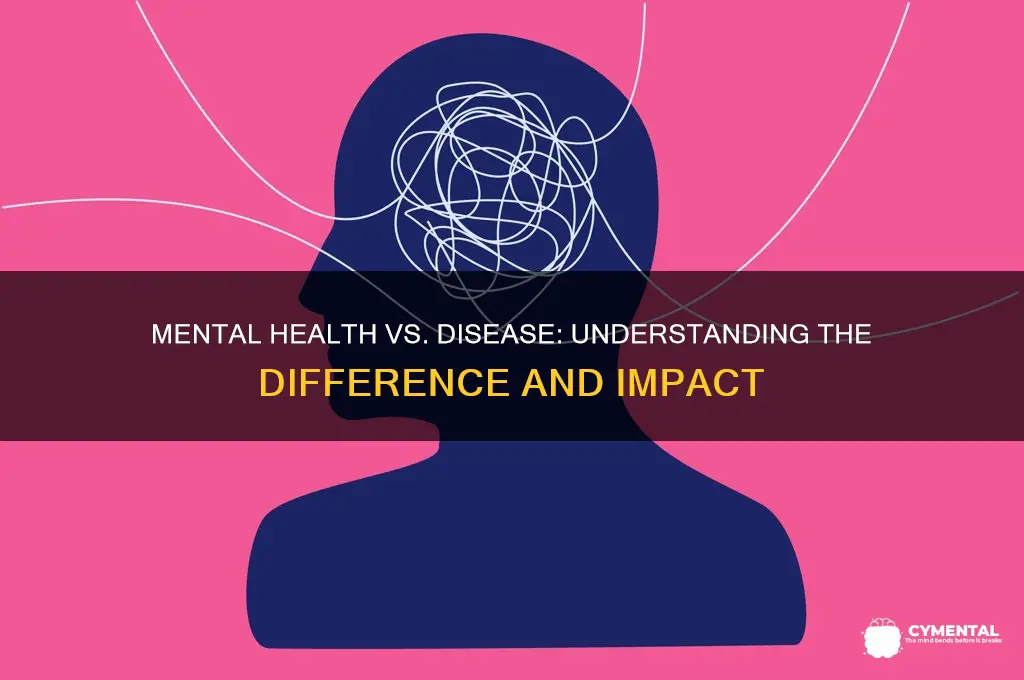
The distinction between a mental health issue and a mental disease is a nuanced and often debated topic in the field of psychology and psychiatry. While both terms refer to conditions that affect an individual's emotional, psychological, and social well-being, they are not interchangeable. Mental health issues, such as stress, anxiety, or mild depression, are typically characterized by temporary or situational challenges that can be managed with therapy, lifestyle changes, or support systems. In contrast, mental diseases, like schizophrenia, bipolar disorder, or severe depression, are often chronic, biologically-based conditions that require long-term treatment, including medication and intensive therapy. Understanding this distinction is crucial for accurate diagnosis, effective treatment planning, and reducing the stigma surrounding mental health, as it highlights the diverse spectrum of experiences and needs within the mental health landscape.
Explore related products



What You'll Learn

Defining Mental Health vs. Disease
The distinction between mental health issues and diseases is often blurred, yet understanding this difference is crucial for accurate diagnosis and treatment. Mental health encompasses emotional, psychological, and social well-being, while a disease typically refers to a specific, diagnosable condition with identifiable causes and symptoms. For instance, stress is a mental health concern, but major depressive disorder is classified as a disease due to its clinical criteria and biological underpinnings. Recognizing this distinction helps in tailoring interventions—whether lifestyle adjustments, therapy, or medication—to address the root cause effectively.
Consider anxiety: while occasional worry is a normal part of life, generalized anxiety disorder (GAD) is a diagnosable condition characterized by persistent, excessive fear lasting at least six months. Here, the line between a mental health issue and a disease becomes apparent. GAD often requires treatment with SSRIs (e.g., sertraline 50–200 mg/day) or cognitive-behavioral therapy, whereas situational anxiety might resolve with stress management techniques like mindfulness or exercise. This example highlights how context and severity dictate whether a concern is a mental health issue or a disease.
From a comparative perspective, mental health issues are often fluid and influenced by environmental factors, whereas diseases are typically more rigid and rooted in biology. For example, schizophrenia is a mental health disease with genetic predispositions and neurological abnormalities, whereas low self-esteem is a mental health issue often tied to social experiences. This comparison underscores the importance of holistic assessment: diseases may require medical intervention, while mental health issues might benefit from environmental modifications or therapeutic support.
To navigate this distinction practically, start by assessing duration, intensity, and impact on daily functioning. If symptoms persist beyond typical coping mechanisms or interfere with work, relationships, or self-care, consult a healthcare professional. For instance, insomnia lasting over three months might indicate a sleep disorder (a disease), whereas occasional sleeplessness could be a mental health issue tied to temporary stress. Tools like the PHQ-9 for depression or GAD-7 for anxiety can aid in self-assessment, but professional evaluation is essential for diagnosis.
In conclusion, distinguishing between mental health issues and diseases requires a nuanced approach. Mental health issues are often situational and responsive to lifestyle changes, while diseases demand targeted medical or therapeutic interventions. By understanding this difference, individuals can advocate for themselves more effectively, ensuring they receive the appropriate care. Whether it’s adjusting daily habits or starting medication, clarity in this distinction empowers better mental health management.
Recognizing Mental Health Struggles in Your Partner: Signs and Support
You may want to see also
Explore related products


$22.22 $46


Symptoms: Temporary or Chronic?
Distinguishing between temporary and chronic symptoms is crucial in mental health, as it shapes treatment approaches and patient expectations. Temporary symptoms, such as situational anxiety or grief, often arise in response to specific stressors and typically resolve within weeks or months. Chronic symptoms, like those in major depressive disorder or generalized anxiety disorder, persist for years and significantly impair daily functioning. Understanding this distinction helps clinicians tailor interventions—short-term therapy for transient issues versus long-term medication and psychotherapy for enduring conditions.
Consider a 25-year-old experiencing panic attacks after a job loss. If these attacks subside within 3–6 months as they adjust to a new role, the issue is likely temporary. However, if attacks recur weekly for over six months despite stable employment, a chronic diagnosis such as panic disorder may apply. The *Diagnostic and Statistical Manual of Mental Disorders (DSM-5)* uses duration criteria (e.g., depressive episodes lasting ≥2 weeks) to differentiate, but clinical judgment remains essential, as some conditions (like seasonal affective disorder) exhibit episodic patterns.
For patients, recognizing symptom duration impacts self-management. Temporary issues may respond to lifestyle changes: 30 minutes of daily exercise, mindfulness practices, or social support. Chronic conditions often require structured treatment plans, such as selective serotonin reuptake inhibitors (SSRIs) at 10–20 mg/day for depression, paired with cognitive-behavioral therapy. Ignoring chronicity risks undertreatment, while mislabeling temporary symptoms as permanent can foster unnecessary dependency on medication or therapy.
A comparative analysis reveals that age and context influence perception. Adolescents may exhibit mood swings during hormonal shifts, which are often temporary, while persistent irritability could signal emerging borderline personality traits. Similarly, post-traumatic stress symptoms after a car accident might resolve in 90 days for one individual but evolve into chronic PTSD in another. Tracking symptom frequency (e.g., panic attacks ≥4/month) and functional impact (e.g., missed workdays) aids in classification.
Practically, patients can use journaling to monitor symptoms, noting triggers, duration, and intensity. For instance, recording daily anxiety levels on a 1–10 scale over 3 months helps identify patterns. Clinicians should educate patients on red flags: symptoms lasting >6 months, worsening despite intervention, or disrupting work/relationships. Early intervention for chronic conditions improves prognosis—for example, initiating SSRIs within 3 months of persistent depression onset enhances response rates by 20–30%. In contrast, overmedicalizing temporary distress risks stigmatizing normal human experiences. Balancing vigilance with nuance ensures appropriate care.
Effective Strategies to Prevent Mental Health Issues and Promote Well-Being
You may want to see also
Explore related products




Biological vs. Psychological Causes
The distinction between biological and psychological causes in mental health is not merely academic—it directly influences treatment approaches. Biological factors, such as genetic predispositions, neurotransmitter imbalances, or structural brain abnormalities, often respond to pharmacological interventions. For instance, selective serotonin reuptake inhibitors (SSRIs) like fluoxetine (20–60 mg/day) are prescribed to correct serotonin deficiencies in depression. In contrast, psychological causes, rooted in environmental stressors, trauma, or maladaptive thought patterns, typically benefit from therapies like cognitive-behavioral therapy (CBT) or dialectical behavior therapy (DBT). Understanding this divide is crucial for tailoring effective treatment plans.
Consider the case of anxiety disorders. Biologically, heightened amygdala activity and dysregulated cortisol levels may underpin symptoms. Psychologically, chronic stress or learned helplessness could be the culprits. A 35-year-old patient with generalized anxiety disorder might find relief through a combination of sertraline (50–200 mg/day) to address biological imbalances and mindfulness-based stress reduction (MBSR) to tackle psychological triggers. This dual approach highlights the interplay between biological and psychological factors, emphasizing the need for integrated care.
While biological causes often dominate public discourse, psychological factors are equally critical. For example, childhood trauma can rewire neural pathways, creating long-term vulnerabilities to conditions like PTSD. Therapies like eye movement desensitization and reprocessing (EMDR) target these psychological roots by restructuring traumatic memories. Conversely, biological interventions like ketamine infusions (0.5 mg/kg) have shown promise in rapidly alleviating treatment-resistant depression by promoting synaptic growth. These examples illustrate how both domains contribute uniquely to mental health outcomes.
A practical takeaway is the importance of comprehensive assessment. Clinicians should not default to biological explanations without exploring psychological histories, nor should they overlook potential genetic markers. For instance, a teenager with ADHD may benefit from methylphenidate (10–60 mg/day) to address dopamine dysregulation but also require behavioral therapy to develop coping strategies. By acknowledging both biological and psychological causes, practitioners can offer more nuanced, patient-centered care.
Ultimately, the biological vs. psychological debate is not about choosing sides but recognizing their interconnectedness. Mental health issues rarely stem from a single cause; they are often the result of complex interactions between genes, brain chemistry, and life experiences. For example, schizophrenia involves dopamine hyperactivity (treated with antipsychotics like olanzapine, 5–20 mg/day) but is also influenced by psychosocial factors like urban upbringing or migration. Embracing this duality allows for a more holistic understanding and treatment of mental health conditions.
Unraveling the Garcia Girls' Accents: Mental Health Struggles Explored
You may want to see also
Explore related products



Diagnosis: Criteria and Challenges
Distinguishing between a mental health issue and a mental disease hinges on diagnostic criteria, yet these criteria are neither static nor universally agreed upon. The Diagnostic and Statistical Manual of Mental Disorders (DSM-5) and the International Classification of Diseases (ICD-11) provide frameworks, but their classifications evolve with research and cultural shifts. For instance, grief was once considered a normal response to loss but is now scrutinized for its potential to meet criteria for depressive disorders under specific durations and symptom severity. This fluidity underscores the challenge: where does normal human experience end, and pathology begin?
Diagnosis requires a systematic approach, often involving symptom checklists, duration thresholds, and functional impairment assessments. For example, generalized anxiety disorder is diagnosed when excessive worry persists for at least six months, accompanied by symptoms like restlessness or sleep disturbance. However, these criteria can be subjective. A teenager’s anxiety about exams might mirror clinical symptoms but be contextually appropriate, while an adult’s similar presentation could indicate disorder. Clinicians must discern between adaptive stress responses and maladaptive patterns, a task complicated by individual variability and cultural norms.
One of the most contentious challenges is the reliance on self-reported symptoms. Unlike physical diseases, mental health diagnoses lack definitive biomarkers. A patient’s description of their experience is pivotal, yet this can be influenced by factors like stigma, language barriers, or a desire to conform to perceived diagnostic expectations. For instance, a person might underreport suicidal ideation due to fear of hospitalization or overstate symptoms to access treatment. This subjectivity demands clinicians employ collateral information, such as reports from family members or behavioral observations, to triangulate accuracy.
Cultural differences further complicate diagnosis. Symptoms like hearing voices are pathologized in Western frameworks but may be interpreted as spiritual experiences in other cultures. The DSM-5 acknowledges this with cultural formulations, yet these remain secondary to primary diagnoses, risking misclassification. For example, a shaman in a traditional community might describe experiences akin to schizophrenia but function without impairment, challenging the disorder’s universal applicability. Clinicians must balance standardized criteria with cultural context, a delicate task requiring humility and cross-cultural competence.
Finally, the practical implications of diagnosis cannot be overlooked. Labeling a condition as a disease often triggers insurance coverage, treatment protocols, and legal protections, while framing it as an issue might relegate it to self-management or therapy. For instance, attention-deficit/hyperactivity disorder (ADHD) diagnoses in children can unlock accommodations in schools but also carry risks of overmedication. Adults seeking ADHD diagnosis may face skepticism due to age biases. Navigating these stakes requires transparency about diagnostic limitations and collaboration between clinicians, patients, and support systems to prioritize holistic well-being over rigid categorization.
Navigating Mental Health Disclosure in Job Applications: Tips for Success
You may want to see also
Explore related products


Treatment: Therapy, Medication, or Both?
The distinction between a mental health issue and a mental disease often hinges on severity, duration, and biological underpinnings. While anxiety might be situational and transient, generalized anxiety disorder (GAD) is chronic and pervasive, rooted in neurochemical imbalances. This distinction matters because it shapes treatment approaches. Therapy, medication, or a combination of both? The answer depends on the condition’s nature, its impact on daily life, and the individual’s preferences. For instance, mild depression may respond well to cognitive-behavioral therapy (CBT) alone, while severe major depressive disorder often requires antidepressants like SSRIs (e.g., fluoxetine 20–60 mg/day) alongside psychotherapy.
Consider the case of obsessive-compulsive disorder (OCD), a condition often misconstrued as a mere personality quirk. OCD is a neurobiological disorder involving serotonin dysregulation. Exposure and response prevention (ERP) therapy is the gold standard, but when compulsions significantly impair function—say, spending 4+ hours daily on rituals—selective serotonin reuptake inhibitors (SSRIs) like sertraline (50–200 mg/day) are typically added. Here, medication dampens the biological hyperactivity, making therapy more effective. This combination approach underscores the interplay between brain chemistry and behavioral patterns.
For children and adolescents, the calculus shifts. The developing brain is more sensitive to medication side effects, and long-term impacts are less understood. For ADHD, stimulant medications like methylphenidate (10–60 mg/day) are often prescribed, but behavioral therapy is equally critical. Parents should ensure therapists use evidence-based methods, such as parent-child interaction therapy (PCIT), to teach coping strategies. In bipolar disorder, mood stabilizers like lithium (600–1200 mg/day) are essential for managing manic episodes, but psychotherapy helps patients recognize triggers and develop emotional regulation skills.
Practical tips for navigating treatment decisions include: start with the least invasive option (e.g., therapy for mild conditions), monitor progress systematically (e.g., mood journals), and communicate openly with providers. For medication, always inquire about potential side effects (e.g., weight gain with antipsychotics) and dosage titration. Combining treatments requires coordination—ensure your therapist and psychiatrist collaborate. Finally, remember that treatment is not one-size-fits-all. A 25-year-old with panic disorder might thrive on CBT alone, while a 40-year-old with treatment-resistant depression may need electroconvulsive therapy (ECT) alongside medication.
The takeaway? Therapy addresses maladaptive thoughts and behaviors, medication modulates neurochemistry, and both often work synergistically. The key is tailoring the approach to the condition’s complexity and the individual’s needs. Whether it’s a mental health issue or a disease, the goal remains the same: restoring function and improving quality of life.
Enhance Your Well-Being: Practical Strategies to Improve Mental Health Issues
You may want to see also
Frequently asked questions
While related, they are not the same. A mental health issue refers to a broad range of conditions affecting mood, thinking, and behavior, which can vary in severity. A mental disease, or mental illness, is a specific diagnosable condition, such as depression or schizophrenia, that significantly impairs functioning.
Stress and anxiety can be both. Mild or situational stress and anxiety are common mental health issues, but when persistent, severe, and impairing daily life, they may be diagnosed as anxiety disorders, which are classified as mental diseases.
Personality traits like introversion or shyness are not mental health issues or diseases. They are normal variations in human behavior. However, if these traits cause significant distress or impairment, they might be linked to conditions like social anxiety disorder, which is a mental health issue.
The key difference lies in severity, duration, and impact on daily life. Mental health issues are often temporary or situational, while mental diseases are persistent, diagnosable conditions. Consulting a mental health professional is the best way to determine the nature of your experience.