Madison Cole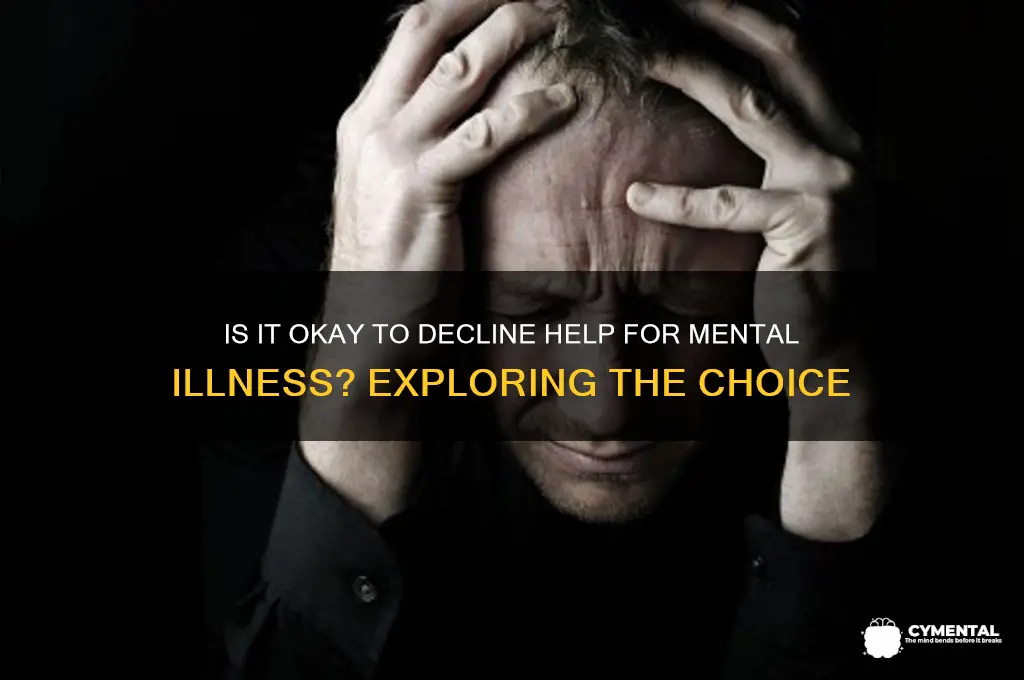
Struggling with mental illness can be isolating, and the question of whether it’s okay to not receive help is complex and deeply personal. While seeking support is often encouraged as a vital step toward healing, some individuals may feel hesitant due to stigma, fear of judgment, or a desire to manage their condition independently. It’s important to acknowledge that everyone’s journey is unique, and what works for one person may not work for another. However, untreated mental illness can worsen over time, impacting relationships, work, and overall quality of life. Ultimately, the decision to seek help should be respected, but it’s equally crucial to emphasize that support is available and can make a significant difference in recovery and well-being.
| Characteristics | Values |
|---|---|
| Prevalence of Unmet Mental Health Needs | Approximately 56% of adults with mental illness in the U.S. do not receive treatment (Mental Health America, 2023). |
| Common Reasons for Not Seeking Help | Stigma (50%), lack of access to care (30%), financial barriers (25%), belief in self-reliance (20%) (NAMI, 2022). |
| Impact on Health Outcomes | Untreated mental illness increases risk of chronic physical conditions (e.g., heart disease), substance abuse, and suicide (WHO, 2023). |
| Cultural Factors | In some cultures, mental illness is seen as a personal weakness or spiritual issue, reducing help-seeking behavior (APA, 2021). |
| Self-Management Strategies | Some individuals use coping mechanisms like exercise, meditation, journaling, or peer support instead of professional help (CAMH, 2022). |
| Professional Perspective | Mental health professionals emphasize the importance of early intervention but respect autonomy in decision-making (APA Ethics Code, 2023). |
| Legal and Ethical Considerations | Individuals have the right to refuse treatment unless they pose an immediate danger to themselves or others (UN Convention on the Rights of Persons with Disabilities, 2006). |
| Long-Term Consequences | Delayed treatment can lead to symptom worsening, social isolation, and reduced quality of life (NIMH, 2023). |
| Support for Autonomy | It is ethically acceptable to not seek help if the decision is informed, voluntary, and does not harm others (Bioethics Journal, 2022). |
| Alternatives to Traditional Treatment | Online therapy, support groups, and community resources are increasingly available for those hesitant to seek formal help (SAMHSA, 2023). |
Explore related products


What You'll Learn
- Stigma and Self-Reliance: Fear of judgment often discourages seeking help for mental health struggles
- Cultural Influences: Societal norms may promote independence, minimizing mental health support acceptance
- Personal Pride: Some view asking for help as weakness, preferring to manage alone
- Lack of Awareness: Not recognizing symptoms or available resources can prevent seeking assistance
- Past Trauma: Negative experiences with therapy or support systems may deter future attempts

Stigma and Self-Reliance: Fear of judgment often discourages seeking help for mental health struggles
The fear of being judged as weak or incapable can paralyze individuals struggling with mental health issues, trapping them in a cycle of silence and self-reliance. This stigma often stems from societal misconceptions that equate seeking help with failure, perpetuating the myth that mental illness should be manageable through sheer willpower. For example, a 2021 study published in the *Journal of Mental Health* found that 40% of respondents avoided therapy due to concerns about being labeled as "unstable" or "overly emotional." Such reluctance not only delays recovery but can exacerbate symptoms, turning a treatable condition into a chronic struggle.
Consider the case of a 28-year-old professional who, despite experiencing severe anxiety, refused to consult a therapist for years, fearing workplace repercussions. "I didn’t want to be seen as someone who couldn’t handle stress," they admitted. This mindset is not uncommon; a 2019 survey by the American Psychological Association revealed that 60% of employees worry about negative career consequences if they disclose mental health issues. The irony lies in the fact that untreated mental health struggles often lead to decreased productivity and job performance, the very outcomes individuals aim to avoid by staying silent.
Breaking this cycle requires reframing self-reliance as a barrier rather than a virtue. Practical steps include normalizing conversations about mental health in everyday settings, such as workplaces or social circles. Employers can play a pivotal role by offering anonymous mental health resources and fostering a culture of empathy. For individuals, starting small—like confiding in a trusted friend or using online therapy platforms—can reduce the intimidation factor of seeking help. Remember, acknowledging vulnerability is not a sign of weakness but a step toward resilience.
Comparing mental health to physical health can also shift perspectives. No one would shame a person for seeing a doctor for a broken leg, yet the same logic is often absent when it comes to mental illness. Just as physical ailments require professional intervention, mental health struggles benefit from expert guidance. For instance, cognitive-behavioral therapy (CBT) has a proven success rate of 50–75% for conditions like depression and anxiety, according to the National Institute of Mental Health. Ignoring such evidence-based solutions out of fear of judgment is akin to refusing medication for a treatable disease.
Ultimately, the stigma surrounding mental health help-seeking is a collective problem requiring individual and societal action. By challenging misconceptions, leveraging available resources, and prioritizing well-being over perceived judgment, individuals can break free from the shackles of self-reliance. The question isn’t whether it’s okay to avoid help—it’s whether one can afford the consequences of doing so.
Canine Companions: How Dogs Boost Mental Health and Well-being
You may want to see also
Explore related products


Cultural Influences: Societal norms may promote independence, minimizing mental health support acceptance
In many cultures, the ideal of self-reliance is deeply ingrained, often celebrated as a cornerstone of personal strength. This ethos, while admirable in fostering resilience, can inadvertently stigmatize seeking help for mental health issues. For instance, in individualistic societies like the United States, phrases such as "pull yourself up by your bootstraps" are commonplace, reinforcing the notion that relying on others is a sign of weakness. Such cultural narratives can deter individuals from accessing mental health support, leaving them to grapple with their struggles in isolation.
Consider the contrast between collectivist cultures, where community support is prioritized, and individualistic ones, where independence is paramount. In Japan, for example, the concept of *gaman*—enduring hardship with patience and dignity—can discourage open discussions about mental health. Similarly, in some African cultures, mental illness may be viewed as a personal or familial failure rather than a medical condition, further isolating those affected. These cultural norms, while rooted in historical context, can create barriers to seeking professional help, perpetuating cycles of untreated mental illness.
To navigate this cultural challenge, it’s essential to reframe the narrative around mental health support. One practical step is to integrate mental health education into cultural conversations, emphasizing that seeking help is not a sign of weakness but a proactive step toward well-being. For instance, workplaces can implement training programs that normalize therapy or counseling, much like physical health check-ups. Families can also play a role by openly discussing mental health, reducing the stigma associated with vulnerability.
A cautionary note: while promoting independence is valuable, it’s crucial to recognize its limits. Mental health struggles often require professional intervention, and delaying or avoiding treatment can exacerbate conditions. For example, untreated depression can lead to severe functional impairment, affecting relationships, work, and overall quality of life. Thus, cultural norms should not overshadow the necessity of timely, evidence-based care.
In conclusion, societal emphasis on independence can significantly impact mental health support acceptance. By acknowledging these cultural influences and actively working to shift perspectives, individuals and communities can foster an environment where seeking help is not only accepted but encouraged. This balance between self-reliance and support is key to addressing mental health challenges effectively.
Mental Health Courts: Reducing Recidivism Through Supportive Justice Approaches
You may want to see also
Explore related products





Personal Pride: Some view asking for help as weakness, preferring to manage alone
Personal pride can be a double-edged sword, especially when it comes to mental health. For some, the act of asking for help is seen as an admission of defeat, a crack in the armor of self-reliance they’ve spent years forging. This mindset often stems from societal narratives that equate independence with strength, leaving little room for vulnerability. Yet, the irony lies in the fact that mental illness thrives in isolation, feeding on the very silence it demands. By refusing help, individuals may inadvertently prolong their suffering, mistaking endurance for resilience.
Consider the analogy of a broken leg: no one would shame a person for seeking medical attention, yet the same logic rarely applies to mental health. This discrepancy highlights a dangerous cultural bias. Mental illness, like physical injury, requires intervention, and self-management alone can be as ineffective as setting a bone without professional guidance. For instance, untreated depression can worsen over time, with symptoms escalating from persistent sadness to suicidal ideation. The belief that "I can handle this on my own" often delays critical treatment, turning a manageable condition into a crisis.
From a practical standpoint, managing mental illness without support is akin to navigating a labyrinth blindfolded. Therapy, medication, and support networks provide tools and perspectives that solitary coping mechanisms lack. For example, cognitive-behavioral therapy (CBT) has been shown to reduce symptoms of anxiety and depression in 50–75% of cases, a success rate that far outpaces unguided self-help. Similarly, antidepressants, when prescribed correctly, can restore chemical imbalances that no amount of willpower can fix. Ignoring these resources out of pride is not just unwise—it’s counterproductive.
The fear of appearing weak is deeply rooted in societal expectations, particularly in cultures that valorize stoicism. However, this fear often stems from a misunderstanding of what strength truly means. Strength is not the absence of vulnerability but the willingness to confront it. Take athletes, for instance: they rely on coaches, trainers, and teammates to perform at their best. Mental health is no different. Seeking help is not a sign of failure but a strategic move toward recovery. It takes courage to admit when you’re struggling, and that courage is the cornerstone of true resilience.
Ultimately, the decision to forgo help for mental illness is often a choice between pride and progress. While self-reliance has its merits, it should not come at the expense of well-being. The takeaway is clear: asking for help is not a weakness but a necessary step toward healing. Just as a map is essential for an unfamiliar journey, professional support provides the guidance needed to navigate the complexities of mental illness. Pride may keep you standing alone, but humility will help you move forward.
Rehabilitation: A Powerful Tool for Mental Health Recovery and Wellness
You may want to see also
Explore related products


$12.14 $19.99

$10.21 $18.95


Lack of Awareness: Not recognizing symptoms or available resources can prevent seeking assistance
Mental health symptoms often masquerade as everyday struggles, making them difficult to identify. For instance, persistent fatigue might be dismissed as overwork, while irritability could be chalked up to stress. Without awareness of these as potential red flags, individuals may normalize their distress, delaying intervention. A 2021 study by the National Alliance on Mental Illness (NAMI) found that 56% of adults with mental illness did not receive treatment, often due to unrecognized symptoms. This highlights the critical need for education on how mental health issues manifest—whether through mood changes, physical symptoms, or behavioral shifts—to encourage timely action.
Consider the case of Sarah, a 28-year-old professional who experienced frequent anxiety attacks but attributed them to her demanding job. She only sought help after a colleague recognized her symptoms and suggested therapy. This scenario underscores the importance of both self-awareness and community knowledge. Practical steps include maintaining a symptom journal to track patterns, using online self-assessment tools like those provided by Mental Health America, and consulting primary care physicians for initial screenings. Early recognition can transform a spiraling condition into a manageable one.
Even when symptoms are acknowledged, lack of awareness about available resources can halt progress. Many assume therapy is unaffordable or inaccessible, unaware of sliding-scale clinics, telehealth platforms, or community mental health centers. For example, Open Path Collective offers therapy sessions starting at $30–60, while apps like BetterHelp provide flexible, affordable options. Additionally, schools, workplaces, and religious institutions often have underutilized counseling services. A proactive approach involves researching local resources, inquiring about employer-provided mental health benefits, and exploring government-funded programs like SAMHSA’s National Helpline.
Cultural stigma compounds this issue, particularly in communities where mental health discussions are taboo. In such cases, peer-led initiatives and culturally sensitive resources can bridge the gap. Organizations like The Steve Fund focus on mental health support for young people of color, while NAMI offers multilingual materials to reach diverse populations. By tailoring awareness campaigns to specific cultural contexts, we can dismantle barriers and normalize seeking help. For instance, framing therapy as a tool for personal growth rather than a sign of weakness can resonate more effectively in certain communities.
Ultimately, addressing the lack of awareness requires a multi-pronged strategy. Public health campaigns should emphasize symptom recognition and resource availability, while educational institutions and workplaces must integrate mental health literacy into their curricula and policies. Individuals can contribute by sharing their experiences, reducing stigma, and advocating for accessible care. The takeaway is clear: awareness is not just about knowing something exists but understanding how to engage with it. Without this, even the most robust support systems remain out of reach.
Psychologists: Essential Allies in Navigating Mental Health Challenges
You may want to see also
Explore related products


Past Trauma: Negative experiences with therapy or support systems may deter future attempts
Past trauma from negative therapeutic experiences can create a psychological barrier thicker than any stigma. Imagine seeking solace only to encounter a therapist who dismisses your pain, misdiagnoses your condition, or violates your trust. Such encounters don’t just fail to heal—they deepen wounds, embedding a belief that the system itself is unsafe. For instance, a survivor of emotional abuse might freeze at the thought of opening up again after a therapist invalidated their experiences, labeling them as "overreactions." This isn’t mere reluctance; it’s a survival mechanism rooted in learned helplessness.
Consider the mechanics of this deterrence. When therapy becomes a retraumatizing event, the brain’s threat response hardwires avoidance as a protective measure. Neurobiologically, this aligns with the amygdala’s role in encoding fear-based memories. For someone who’s experienced gaslighting in a support group or felt judged by a counselor, the mere suggestion of therapy can trigger cortisol spikes, mimicking the body’s response to physical danger. Over time, this conditioning turns avoidance into a default, not a choice.
Yet, not all hope is lost. Rebuilding trust requires a paradigm shift in how support systems operate. Start with informed consent—not just for treatment plans, but for the therapist’s approach, qualifications, and limitations. For example, a client with PTSD from medical settings might need a therapist trained in trauma-informed care, using techniques like grounding exercises before diving into sensitive topics. Practical steps include requesting a preliminary consultation to gauge compatibility, or seeking peer-reviewed platforms like Psychology Today to verify a therapist’s expertise in handling specific traumas.
Compare this to the pharmaceutical world: Just as a patient allergic to penicillin avoids it entirely, someone traumatized by therapy may need to bypass traditional talk therapy altogether. Alternatives like art therapy, somatic experiencing, or even AI-assisted mental health apps can serve as detours on the road to healing. The key is acknowledging that one size never fits all—especially when past failures have left emotional scars.
In conclusion, refusing help after traumatic support experiences isn’t a moral failing; it’s a rational response to systemic flaws. The onus lies on providers to rebuild trust through transparency, adaptability, and humility. For individuals, the takeaway is clear: Your reluctance is valid, but so is your right to heal on your terms. Whether through non-traditional methods or a carefully vetted therapist, recovery doesn’t demand revisiting the battlefield—it invites you to chart a new path.
Melodic Healing: How Musical Instruments Boost Mental Well-Being
You may want to see also
Frequently asked questions
While self-management can be effective for some, mental illness often requires professional support for proper treatment. Avoiding help may lead to worsening symptoms or prolonged suffering. It’s okay to try coping on your own, but reaching out for professional guidance is strongly encouraged.
People’s opinions vary, but prioritizing your well-being is more important than fearing judgment. Many understand that seeking help is a personal choice, and not everyone is ready or able to access support. Focus on what’s best for you rather than worrying about others’ perceptions.
Recovery without professional help is possible for some, but it depends on the severity and type of mental illness. Professional treatment often provides tools and strategies that can significantly improve outcomes. Relying solely on self-help may limit your progress, so consider exploring available resources.