Ava Ramirez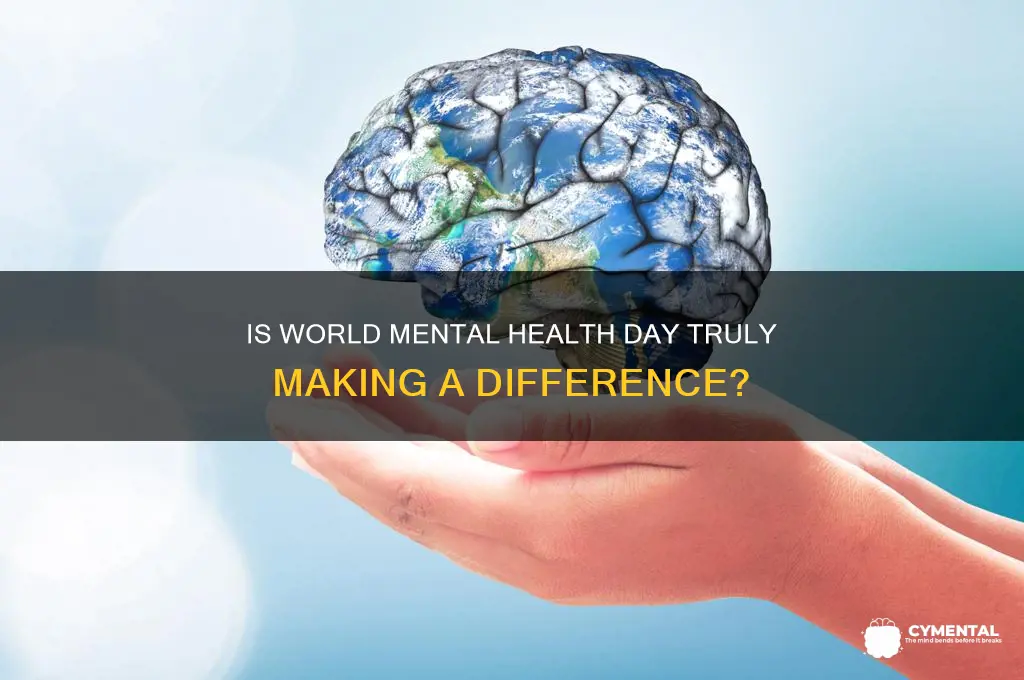
World Mental Health Day, observed annually on October 10th, aims to raise awareness about mental health issues, promote open conversations, and mobilize efforts to support mental well-being globally. While the initiative has successfully destigmatized mental health discussions and encouraged individuals to seek help, questions remain about its tangible impact. Critics argue that a single day of awareness may not be sufficient to address systemic challenges such as inadequate resources, unequal access to care, and persistent societal biases. Despite these limitations, the day serves as a vital catalyst for ongoing dialogue, policy advocacy, and community engagement, highlighting the need for sustained, year-round efforts to improve mental health outcomes worldwide.
| Characteristics | Values |
|---|---|
| Awareness | Significantly increases public awareness about mental health issues, reducing stigma and encouraging conversations. |
| Global Reach | Observed in over 150 countries, fostering international collaboration and shared initiatives. |
| Policy Impact | Influences governments and organizations to implement mental health policies and allocate resources. |
| Community Engagement | Mobilizes communities, NGOs, and individuals to organize events, workshops, and campaigns. |
| Access to Resources | Provides platforms for sharing mental health resources, tools, and support services. |
| Media Coverage | Generates widespread media attention, amplifying mental health narratives and personal stories. |
| Workplace Initiatives | Encourages employers to prioritize employee mental well-being through programs and policies. |
| Youth Involvement | Engages young people in mental health advocacy and education, fostering early intervention. |
| Research Promotion | Highlights the importance of mental health research and evidence-based practices. |
| Long-Term Impact | While awareness is high, sustained action and funding remain challenges for long-term change. |
Explore related products





What You'll Learn
- Awareness Campaigns: Effectiveness of global initiatives in increasing mental health awareness and reducing stigma
- Policy Impact: Influence on government policies and funding for mental health services worldwide
- Community Engagement: Role in fostering local support networks and peer-to-peer mental health advocacy
- Social Media Reach: How online platforms amplify messages and engage younger audiences effectively
- Long-Term Change: Measuring sustained behavioral shifts beyond the annual observance of the day

Awareness Campaigns: Effectiveness of global initiatives in increasing mental health awareness and reducing stigma
Global awareness campaigns like World Mental Health Day have undeniably amplified conversations about mental health, but their effectiveness in reducing stigma and fostering tangible change remains a complex question. Data from the World Health Organization (WHO) reveals a 20% increase in Google searches related to mental health during October, the month hosting World Mental Health Day. This surge in online engagement suggests heightened curiosity, yet it doesn’t necessarily translate to behavioral shifts or improved access to care. For instance, while social media platforms buzz with hashtags like #MentalHealthAwareness, studies show that only 1 in 3 individuals who express online support actively seek or provide help offline. This disparity highlights a critical gap: awareness without actionable steps risks becoming performative activism rather than a catalyst for systemic change.
Consider the campaign strategies employed by global initiatives. Many rely on celebrity endorsements, personal testimonials, and viral challenges to capture attention. While these methods are effective in reaching broad audiences, they often oversimplify mental health issues, reducing them to catchy slogans or fleeting trends. For example, the "Bell Let’s Talk" campaign in Canada, which donates funds for every social media interaction, has raised millions but faces criticism for its superficial engagement. Participants may post a message without fully understanding the complexities of mental illness or the barriers to treatment. To bridge this gap, campaigns must pair visibility with education, offering resources like free counseling hotlines, self-assessment tools, or guides to local mental health services. Without such practical components, awareness risks becoming a hollow echo chamber.
A comparative analysis of regional campaigns reveals that localized, culturally sensitive initiatives often yield more impactful results than one-size-fits-all global efforts. In India, the "DOST" campaign by the National Institute of Mental Health and Neurosciences (NIMHANS) uses vernacular languages and community leaders to destigmatize mental health discussions. This approach contrasts sharply with Western-centric campaigns that may alienate non-English speakers or fail to address region-specific taboos. For instance, in Japan, where suicide rates are among the highest globally, the "Kokoro no Mimi" (Ear for the Heart) initiative trains volunteers to listen without judgment, aligning with cultural values of empathy and discretion. These examples underscore the importance of tailoring campaigns to local contexts, ensuring that awareness translates into acceptance and action.
Despite their limitations, global initiatives play a pivotal role in normalizing mental health conversations, particularly among younger demographics. A 2021 survey by the American Psychological Association found that 70% of Gen Z respondents felt more comfortable discussing mental health than previous generations, a shift partly attributed to widespread awareness campaigns. However, this progress is unevenly distributed. In low-income countries, where mental health resources are scarce, campaigns often fail to resonate due to more pressing concerns like poverty and healthcare access. To address this disparity, global initiatives must adopt a dual strategy: advocating for policy changes that integrate mental health into primary care while empowering local communities to lead their own awareness efforts. Only then can campaigns move beyond symbolism to create lasting impact.
Ultimately, the effectiveness of global awareness campaigns hinges on their ability to evolve from awareness to advocacy. While World Mental Health Day and similar initiatives have succeeded in breaking the silence around mental health, their long-term success requires measurable outcomes: increased funding for mental health services, reduced wait times for therapy, and improved public attitudes toward mental illness. Practical steps, such as integrating mental health education into school curricula or mandating workplace training, can transform awareness into systemic change. As individuals, we can amplify these efforts by moving beyond likes and shares to engage in meaningful dialogue, support policy reforms, and challenge stigmatizing behaviors in our daily lives. Awareness is just the first step—action is what turns it into progress.
Mental Health Counselors vs. Other Helping Professionals: Key Differences Explained
You may want to see also
Explore related products





Policy Impact: Influence on government policies and funding for mental health services worldwide
World Mental Health Day has catalyzed significant shifts in government policies and funding for mental health services globally, though its impact varies widely by region and political will. One of the most tangible outcomes is the increased allocation of resources to mental health programs in countries like Australia, where the government has committed over AUD 100 million annually to initiatives such as Headspace, a youth mental health foundation. Similarly, the UK’s NHS has seen a 10% rise in mental health funding since 2019, partly influenced by advocacy efforts tied to this annual observance. These examples illustrate how the day’s awareness-raising campaigns can translate into concrete financial commitments, though sustained advocacy remains critical to ensure these funds are effectively utilized.
However, the policy impact of World Mental Health Day is not uniform, particularly in low- and middle-income countries (LMICs) where mental health budgets often constitute less than 2% of total health expenditure. In India, for instance, despite the day’s growing visibility, mental health accounts for only 0.05% of the national health budget. This disparity highlights a critical challenge: while the day succeeds in elevating global conversations, its ability to drive policy change is often constrained by systemic issues like inadequate infrastructure and competing public health priorities. To bridge this gap, LMICs require targeted strategies, such as integrating mental health into primary care systems and leveraging international partnerships for funding and expertise.
A comparative analysis reveals that countries with robust civil society engagement tend to experience more pronounced policy shifts. In Canada, for example, grassroots organizations have leveraged World Mental Health Day to lobby for the inclusion of mental health parity in federal legislation, ensuring insurance coverage for mental health services equivalent to physical health. This underscores the importance of pairing global awareness campaigns with localized advocacy efforts. Governments can amplify this impact by establishing clear policy frameworks, such as mandating mental health education in schools or implementing workplace mental health standards, as seen in Singapore’s *Beyond the Label* initiative.
To maximize the day’s policy influence, stakeholders must adopt a multi-pronged approach. First, governments should commit to evidence-based funding models, such as the World Health Organization’s Mental Health Gap Action Programme (mhGAP), which provides cost-effective interventions for LMICs. Second, policymakers must prioritize data collection to measure the impact of mental health initiatives, ensuring accountability and informed decision-making. Finally, international bodies like the UN should incentivize policy reforms through funding conditionalities or recognition programs, fostering a race to the top in global mental health governance. Without such strategic interventions, World Mental Health Day risks remaining a symbolic gesture rather than a driver of systemic change.
Supporting Mental Health: Nigerian Families’ Strategies for Caring and Healing
You may want to see also
Explore related products


Community Engagement: Role in fostering local support networks and peer-to-peer mental health advocacy
World Mental Health Day, observed annually on October 10th, has become a global platform for raising awareness about mental health issues. However, its effectiveness hinges on more than just awareness—it requires actionable, community-driven initiatives. Community engagement plays a pivotal role in transforming this awareness into tangible support networks and peer-to-peer advocacy, ensuring that the day’s impact extends beyond a single event. By fostering local connections, communities can address mental health challenges in culturally sensitive, accessible, and sustainable ways.
Consider the power of peer-to-peer advocacy in mental health. When individuals with lived experiences share their stories, they reduce stigma and create safe spaces for others to seek help. For instance, local workshops or support groups led by peers can provide practical tools for managing stress, anxiety, or depression. A study by the World Health Organization highlights that peer-led interventions increase help-seeking behavior by 40% in communities where such programs are active. To implement this, start by identifying local leaders or volunteers with personal or professional mental health expertise. Train them in facilitation skills and provide resources like mental health first aid kits, which include crisis hotlines, coping strategies, and self-care guides.
Building local support networks requires intentional collaboration between community organizations, schools, workplaces, and healthcare providers. For example, a community in rural India established a mental health task force comprising teachers, faith leaders, and healthcare workers. This network organized monthly awareness sessions, distributed informational pamphlets in local languages, and created a referral system for professional help. Such initiatives not only amplify the reach of World Mental Health Day but also ensure ongoing support. To replicate this, map out key stakeholders in your area, define shared goals, and allocate responsibilities. Regular meetings and feedback loops can keep the network dynamic and responsive to community needs.
However, community engagement is not without challenges. Limited resources, cultural barriers, and lack of trust can hinder progress. For instance, in some cultures, mental health discussions are taboo, making it difficult to engage older generations. To overcome this, tailor your approach to local contexts. Use storytelling, art, or music to communicate mental health messages in culturally relevant ways. Partner with trusted community figures, such as religious leaders or elders, to endorse initiatives. Additionally, ensure that all activities are inclusive, considering factors like language, accessibility for disabilities, and age-appropriate content.
Ultimately, the success of World Mental Health Day in fostering local support networks and peer-to-peer advocacy depends on sustained community engagement. It’s not enough to organize a single event; the goal is to embed mental health conversations into the fabric of daily life. By empowering peers, collaborating across sectors, and adapting to local needs, communities can turn awareness into action. Start small, measure impact, and iterate—because meaningful change begins at the grassroots level.
Supporting Mental Health in Palestine: Strategies for Resilience and Healing
You may want to see also
Explore related products




Social Media Reach: How online platforms amplify messages and engage younger audiences effectively
Social media platforms have become the modern town square, where conversations about mental health resonate far beyond what traditional campaigns could achieve. On World Mental Health Day, hashtags like #MentalHealthAwareness and #EndTheStigma trend globally, reaching millions in real time. Instagram, TikTok, and Twitter amplify these messages through shares, likes, and comments, creating a ripple effect that traditional media cannot match. For younger audiences, who spend an average of 3 hours daily on social media, these platforms are not just a source of entertainment but a vital space for education and connection.
Consider the power of TikTok, where short, engaging videos can dismantle myths about mental health in under 60 seconds. Creators like Dr. Julie Smith and Alex Light use relatable narratives and actionable tips to reach audiences as young as 13. Their content often includes practical advice, such as "Take a 5-minute breathing break when overwhelmed" or "Limit social media to 1 hour daily to reduce anxiety." These bite-sized strategies are more likely to be adopted by younger users, who prefer quick, digestible information over lengthy articles or seminars.
However, the effectiveness of social media in mental health advocacy isn’t without caution. While platforms can foster community, they can also perpetuate harmful trends or misinformation. For instance, viral challenges like "The 48-Hour Fast for Clarity" can mislead teens into believing extreme measures are necessary for mental well-being. To mitigate this, organizations like the World Health Organization (WHO) collaborate with influencers to fact-check content and promote evidence-based practices. Parents and educators can also play a role by guiding younger users to follow verified accounts and critically evaluate what they see.
One of the most impactful ways social media engages younger audiences is through storytelling. Platforms like Instagram Stories and Snapchat allow users to share personal experiences anonymously, reducing the fear of judgment. Campaigns like "Share Your Story" encourage teens to post about their mental health journeys, often accompanied by resources like crisis hotline numbers or links to therapy apps. This peer-to-peer approach builds trust and normalizes seeking help, as 70% of teens report feeling more comfortable discussing mental health after seeing others do so online.
To maximize social media’s potential on World Mental Health Day, organizations should adopt a multi-platform strategy. Start with Instagram for visually appealing infographics, use TikTok for engaging videos, and leverage Twitter for real-time discussions. Incorporate interactive elements like polls ("How do you prioritize mental health?") or challenges ("Post a photo of something that brings you joy"). For younger audiences, collaborate with micro-influencers who have a following of 10,000–50,000, as their content feels more authentic and relatable. Finally, track engagement metrics to refine future campaigns—what resonates? What falls flat? By tailoring content to platform-specific behaviors, mental health messages can cut through the noise and inspire meaningful action.
Neuroscience Unveils the Brain's Role in Mental Health Insights
You may want to see also
Explore related products


Long-Term Change: Measuring sustained behavioral shifts beyond the annual observance of the day
World Mental Health Day, observed annually on October 10th, serves as a global platform to raise awareness and advocate for mental health issues. However, its true impact lies not in the day itself but in the long-term behavioral changes it can inspire. Measuring these sustained shifts requires a strategic approach, focusing on tangible outcomes rather than fleeting engagement. For instance, tracking the increase in mental health screenings or therapy sessions in the months following the event can provide concrete evidence of its influence. Without such metrics, the day risks becoming a symbolic gesture rather than a catalyst for meaningful change.
To foster long-term change, organizations and individuals must adopt a multi-faceted strategy that extends beyond the annual observance. One effective method is to integrate mental health education into existing systems, such as schools and workplaces. For example, a company could implement a year-round mental health training program, starting with a pilot group of 50 employees. By measuring reductions in sick days, improvements in productivity, and employee feedback over 12 months, the program’s effectiveness can be quantified. This approach not only sustains the momentum of World Mental Health Day but also embeds mental health awareness into daily practices.
Another critical aspect is leveraging technology to track and encourage behavioral shifts. Apps that promote mindfulness, journaling, or therapy access can provide data on user engagement and progress. For instance, a mental health app could offer a 30-day challenge during October, with reminders and rewards for consistent use. By analyzing user retention and self-reported well-being scores six months later, developers can assess whether the initial engagement translated into lasting habits. Such tools bridge the gap between awareness and action, turning one-day participation into ongoing commitment.
However, measuring long-term change is not without challenges. One common pitfall is relying solely on self-reported data, which can be biased or inconsistent. To mitigate this, combine qualitative feedback with quantitative metrics, such as healthcare utilization rates or workplace absenteeism. Additionally, ensure that initiatives are tailored to diverse populations, as a one-size-fits-all approach may overlook specific needs. For example, a program targeting adolescents might focus on social media campaigns and peer support, while one for seniors could emphasize in-person workshops and community resources.
Ultimately, the success of World Mental Health Day hinges on its ability to spark enduring transformations. By setting clear, measurable goals and employing creative strategies, stakeholders can ensure that the day’s impact extends far beyond October 10th. Whether through systemic integration, technological innovation, or targeted interventions, the focus must remain on fostering behaviors that prioritize mental well-being year-round. Only then can the observance truly fulfill its purpose of creating a healthier, more compassionate world.
Social Media's Positive Impact: Supporting Teen Mental Health and Well-being
You may want to see also
Frequently asked questions
World Mental Health Day is observed annually on October 10th to raise awareness about mental health issues, reduce stigma, and promote mental well-being. It aims to help by encouraging global conversations, advocating for better mental health policies, and providing resources for individuals to seek support.
Yes, World Mental Health Day has contributed to reducing stigma by normalizing discussions about mental health and encouraging people to share their experiences. However, progress varies by region, and sustained efforts are needed to achieve long-term change.
World Mental Health Day often highlights available resources, such as helplines, counseling services, and community programs. It also encourages governments and organizations to improve access to mental health care, making it easier for individuals to seek help.
While World Mental Health Day raises awareness, addressing disparities requires systemic changes, increased funding, and equitable access to care. The day serves as a catalyst for advocacy but must be complemented by ongoing efforts to bridge gaps in mental health services worldwide.