Ava Ramirez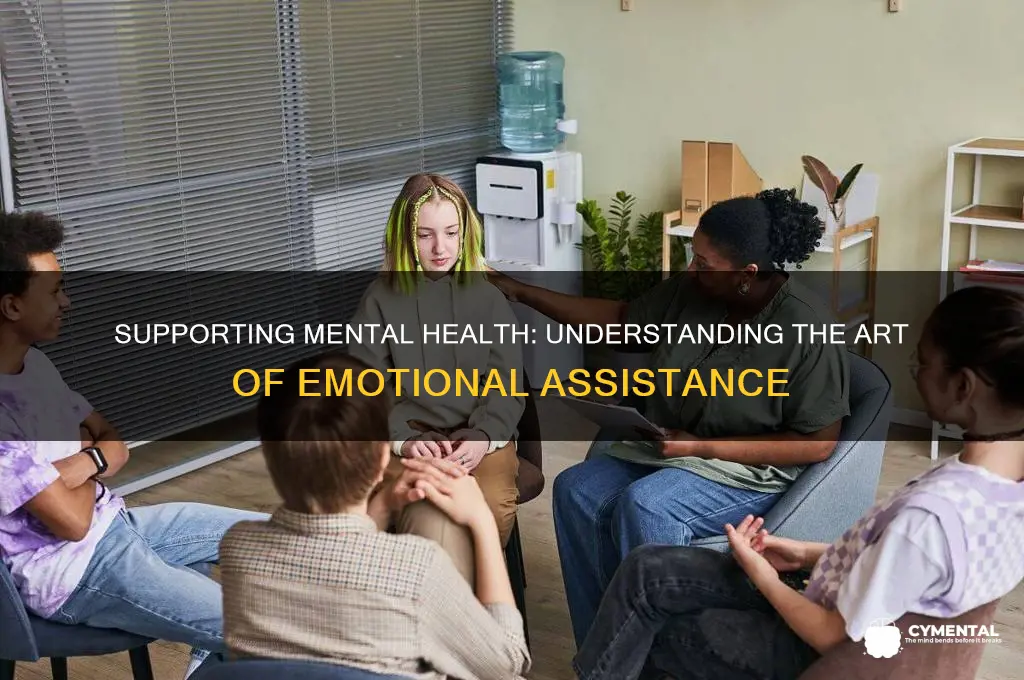
Helping someone mentally is often referred to as mental health support, which encompasses a range of actions and practices aimed at improving an individual’s emotional, psychological, and social well-being. This can include counseling, therapy, active listening, or simply offering empathy and understanding. Professionals like psychologists, therapists, or counselors often provide structured assistance, while friends, family, or peers may offer informal support through compassion and encouragement. The goal is to create a safe space for the person to express their feelings, process challenges, and develop coping strategies, ultimately fostering resilience and recovery.
Explore related products


What You'll Learn
- Therapy & Counseling: Professional support to address mental health issues through talk-based interventions
- Peer Support: Emotional assistance from individuals with shared experiences or challenges
- Crisis Intervention: Immediate help for individuals in acute mental distress or emergencies
- Mindfulness Practices: Techniques to promote mental well-being through present-moment awareness
- Psychoeducation: Teaching individuals about mental health conditions, coping strategies, and self-care

Therapy & Counseling: Professional support to address mental health issues through talk-based interventions
Mental health challenges often require more than self-help or casual support. Therapy and counseling are structured, professional interventions designed to address psychological issues through guided conversation. Unlike advice from friends or family, these practices are rooted in evidence-based techniques delivered by trained experts. For instance, cognitive-behavioral therapy (CBT) helps individuals reframe negative thought patterns, while psychodynamic therapy explores unconscious processes influencing behavior. Sessions typically last 45–60 minutes and may occur weekly or biweekly, depending on the severity of the issue.
Consider the process as a collaborative effort between client and therapist. The therapist employs active listening, empathy, and specialized tools to help clients gain insight, develop coping strategies, and achieve specific goals. For example, a person struggling with anxiety might learn mindfulness techniques to manage symptoms, while someone with depression could work on behavioral activation to increase engagement in meaningful activities. Research shows that consistent participation in therapy can lead to measurable improvements in mood, functioning, and overall quality of life.
Choosing the right type of therapy is crucial for effectiveness. Modalities like dialectical behavior therapy (DBT) are particularly effective for emotional regulation in conditions like borderline personality disorder, while interpersonal therapy (IPT) focuses on relationship issues often linked to depression. Group therapy offers a communal approach, allowing individuals to share experiences and learn from peers. Regardless of the format, the therapeutic alliance—the relationship between client and therapist—is a key predictor of success.
Practical considerations matter, too. Therapy can be costly, but many providers offer sliding-scale fees or accept insurance. Online platforms have expanded access, making it possible to attend sessions from home. For those hesitant to start, beginning with a single session can provide clarity on whether the approach feels right. Remember, therapy is not a quick fix but a commitment to long-term mental wellness. By addressing root causes rather than symptoms, it empowers individuals to build resilience and navigate life’s challenges more effectively.
Green's Healing Power: Physical and Mental Benefits of Nature's Color
You may want to see also
Explore related products


Peer Support: Emotional assistance from individuals with shared experiences or challenges
Peer support is a powerful form of mental health assistance where individuals who have faced similar challenges provide emotional and practical help to one another. Unlike professional therapy, peer support thrives on shared experiences, creating a unique bond of understanding and empathy. For example, someone who has recovered from depression can offer insights and encouragement to another navigating the same struggle, often in ways a clinician might not. This approach is particularly effective because it reduces feelings of isolation and fosters a sense of belonging, which are critical for mental well-being.
To engage in peer support, start by identifying groups or communities focused on your specific challenge, whether it’s anxiety, addiction, or grief. Online platforms like 7 Cups or in-person organizations such as Depression and Bipolar Support Alliance (DBSA) offer structured environments for connection. When participating, be open about your experiences but also respectful of others’ boundaries. A practical tip is to set a goal for each session, such as sharing one struggle and one victory, to keep the conversation focused and productive. Remember, peer support is reciprocal—listening and offering encouragement are as important as receiving it.
One of the strengths of peer support is its accessibility. Unlike therapy, which can be costly or have long wait times, peer support is often free or low-cost and readily available. However, it’s essential to recognize its limitations. Peer support is not a substitute for professional treatment, especially in cases of severe mental illness. For instance, while a peer can provide coping strategies for panic attacks, they cannot prescribe medication or diagnose conditions. Combining peer support with professional care often yields the best outcomes, creating a holistic support system.
The effectiveness of peer support lies in its ability to normalize struggles and provide hope. Hearing someone say, “I’ve been there, and I got through it,” can be incredibly validating. Research shows that individuals in peer support programs report higher levels of self-esteem and reduced symptoms of mental health issues. For example, a study on peer support for PTSD found that participants experienced significant improvements in emotional regulation and social functioning after just 12 weeks of consistent engagement. This highlights the transformative potential of shared experiences.
Incorporating peer support into your mental health toolkit requires intentionality. Start small—join a single group meeting or online chat to gauge its fit. Be patient, as building trust takes time. If you’re leading a peer support session, structure it with a clear agenda, such as a check-in round followed by open discussion. Encourage active listening by summarizing others’ points before responding. Finally, prioritize self-care; supporting others can be emotionally taxing, so set boundaries and seek your own support when needed. Peer support is not just about giving or receiving—it’s about growing together.
Accessing Mental Health Support for Incarcerated Individuals in California
You may want to see also
Explore related products





Crisis Intervention: Immediate help for individuals in acute mental distress or emergencies
In moments of acute mental distress, every second counts. Crisis intervention is the rapid response system designed to stabilize individuals facing immediate psychological emergencies, such as suicidal ideation, severe panic attacks, or psychotic episodes. Unlike long-term therapy, which focuses on root causes, crisis intervention prioritizes de-escalation, safety, and connection to ongoing support. It’s the mental health equivalent of emergency medical care—immediate, focused, and potentially life-saving.
Consider this scenario: A 28-year-old experiencing a panic attack so severe they believe they’re having a heart attack. A trained crisis interventionist would first ensure physical safety, then employ grounding techniques like the 5-4-3-2-1 method (naming five things seen, four felt, etc.) to anchor the individual in the present. Breathing exercises, such as inhaling for four seconds, holding for four, and exhaling for six, can further reduce hyperventilation. The goal isn’t to "fix" the underlying anxiety disorder but to halt the immediate crisis and create a window for rational decision-making.
Crisis intervention frameworks, like the Assessment-Intervention-Stabilization model, guide professionals through structured steps. Assessment involves identifying risks (e.g., self-harm potential) and resources (e.g., supportive family members). Intervention includes active listening, empathy, and practical strategies tailored to the situation. Stabilization focuses on connecting the individual to follow-up care, such as a therapist or crisis hotline. For instance, a teenager in suicidal crisis might be referred to a 24/7 youth helpline (e.g., the National Suicide Prevention Lifeline at 988 in the U.S.) or a local emergency psychiatric unit.
While crisis intervention is critical, it’s not without challenges. Missteps, like minimizing the person’s experience ("It’s not that bad") or failing to establish trust, can exacerbate distress. Training programs, such as Applied Suicide Intervention Skills Training (ASIST), emphasize nonjudgmental communication and risk assessment to mitigate these risks. For bystanders, knowing basic techniques—like asking directly, "Are you thinking about suicide?"—can make a difference, as research shows this question does not "plant the idea" but opens a lifeline for help.
In essence, crisis intervention is a bridge—a temporary but vital connection between chaos and recovery. It requires skill, compassion, and immediacy, serving as a reminder that in mental health emergencies, the right words and actions at the right time can alter the course of a life. Whether delivered by a professional or a well-informed friend, it’s a testament to the power of human connection in moments of profound vulnerability.
The Right to Refuse: Mental Health Treatment and Autonomy
You may want to see also
Explore related products


Mindfulness Practices: Techniques to promote mental well-being through present-moment awareness
Mindfulness practices are rooted in the art of cultivating present-moment awareness, a skill increasingly recognized as vital for mental well-being. Unlike passive relaxation, mindfulness actively trains the mind to observe thoughts and feelings without judgment, reducing the grip of anxiety, stress, and rumination. Research shows that consistent practice can alter brain structures associated with attention and emotional regulation, offering tangible benefits for mental health.
One foundational technique is focused attention meditation, where individuals concentrate on a single point, such as the breath or a mantra. Start by sitting comfortably, closing your eyes, and inhaling deeply for a count of four, then exhaling for six. If the mind wanders—which it inevitably will—gently redirect focus to the breath. Aim for 5–10 minutes daily, gradually increasing to 20 minutes as the practice becomes more natural. This method is accessible to all ages, though younger children may benefit from shorter, guided sessions incorporating storytelling or movement.
Another powerful practice is body scan meditation, which promotes awareness of physical sensations. Lie down in a quiet space and mentally scan your body from head to toe, noting tension or discomfort without trying to change it. This technique is particularly effective for managing stress-related physical symptoms, such as headaches or muscle tightness. Pair it with deep breathing for enhanced relaxation. Caution: Avoid this practice if you’re experiencing acute physical pain, as it may heighten discomfort.
For those seeking mindfulness in motion, walking meditation offers a dynamic alternative. Walk slowly, focusing on the sensation of each step—the heel striking the ground, the shift of weight, the toes pushing off. Engage all senses by noticing sounds, smells, and the feel of the air. This practice is ideal for individuals who find seated meditation challenging or prefer an active approach. Incorporate it into daily routines, such as walking to work or during breaks, for consistent mental grounding.
Finally, loving-kindness meditation (Metta) fosters emotional well-being by cultivating compassion. Begin by silently repeating phrases like, “May I be happy. May I be healthy. May I live with ease.” Gradually extend these wishes to loved ones, acquaintances, and even difficult individuals. Studies suggest this practice reduces symptoms of depression and increases positive emotions. It’s particularly beneficial for those struggling with self-criticism or interpersonal conflicts.
Incorporating these mindfulness techniques into daily life requires consistency, not perfection. Start small, be patient with yourself, and adapt practices to fit your lifestyle. Over time, present-moment awareness becomes a natural tool for navigating life’s challenges, fostering resilience and mental clarity.
Inpatient Mental Health Facilities: Effective Treatment or Temporary Relief?
You may want to see also
Explore related products


Psychoeducation: Teaching individuals about mental health conditions, coping strategies, and self-care
Psychoeducation stands as a cornerstone in mental health support, offering individuals a structured understanding of their conditions, practical coping strategies, and actionable self-care techniques. Unlike therapy, which often delves into emotional exploration, psychoeducation focuses on knowledge transfer, empowering individuals to manage their mental health proactively. For instance, a person diagnosed with generalized anxiety disorder might learn about the physiological mechanisms of anxiety, such as the fight-or-flight response, and how deep breathing exercises can recalibrate their nervous system. This approach demystifies mental health challenges, replacing fear and confusion with clarity and control.
Consider the process of psychoeducation as a three-step framework. First, education involves teaching the individual about their specific condition—its causes, symptoms, and progression. For a teenager with depression, this might include explaining how serotonin imbalances affect mood and energy levels. Second, skill-building introduces coping strategies tailored to the condition. For someone with panic disorder, this could involve practicing progressive muscle relaxation or cognitive reframing techniques. Third, self-care integration encourages habits like maintaining a sleep schedule, journaling, or engaging in physical activity. Each step is designed to be practical, with tools like worksheets, apps, or guided exercises to reinforce learning.
One of the strengths of psychoeducation lies in its adaptability across age groups and cultural contexts. For children, psychoeducation might take the form of interactive games or storytelling to explain emotions and coping mechanisms. For example, a therapist might use a "feelings thermometer" to help a child identify and express their emotional state. In contrast, older adults might benefit from structured group sessions that address age-specific challenges, such as managing anxiety related to retirement or health concerns. Cultural sensitivity is also critical; psychoeducation must account for varying beliefs about mental health, ensuring that the information resonates with the individual’s worldview.
Despite its benefits, psychoeducation is not a one-size-fits-all solution. Its effectiveness depends on the individual’s readiness to learn and apply the information. For instance, someone in the acute phase of a psychotic episode may not be able to engage with complex explanations or strategies. Additionally, psychoeducation should complement, not replace, other forms of treatment like medication or therapy. A common pitfall is assuming that knowledge alone will resolve deep-seated emotional issues—it’s a tool, not a cure-all. Practitioners must balance information delivery with empathy, ensuring the individual feels supported rather than overwhelmed.
In practice, psychoeducation can be delivered in various formats: individual sessions, group workshops, online modules, or even printed materials. For example, a person with bipolar disorder might attend a six-week psychoeducation program that covers mood tracking, medication adherence, and early warning signs of relapse. Families can also benefit from psychoeducation, learning how to support their loved one without enabling maladaptive behaviors. The key is consistency and repetition—reinforcing concepts over time to foster long-term behavioral change. When implemented thoughtfully, psychoeducation transforms passive sufferers into active participants in their mental health journey.
Nutrition's Powerful Impact: Boosting Mental Health and Well-Being
You may want to see also
Frequently asked questions
It is often referred to as emotional support or mental health support. This can involve listening, offering comfort, and helping the person feel understood and less alone.
This is called mental health counseling or therapy. Professionals like psychologists, therapists, or counselors use evidence-based techniques to help individuals manage and improve their mental well-being.
This is often referred to as being a mental health ally or providing peer support. It involves offering non-judgmental presence, encouragement, and practical assistance during difficult times.