Caleb Wright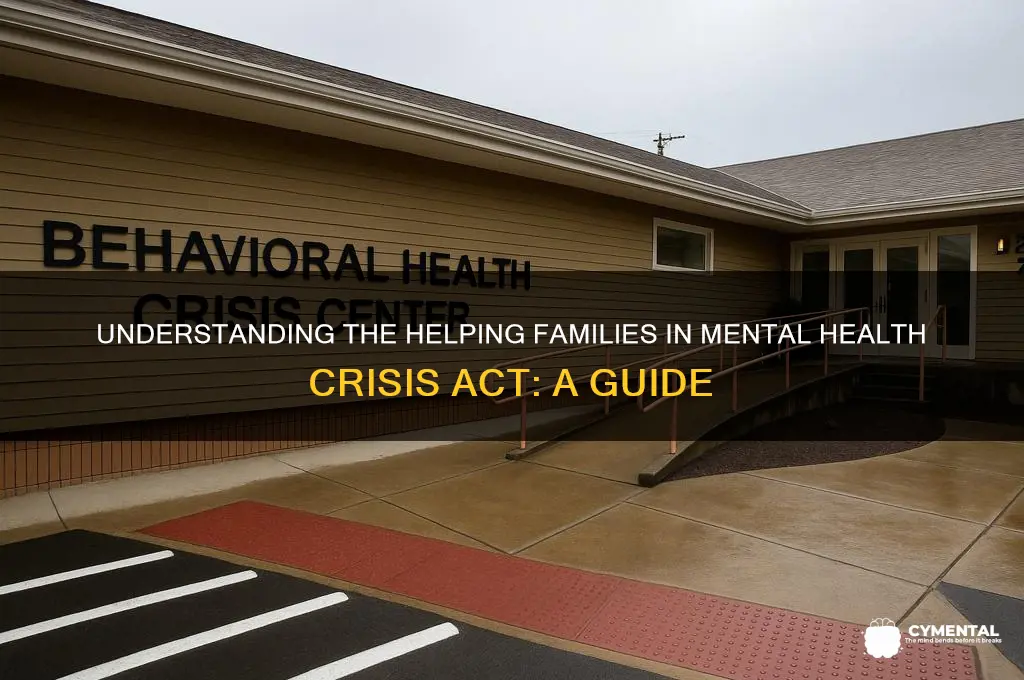
The Helping Families in Mental Health Crisis Act is a significant piece of legislation aimed at reforming the U.S. mental health care system to better support individuals and families facing severe mental illness. Introduced in response to growing concerns about gaps in care, lack of access to treatment, and tragic outcomes associated with untreated mental health conditions, the act seeks to improve coordination among healthcare providers, increase funding for mental health services, and enhance crisis intervention programs. By addressing issues such as involuntary commitment laws, privacy barriers, and the shortage of mental health professionals, the legislation aims to provide families with the tools and resources needed to help their loved ones receive timely and effective care, ultimately reducing the burden of mental health crises on individuals, families, and communities.
| Characteristics | Values |
|---|---|
| Full Name | Helping Families in Mental Health Crisis Act |
| Year Enacted | 2016 (as part of the 21st Century Cures Act) |
| Primary Goal | Improve mental health care access and treatment for individuals in crisis |
| Key Focus Areas | - Care coordination - Crisis intervention - Family involvement |
| Provisions | - Establishes Assisted Outpatient Treatment (AOT) programs - Expands mental health workforce training - Enhances HIPAA privacy rules for caregivers |
| Target Population | Individuals with serious mental illness (SMI) and their families |
| Funding | Allocates federal funds for mental health services and research |
| Notable Sections | - Section 9002: AOT programs - Section 9003: HIPAA modifications |
| Impact on Families | Provides legal tools for families to seek treatment for loved ones |
| Controversies | Criticisms over potential coercion and civil liberties concerns |
| Current Status | Active, with ongoing implementation and state-level adaptations |
Explore related products


What You'll Learn
- Crisis Response Services: Enhances access to immediate mental health crisis intervention and support systems
- Mental Health Courts: Expands court programs to divert individuals with mental illness from incarceration
- Workforce Development: Funds training for mental health professionals to address workforce shortages
- SAMHSA Reforms: Strengthens oversight and coordination of federal mental health programs
- HIPAA Clarifications: Improves privacy rules to allow better family involvement in care

Crisis Response Services: Enhances access to immediate mental health crisis intervention and support systems
Mental health crises demand immediate, effective responses to prevent escalation and ensure safety. The Helping Families in Mental Health Crisis Act addresses this need by enhancing access to crisis response services, a critical component of its broader framework. These services are designed to provide rapid intervention, stabilize individuals in distress, and connect them to ongoing care, thereby reducing the burden on emergency rooms and law enforcement while improving outcomes.
Consider the structure of a robust crisis response system: 24/7 crisis hotlines, mobile crisis teams, and crisis stabilization units form its backbone. Hotlines, such as the 988 Suicide & Crisis Lifeline, offer immediate telephone support, often staffed by trained mental health professionals who can de-escalate situations and guide callers to local resources. Mobile crisis teams take this a step further by dispatching clinicians and peer specialists directly to the individual’s location, providing on-site assessment and intervention. For those requiring a higher level of care, crisis stabilization units offer short-term, inpatient-like settings without the long-term commitment of hospitalization, typically serving adults aged 18 and older for up to 72 hours.
Implementation of these services requires careful coordination. For instance, mobile crisis teams should aim to arrive within 60 minutes of a call, as rapid response times correlate with better outcomes. Additionally, integrating these services with local emergency medical services (EMS) and law enforcement ensures a seamless handoff, reducing the risk of inappropriate arrests or hospitalizations. A key takeaway is that crisis response services are not one-size-fits-all; they must be tailored to the needs of diverse populations, including children, veterans, and individuals with co-occurring substance use disorders.
Critics argue that while these services are promising, their effectiveness hinges on adequate funding and workforce development. Training for crisis responders must include de-escalation techniques, cultural competency, and trauma-informed care. For example, a study found that crisis teams with peer specialists—individuals with lived experience of mental health challenges—achieved higher rates of engagement and satisfaction among clients. Policymakers must also address disparities in access, particularly in rural or underserved areas, by investing in telehealth capabilities and community-based partnerships.
In practice, families and individuals can maximize these services by knowing how to access them. Save the 988 number in your contacts, familiarize yourself with local mobile crisis team protocols, and advocate for schools and workplaces to include crisis response training in their safety plans. For parents of children under 18, inquire about youth-specific crisis services, as these often involve family-centered approaches. Ultimately, the Helping Families in Mental Health Crisis Act’s emphasis on crisis response services represents a paradigm shift—from reactive to proactive care, ensuring that no one faces a mental health crisis alone.
Family Involvement: A Key to Effective Mental Health Recovery
You may want to see also
Explore related products


Mental Health Courts: Expands court programs to divert individuals with mental illness from incarceration
The Helping Families in Mental Health Crisis Act introduces a transformative approach to addressing the intersection of mental health and the criminal justice system through the expansion of Mental Health Courts. These specialized courts aim to divert individuals with mental illness away from incarceration and into treatment programs, recognizing that traditional punitive measures often exacerbate rather than resolve underlying issues. By prioritizing rehabilitation over punishment, Mental Health Courts seek to reduce recidivism, alleviate the burden on correctional facilities, and improve outcomes for those struggling with mental health challenges.
Consider the typical scenario: an individual with untreated schizophrenia is arrested for a nonviolent offense, such as trespassing or disorderly conduct. In a conventional court, they might face jail time, where access to mental health care is limited and conditions can worsen their condition. In contrast, a Mental Health Court would assess their needs, connect them with community-based treatment, and monitor their progress through mandatory therapy, medication management, and regular court appearances. This model not only addresses the root cause of their behavior but also fosters accountability and long-term stability.
Expanding Mental Health Courts under this act involves several key steps. First, funding is allocated to train judges, attorneys, and court staff to understand mental health issues and collaborate with treatment providers. Second, partnerships are established with local mental health agencies to ensure seamless access to services, including crisis intervention, case management, and housing support. Third, eligibility criteria are defined to include individuals with severe mental illnesses, such as bipolar disorder, major depression, or schizophrenia, who are at risk of incarceration. For example, a 28-year-old with schizoaffective disorder arrested for public disturbance might be diverted to a program requiring weekly therapy sessions, monthly psychiatric evaluations, and participation in a supported employment program.
However, implementing Mental Health Courts is not without challenges. Critics argue that such programs may inadvertently criminalize mental illness by placing individuals under court supervision for behaviors linked to their condition. Additionally, disparities in access to resources can limit the effectiveness of these courts in underserved communities. To mitigate these concerns, the act emphasizes voluntary participation, cultural competency training for court personnel, and ongoing evaluation of program outcomes. For instance, a court in a rural area might partner with telehealth providers to deliver therapy remotely, ensuring that geographic barriers do not prevent individuals from receiving care.
Ultimately, the expansion of Mental Health Courts through the Helping Families in Mental Health Crisis Act represents a compassionate and evidence-based strategy to reform the criminal justice system. By diverting individuals with mental illness from incarceration to treatment, these courts not only improve individual lives but also contribute to safer, healthier communities. Practical tips for success include fostering collaboration between justice and health systems, tailoring programs to local needs, and advocating for sustained funding to ensure long-term viability. This approach underscores the belief that mental health challenges are not crimes but conditions deserving of care and support.
Effective Strategies to Combat Mental Fatigue and Boost Productivity
You may want to see also
Explore related products


Workforce Development: Funds training for mental health professionals to address workforce shortages
The Helping Families in Mental Health Crisis Act recognizes a stark reality: the demand for mental health services far outstrips the available workforce. This critical shortage leaves countless individuals struggling to access timely and effective care. To address this crisis, the Act allocates significant funding for workforce development, specifically targeting the training and recruitment of mental health professionals.
Imagine a scenario where a young adult experiencing their first psychotic episode faces a months-long wait for an appointment with a psychiatrist. This delay can exacerbate symptoms, hinder recovery, and increase the risk of hospitalization. The Act aims to prevent such scenarios by investing in a robust pipeline of qualified mental health providers.
This funding isn't a blanket solution; it's strategically directed towards programs that address specific workforce gaps. For instance, scholarships and loan forgiveness programs incentivize individuals to pursue careers in high-demand fields like child and adolescent psychiatry, addiction counseling, and rural mental health services. Additionally, the Act supports training programs that equip existing healthcare professionals with the skills to identify and manage mental health concerns, effectively expanding the pool of available providers.
Think of it as a multi-pronged approach: attracting new talent, retaining experienced professionals, and upskilling the existing workforce. By addressing these three critical areas, the Act aims to create a sustainable solution to the workforce shortage, ensuring that individuals in crisis receive the care they need, when they need it.
The impact of this investment extends far beyond individual lives. A well-staffed mental health system reduces the burden on emergency departments, decreases hospitalizations, and promotes overall community well-being. It's an investment in both human potential and societal health, demonstrating a commitment to treating mental illness with the same urgency and resources as physical ailments.
Virtual Reality: A Revolutionary Tool for Mental Health Treatment
You may want to see also
Explore related products


SAMHSA Reforms: Strengthens oversight and coordination of federal mental health programs
The Helping Families in Mental Health Crisis Act, signed into law in 2016, aimed to overhaul the nation's fragmented mental health system. A key component of this reform was strengthening the Substance Abuse and Mental Health Services Administration (SAMHSA), the federal agency tasked with leading public health efforts to advance behavioral health.
SAMHSA, often criticized for lack of coordination and oversight, was granted new authorities and responsibilities under the Act. This shift aimed to address the siloed nature of federal mental health programs, where duplication of efforts and inconsistent service delivery were common.
The Act mandated SAMHSA to establish a comprehensive strategic plan, outlining clear goals and objectives for federal mental health initiatives. This plan would ensure alignment across agencies, promote evidence-based practices, and prioritize underserved populations. Additionally, SAMHSA was tasked with developing performance metrics to track progress and hold programs accountable for outcomes.
One concrete example of this strengthened oversight is the establishment of the Interdepartmental Serious Mental Illness Coordinating Committee. This committee, chaired by SAMHSA, brings together representatives from various federal agencies to coordinate efforts and eliminate redundancies in programs serving individuals with serious mental illness. This collaborative approach ensures a more holistic and efficient use of resources, ultimately leading to better outcomes for those in need.
The Act also empowered SAMHSA to provide technical assistance and training to states and local communities, fostering the adoption of best practices and evidence-based interventions. This support is crucial for ensuring that federal funding translates into tangible improvements in mental health care at the local level.
While the SAMHSA reforms under the Helping Families in Mental Health Crisis Act represent a significant step forward, ongoing evaluation and adaptation are essential. Continuous monitoring of program effectiveness, coupled with a commitment to data-driven decision-making, will be crucial for ensuring that these reforms lead to lasting improvements in the lives of individuals and families struggling with mental illness.
Embrace the Quiet: How Silence Boosts Mental Health and Well-being
You may want to see also
Explore related products


HIPAA Clarifications: Improves privacy rules to allow better family involvement in care
The Helping Families in Mental Health Crisis Act addresses a critical tension: balancing patient privacy with the need for family support during mental health emergencies. HIPAA (Health Insurance Portability and Accountability Act) historically restricted communication between healthcare providers and family members, even in dire situations. This section focuses on how the Act clarifies HIPAA rules to foster better family involvement without compromising patient rights.
Consider a scenario where a young adult experiencing severe psychosis refuses treatment and isolates themselves. Under traditional HIPAA interpretations, providers might hesitate to share crucial information with concerned parents, fearing legal repercussions. The Act introduces specific exceptions, allowing providers to disclose relevant health information to caregivers if the patient poses a serious and imminent threat to themselves or others, or if the caregiver is directly involved in the patient’s care. For instance, a therapist could inform a parent about a suicidal ideation risk, enabling them to take immediate protective actions.
These clarifications are not a blanket permission slip. Providers must still exercise judgment, disclosing only the minimum necessary information to address the immediate concern. For example, sharing a diagnosis of schizophrenia might be unnecessary if the focus is on preventing self-harm. The Act also emphasizes the importance of documenting such disclosures to ensure accountability. Families should be aware that while these changes empower them to act, they do not grant unrestricted access to medical records.
A practical tip for families navigating this terrain: maintain open communication with the patient’s treatment team. Express your willingness to support their care while respecting their autonomy. Providers are more likely to collaborate when they see families as partners rather than adversaries. Additionally, familiarize yourself with the Act’s provisions to advocate effectively for your loved one.
In conclusion, the HIPAA clarifications within the Helping Families in Mental Health Crisis Act represent a nuanced approach to a complex issue. By striking a balance between privacy and family involvement, the Act ensures that patients in crisis receive the support they need while safeguarding their rights. This shift underscores the importance of collaboration in mental health care, recognizing that families often play a vital role in recovery.
How to Open Up About Your Mental Health: A Guide to Asking for Help
You may want to see also
Frequently asked questions
The Helping Families in Mental Health Crisis Act is a proposed legislation aimed at reforming the U.S. mental health system to improve access to care, enhance treatment options, and support individuals and families facing mental health crises.
The act aims to help individuals with serious mental illness, their families, and caregivers by addressing gaps in the mental health care system, such as limited access to treatment, lack of resources, and fragmented care.
Key provisions include increasing funding for mental health services, expanding the workforce of mental health professionals, improving crisis intervention programs, and promoting better coordination between healthcare providers, law enforcement, and community organizations.
As of the latest updates, the act has not been passed into law. It has been introduced and debated in Congress but has not yet received final approval. Efforts to advance the legislation continue, with ongoing discussions and revisions.


![DSS Games Our Family is So Weird [A Family Card Game to Decide Who’s Most Likely to | Game Night Idea for Teens, Adults & Groups | Great for Reunions, Vacation, Road Trips]](https://m.media-amazon.com/images/I/61LDUlN7NVL._AC_UY218_.jpg)