Caleb Wright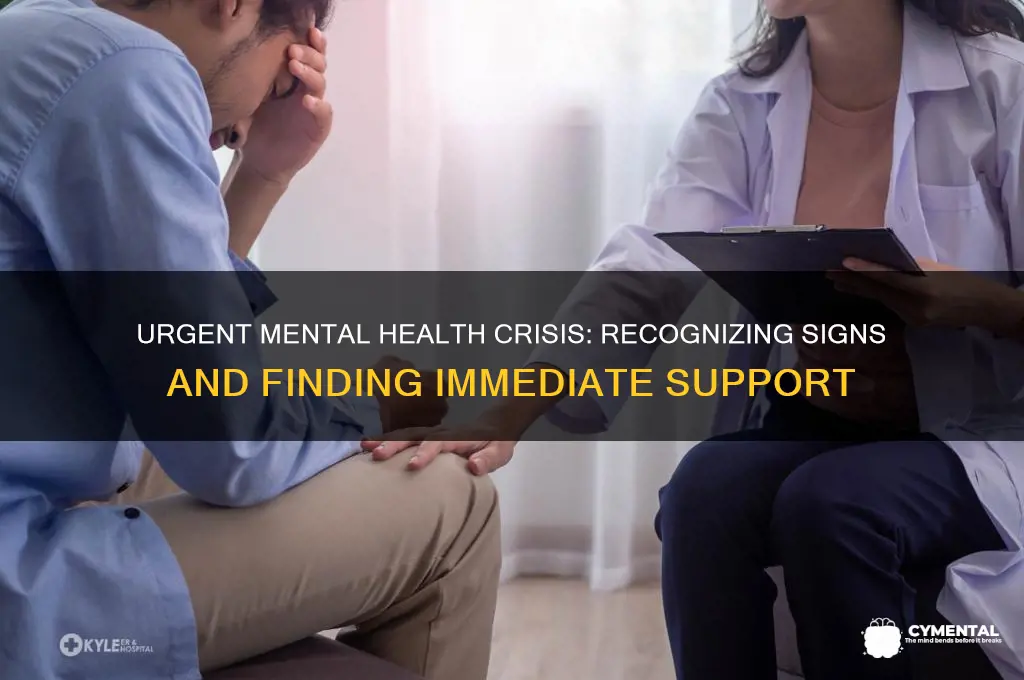
When someone needs mental health help immediately, it is crucial to recognize the urgency and act swiftly to ensure their safety and well-being. Signs of a mental health crisis can include severe anxiety, suicidal thoughts, self-harm, psychotic episodes, or an inability to function in daily life. In such situations, it is essential to remain calm, express empathy, and encourage the individual to seek professional assistance. Contacting emergency services, a crisis hotline, or a mental health professional can provide immediate support. Loved ones should avoid minimizing the person’s feelings and instead offer reassurance while helping them access the necessary resources. Timely intervention can prevent escalation and save lives, making it vital to prioritize swift and compassionate action.
Explore related products


What You'll Learn
- Suicidal Thoughts or Actions: Immediate intervention needed if expressing or attempting self-harm or suicide
- Severe Psychosis: Hallucinations, delusions, or detachment from reality requiring urgent professional care
- Severe Panic Attacks: Intense, prolonged panic attacks with physical symptoms like chest pain or numbness
- Acute Trauma Reactions: Flashbacks, dissociation, or extreme distress after a traumatic event
- Severe Self-Harm: Repeated or life-threatening self-injury behaviors needing immediate medical attention

Suicidal Thoughts or Actions: Immediate intervention needed if expressing or attempting self-harm or suicide
Suicidal thoughts or actions demand immediate intervention, as they signal a critical mental health crisis. Recognizing the signs is the first step: explicit statements like “I want to die” or “I can’t take it anymore,” sudden withdrawal from social activities, giving away prized possessions, or drastic changes in behavior (e.g., reckless driving, increased substance use) are red flags. These behaviors often reflect unbearable emotional pain, not a desire to end life itself. Acting swiftly can save a life, making it essential to treat such signs as emergencies, not cries for attention.
Instructively, if someone expresses suicidal intent, remain calm but assertive. Start by asking directly, “Are you thinking about ending your life?” This question, though difficult, validates their feelings and opens a lifeline for communication. Avoid minimizing their pain with phrases like “It’ll get better” or “You have so much to live for.” Instead, actively listen, express concern, and reassure them they’re not alone. Immediately contact emergency services (911 in the U.S.) or a suicide hotline (e.g., 988 for the Suicide & Crisis Lifeline) while staying with the person. If they’ve already attempted self-harm, prioritize physical safety by removing dangerous objects and administering first aid if trained to do so.
Persuasively, delaying action in these situations can be fatal. Research shows that individuals in suicidal crises often experience ambivalence, meaning part of them wants to live. Quick intervention during this window can shift the balance toward survival. For instance, a study published in *The Lancet* found that 90% of suicide attempt survivors did not go on to die by suicide, highlighting the importance of timely intervention. By acting decisively, you become a critical link in their chain of survival, offering them a chance to access professional help and long-term support.
Comparatively, while other mental health crises (e.g., panic attacks, severe depression) require urgent care, suicidal ideation is uniquely time-sensitive. Unlike a panic attack, which typically subsides within minutes, suicidal impulses can escalate rapidly, especially if the individual has a plan and means. For example, access to firearms increases the risk of suicide by 400%, according to the Harvard School of Public Health. This stark difference underscores why suicidal thoughts or actions necessitate a more aggressive response than other mental health emergencies, including immediate professional involvement.
Descriptively, imagine a scenario where a friend texts, “I can’t do this anymore.” Your response could be the difference between life and death. First, call them immediately to assess their immediate risk. If they’re unresponsive or confirm suicidal intent, notify emergency services and provide their location. While waiting for help, keep them engaged in conversation, focusing on their feelings rather than debating their decision. If in person, stay physically close but avoid physical restraint unless absolutely necessary. Afterward, encourage them to seek ongoing care, such as therapy or hospitalization, and offer to accompany them. Your role isn’t to “fix” them but to bridge the gap until professional help arrives.
Practically, prepare ahead by saving crisis hotline numbers in your phone and familiarizing yourself with local mental health resources. Apps like Calm Harm or Crisis Text Line provide tools for de-escalation. If you’re a caregiver, ensure firearms or medications are securely locked away. Remember, intervening in a suicidal crisis isn’t about heroism—it’s about humanity. Your actions, no matter how small, can create a lifeline for someone drowning in despair.
Melodies of Healing: How Music Supports Mental Health Recovery
You may want to see also
Explore related products


$10.99 $28.99


Severe Psychosis: Hallucinations, delusions, or detachment from reality requiring urgent professional care
Severe psychosis is a critical mental health emergency that demands immediate professional intervention. Unlike milder forms of psychological distress, psychosis involves a profound disconnection from reality, often manifesting as hallucinations, delusions, or a complete breakdown in logical thinking. These symptoms can escalate rapidly, posing risks to both the individual and those around them. Recognizing the signs early and acting swiftly can prevent long-term harm and facilitate recovery.
Consider this scenario: A 28-year-old individual begins hearing voices commanding them to harm themselves or others, while simultaneously believing they are being surveilled by a government agency. This is not merely a "bad day" or temporary stress—it’s a psychotic episode requiring urgent care. Hallucinations and delusions in psychosis are not fleeting or benign; they are persistent, intense, and impervious to rational explanation. For instance, antipsychotic medications like olanzapine (starting at 5–10 mg daily) or risperidone (1–2 mg daily) are often prescribed to stabilize symptoms, but only under strict medical supervision. Delaying treatment can lead to self-harm, aggression, or irreversible social and cognitive decline.
The urgency of addressing severe psychosis cannot be overstated. Unlike anxiety or depression, which may allow time for gradual intervention, psychosis is a neurological wildfire. The brain’s ability to discern reality is compromised, often due to imbalances in dopamine or serotonin. Without prompt intervention, the condition can spiral into chronic schizophrenia or other persistent disorders. For adolescents and young adults (ages 15–25), this is particularly critical, as their brains are still developing, and early psychosis can alter neural pathways permanently.
Here’s a practical guide for immediate action: First, ensure safety. If the individual is at risk of harming themselves or others, call emergency services immediately. Second, avoid confrontation or attempts to "reason" with their delusions—this can escalate agitation. Instead, speak calmly and acknowledge their distress without validating the false beliefs. Third, contact a mental health professional or crisis hotline (e.g., the National Alliance on Mental Illness Helpline) for guidance. Finally, accompany the individual to an emergency room or psychiatric facility for evaluation. Medications and therapy, such as cognitive-behavioral therapy for psychosis (CBTp), are most effective when started within the first episode.
In comparison to other mental health crises, severe psychosis stands out for its immediacy and potential for danger. While suicidal ideation or panic attacks are undeniably urgent, psychosis uniquely distorts perception, rendering the individual incapable of self-advocacy. This is why external intervention is non-negotiable. Families and caregivers must be educated on early warning signs, such as sudden social withdrawal, incoherent speech, or bizarre behavior, to act before the condition worsens.
In conclusion, severe psychosis is not a condition that resolves on its own or with time. It is a medical emergency requiring specialized care. By understanding its symptoms, risks, and treatment pathways, we can bridge the gap between crisis and recovery, ensuring that those affected receive the urgent help they need.
Silent Struggles: Why Many Avoid Seeking Mental Health Support
You may want to see also
Explore related products


Severe Panic Attacks: Intense, prolonged panic attacks with physical symptoms like chest pain or numbness
Severe panic attacks are not merely moments of heightened anxiety; they are full-body crises that can mimic life-threatening conditions. Imagine experiencing chest pain so intense it feels like a heart attack, or numbness spreading through your limbs, leaving you convinced you’re having a stroke. These physical symptoms, coupled with overwhelming fear and a sense of detachment from reality, can last for hours, leaving the individual exhausted and traumatized. Unlike typical anxiety, these episodes often require immediate intervention to prevent long-term psychological and physical harm.
When someone is in the throes of a severe panic attack, the first step is to ensure safety and reassurance. Encourage slow, deep breathing—inhale for 4 seconds, hold for 4 seconds, exhale for 6 seconds—to help regulate their nervous system. Grounding techniques, such as naming five things they can see, four they can touch, and one they can smell, can pull them back to the present moment. However, if symptoms persist or worsen, medical attention is non-negotiable. Chest pain, numbness, or prolonged hyperventilation could indicate a serious condition that requires professional evaluation.
The aftermath of a severe panic attack is just as critical as the event itself. Individuals often experience shame, confusion, or fear of recurrence, which can exacerbate their anxiety. Encouraging them to seek mental health support, such as cognitive-behavioral therapy (CBT) or medication like SSRIs (starting at 10–20 mg daily, adjusted by a psychiatrist), can provide long-term relief. Practical tips, like maintaining a consistent sleep schedule, limiting caffeine, and practicing mindfulness, can also reduce the likelihood of future episodes.
Comparing severe panic attacks to other mental health crises highlights their unique urgency. While depression may unfold slowly and suicidal ideation demands immediate crisis intervention, severe panic attacks are acute, physically debilitating events that require both immediate and ongoing care. They are not a sign of weakness but a signal that the body’s stress response has reached a breaking point. Recognizing this distinction ensures the individual receives the right kind of help at the right time.
In conclusion, severe panic attacks are not just "bad anxiety"—they are emergencies that demand swift action and compassionate follow-up. By understanding their symptoms, providing immediate support, and advocating for professional treatment, we can help individuals regain control and prevent future episodes. Ignoring these signs or dismissing them as "overreactions" only deepens the suffering. Act quickly, act knowingly, and act with empathy.
Gratitude's Power: Enhancing Mental Health and Emotional Well-being
You may want to see also
Explore related products


Acute Trauma Reactions: Flashbacks, dissociation, or extreme distress after a traumatic event
Trauma doesn’t always announce itself with dramatic scars or visible wounds. Often, it manifests in the mind, replaying the event as if it’s happening all over again. Flashbacks, dissociation, and extreme distress are hallmark signs of acute trauma reactions, signaling that the brain is struggling to process the overwhelming experience. These symptoms aren’t just "overreactions" or signs of weakness—they’re survival mechanisms gone awry, trapping the individual in a cycle of fear and helplessness. Recognizing these reactions is the first step in providing immediate and effective mental health support.
Consider a 32-year-old survivor of a car accident who, weeks later, freezes at the sound of screeching tires, their heart racing as if they’re back in the vehicle. This is a flashback, a vivid and involuntary reliving of the trauma. Dissociation, on the other hand, might look like a teenager zoning out in class, unable to recall what the teacher just said, their mind disconnecting from the present to escape emotional pain. Extreme distress could manifest as uncontrollable crying, panic attacks, or even aggressive outbursts. These reactions aren’t linear; they can appear hours, days, or weeks after the event, often triggered by seemingly unrelated stimuli. Understanding these patterns is crucial for identifying when someone needs immediate mental health intervention.
Immediate support for acute trauma reactions involves grounding techniques to help the individual reconnect with the present. For flashbacks, encourage the person to focus on their surroundings: name five things they can see, four they can touch, three they can hear, two they can smell, and one they can taste. This "5-4-3-2-1" method anchors them in reality. For dissociation, gentle physical prompts like holding a cold glass of water or feeling a textured object can help reorient their senses. However, these are temporary measures—professional help is non-negotiable. A mental health professional can provide tools like Eye Movement Desensitization and Reprocessing (EMDR) or trauma-focused cognitive behavioral therapy (TF-CBT), evidence-based approaches proven to alleviate acute trauma symptoms.
Comparing acute trauma reactions to other stress responses highlights their severity. While general anxiety might cause restlessness, acute trauma reactions can render someone functionally impaired. For instance, a soldier experiencing flashbacks might be unable to leave their home due to fear of perceived threats, while a student dissociating in class may fail to meet academic deadlines. These reactions aren’t just disruptive—they’re debilitating. Unlike everyday stress, which often resolves with time, acute trauma reactions require targeted intervention to prevent long-term conditions like PTSD. Early recognition and action can mean the difference between recovery and chronic suffering.
Finally, it’s essential to approach someone experiencing acute trauma reactions with empathy and patience. Avoid phrases like "Just calm down" or "It’s all in your head," which minimize their experience. Instead, validate their feelings: "I can see this is really hard for you right now." Offer to accompany them to a mental health professional or help them find resources. Practical steps include ensuring their immediate safety, reducing environmental triggers (like loud noises or crowded spaces), and encouraging self-care practices like hydration and rest. Remember, acute trauma reactions are treatable, but the window for intervention is critical. Acting swiftly can prevent the trauma from becoming a defining part of their life.
Boost Brain Power: Habits and Foods for Mental Energy and Focus
You may want to see also
Explore related products


Severe Self-Harm: Repeated or life-threatening self-injury behaviors needing immediate medical attention
Self-harm, when it escalates to repeated or life-threatening behaviors, is a critical mental health emergency demanding immediate intervention. Unlike occasional self-injury, severe self-harm often involves deeper cuts, ingestion of toxic substances, or methods with high mortality risk, such as jumping from heights. These actions reflect a profound internal crisis, where the individual’s coping mechanisms have failed, and their distress has reached a breaking point. Recognizing these signs—like frequent emergency room visits, visible severe injuries, or explicit suicidal statements—is crucial for timely action.
Steps to Take When Severe Self-Harm is Suspected:
- Ensure Safety: Remove any harmful objects or substances from the individual’s immediate environment. If they are actively harming themselves, call emergency services (e.g., 911 in the U.S.) without delay.
- Stay Calm and Nonjudgmental: Approach the person with empathy, avoiding accusations or shock reactions. Phrases like, “I’m here for you,” or “Let’s get you help,” can provide reassurance.
- Seek Professional Help: Escort the individual to the nearest emergency department or contact a crisis hotline (e.g., the National Suicide Prevention Lifeline at 988 in the U.S.). Severe self-harm often requires psychiatric evaluation and hospitalization to stabilize both physical and mental health.
Cautions: Avoid minimizing their pain or suggesting they “stop” without addressing the underlying issues. Do not leave them alone if they are at imminent risk of further harm. Self-harm is a symptom of deeper emotional turmoil, and superficial interventions can exacerbate feelings of isolation.
Takeaway: Severe self-harm is not a cry for attention but a desperate attempt to survive unbearable emotional pain. Immediate medical and psychiatric intervention can save lives and provide a pathway to healing. Acting swiftly and compassionately can make the difference between tragedy and recovery.
Encouraging Mental Health Support: Ethical Approaches to Intervention
You may want to see also
Frequently asked questions
Immediate mental health help is needed if the person is experiencing severe symptoms such as suicidal thoughts, self-harm, psychosis, inability to care for themselves, or poses a danger to others. Look for signs like extreme agitation, disconnection from reality, or sudden, drastic changes in behavior.
Stay calm and call emergency services (e.g., 911 in the U.S.) if the person is in immediate danger. Encourage them to seek professional help, such as contacting a crisis hotline or visiting an emergency room. Stay with them if possible, and remove any harmful objects from their vicinity.
Immediate support can be found through crisis hotlines (e.g., 988 Suicide & Crisis Lifeline in the U.S.), local emergency rooms, or mobile crisis units. Many communities also offer walk-in mental health clinics or telehealth services for urgent needs.