Lucas Bennett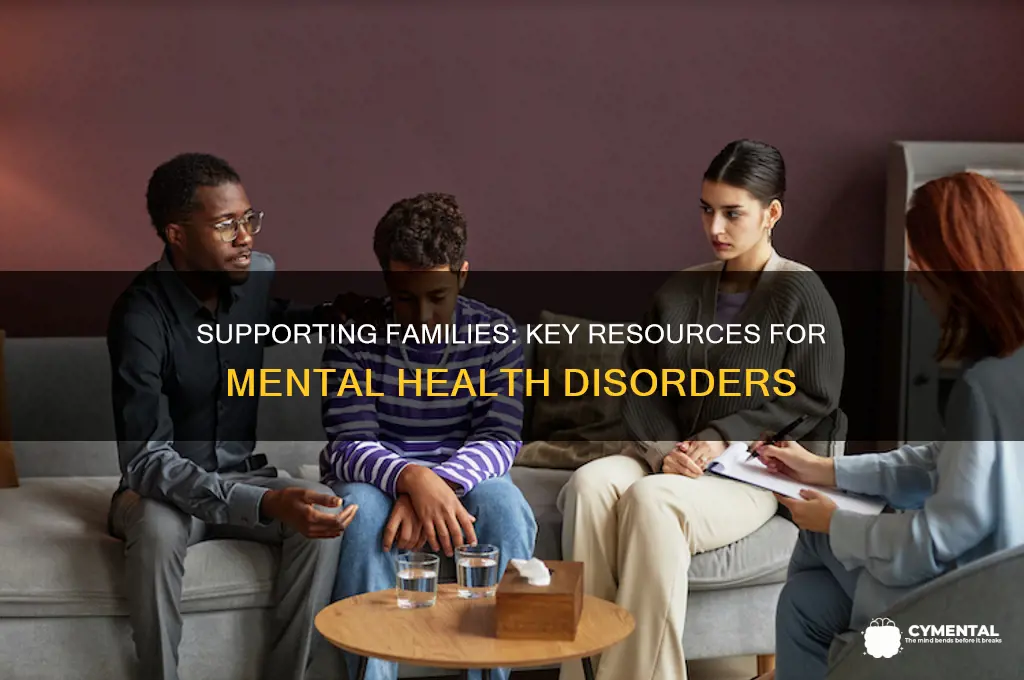
Families dealing with mental disorders often require a network of support to navigate the challenges they face. Professionals such as psychiatrists, psychologists, and licensed therapists play a crucial role in diagnosing, treating, and managing mental health conditions. Social workers and case managers assist with accessing resources, coordinating care, and providing emotional support. Support groups and community organizations offer peer connections and shared experiences, while schools and workplaces may provide accommodations and counseling services. Additionally, family members themselves are vital in offering understanding, encouragement, and practical assistance, though they may also benefit from caregiver support programs. Together, these individuals and systems create a comprehensive framework to help families cope with and address mental health issues effectively.
Explore related products

$18.59 $19.95


What You'll Learn
- Mental Health Professionals: Psychiatrists, psychologists, and therapists provide diagnosis, treatment, and support for families
- Support Groups: Peer-led groups offer shared experiences, coping strategies, and emotional encouragement for affected families
- Community Resources: Local organizations provide education, workshops, and access to mental health services for families
- School Counselors: Educators and counselors assist families by identifying issues and connecting them to appropriate resources
- Family Therapists: Specialized therapists focus on improving communication and resolving conflicts within families with mental disorders

Mental Health Professionals: Psychiatrists, psychologists, and therapists provide diagnosis, treatment, and support for families
Families grappling with mental disorders often find themselves navigating a complex web of emotions, challenges, and uncertainties. In these moments, mental health professionals—psychiatrists, psychologists, and therapists—emerge as critical allies, offering diagnosis, treatment, and support tailored to the unique needs of both individuals and their families. Each of these roles brings distinct expertise to the table, creating a multifaceted approach to healing.
Consider the psychiatrist, a medical doctor specializing in mental health. Their ability to diagnose and prescribe medication sets them apart. For instance, a child exhibiting symptoms of ADHD might benefit from a stimulant medication like methylphenidate, starting at a low dose of 5–10 mg daily, adjusted based on age and response. Psychiatrists also monitor side effects, ensuring the treatment aligns with the family’s goals. This medical perspective is invaluable for conditions requiring pharmacological intervention, such as bipolar disorder or severe depression, where medication can stabilize symptoms and create a foundation for further therapy.
Psychologists, on the other hand, focus on the mind’s inner workings, employing evidence-based therapies like cognitive-behavioral therapy (CBT) to address thought patterns and behaviors. For families dealing with anxiety disorders, a psychologist might guide parents in implementing structured coping strategies, such as deep breathing exercises or gradual exposure techniques, to help children manage triggers. Unlike psychiatrists, psychologists do not prescribe medication but instead delve into the psychological roots of disorders, fostering resilience and adaptive skills. Their role is particularly vital in cases where trauma or relational dynamics contribute to mental health challenges.
Therapists, including licensed clinical social workers (LCSWs) and marriage and family therapists (MFTs), often serve as the bridge between individual and family healing. They specialize in systemic approaches, addressing how mental disorders impact relationships and communication. For example, a therapist might work with a family to establish boundaries, improve active listening, or resolve conflicts exacerbated by a member’s depression. Group therapy sessions can also provide a safe space for families to express emotions and learn from shared experiences. These professionals are adept at tailoring interventions to cultural contexts, ensuring that support feels relevant and accessible.
The collaborative efforts of these professionals create a holistic support system for families. Imagine a teenager struggling with schizophrenia: a psychiatrist manages their medication, a psychologist helps them process hallucinations, and a therapist works with the family to reduce stress and improve cohesion. This integrated approach not only addresses the disorder but also strengthens the family’s ability to cope and thrive. By understanding the unique contributions of each role, families can make informed decisions about the care they seek, transforming challenges into opportunities for growth.
Serving Others: A Powerful Path to Better Mental Well-Being
You may want to see also
Explore related products

$12.99 $22.99

$32.99 $32.99

$14.21 $30


Support Groups: Peer-led groups offer shared experiences, coping strategies, and emotional encouragement for affected families
Peer-led support groups are lifelines for families navigating mental disorders, offering a unique blend of empathy, practical advice, and hope. Unlike clinical settings, these groups foster a sense of community where members share their raw, unfiltered experiences. A mother struggling with her child’s bipolar disorder might hear another parent describe a similar sleepless night, validating her exhaustion and reminding her she’s not alone. This shared vulnerability breaks down isolation, a common yet devastating side effect of caregiving.
Consider the structure of a typical peer-led group: weekly meetings, often 90 minutes long, led by trained facilitators who themselves have lived experience. Sessions might begin with a check-in, where members briefly share updates, followed by a themed discussion on topics like boundary-setting, self-care, or navigating the healthcare system. Crucially, these groups aren’t therapy—they’re spaces for collective problem-solving. For instance, a family grappling with a loved one’s schizophrenia might learn from others how to de-escalate episodes or advocate for better treatment plans.
The power of these groups lies in their ability to humanize struggles often shrouded in stigma. A father in a NAMI Family-to-Family class, for example, might realize his guilt over his son’s depression is a common, if unspoken, emotion among caregivers. This normalization can be transformative, reducing self-blame and fostering resilience. Studies show participants report improved coping skills, reduced stress levels, and increased feelings of empowerment after consistent attendance.
However, not all support groups are created equal. Families should seek groups aligned with their specific needs—whether focused on a particular diagnosis, age group, or cultural background. Online platforms like 7 Cups or in-person groups through organizations like NAMI offer diverse options. A caution: while peer support is invaluable, it shouldn’t replace professional treatment. Instead, think of it as a complementary tool, a weekly dose of solidarity in a journey that often feels solitary.
Ultimately, peer-led support groups serve as both mirror and map. They reflect the shared humanity of caregivers, reminding them their struggles are valid, while offering practical strategies to navigate uncharted territory. For families drowning in the complexities of mental illness, these groups throw a lifeline—not just of survival, but of collective healing.
Marijuana and Mental Health: Exploring Potential Benefits and Risks
You may want to see also
Explore related products


$24.1 $25.95


Community Resources: Local organizations provide education, workshops, and access to mental health services for families
Local organizations often serve as lifelines for families navigating mental health challenges, offering a blend of education, practical support, and access to services tailored to community needs. These groups recognize that mental health is a family affair, impacting not just the individual but the entire household. By providing workshops, they demystify complex disorders, equipping families with tools to communicate effectively and manage stress. For instance, organizations like the National Alliance on Mental Illness (NAMI) offer Family-to-Family classes, an 8-week program designed for caregivers of individuals with mental illness, covering topics from medication management to crisis preparation. Such initiatives foster resilience by turning knowledge into actionable strategies.
Beyond education, local organizations act as gateways to mental health services, bridging gaps in accessibility. Many families face barriers like cost, stigma, or lack of awareness about available resources. Community centers and nonprofits often partner with clinics to offer sliding-scale therapy sessions, support groups, or even free screenings for conditions like depression or anxiety. For example, the Mental Health America (MHA) affiliate network provides localized resources, including peer-led programs for youth and adults. These partnerships ensure families don’t navigate the system alone, offering a safety net that extends beyond clinical settings.
Workshops hosted by these organizations also focus on prevention and early intervention, critical for families at risk. Programs like Youth Mental Health First Aid train caregivers to recognize warning signs in children and adolescents, such as withdrawal or sudden changes in behavior. Delivered in 8-hour sessions, these workshops teach a 5-step action plan to respond to crises, from self-injury to panic attacks. By empowering families to act swiftly, these initiatives can prevent minor issues from escalating into major crises, saving time, emotional toll, and healthcare costs.
However, the effectiveness of these resources hinges on community engagement and awareness. Families must know these services exist and feel safe accessing them. Local organizations combat this by hosting outreach events, like mental health fairs or peer-led storytelling sessions, which normalize conversations around mental health. For instance, some groups organize art therapy workshops for families, combining creativity with emotional expression in a low-pressure environment. Such approaches reduce stigma while building trust, ensuring families feel supported rather than judged.
In conclusion, local organizations are indispensable allies for families dealing with mental disorders, offering a trifecta of education, workshops, and service access. Their hyper-localized approach addresses unique community needs, from cultural sensitivities to socioeconomic barriers. By participating in programs like NAMI’s Family-to-Family or MHA’s peer support groups, families gain not just knowledge but a sense of belonging. These resources remind us that mental health is a collective responsibility, best tackled through community-driven solutions.
Social Services and Mental Health: A Path to Healing and Support
You may want to see also
Explore related products


School Counselors: Educators and counselors assist families by identifying issues and connecting them to appropriate resources
School counselors often serve as the first line of defense in identifying mental health issues within families. Positioned at the intersection of education and psychology, these professionals are uniquely equipped to notice subtle changes in student behavior that may signal underlying problems at home. For instance, a child exhibiting sudden aggression or withdrawal in the classroom could be reacting to familial stress, such as parental conflict or a caregiver’s untreated mental illness. By maintaining open communication with both students and parents, counselors can piece together these behavioral clues and initiate timely interventions. This proactive approach not only supports the student but also extends a helping hand to the family, fostering a collaborative environment for addressing mental health challenges.
Once an issue is identified, the role of the school counselor shifts from observer to navigator, guiding families through the complex landscape of mental health resources. This involves assessing the specific needs of the family—whether it’s therapy for a child, support groups for parents, or crisis intervention—and connecting them to appropriate services. For example, a counselor might recommend a local mental health clinic that offers sliding-scale fees for low-income families or suggest online platforms providing anonymous counseling for teenagers. Practical tools, such as resource directories or referral forms, are often provided to streamline the process. By acting as a bridge between families and external support systems, counselors ensure that help is not only accessible but also tailored to the unique circumstances of each household.
The effectiveness of school counselors in assisting families hinges on their ability to build trust and maintain confidentiality. Families grappling with mental health issues often face stigma or fear judgment, which can deter them from seeking help. Counselors address this by creating safe, nonjudgmental spaces where parents and students feel comfortable sharing their struggles. For instance, a counselor might hold private meetings with parents during school hours or offer after-school sessions to accommodate busy schedules. This flexibility, combined with empathetic listening, encourages families to open up and engage with the support being offered. Over time, this trust-based relationship becomes a cornerstone for sustained progress and healing.
Despite their critical role, school counselors often face challenges that can hinder their ability to assist families effectively. High student-to-counselor ratios, limited funding, and competing administrative duties frequently stretch their resources thin. To mitigate these obstacles, some schools have adopted innovative solutions, such as integrating mental health training into teacher development programs or partnering with community organizations to expand resource networks. Families can also play a part by advocating for increased funding for school counseling programs and staying engaged in the process. Ultimately, while school counselors are invaluable allies, their impact is maximized when supported by systemic changes and active family participation.
Mental Exercise and Dementia: Unlocking Brain Health Benefits
You may want to see also
Explore related products


Family Therapists: Specialized therapists focus on improving communication and resolving conflicts within families with mental disorders
Family therapists are pivotal in addressing the intricate dynamics that arise when mental disorders affect multiple members of a household. Unlike individual therapy, which focuses on personal struggles, family therapy targets the relational patterns that can exacerbate or alleviate mental health challenges. For instance, a child with anxiety may exhibit more severe symptoms if family interactions are marked by criticism or neglect. Therapists trained in this modality work to identify such patterns, employing techniques like structural family therapy or systemic interventions to foster healthier communication and support systems.
Consider a practical scenario: a teenager diagnosed with depression often isolates themselves, leading to strained relationships with parents and siblings. A family therapist might begin by mapping the family’s communication style, noting instances of blame or withdrawal. Through guided exercises, such as active listening or role-playing, the therapist helps family members express emotions constructively and set boundaries. Research shows that such interventions can reduce symptom severity by up to 30% in adolescents when combined with individual treatment. Sessions typically last 50–60 minutes, with a recommended frequency of weekly or biweekly meetings for at least 3–6 months.
One of the most compelling aspects of family therapy is its ability to address transgenerational trauma. Mental disorders often have roots in unresolved family histories, such as abuse, loss, or chronic stress. Therapists skilled in this area use genograms—visual tools that map family relationships and events—to uncover recurring themes. By helping families acknowledge and reframe these narratives, therapists empower them to break cycles of dysfunction. For example, a family with a history of substance abuse might learn to replace enabling behaviors with accountability and encouragement, fostering resilience across generations.
However, engaging in family therapy requires commitment and openness from all participants. Resistance is common, particularly when members feel blamed or defensive. Therapists mitigate this by establishing a neutral, nonjudgmental environment and emphasizing shared goals. For families hesitant to start, beginning with a single joint session can ease anxiety and demonstrate the process’s value. Additionally, therapists often assign “homework,” such as practicing gratitude exercises or scheduling family meetings, to reinforce progress between sessions.
In conclusion, family therapists play a unique and indispensable role in the mental health ecosystem. By focusing on relational dynamics, they not only alleviate individual symptoms but also strengthen the family unit as a whole. For families navigating mental disorders, this approach offers a pathway to healing that honors the interconnectedness of their experiences. Whether addressing acute crises or long-standing issues, family therapy provides tools and insights that can transform lives—one conversation at a time.
Mental Health Diagnoses: A Helpful First Step or Hindrance?
You may want to see also
Frequently asked questions
Families can seek help from mental health professionals such as psychologists, psychiatrists, counselors, and social workers, who specialize in family therapy and mental health support.
Yes, many communities offer resources like support groups, non-profit organizations, and local mental health clinics that provide assistance and guidance for families.
Yes, schools often have counselors, psychologists, and special education programs that can support families and children dealing with mental health challenges.
Primary care physicians can provide initial assessments, referrals to specialists, and ongoing support for families managing mental health issues, often serving as a first point of contact.