Madison Cole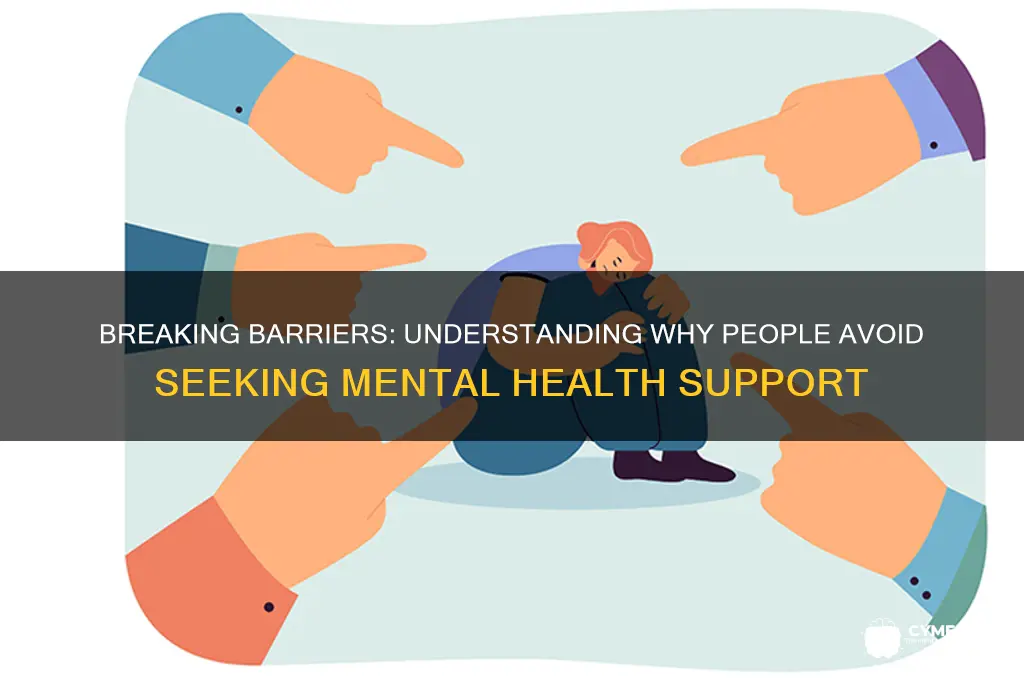
Many people struggle with mental health issues but hesitate to seek help due to a combination of stigma, fear of judgment, and a lack of awareness about available resources. Societal misconceptions often label mental health challenges as a sign of weakness, leading individuals to internalize shame and avoid reaching out. Additionally, the cost and accessibility of mental health services can be prohibitive, while cultural or personal beliefs may discourage open conversations about emotional pain. Fear of being misunderstood or dismissed further deters individuals from seeking support, perpetuating a cycle of silence and suffering. Addressing these barriers requires destigmatizing mental health, improving access to affordable care, and fostering a culture of empathy and understanding.
Explore related products


What You'll Learn

Stigma and shame surrounding mental health issues
Stigma and shame act as silent barriers, preventing countless individuals from seeking help for mental health issues. Consider this: a 2023 survey by the American Psychological Association revealed that 57% of adults experiencing mental health challenges cited fear of judgment as a primary reason for avoiding treatment. This statistic underscores a pervasive cultural issue—the societal tendency to equate mental illness with weakness, lack of willpower, or personal failure. Such misconceptions foster an environment where admitting to struggling feels akin to confessing a moral shortcoming, rather than acknowledging a legitimate health concern.
To dismantle this barrier, it’s instructive to examine the role of language and media representation. Phrases like “commit suicide” or labeling someone as “schizophrenic” instead of “a person with schizophrenia” perpetuate dehumanizing stereotypes. Conversely, campaigns like the UK’s “Time to Change” have demonstrated that reframing mental health narratives can reduce stigma by 5% annually. Practical steps include replacing stigmatizing language with person-first terminology and amplifying stories of recovery to normalize seeking help. For instance, sharing testimonials from public figures who’ve openly addressed their mental health struggles can inspire others to follow suit.
A comparative analysis reveals that stigma manifests differently across cultures, yet its impact remains universal. In collectivist societies, mental health issues may be seen as a reflection on the family, leading individuals to suffer in silence to preserve honor. In contrast, individualistic cultures often emphasize self-reliance, framing vulnerability as a personal failing. However, both contexts share a common thread: the fear of social exclusion. Addressing this requires tailored interventions, such as community-based workshops in collectivist settings or workplace policies promoting mental health days in individualistic ones.
Persuasively, it’s worth noting that stigma doesn’t just harm individuals—it strains healthcare systems. Untreated mental health conditions often escalate into physical ailments, costing the U.S. economy $193 billion annually in lost earnings and healthcare expenses. By investing in stigma-reduction programs, societies can achieve a twofold benefit: improving quality of life for individuals and alleviating economic burdens. For employers, offering mental health training for managers and confidential counseling services can create a culture of support, encouraging employees to seek help without fear of repercussions.
Finally, a descriptive approach highlights the emotional toll of stigma. Imagine a young adult diagnosed with depression, torn between the relief of understanding their symptoms and the dread of being labeled “broken.” This internal conflict often leads to self-isolation, exacerbating their condition. To counteract this, peer support groups and online platforms like 7 Cups provide safe spaces for individuals to share experiences without judgment. Pairing these resources with educational initiatives that debunk myths—such as the idea that mental illness is untreatable—can empower people to prioritize their well-being over societal expectations.
Recognizing and Recovering: Steps to Seek Support for Mental Abuse
You may want to see also
Explore related products


Fear of being judged or misunderstood by others
Stigma silences. The fear of judgment and misunderstanding is a powerful deterrent, keeping countless individuals from seeking the mental health support they desperately need. Imagine carrying a heavy burden, knowing relief is within reach, yet choosing to endure the weight because you fear the labels, the whispers, the perceived shame. This is the reality for many who struggle with mental health issues.
A 2019 study by the National Alliance on Mental Illness (NAMI) found that 60% of adults with mental illness didn't receive mental health services in the previous year. Fear of judgment, a pervasive stigma, is a significant contributor to this alarming statistic. This fear manifests in various ways: the worry of being seen as weak, "crazy," or somehow flawed. It's the dread of being treated differently by friends, family, colleagues, or even healthcare professionals.
Consider Sarah, a 28-year-old marketing professional. She's been battling anxiety for years, experiencing panic attacks and constant worry. Despite knowing therapy could help, she avoids seeking help. "What if my boss finds out?" she thinks. "Will they think I can't handle the job? Will my colleagues see me as unstable?" These fears, fueled by societal misconceptions about mental illness, keep Sarah trapped in a cycle of silence and suffering.
The consequences of this silence are dire. Untreated mental health conditions can worsen over time, leading to decreased quality of life, strained relationships, and even physical health problems. Think of it like ignoring a broken bone – it won't heal on its own, and the pain will only intensify.
Breaking free from this fear requires a multi-pronged approach. Firstly, education is key. Challenging stereotypes and promoting accurate information about mental health is crucial. Campaigns like NAMI's "StigmaFree" initiative aim to replace fear with understanding. Secondly, creating safe spaces is essential. Support groups, online communities, and confidential helplines provide individuals with a judgment-free zone to share their experiences and seek guidance. Finally, encouraging empathy and open dialogue is vital. By normalizing conversations about mental health, we can chip away at the stigma that fuels fear.
Just as we wouldn't hesitate to seek help for a physical ailment, we must foster an environment where seeking help for mental health is met with compassion and understanding, not judgment.
Psychedelics as Treatment: Healing Drug-Induced Mental Illness?
You may want to see also
Explore related products


Lack of awareness about available resources and support
A staggering number of mental health resources exist, yet many remain invisible to those who need them most. This isn't simply a matter of people choosing to ignore help; it's a systemic issue of awareness. Imagine a lifeline thrown into a foggy sea – its existence is meaningless if the drowning person can't see it.
Public health campaigns often focus on destigmatizing mental illness, which is crucial, but they frequently fall short in clearly outlining *where* and *how* to access support.
Consider this: a recent study found that 60% of individuals experiencing anxiety or depression symptoms didn't seek help because they didn't know where to turn. This highlights a critical gap. We need to move beyond awareness of the problem itself and towards actionable knowledge. Think of it like this: knowing you have a flat tire is one thing, knowing how to change it – or even where to find a mechanic – is another entirely.
Public service announcements, school curricula, and even workplace wellness programs should prioritize providing concrete information: hotline numbers, community mental health center locations, online therapy platforms, and support group directories.
The digital age presents both opportunities and challenges. While online resources are abundant, the sheer volume can be overwhelming. A simple Google search for "mental health help" yields millions of results, many of which are irrelevant or unreliable. We need curated, easily navigable platforms that act as central hubs, categorizing resources by type, location, and specific needs. Imagine a user-friendly app that connects individuals with local therapists, peer support groups, or crisis hotlines based on their zip code and presenting concerns.
Let's be clear: simply listing resources isn't enough. We need to actively promote them through diverse channels. Social media campaigns, community events, and collaborations with trusted organizations like schools, churches, and workplaces can effectively disseminate information to those who might otherwise slip through the cracks. Think targeted advertising, but for mental health support – reaching people where they are, in languages they understand, and in formats that resonate.
By addressing the awareness gap, we can transform the landscape of mental health care. It's not about creating more resources, but about making existing ones visible and accessible to everyone who needs them.
Mental Health: Your Powerful Ally in Navigating Life's Challenges
You may want to see also
Explore related products





Financial barriers to accessing mental health care
Financial barriers to mental health care are a stark reality for millions, often turning a critical need into an unattainable luxury. Consider this: in the United States, the average cost of a single therapy session ranges from $100 to $250 without insurance. For someone earning minimum wage, this equates to nearly a full day’s pay. When compounded with the cost of medication—antidepressants like SSRIs can cost $50 to $200 monthly—it’s clear why many forgo treatment. These expenses, coupled with high insurance deductibles or lack of coverage for mental health services, create a system where financial stability becomes a prerequisite for mental well-being.
Now, let’s dissect the insurance dilemma. While the Affordable Care Act mandated mental health coverage, the quality and extent of that coverage vary wildly. Many plans impose strict limits on the number of therapy sessions or require pre-authorization for psychiatric medications. For instance, a person might be approved for only 10 therapy sessions annually, far below the recommended 12–20 sessions for moderate depression. Additionally, out-of-network providers often charge exorbitant fees, leaving patients to choose between subpar care and financial ruin. This patchwork system disproportionately affects low-income individuals and those in rural areas, where providers are scarce and costs are higher.
To navigate these barriers, practical strategies are essential. First, research sliding-scale clinics or community health centers, which adjust fees based on income. For example, a person earning $20,000 annually might pay $20–$40 per session instead of the standard $150. Second, explore telehealth platforms like BetterHelp or Talkspace, which offer subscriptions starting at $60 weekly—still costly, but often more affordable than in-person care. Third, inquire about pharmaceutical assistance programs; drug manufacturers like Pfizer and Eli Lilly offer discounts for medications such as Zoloft or Cymbalta, reducing monthly costs to as low as $25. These steps, while not perfect, can make care more accessible.
Finally, consider the long-term consequences of untreated mental health issues. A study by the World Health Organization estimates that depression and anxiety disorders cost the global economy $1 trillion annually in lost productivity. For individuals, untreated mental illness can lead to job loss, homelessness, or chronic physical conditions, further exacerbating financial strain. Investing in affordable mental health care isn't just a moral imperative—it’s an economic one. Policymakers, employers, and insurers must collaborate to dismantle financial barriers, ensuring that mental health care is a right, not a privilege.
Baking Therapy: Healing Minds Through the Art of Baking
You may want to see also
Explore related products


$12.99 $14.99


Belief that symptoms will resolve on their own
One common barrier to seeking mental health support is the belief that symptoms will simply fade away with time. This misconception often stems from the intermittent nature of mental health struggles; individuals might experience periods of relief, leading them to assume the issue has resolved. For example, someone with anxiety may notice their symptoms lessen during a calm week at work, only to resurface when stress returns. This cycle can create a false sense of security, delaying professional intervention.
Consider the analogy of a physical injury: a sprained ankle might feel better after rest, but without proper treatment, it remains vulnerable to re-injury. Mental health operates similarly. Symptoms like persistent sadness, irritability, or difficulty concentrating may ebb and flow, but without addressing the underlying cause, they are likely to recur. Research shows that untreated mental health conditions often worsen over time, increasing the risk of chronicity and complications. For instance, untreated depression can lead to physical health issues, such as cardiovascular problems, while untreated anxiety may escalate into panic disorder.
To counteract this belief, it’s essential to recognize the difference between temporary relief and genuine resolution. Practical steps include tracking symptoms over time using a journal or app to identify patterns. If symptoms persist or recur despite self-management efforts, this is a clear signal to seek professional help. Additionally, educating oneself about the progressive nature of mental health conditions can shift perspective. For example, understanding that generalized anxiety disorder often requires cognitive-behavioral therapy or medication for long-term management can motivate individuals to act sooner rather than later.
Persuasively, waiting for symptoms to resolve on their own is akin to ignoring a leaky roof—it may seem manageable at first, but the damage accumulates over time. Early intervention is key to preventing minor issues from becoming major crises. Therapists and mental health professionals are trained to provide tools and strategies that not only alleviate symptoms but also build resilience against future challenges. By reframing the belief that symptoms will self-resolve as a myth, individuals can take proactive steps toward lasting well-being.
In conclusion, the belief that mental health symptoms will resolve on their own is a significant yet misguided reason for avoiding help. By acknowledging the cyclical nature of symptoms, understanding the risks of delay, and taking proactive measures, individuals can break free from this barrier. Seeking professional support is not a sign of weakness but a strategic decision to address the root cause and foster long-term mental health.
Exploring Alcohol's Role in Mental Health: Benefits or Risks?
You may want to see also
Frequently asked questions
People may avoid seeking help due to stigma, fear of judgment, lack of awareness about available resources, or the belief that they should handle their problems alone.
Stigma creates shame and embarrassment, making individuals fear being labeled as "weak" or "crazy," which discourages them from reaching out for support.
Some may minimize their struggles, believing they can cope on their own, or they may not recognize the severity of their symptoms due to a lack of mental health education.
High costs of therapy, medication, or treatment programs can be a significant barrier, especially for those without insurance or financial resources.
Cultural beliefs may view mental health issues as a personal failing or taboo, leading individuals to avoid seeking help to conform to societal expectations or family norms.


![Shame (The Criterion Collection) [Blu-ray]](https://m.media-amazon.com/images/I/81L-2w6IK0L._AC_UY218_.jpg)