Ava Ramirez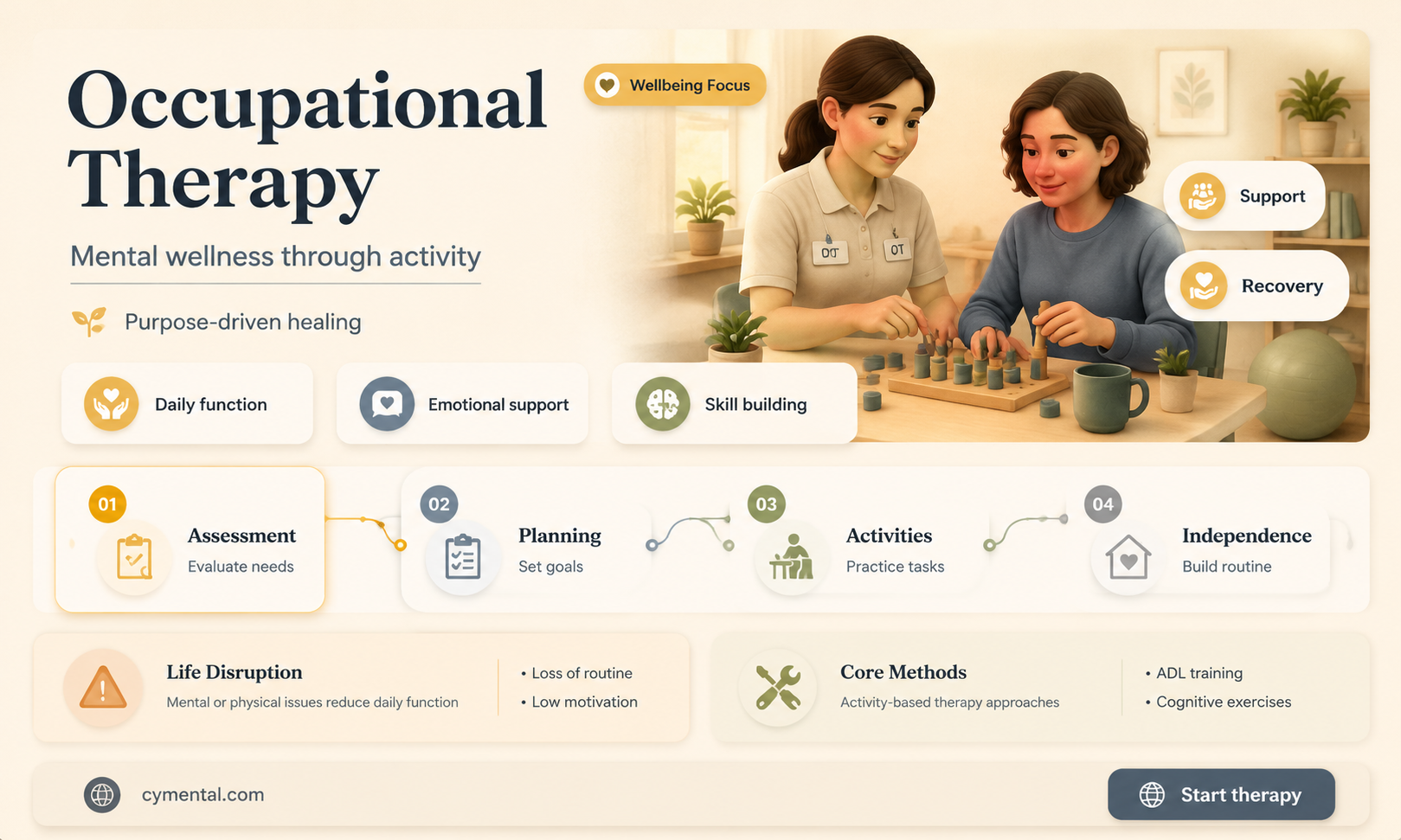
Occupational therapy (OT) plays a vital role in supporting mental health by focusing on the therapeutic use of everyday activities to improve well-being. Through tailored interventions, OT helps individuals develop coping strategies, enhance daily functioning, and foster a sense of purpose and independence. By addressing challenges related to self-care, productivity, and leisure, occupational therapists empower clients to manage symptoms of anxiety, depression, and other mental health conditions. OT also promotes social engagement and environmental adaptations, creating a supportive framework for recovery and resilience, ultimately improving overall quality of life.
| Characteristics | Values |
|---|---|
| Improves Daily Functioning | Occupational therapy (OT) helps individuals with mental health conditions develop skills to manage daily activities like self-care, work, and leisure, enhancing independence and quality of life. |
| Promotes Routine and Structure | OT focuses on creating structured routines, which can reduce anxiety and provide a sense of stability for those with mental health challenges. |
| Enhances Social Participation | Therapists work on improving social skills and confidence, enabling individuals to engage more effectively in community and social activities. |
| Addresses Sensory Processing Issues | OT provides strategies to manage sensory sensitivities, common in conditions like autism or PTSD, to improve emotional regulation. |
| Supports Vocational Rehabilitation | OT assists in job-related skills training, workplace accommodations, and stress management to help individuals return to or maintain employment. |
| Encourages Mindfulness and Coping Skills | Therapists teach mindfulness techniques and coping strategies to manage stress, anxiety, and other mental health symptoms. |
| Focuses on Holistic Well-being | OT considers physical, emotional, and environmental factors to address mental health holistically, often integrating with other therapies. |
| Customized Interventions | OT plans are tailored to individual needs, ensuring personalized support for specific mental health challenges. |
| Improves Self-Efficacy | By mastering tasks and skills, individuals build confidence and a sense of accomplishment, positively impacting mental health. |
| Supports Recovery and Resilience | OT fosters resilience by helping individuals adapt to challenges and develop long-term strategies for mental health management. |
Explore related products


$85.44 $90


What You'll Learn
- Occupational Therapy for Stress Reduction: Techniques to manage stress through meaningful activities and routines
- OT in Anxiety Management: Using structured tasks to reduce anxiety and improve emotional regulation
- Enhancing Social Skills via OT: Activities to boost social interaction and communication in daily life
- OT for Depression Recovery: Engaging in purposeful tasks to combat depression and increase motivation
- Cognitive Improvement with OT: Exercises to enhance focus, memory, and problem-solving skills for mental clarity

Occupational Therapy for Stress Reduction: Techniques to manage stress through meaningful activities and routines
Stress is an inevitable part of life, but chronic stress can erode mental health, leading to anxiety, depression, and burnout. Occupational therapy (OT) offers a unique approach to stress reduction by focusing on engagement in meaningful activities and routines that promote balance, purpose, and well-being. Unlike traditional talk therapy, OT addresses stress through action, helping individuals build resilience by integrating purposeful occupations into their daily lives.
Consider the case of a 35-year-old professional who spends 10 hours daily at a desk, leading to physical tension and mental exhaustion. An occupational therapist might introduce a structured routine that includes 15-minute stretching breaks every two hours, paired with a 30-minute evening hobby like painting or gardening. These activities not only disrupt sedentary behavior but also provide a mental escape, reducing cortisol levels and fostering a sense of accomplishment. Research shows that engaging in creative or physical tasks for at least 20 minutes daily can significantly lower stress markers in adults aged 25–50.
Analyzing the effectiveness of OT for stress reduction, it’s clear that the key lies in personalization. For instance, a teenager overwhelmed by academic pressure might benefit from time management strategies, such as the Pomodoro Technique (25 minutes of focus followed by a 5-minute break), combined with sensory integration activities like fidgeting with stress balls or listening to calming music. In contrast, an older adult experiencing stress due to retirement might find purpose in volunteering or learning a new skill, such as knitting or woodworking, which OT can facilitate. The common thread is tailoring activities to individual needs, ensuring they align with personal interests and lifestyle.
A persuasive argument for OT’s role in stress management is its holistic approach. Unlike quick fixes like meditation apps or temporary distractions, OT addresses the root causes of stress by fostering habits that enhance overall functioning. For example, a therapist might work with a client to design a morning routine that includes mindfulness exercises, light exercise, and a nutritious breakfast, setting a positive tone for the day. Over time, these routines become second nature, reducing reliance on external stress-relief methods. Studies indicate that individuals who consistently engage in OT-recommended activities report a 40% reduction in stress levels within three months.
In conclusion, occupational therapy provides a practical, evidence-based framework for managing stress through meaningful activities and routines. By focusing on individualized solutions and sustainable habits, OT empowers individuals to reclaim control over their mental health. Whether through structured breaks, creative hobbies, or purposeful routines, the techniques employed in OT offer a pathway to resilience and well-being, making it a valuable tool in the fight against chronic stress.
Accessing Free Mental Health Support: Options and Resources Available
You may want to see also
Explore related products


OT in Anxiety Management: Using structured tasks to reduce anxiety and improve emotional regulation
Anxiety disorders affect approximately 284 million people globally, making them the most prevalent mental health conditions. Occupational therapy (OT) offers a unique approach to anxiety management by leveraging structured tasks to promote emotional regulation and functional independence. Unlike traditional talk therapy, OT focuses on actionable, goal-directed activities that engage the mind and body simultaneously, fostering a sense of accomplishment and control.
Consider a 35-year-old professional experiencing generalized anxiety disorder. An OT practitioner might introduce a structured task like progressive muscle relaxation paired with a sensory-based activity, such as kneading therapeutic clay. This dual-focus technique requires the individual to alternate between tensing and releasing muscle groups while maintaining tactile engagement. Research suggests that combining proprioceptive input (muscle relaxation) with sensory modulation reduces cortisol levels by up to 25% within 20 minutes. The task is performed for 10–15 minutes daily, with progress tracked via self-reported anxiety scales and physiological markers like heart rate variability.
Structured tasks in OT are not one-size-fits-all. For adolescents with social anxiety, role-playing scenarios in a controlled environment can desensitize them to triggers while building coping skills. For instance, a therapist might design a 4-week program where participants practice initiating conversations using scripted dialogues, gradually reducing reliance on prompts. Studies show that such graded exposure techniques improve emotional regulation in 70% of cases when combined with cognitive reframing exercises. Caution: Avoid overwhelming clients by escalating task complexity too quickly; incremental challenges yield better outcomes.
The efficacy of structured tasks lies in their ability to retrain the brain’s response to stress. Neuroplasticity principles underpin this approach, as repetitive, purposeful activities strengthen neural pathways associated with calmness and focus. For children aged 8–12, OT practitioners often incorporate play-based tasks like building with LEGO bricks while narrating feelings. This combines fine motor engagement with emotional expression, teaching young clients to label and manage anxiety in real-time. Practical tip: Use a timer to limit task duration to 15–20 minutes, preventing overstimulation.
In conclusion, OT’s use of structured tasks in anxiety management is both science-backed and highly adaptable. By integrating sensory, cognitive, and motor elements, these activities provide immediate coping mechanisms while fostering long-term emotional resilience. Whether for adults, teens, or children, the key is consistency and personalization. Start small, measure progress, and adjust tasks to meet evolving needs—a formula that transforms anxiety from an overwhelming force into a manageable challenge.
Mental Health's Impact on Skin Aging: Unveiling the Mind-Face Connection
You may want to see also
Explore related products


Enhancing Social Skills via OT: Activities to boost social interaction and communication in daily life
Social skills are the bedrock of mental well-being, yet many individuals struggle with anxiety, awkwardness, or disconnection in interpersonal situations. Occupational therapy (OT) offers a structured, activity-based approach to bridge this gap by targeting sensory processing, emotional regulation, and practical communication strategies. Through tailored interventions, OT practitioners help clients build confidence and competence in social scenarios, fostering deeper connections and improved quality of life.
Consider the case of a teenager with autism who avoids group settings due to sensory overload. An OT might introduce a graded exposure activity, such as practicing brief interactions at a quiet café, gradually increasing duration and complexity. Pairing this with sensory integration techniques, like deep pressure therapy before social outings, can reduce anxiety and improve focus. Over time, the client learns to navigate social cues and manage sensory input, making group activities less daunting. This methodical approach not only enhances social participation but also empowers the individual to self-regulate in challenging environments.
For adults experiencing social withdrawal due to depression or anxiety, OT can incorporate role-playing exercises to simulate common interactions, such as initiating conversations or asserting boundaries. These activities are often paired with cognitive-behavioral strategies to challenge negative thought patterns. For instance, a client might practice asking a coworker for help while reframing fears of rejection as opportunities for connection. Research suggests that such structured practice can rewire neural pathways, making social engagement feel more natural and less threatening.
Children with developmental delays often benefit from play-based OT interventions that implicitly teach social skills. A therapist might use board games to encourage turn-taking, negotiation, and emotional expression. For example, during a game of "Candy Land," the therapist prompts the child to verbalize frustration ("I’m upset I didn’t get that card") and celebrate successes ("Good job waiting your turn!"). These activities not only improve communication but also reinforce the social norms of cooperation and empathy. Parents can extend these lessons at home by incorporating similar games into daily routines.
A key takeaway is that OT’s strength lies in its ability to embed social skill-building into meaningful, everyday activities. Whether through sensory modulation, role-playing, or play, these interventions are designed to be practical and sustainable. Clients are not merely taught skills in isolation but learn to apply them in real-world contexts, ensuring lasting change. By addressing the underlying barriers to social interaction, OT helps individuals move from avoidance to engagement, fostering a sense of belonging and mental resilience.
Seeking Mental Health Support: Does Therapy and Treatment Truly Work?
You may want to see also
Explore related products


OT for Depression Recovery: Engaging in purposeful tasks to combat depression and increase motivation
Depression often saps motivation, leaving individuals trapped in a cycle of inertia and hopelessness. Occupational therapy (OT) intervenes by reintroducing purposeful activities, carefully tailored to reignite interest and restore a sense of accomplishment. Unlike passive treatments, OT actively engages individuals in tasks aligned with their values and abilities, whether it’s cooking a simple meal, tending to a plant, or organizing a workspace. These activities, though seemingly mundane, serve as anchors to reality, providing structure and measurable progress in a life often dominated by emotional chaos.
Consider the case of a 32-year-old graphic designer who, after months of depressive episodes, struggled to complete even basic tasks. An OT practitioner introduced a graded activity schedule, starting with 15-minute sessions of sketching—a task tied to her professional identity. Over six weeks, the duration increased to 45-minute sessions, paired with journaling to reflect on feelings of competence and frustration. By week eight, she reported a 30% increase in daily productivity and a renewed sense of purpose. This example underscores the power of task-specific engagement in rebuilding motivation and self-efficacy.
However, not all purposeful tasks yield the same results. OT practitioners must assess clients’ energy levels, cognitive load, and emotional triggers to avoid overwhelm. For instance, a task requiring high social interaction, like volunteering at a community center, might exacerbate anxiety in someone with comorbid social phobia. Instead, solitary activities like knitting or digital organizing could provide a safer starting point. The key lies in balancing challenge and comfort, ensuring the task is achievable yet meaningful enough to foster a sense of pride.
Critics might argue that engaging in tasks is merely a distraction from underlying emotional issues. Yet, OT’s approach is not to bypass therapy but to complement it by addressing the functional impairments depression creates. By restoring engagement in daily occupations, individuals often find the mental bandwidth to process emotions more effectively in concurrent talk therapy. A 2021 study in the *Journal of Occupational Therapy* found that participants who combined OT with cognitive-behavioral therapy (CBT) showed a 40% greater reduction in depressive symptoms compared to CBT alone.
In practice, integrating OT into depression recovery requires collaboration between therapists, clients, and often their support systems. Caregivers can assist by breaking tasks into smaller steps, providing gentle reminders, and celebrating progress, no matter how small. For instance, a caregiver might assist a depressed teenager by setting up a daily 10-minute journaling routine, gradually increasing the time as tolerance builds. The goal is not perfection but consistent engagement, as each completed task chips away at the paralysis of depression.
Ultimately, OT’s focus on purposeful tasks offers a tangible pathway out of depression’s abstract grip. By reconnecting individuals with activities that matter to them, it transforms passive suffering into active recovery. Whether through creative expression, daily chores, or vocational pursuits, these tasks become more than actions—they become symbols of resilience and hope.
Helping Others with Mental Illness: A Mutual Path to Healing
You may want to see also
Explore related products






Cognitive Improvement with OT: Exercises to enhance focus, memory, and problem-solving skills for mental clarity
Occupational therapy (OT) offers targeted exercises to sharpen cognitive functions like focus, memory, and problem-solving, which are often compromised by mental health challenges. These exercises are designed to rewire neural pathways, improve mental clarity, and enhance daily functioning. For instance, a study published in the *American Journal of Occupational Therapy* found that structured cognitive tasks significantly improved executive function in adults with depression and anxiety. By integrating these practices into routine, individuals can regain control over their mental processes and improve overall well-being.
One effective OT exercise for enhancing focus is the Pomodoro Technique with a Twist. Traditionally, this method involves 25 minutes of focused work followed by a 5-minute break. OT adapts this by incorporating sensory breaks during the pause—such as deep breathing, stretching, or a quick walk—to reset the mind. For adults, aim for 4–6 cycles per day, while adolescents can start with 2–3 cycles. The key is consistency; over time, this practice trains the brain to sustain attention for longer periods, reducing mental fatigue and improving productivity.
To bolster memory, OT often employs contextual association tasks. For example, when trying to remember a grocery list, link each item to a specific room in your home. Milk could be associated with the kitchen, eggs with the fridge, and bread with the pantry. This spatial mnemonic technique leverages the brain’s natural ability to recall visual and spatial information. For older adults or those with memory impairments, start with 5–7 items and gradually increase complexity. Pairing this exercise with verbal repetition enhances retention, making it a powerful tool for everyday memory challenges.
Problem-solving skills benefit from simulated decision-making scenarios, a staple in OT cognitive training. These exercises present hypothetical situations—like planning a budget or resolving a conflict—and require step-by-step solutions. For instance, a therapist might ask, “How would you handle a missed deadline at work?” The process of breaking down problems into manageable parts strengthens analytical thinking. For children and teens, simplify scenarios to match their developmental stage, such as resolving a playground dispute. Regular practice, even 15–20 minutes daily, fosters adaptability and confidence in real-life decision-making.
While these exercises are powerful, they require mindful implementation. Overloading the brain with too many tasks at once can lead to frustration. Start with one exercise per day and gradually combine them as proficiency improves. Additionally, track progress using journals or apps to stay motivated. OT’s holistic approach ensures these cognitive improvements translate into tangible life skills, from better time management to enhanced interpersonal communication. By committing to these practices, individuals can achieve lasting mental clarity and resilience.
Finding Support: Where to Go for Help in Difficult Times
You may want to see also
Frequently asked questions
OT helps individuals with anxiety by teaching coping strategies, such as mindfulness, sensory modulation techniques, and structured routines, to manage stress and improve daily functioning.
Yes, OT can assist in treating depression by promoting engagement in meaningful activities, improving sleep patterns, and enhancing social participation to boost mood and overall well-being.
OT supports individuals with ADHD by developing organizational skills, creating structured environments, and teaching time management techniques to improve focus and reduce overwhelm.
OT helps manage PTSD symptoms by addressing sensory sensitivities, teaching grounding techniques, and gradually reintroducing individuals to activities they may have avoided due to trauma.
Yes, OT can benefit individuals with eating disorders by focusing on rebuilding healthy routines, improving body awareness, and fostering positive relationships with food and mealtime activities.