Noah Parker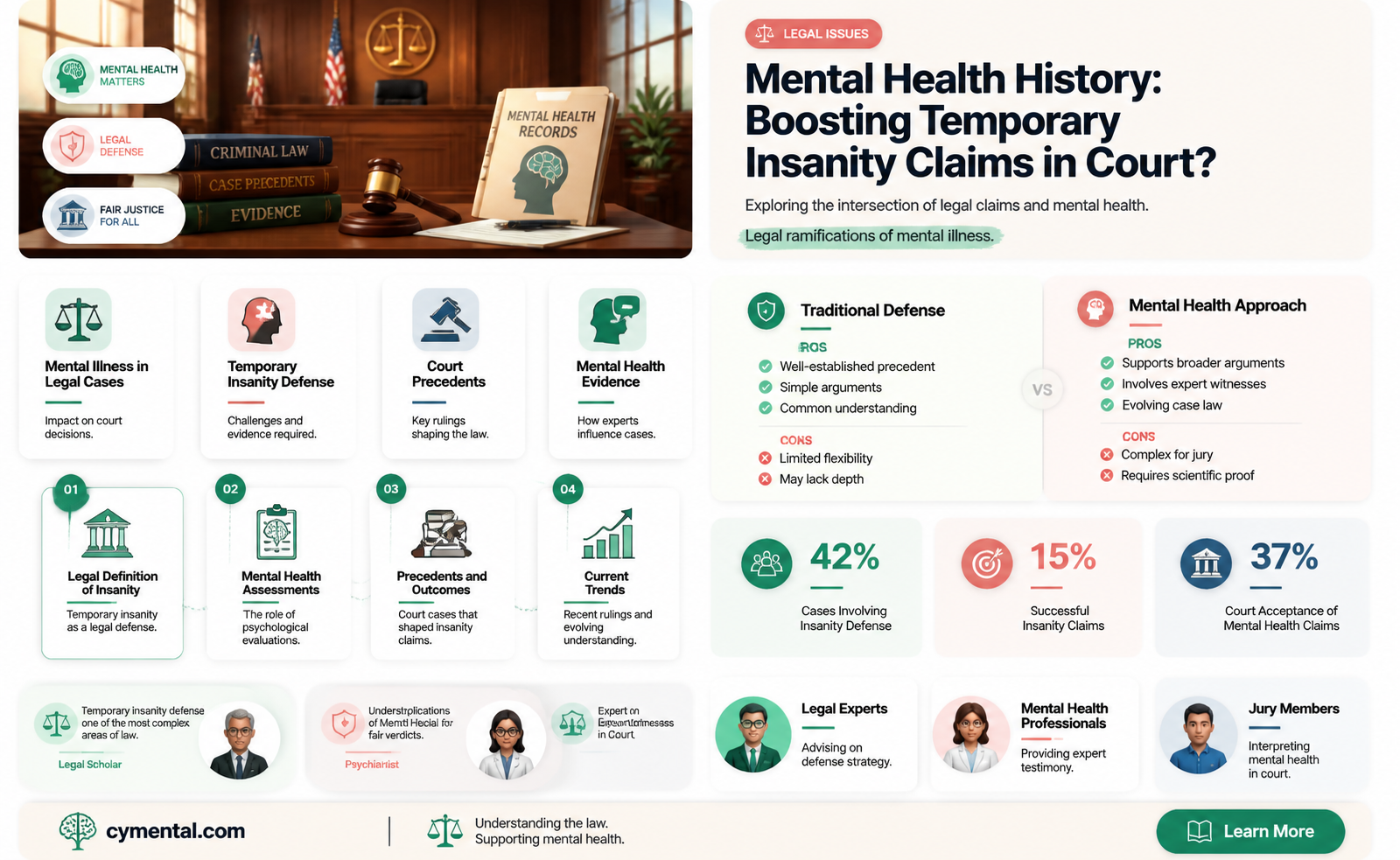
The question of whether a history of mental disorder can support a temporary insanity claim in legal contexts is a complex and contentious issue. Temporary insanity, often referred to as the not guilty by reason of insanity (NGRI) defense, hinges on the defendant's inability to understand the nature of their actions or distinguish right from wrong at the time of the offense. While a pre-existing mental disorder can provide context for a defendant's state of mind, it does not automatically guarantee a successful insanity claim. Courts typically require substantial evidence that the disorder directly caused the defendant's inability to comprehend their actions during the specific incident in question. Additionally, the interplay between a history of mental illness and temporary insanity often involves rigorous psychiatric evaluations, legal scrutiny, and varying state laws, making it a nuanced and highly individualized defense.
| Characteristics | Values |
|---|---|
| Relevance of Mental Health History | A history of mental disorder can be relevant in a temporary insanity claim, but it is not automatically determinative. It provides context for the defendant's mental state at the time of the offense. |
| Legal Standard | The defendant must typically prove they were unable to understand the nature of their actions or distinguish right from wrong due to a severe mental disorder at the time of the crime (M'Naghten Rule, ALI Test, or other jurisdiction-specific standards). |
| Expert Testimony | Psychiatric or psychological expert testimony is often required to establish the link between the defendant's mental health history and their state at the time of the offense. |
| Severity and Timing | The mental disorder must be severe and directly related to the defendant's inability to comprehend their actions at the time of the crime, not just a general history of mental health issues. |
| Burden of Proof | The defendant usually bears the burden of proving temporary insanity by a preponderance of the evidence (in some jurisdictions) or clear and convincing evidence (in others). |
| Impact on Verdict | If successful, a temporary insanity claim may result in a verdict of "not guilty by reason of insanity," often leading to commitment to a mental health facility rather than imprisonment. |
| Jurisdictional Variations | Laws regarding insanity defenses vary widely by jurisdiction, with some states having abolished the insanity defense altogether. |
| Public Perception | Claims of temporary insanity, especially when tied to a history of mental disorder, can be controversial and may face skepticism from juries or the public. |
| Documentation | Thorough medical records and documentation of the defendant's mental health history are crucial to support the claim. |
| Potential for Abuse | There is a concern that defendants might misuse mental health history to evade criminal responsibility, necessitating rigorous evaluation by courts. |
Explore related products


What You'll Learn

Legal definitions of insanity
The legal definition of insanity varies significantly across jurisdictions, often hinging on whether the defendant could distinguish right from wrong or control their actions at the time of the offense. For instance, the M’Naghten Rule, adopted in many U.S. states, requires proof that the defendant was unable to understand the nature and quality of their actions or that such actions were wrong. In contrast, the Model Penal Code test broadens this by including defendants who acted under a mental disease or defect that negated their capacity for self-control. These distinctions are critical because they determine whether a history of mental disorder can support a temporary insanity claim. A defendant with a documented mental illness might meet one standard but fail another, depending on the jurisdiction and the specific circumstances of the case.
When evaluating a temporary insanity claim, courts often scrutinize the temporal relationship between the defendant’s mental disorder and the criminal act. For example, a defendant with schizophrenia who experiences an acute psychotic episode during the offense may have a stronger claim than one whose condition is chronic but stable at the time of the crime. Medical records, expert testimony, and eyewitness accounts play a pivotal role in establishing this link. However, a history of mental disorder alone is insufficient; the defendant must demonstrate that the disorder directly impaired their cognitive or volitional capacities at the precise moment of the offense. This requirement underscores the need for precise psychiatric evaluations and clear legal arguments.
One practical challenge in leveraging a history of mental disorder for a temporary insanity claim is the burden of proof. Defendants typically bear the responsibility of proving their insanity by a preponderance of the evidence, though some jurisdictions require only a reasonable doubt standard. This burden often necessitates extensive psychiatric assessments, which can be costly and time-consuming. For low-income defendants, accessing qualified experts may be particularly difficult, creating disparities in the ability to mount a successful defense. Attorneys must therefore strategize early, securing funding for evaluations and preparing to counter prosecutorial challenges to the credibility of mental health evidence.
Comparatively, international legal systems offer alternative frameworks that may be more accommodating to defendants with mental disorders. For instance, the UK’s "automatism" defense allows for acquittal if the defendant’s actions were the result of an external or internal factor beyond their control, such as a sudden psychiatric episode. Similarly, some European countries prioritize treatment over punishment, diverting defendants with severe mental illnesses to psychiatric facilities rather than prisons. These approaches highlight the tension between retributive justice and therapeutic intervention, raising questions about the fairness of U.S. standards in addressing temporary insanity claims rooted in mental disorders.
Ultimately, the viability of a temporary insanity claim based on a history of mental disorder depends on a nuanced interplay of legal standards, psychiatric evidence, and strategic advocacy. Defense attorneys must carefully align their arguments with the specific insanity test in their jurisdiction while marshaling compelling evidence of the defendant’s impaired state at the time of the offense. For defendants, understanding these complexities is crucial, as it can mean the difference between incarceration and treatment. As mental health awareness grows, so too may the legal system’s willingness to recognize the mitigating role of temporary insanity in criminal cases.
Seeking Support: A Guide to Accessing Mental Health Assistance
You may want to see also
Explore related products

$64.23 $64.99


Role of past diagnoses in court
A history of mental disorder can significantly influence the trajectory of a temporary insanity claim in court, but its role is nuanced and often misunderstood. Judges and juries may view past diagnoses as either mitigating factors or evidence of premeditated behavior, depending on the context and presentation. For instance, a well-documented history of schizophrenia with prior psychotic episodes might lend credibility to a defendant’s claim of temporary insanity during the commission of a crime. Conversely, a sporadic or inconsistent mental health record could raise doubts about the authenticity of the claim. The key lies in how the defense frames the history—as a chronic condition that episodically impairs judgment or as a long-term struggle that culminated in a moment of uncontrollable action.
Consider the case of *People v. Serravo* (1992), where the defendant’s extensive history of bipolar disorder was central to his insanity defense. The court scrutinized medical records, treatment adherence, and expert testimony to determine whether his past diagnoses supported his claim of temporary insanity. The takeaway here is that past diagnoses are not automatically advantageous; they must be strategically linked to the defendant’s state of mind at the time of the offense. Defense attorneys often rely on forensic psychologists to establish this connection, using tools like the *DSM-5* criteria to demonstrate how a specific disorder could have rendered the defendant incapable of distinguishing right from wrong.
However, courts are cautious about allowing past diagnoses to overshadow the immediate circumstances of the crime. For example, a defendant with a history of depression who commits a violent act during a manic episode may face skepticism if the manic episode was not previously documented. Prosecutors frequently argue that a history of mental illness indicates awareness of one’s condition, potentially undermining the claim of temporary insanity. To counter this, defense teams must provide concrete evidence of a sudden, acute exacerbation of symptoms, such as a recent change in medication (e.g., a switch from lithium 900 mg daily to 600 mg) or a triggering event like severe sleep deprivation.
Practical tips for leveraging past diagnoses include ensuring all medical records are up-to-date and comprehensive, as gaps or inconsistencies can weaken the defense. Attorneys should also prepare witnesses, such as treating psychiatrists, to testify about the defendant’s specific symptoms and their impact on decision-making. For instance, a psychiatrist might explain how a patient with schizoaffective disorder experienced command hallucinations that directly influenced their actions. Finally, juries are more likely to empathize with defendants whose mental health struggles are portrayed as lifelong battles rather than isolated incidents, making narrative framing critical.
In conclusion, while a history of mental disorder can bolster a temporary insanity claim, its effectiveness hinges on meticulous preparation and strategic presentation. Courts require a clear, causal link between the past diagnosis and the defendant’s state at the time of the offense. By focusing on specificity, consistency, and expert testimony, defense teams can navigate this complex terrain and increase the likelihood of a favorable outcome.
Yoga's Transformative Power: Enhancing Mental Health and Well-being Naturally
You may want to see also
Explore related products


Expert testimony impact
Expert testimony can be the linchpin in a temporary insanity defense, particularly when a history of mental disorder is involved. Psychiatrists, psychologists, and other mental health professionals provide critical insights into the defendant's mental state at the time of the offense, often bridging the gap between complex psychiatric diagnoses and legal standards. Their testimony must establish a direct link between the defendant's mental disorder and the inability to distinguish right from wrong or control their actions, as required by the M’Naghten Rules or other applicable legal tests. For instance, a psychiatrist might detail how a defendant’s schizophrenia, marked by active psychosis, rendered them incapable of understanding the criminality of their actions. Without such expert input, juries and judges often lack the specialized knowledge to evaluate the credibility of a temporary insanity claim.
However, the impact of expert testimony is not guaranteed; its effectiveness hinges on the credibility and clarity of the expert witness. A well-prepared expert who presents a coherent, evidence-based narrative can sway even skeptical jurors. Conversely, inconsistencies or a lack of empirical support in the testimony can undermine the defense. For example, if an expert relies solely on self-reported symptoms without corroborating medical records or diagnostic tests, their conclusions may be dismissed as speculative. Defense teams must therefore vet experts rigorously, ensuring they can withstand cross-examination and present their findings in a manner accessible to laypersons.
The interplay between expert testimony and jury perception is another critical factor. Juries often weigh the expert’s demeanor, confidence, and ability to communicate complex ideas simply. A compelling expert who uses relatable examples—such as comparing psychotic episodes to hallucinations induced by sleep deprivation—can make abstract psychiatric concepts tangible. Additionally, visual aids, such as brain imaging scans or timelines of the defendant’s mental health history, can bolster the expert’s credibility. However, juries may also be influenced by cultural biases or misconceptions about mental illness, making it essential for experts to address these preconceptions directly in their testimony.
Practical considerations also shape the impact of expert testimony. The timing and dosage of psychiatric evaluations matter; assessments conducted shortly after the offense carry more weight than those done years later. Experts should review all available records, including prior hospitalizations, medication histories, and therapy notes, to construct a comprehensive profile of the defendant’s mental health. For instance, documenting a defendant’s non-adherence to antipsychotic medication (e.g., skipping daily 10mg doses of olanzapine) can explain why their symptoms were unmanageable at the time of the offense. Such details not only strengthen the expert’s argument but also provide a roadmap for the defense’s narrative.
Ultimately, the goal of expert testimony in temporary insanity cases is to humanize the defendant while maintaining scientific rigor. By framing the defendant’s actions within the context of their mental disorder, experts can shift the focus from culpability to capacity. For example, a psychologist might describe how a defendant’s severe depression, characterized by psychomotor retardation and suicidal ideation, impaired their ability to form intent. This dual approach—combining empathy with evidence—can transform a history of mental disorder from a mitigating factor into a cornerstone of the defense. When executed effectively, expert testimony does not just inform the court; it educates and persuades, turning complex psychiatric realities into actionable legal arguments.
Supporting Your Adult Son’s Mental Health: Practical Steps for Parents
You may want to see also
Explore related products


$28.45 $29.95


Distinguishing temporary vs. chronic conditions
In legal contexts, distinguishing between temporary and chronic mental conditions is pivotal when evaluating an insanity defense. Temporary conditions, such as acute psychotic episodes or severe dissociative states, are often triggered by specific stressors or events and may resolve within weeks or months. Chronic conditions, like schizophrenia or bipolar disorder, persist over years and require ongoing management. This distinction matters because temporary conditions might align more closely with the legal criteria for insanity, which typically requires a defendant to prove they lacked the capacity to understand their actions at the time of the offense. Chronic conditions, while severe, may not automatically qualify unless the defendant can demonstrate a direct link between their condition and the inability to discern right from wrong during the act.
Consider the case of a defendant with a history of major depressive disorder who experiences a sudden psychotic break after a traumatic event. Here, the temporary nature of the psychosis—triggered by the trauma and potentially treatable with antipsychotics like olanzapine (10–20 mg/day)—could support an insanity claim if medical records show the episode impaired their judgment. In contrast, a defendant with chronic paranoid schizophrenia, managed with long-term antipsychotics like risperidone (2–6 mg/day), might face a harder time proving insanity unless they can show a medication lapse or acute decompensation directly tied to the offense. The key is temporal correlation: the condition must have been active and severe at the precise moment of the crime.
Clinicians play a critical role in this differentiation by providing detailed assessments. For instance, a psychiatrist might use the DSM-5 criteria to differentiate between a brief psychotic disorder (lasting 1 day to 1 month) and schizoaffective disorder (lifelong with episodic exacerbations). Legal teams should request records of symptom onset, duration, and treatment responses to build a timeline. For temporary conditions, evidence of rapid symptom resolution—such as a return to baseline functioning within 30 days—strengthens the argument for insanity. For chronic conditions, focus on proving a recent exacerbation, such as non-adherence to medication or a documented stressor that triggered decompensation.
Practically, defendants and attorneys should avoid conflating a history of mental illness with automatic insanity. Instead, gather evidence of the condition’s *acute* impact at the time of the offense. For example, if a defendant with PTSD experienced a dissociative flashback during the crime, corroborate this with eyewitness accounts or medical records of prior dissociative episodes. Conversely, if a defendant with chronic borderline personality disorder acted impulsively, emphasize the situational trigger (e.g., perceived abandonment) rather than the underlying diagnosis. The goal is to show the condition was not merely present but *actively disabling* during the act.
Ultimately, the distinction between temporary and chronic conditions hinges on timing, severity, and functional impairment. While a history of mental disorder provides context, it is the episodic nature of the condition at the moment of the crime that carries legal weight. Defendants and legal teams must work with mental health professionals to pinpoint whether the condition was transient and overwhelming or longstanding and managed. This nuanced approach ensures the insanity defense is applied fairly, reflecting the complex interplay between mental health and criminal responsibility.
Find Free Depression Support: Resources and Helpful Services Available Now
You may want to see also
Explore related products


Case law precedents
The interplay between a history of mental disorder and temporary insanity claims has been shaped by pivotal case law precedents, each contributing nuanced interpretations of legal responsibility. One landmark case is *Clark v. Arizona* (2006), where the U.S. Supreme Court upheld a state’s limitation on the scope of insanity defenses, emphasizing that defendants could only argue they were unable to understand the nature of their actions, not that their mental illness caused them to act irrationally. This ruling underscores the legal system’s focus on cognitive capacity over behavioral causation, setting a precedent for how mental health histories are evaluated in insanity claims.
In contrast, *People v. Serravo* (1992) illustrates how a history of mental disorder can sometimes bolster a temporary insanity claim. The court recognized that the defendant’s long-standing schizophrenia, coupled with a sudden psychotic break, rendered him incapable of distinguishing right from wrong at the time of the offense. This case highlights the importance of temporal proximity between the mental disorder and the criminal act, suggesting that chronic conditions alone are insufficient without evidence of an acute episode.
A comparative analysis of *State v. Crenshaw* (1982) and *State v. Worley* (2004) reveals divergent outcomes based on the presentation of mental health evidence. In *Crenshaw*, the court rejected the insanity defense because the defendant’s history of depression was deemed insufficient to prove a lack of criminal intent. Conversely, *Worley* succeeded in establishing temporary insanity by linking the defendant’s bipolar disorder to a manic episode that directly impaired judgment. These cases demonstrate the critical role of expert testimony and medical documentation in bridging the gap between mental health history and legal culpability.
Practical takeaways from these precedents include the necessity of establishing a direct causal link between the mental disorder and the criminal act, as well as the importance of timing. Defense strategies should focus on demonstrating that the defendant’s condition was not merely chronic but actively symptomatic at the time of the offense. Additionally, jurisdictions vary in their interpretation of insanity defenses, so legal counsel must tailor arguments to align with local statutes and precedents. For instance, in states following the M’Naghten Rules, proving a lack of understanding of the act’s wrongfulness is paramount, whereas jurisdictions adopting the Model Penal Code may consider broader impairments of cognitive function.
Finally, caution must be exercised in over-relying on mental health history alone. Courts often scrutinize claims to prevent abuse of the insanity defense, particularly in cases where the disorder is well-managed or unrelated to the offense. A comprehensive approach, combining medical records, eyewitness accounts, and expert evaluations, is essential to substantiate the claim. By grounding arguments in both legal precedent and empirical evidence, attorneys can navigate the complex intersection of mental health and criminal responsibility more effectively.
Kick Stress Away: Soccer's Surprising Mental Health Benefits
You may want to see also
Frequently asked questions
No, a history of mental disorder alone does not automatically prove temporary insanity. The defense must demonstrate that the disorder directly caused a lack of understanding of the criminal act or inability to distinguish right from wrong at the time of the offense.
A documented history of mental disorder can provide context and support for a temporary insanity claim, but it must be backed by expert testimony and evidence showing the disorder’s specific impact on the defendant’s mental state at the time of the crime.
Yes, a temporary insanity claim can succeed even without a prior diagnosis if there is compelling evidence that the defendant experienced a sudden and severe mental breakdown at the time of the offense, rendering them incapable of understanding their actions.