Harper Lewis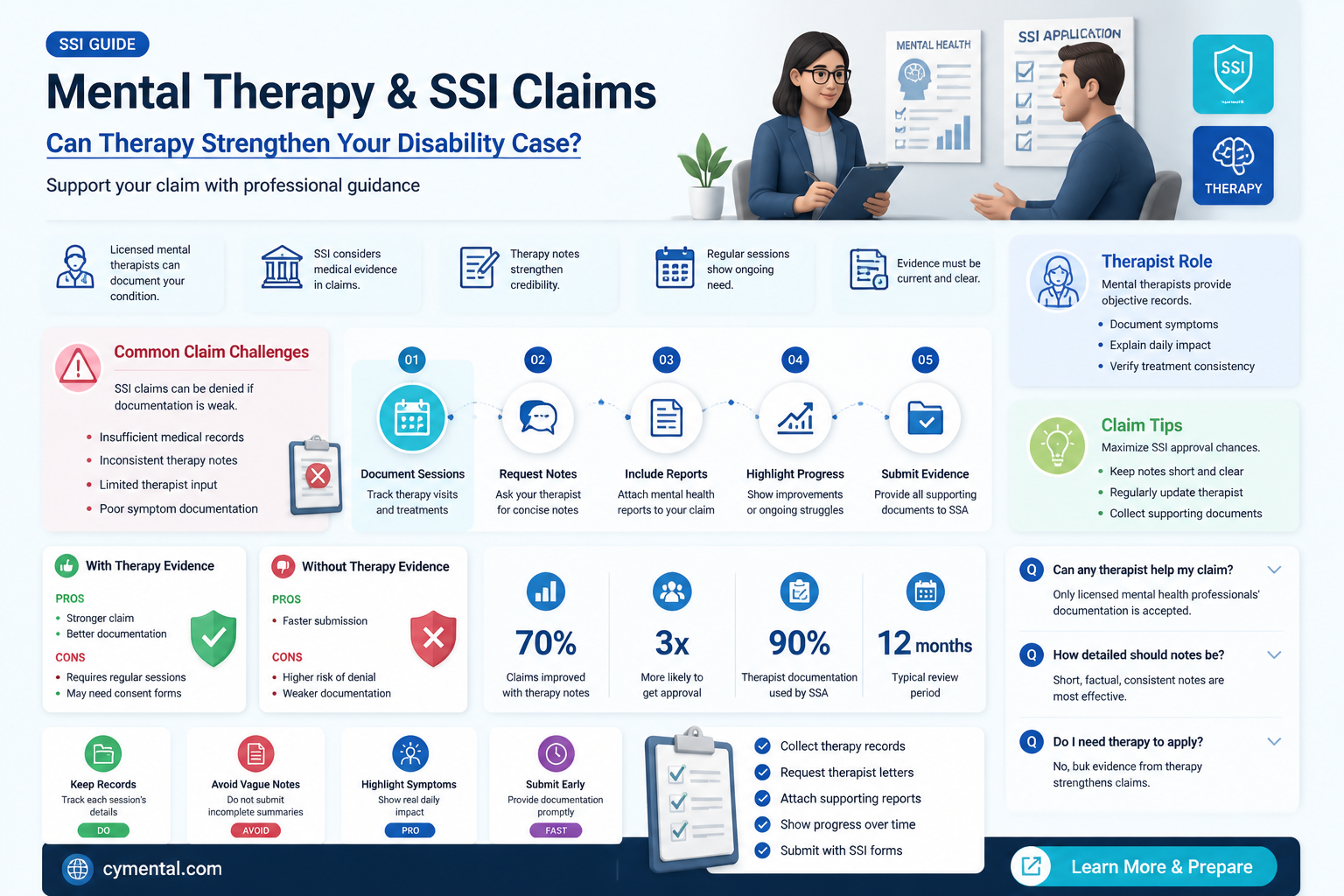
Navigating the complexities of applying for Supplemental Security Income (SSI) disability benefits can be overwhelming, especially when dealing with mental health challenges. Many individuals wonder whether consulting a mental therapist can improve their chances of securing SSI disability approval. A mental therapist can play a crucial role in this process by providing professional documentation of your mental health condition, its severity, and its impact on your daily functioning. Their assessments, treatment records, and expert opinions can serve as vital evidence to support your claim, demonstrating to the Social Security Administration (SSA) that your mental health impairments meet the criteria for disability benefits. While a therapist alone cannot guarantee approval, their involvement can significantly strengthen your case by offering credible, detailed insights into your limitations and the extent to which they hinder your ability to work.
| Characteristics | Values |
|---|---|
| Role of Mental Therapist | A mental therapist can provide critical documentation of your mental health condition, including diagnoses, treatment history, and functional limitations, which are essential for SSI disability claims. |
| Medical Evidence | Therapists can supply detailed medical records, progress notes, and assessments that demonstrate the severity and longevity of your mental health condition. |
| Functional Limitations | Therapists can document how your mental health condition affects daily activities, work ability, and social functioning, which aligns with SSI's criteria for disability. |
| Consistency of Treatment | Regular therapy sessions and adherence to treatment plans can strengthen your claim by showing ongoing impairment and efforts to manage the condition. |
| Expert Opinion | A therapist's professional opinion on your ability to work and function can carry significant weight in SSI evaluations. |
| Supporting Statements | Therapists can write letters or fill out forms (e.g., RFC assessments) detailing your limitations and how they meet SSI's Blue Book listings for mental disorders. |
| Credibility | Consistent, long-term treatment with a licensed therapist adds credibility to your claim compared to self-reported symptoms. |
| Limitations | A therapist's input alone may not be sufficient; additional medical evidence (e.g., from psychiatrists or psychologists) may be required for a comprehensive claim. |
| SSI Eligibility Criteria | SSI requires proof of a severe, long-term disability that prevents substantial gainful activity, and a therapist's documentation can help meet these criteria for mental health conditions. |
| Blue Book Listings | Mental health conditions like depression, anxiety, PTSD, and bipolar disorder are covered under SSI's Blue Book; therapists can help link your symptoms to these listings. |
| Impact on Claim Approval | While not a guarantee, strong therapist documentation significantly improves the chances of winning SSI disability benefits for mental health conditions. |
Explore related products


What You'll Learn

Therapist Documentation for SSI Claims
A mental health therapist's role in supporting a client's SSI disability claim is pivotal, but it hinges on the quality and specificity of their documentation. The Social Security Administration (SSA) requires detailed medical evidence to assess the severity and functional limitations of a mental health condition. Without thorough records, even the most debilitating disorders may fail to meet SSI criteria.
Consider the case of a 32-year-old with severe depression and anxiety. Their therapist’s notes must go beyond vague statements like "patient is struggling." Instead, they should describe observable symptoms (e.g., persistent panic attacks, inability to concentrate for more than 15 minutes) and functional impairments (e.g., missed workdays, difficulty interacting with others). The SSA looks for consistency between clinical observations and the claimant’s reported limitations, so documentation must align with the individual’s daily life challenges.
Effective therapist documentation follows a structured approach. First, it should include a clear diagnosis using DSM-5 criteria, such as "Major Depressive Disorder, severe, with psychotic features." Second, it must detail treatment history, including medication trials (e.g., 20 mg of fluoxetine for 8 weeks with minimal improvement) and therapy modalities (e.g., cognitive-behavioral therapy, 12 sessions). Third, it should assess the client’s ability to perform work-related tasks, such as maintaining a schedule, handling stress, or interacting with coworkers. For instance, a therapist might note, "Patient decompensates under mild pressure, requiring frequent breaks during sessions."
However, therapists must avoid common pitfalls. Overstating limitations without evidence or using subjective language like "seems overwhelmed" can undermine credibility. Conversely, understating symptoms to maintain a therapeutic alliance can harm the claim. Striking a balance requires objectivity and specificity. For example, instead of "patient is anxious," write, "patient exhibits rapid speech, restlessness, and reports daily intrusive thoughts lasting over 30 minutes."
In conclusion, therapist documentation is not just a formality—it’s a critical tool in securing SSI benefits. By providing detailed, evidence-based records, therapists can bridge the gap between clinical observations and the SSA’s disability criteria. For claimants, this means the difference between a denied application and a life-changing approval. Practical tip: Encourage clients to share their SSI application goals early, so therapists can tailor their notes to highlight functional impairments from the outset.
Pets and Mental Health: How Furry Friends Boost Well-Being
You may want to see also
Explore related products




Proving Mental Disability Severity
Proving the severity of a mental disability for SSI (Supplemental Security Income) benefits requires more than a diagnosis—it demands concrete evidence of how your condition impairs daily functioning. The Social Security Administration (SSA) evaluates mental disorders under specific criteria, focusing on limitations in understanding, remembering, or applying information; interacting with others; concentrating, persisting, or maintaining pace; and adapting or managing oneself. A mental therapist plays a pivotal role in this process by documenting these functional impairments through detailed treatment notes, progress reports, and standardized assessments.
For instance, a therapist can use tools like the Global Assessment of Functioning (GAF) scale or the Mental Status Exam (MSE) to quantify your symptoms and their impact on your life. These assessments provide objective data that align with SSA’s disability criteria. For example, a GAF score below 50 indicates severe impairment, which can strengthen your case. Additionally, therapists can highlight specific examples of how your mental health affects daily activities, such as inability to maintain employment, manage finances, or engage in social interactions. This level of detail bridges the gap between a diagnosis and the functional limitations required to prove disability.
However, not all therapist documentation is created equal. Vague or inconsistent records can weaken your claim. To maximize effectiveness, ensure your therapist includes specific observations, such as frequency and duration of symptoms, responses to treatment, and any hospitalizations or crises. For example, noting that you experience panic attacks three times a week, requiring you to leave work early, provides a clearer picture than simply stating "anxiety." Collaborate with your therapist to ensure their records align with SSA’s Blue Book listings for mental disorders, such as depression, anxiety, or PTSD, and emphasize how your condition meets or exceeds the severity thresholds.
One practical tip is to maintain open communication with your therapist about your SSI application. Share the SSA’s criteria and ask them to tailor their documentation accordingly. For example, if you’re applying under Listing 12.04 (Depressive, Bipolar, and Related Disorders), your therapist should document symptoms like persistent depression, suicidal thoughts, or psychomotor agitation, along with their functional consequences. This proactive approach ensures your therapist’s evidence directly supports your claim, increasing the likelihood of approval.
Finally, consider requesting a Medical Source Statement (MSS) from your therapist. This form explicitly links your mental health symptoms to functional limitations, such as inability to complete tasks, follow instructions, or interact appropriately with others. An MSS serves as a powerful tool because it translates clinical observations into the language of disability law. While not mandatory, it can significantly bolster your case by providing a clear, professional opinion on your inability to work due to mental health severity. By leveraging your therapist’s expertise in this way, you transform subjective experiences into objective evidence, a critical step in winning SSI disability benefits.
Supporting Loved Ones: Practical Ways to Help Family with Mental Illness
You may want to see also
Explore related products

$14.99 $29.99


Therapist Testimony in SSI Cases
A mental health therapist's testimony can be a pivotal factor in the outcome of a Supplemental Security Income (SSI) disability case, particularly for claimants with mental health conditions. This testimony provides a professional, clinical perspective on the claimant's limitations, which can significantly influence the Social Security Administration's (SSA) decision-making process.
The Role of Therapist Testimony
In SSI cases, therapist testimony serves as a critical piece of evidence, offering a detailed account of the claimant's mental health symptoms, diagnosis, and functional limitations. This information is essential in helping the SSA understand how the claimant's mental health condition impacts their daily life and ability to work. For instance, a therapist might testify about a claimant's severe anxiety disorder, explaining how it leads to frequent panic attacks, social withdrawal, and difficulty concentrating – all of which can substantially limit the individual's capacity to maintain employment.
Crafting a Compelling Testimony
To maximize the impact of therapist testimony, it is crucial to provide specific, concrete examples of the claimant's limitations. Instead of merely stating that a claimant has depression, a therapist should describe how this condition manifests in their life. For example, "Claimant X experiences persistent feelings of hopelessness, resulting in a 50% reduction in their ability to complete tasks, attend social events, or maintain personal relationships." Such detailed accounts help the SSA adjudicator grasp the severity and extent of the claimant's mental health challenges.
Addressing Functional Limitations
When preparing testimony, therapists should focus on the claimant's functional limitations, as these are the primary factors considered by the SSA. This includes assessing the individual's ability to perform basic work-related activities, such as understanding and remembering instructions, interacting with others, and maintaining concentration. For example, a therapist might note that a claimant with schizophrenia experiences frequent auditory hallucinations, which severely impair their ability to focus on tasks for more than 15-20 minutes at a time.
Collaborating with Legal Representatives
Therapists can enhance the effectiveness of their testimony by collaborating with the claimant's legal representative. This involves providing detailed treatment records, completing medical source statements, and being available for consultations or depositions. By working together, therapists and legal representatives can ensure that the claimant's mental health limitations are accurately represented and supported by clinical evidence. For instance, a therapist might work with an attorney to prepare a residual functional capacity (RFC) assessment, which outlines the claimant's physical and mental limitations in a format that aligns with SSA requirements.
Overcoming Common Challenges
One challenge in SSI cases is the potential for therapist testimony to be perceived as biased or subjective. To mitigate this, therapists should maintain detailed, objective treatment notes and be prepared to justify their opinions with specific clinical findings. Additionally, therapists should be aware of the SSA's listing of impairments for mental disorders (e.g., Section 12.00) and ensure their testimony aligns with these criteria. For example, when testifying about a claimant with bipolar disorder, a therapist should reference the specific symptoms and functional limitations outlined in Section 12.04 of the SSA's Blue Book. By doing so, therapists can provide testimony that is both credible and persuasive, increasing the likelihood of a favorable outcome for the claimant.
Effective Strategies and Tools to Help You Overcome Daily Challenges
You may want to see also
Explore related products



Mental Health Records Impact
Mental health records are pivotal in SSI disability claims, serving as the backbone of evidence for psychological impairments. These documents, which include diagnoses, treatment plans, and progress notes, must align with the Social Security Administration’s (SSA) criteria for disability. For instance, a therapist’s consistent documentation of severe depression, anxiety, or PTSD, supported by standardized assessments like the PHQ-9 or GAD-7, can substantiate the claimant’s inability to perform substantial gainful activity. Without detailed records, even legitimate claims risk denial due to insufficient proof.
Consider the case of a 35-year-old claimant with bipolar disorder. Her therapist’s records noted frequent hospitalizations, medication trials (e.g., lithium at 900 mg daily), and persistent symptoms despite treatment. These specifics, coupled with the therapist’s opinion on functional limitations (e.g., difficulty concentrating, social withdrawal), provided the SSA with a clear picture of her disability. In contrast, vague entries like “patient is struggling” lack the detail needed to support a claim. Therapists must document observable behaviors, treatment responses, and how symptoms impair daily functioning.
The impact of mental health records extends beyond diagnosis—it lies in their ability to demonstrate longitudinal impairment. For example, a claimant with schizophrenia whose records show monthly therapy sessions, antipsychotic adherence (e.g., olanzapine 20 mg), and recurring psychotic episodes is more likely to succeed than one with sporadic documentation. Gaps in treatment or inconsistent reporting can raise doubts about the severity of the condition. Thus, therapists should maintain regular, detailed records, even if the patient’s condition appears stable, to establish a pattern of disability.
Practical tips for therapists include using measurable language (e.g., “patient exhibits suicidal ideation twice weekly” vs. “patient is depressed”), incorporating functional assessments (e.g., inability to manage finances or maintain relationships), and collaborating with other providers to ensure records are cohesive. For claimants, requesting a detailed medical source statement from their therapist can be invaluable. This statement should explicitly link symptoms to SSA’s disability criteria, such as decompensating in work-like settings or inability to adapt to changes.
In conclusion, mental health records are not just clinical tools—they are legal instruments in SSI disability claims. Their clarity, consistency, and specificity can make the difference between approval and denial. Therapists and claimants alike must recognize their dual purpose: to guide treatment and to advocate for financial support when mental illness renders work impossible. By treating documentation with the same rigor as therapy itself, they can significantly enhance the likelihood of a successful claim.
Effective Strategies to Help Others: A Comprehensive Guide to Support
You may want to see also
Explore related products



SSI Criteria for Mental Disorders
To qualify for Supplemental Security Income (SSI) based on a mental disorder, understanding the Social Security Administration’s (SSA) criteria is essential. The SSA evaluates mental disorders under Section 12.00 of its Blue Book, categorizing them into 11 classifications, including neurocognitive disorders, schizophrenia spectrum, depressive disorders, and anxiety disorders. Each category requires specific medical evidence demonstrating severity and functional limitation. For instance, a diagnosis alone is insufficient; the disorder must significantly impair daily functioning, social interaction, or concentration for at least 12 months.
Consider the case of a claimant with major depressive disorder. The SSA requires documentation of at least five symptoms, such as depressed mood, appetite disturbance, or suicidal thoughts, alongside extreme limitation in one area of mental functioning (e.g., inability to understand instructions) or marked limitation in two areas (e.g., difficulty adapting to change and managing oneself). A mental therapist plays a critical role here by providing detailed treatment notes, progress reports, and standardized assessments like the PHQ-9 (Patient Health Questionnaire) to substantiate the claimant’s condition.
However, meeting the criteria isn’t solely about medical evidence. The SSA also assesses residual functional capacity (RFC), determining what work-related tasks an individual can still perform. For example, someone with generalized anxiety disorder might struggle with public interaction but manage solitary tasks. A therapist’s input is invaluable in this step, as they can describe how symptoms like panic attacks or intrusive thoughts limit the claimant’s ability to sustain employment. Without such specificity, the SSA may underestimate the disorder’s impact.
One common pitfall is assuming frequent therapy sessions automatically prove disability. The SSA looks for consistency between treatment frequency and symptom severity. For instance, weekly therapy for mild anxiety may raise questions, while monthly sessions for severe PTSD could be deemed inadequate. Therapists should align treatment plans with the disorder’s documented severity, ensuring records reflect the claimant’s functional limitations clearly.
Finally, for claimants with co-occurring disorders (e.g., bipolar disorder and substance abuse), the SSA evaluates whether substance use is a contributing factor. If it is, the claimant may be denied unless they can prove the mental disorder would still be disabling without substance use. Therapists must carefully document the primary diagnosis and its independent impact, using tools like the GAF (Global Assessment of Functioning) scale to quantify impairment. By adhering to these specifics, therapists can significantly strengthen a claimant’s case for SSI approval.
Finding Support: Where to Get Help for Schizophrenia Treatment
You may want to see also
Frequently asked questions
Yes, a mental therapist can provide crucial documentation and evidence of your mental health condition, which is often required to support your SSI disability claim.
A mental therapist can diagnose your condition, provide treatment records, and write a detailed medical source statement explaining how your mental health limits your ability to work.
While a therapist’s opinion is valuable, it is typically one part of a larger body of evidence. The Social Security Administration (SSA) also considers medical records, work history, and other supporting documentation.
Consistent and ongoing treatment with a mental therapist is important. Regular visits demonstrate the severity and persistence of your condition, which can strengthen your SSI disability claim.