Ava Ramirez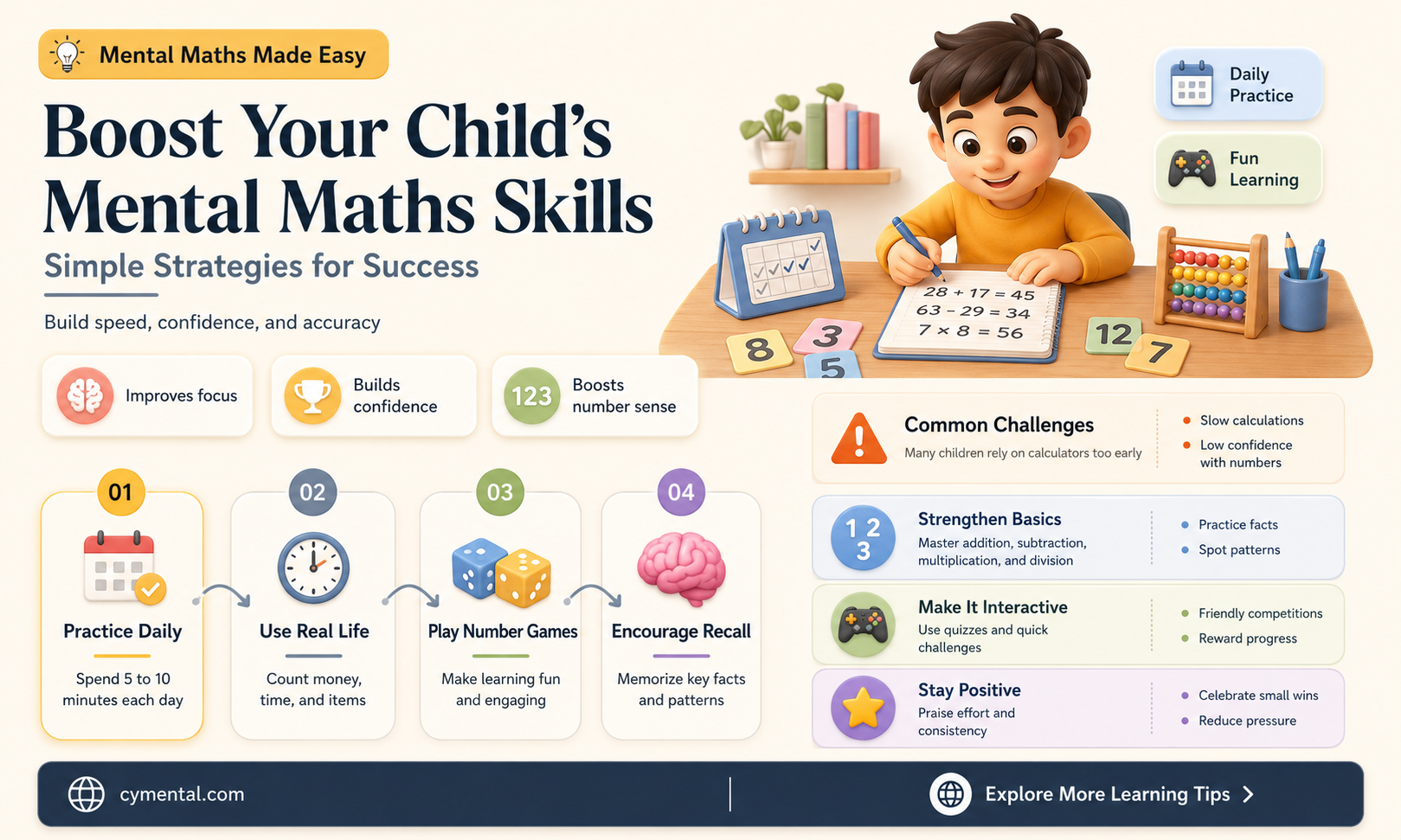
Helping your child develop strong mental maths skills is a valuable investment in their academic and cognitive growth. Mental maths not only enhances their ability to solve problems quickly but also builds confidence and a deeper understanding of mathematical concepts. To support your child, start by incorporating maths into everyday activities, such as counting objects, estimating quantities, or calculating discounts while shopping. Encourage regular practice with simple exercises like addition, subtraction, multiplication, and division, using tools like flashcards or online games tailored to their age and skill level. Foster a positive attitude towards maths by praising effort rather than focusing solely on correct answers, and model problem-solving strategies aloud to demonstrate logical thinking. Additionally, ensure they understand the underlying principles rather than relying on memorization, as this promotes flexibility and creativity in solving problems. By making maths engaging and relatable, you can help your child develop a strong foundation in mental maths that will benefit them throughout their life.
| Characteristics | Values |
|---|---|
| Practice Regularly | Daily short sessions (5-10 minutes) are more effective than longer, less frequent ones. Use everyday situations like shopping, cooking, or telling time to practice. |
| Use Visual Aids | Number lines, charts, and manipulatives (e.g., counters, beads) help children visualize mathematical concepts and operations. |
| Break Down Problems | Teach children to decompose numbers (e.g., 10 + 8 = 10 + 5 + 3) and use simpler steps to solve complex problems. |
| Teach Number Bonds | Focus on pairs of numbers that add up to 10, 20, etc., to build a strong foundation for addition and subtraction. |
| Use Estimation | Encourage rounding numbers to estimate answers quickly, fostering a sense of approximate reasoning. |
| Play Math Games | Games like dice games, card games, or apps (e.g., Prodigy, Math Bingo) make learning fun and engaging. |
| Memorize Times Tables | Regularly practice multiplication facts using songs, rhymes, or flashcards to improve speed and accuracy. |
| Encourage Mental Strategies | Teach strategies like doubling, halving, or using known facts (e.g., 5 × 6 = 5 × 5 + 5) to solve problems mentally. |
| Provide Real-Life Contexts | Relate math to real-life scenarios (e.g., sharing toys, measuring ingredients) to make it meaningful and relevant. |
| Offer Positive Reinforcement | Praise effort and progress, not just correct answers, to build confidence and motivation. |
| Use Technology Wisely | Supplement learning with educational apps, websites, or videos, but balance screen time with hands-on activities. |
| Be Patient and Supportive | Allow children to make mistakes and learn from them, providing guidance without taking over the problem-solving process. |
| Model Math Thinking | Verbalize your thought process when solving problems to demonstrate how to approach mental math challenges. |
| Set Realistic Goals | Break learning into achievable milestones and celebrate small victories to keep your child motivated. |
| Incorporate Patterns and Sequences | Practice identifying and continuing number patterns to enhance logical thinking and mental math skills. |
Explore related products


What You'll Learn
- Daily Practice Tips: Incorporate short, fun math activities into daily routines for consistent practice
- Number Sense Games: Use games like dice rolling or card matching to build foundational number skills
- Mental Strategies: Teach tricks like doubling, halving, or rounding to simplify calculations
- Real-Life Problems: Apply math to everyday situations, such as shopping or cooking, for practical learning
- Positive Reinforcement: Praise effort and progress to boost confidence and motivation in mental math

Daily Practice Tips: Incorporate short, fun math activities into daily routines for consistent practice
Children thrive on routine, and weaving mental math practice into daily activities transforms learning into a seamless, enjoyable habit. Start with morning routines: while preparing breakfast, ask your child to estimate how many minutes it takes for toast to pop or how many slices of fruit fit on a plate. These micro-moments of engagement, lasting just 2–3 minutes, build number sense without feeling like "work." For younger children (ages 4–7), focus on counting and basic addition; for older kids (ages 8–12), introduce multiplication or division challenges. The key is consistency—daily exposure, even in small doses, reinforces skills more effectively than sporadic, longer sessions.
Incorporate playful challenges during transitions, such as car rides or walks to school. For instance, turn license plates into math puzzles by adding or subtracting the digits. Or, during a walk, ask your child to estimate the number of steps to the next lamppost and then compare the guess to the actual count. These activities require no prep and take less than 5 minutes, making them ideal for busy families. Research shows that gamifying math improves engagement, particularly for reluctant learners, as it shifts the focus from correctness to exploration and fun.
Mealtimes offer another opportunity for practical math practice. Involve your child in setting the table by asking, "If there are 4 people and each needs 2 utensils, how many do we need in total?" Or, during grocery shopping, challenge them to calculate the total cost of items in the cart, rounding prices to the nearest dollar for simplicity. For ages 6–10, this reinforces addition and estimation; for older children, introduce percentages by discussing discounts or taxes. These real-world applications make math tangible and relevant, fostering a deeper understanding.
End the day with a quick, reflective activity to solidify learning. Before bedtime, ask your child to recall a math problem they encountered that day and explain how they solved it. Alternatively, introduce a "number of the day" routine, where they think of creative ways to represent a chosen number (e.g., "7 can be 5 fingers and 2 toes, or 3 apples and 4 oranges"). This 2–3 minute ritual encourages metacognition and builds confidence. Studies highlight that daily reflection improves retention, turning passive learning into active mastery.
The beauty of these strategies lies in their simplicity and adaptability. By embedding math into everyday life, you remove the pressure of formal practice while ensuring consistent exposure. Start with one activity per day and gradually add more as your child becomes comfortable. Over time, these short, fun interactions will not only sharpen mental math skills but also cultivate a positive attitude toward learning—a priceless gift for any child.
Fear of Losing Gun Rights Shouldn't Deter Seeking Mental Health Support
You may want to see also
Explore related products


Number Sense Games: Use games like dice rolling or card matching to build foundational number skills
Games are a powerful tool for developing number sense, the intuitive understanding of numbers and their relationships that underpins mental math. Dice rolling and card matching games, in particular, offer a tactile and engaging way to build foundational skills like number recognition, counting, and basic operations.
For young children (ages 3-5), start with simple dice games. Roll a single die and have your child identify the number shown. Progress to rolling two dice and adding the numbers together. Games like "Race to Ten" (rolling dice to reach a target sum) or "Snakes and Ladders" (with number recognition and counting) are excellent choices. These games not only reinforce number identification but also introduce basic addition concepts in a playful context.
Card matching games offer a versatile platform for various number sense activities. Create a deck of cards with numbers written on them, ranging from 1 to 20 for beginners, and gradually increasing the range as skills improve. Play a simple matching game where players flip over two cards and identify if they represent the same number. For older children (ages 6-8), introduce more complex matching criteria, such as finding pairs that add up to a specific target number or identifying cards that are multiples of a given number. This not only strengthens number recognition but also fosters an understanding of number relationships and basic arithmetic operations.
Key Takeaway: Number sense games like dice rolling and card matching provide a fun and effective way to build a strong mathematical foundation. By incorporating these games into your child's routine, you can make learning numbers and basic operations an enjoyable and engaging experience, setting them up for success in more complex mathematical concepts later on.
Playing Piano: A Therapeutic Key to Enhancing Mental Well-Being
You may want to see also
Explore related products



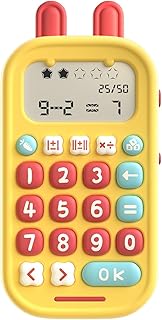
Mental Strategies: Teach tricks like doubling, halving, or rounding to simplify calculations
Mental math can be daunting for children, but teaching them strategic shortcuts transforms complex problems into manageable tasks. Start with doubling and halving, which are foundational skills for multiplication and division. For instance, instead of directly calculating 36 ÷ 6, encourage your child to halve 36 twice (18, then 9) and recognize that halving twice is the same as dividing by 4, then adjusting for the remaining factor. This method builds number sense and flexibility in thinking. Practice with everyday scenarios, like sharing 12 cookies among 3 friends, to make it relatable for children aged 6–9.
Rounding is another powerful tool that simplifies addition, subtraction, and estimation. Teach your child to round numbers to the nearest 10 or 100 before calculating, then adjust the final answer if needed. For example, instead of adding 47 + 63, round both to 50 and get 100, then subtract the excess (3 + 3 = 6) to arrive at 106. This strategy is particularly useful for quick estimates in real-life situations, such as calculating the total cost of items in a shopping cart. Introduce rounding to children aged 8–10, as it requires a grasp of place value.
While these strategies are effective, caution is needed to ensure children don’t rely on them blindly. Doubling and halving work best with even numbers, so pair them with practice on odd numbers to avoid confusion. Rounding can lead to inaccuracies if overused, so emphasize its role as an estimation tool rather than a precise method. Regularly review when and why these strategies are appropriate to build critical thinking skills.
Incorporate games and challenges to reinforce these mental strategies. For doubling, play a "Double Trouble" game where you call out numbers and your child doubles them mentally. For rounding, create a "Round-Off Race" where you both estimate sums or differences by rounding first. These activities not only make learning fun but also help children internalize the strategies for automatic recall. Aim for 10–15 minutes of practice daily, tailored to your child’s age and skill level.
The takeaway is that mental strategies like doubling, halving, and rounding are not just tricks—they are building blocks for mathematical fluency. By teaching these methods systematically and contextualizing them in real-world scenarios, you empower your child to approach calculations with confidence and creativity. Start small, be consistent, and watch as these strategies become second nature, paving the way for more advanced math concepts.
Gender Affirming Care: Boosting Mental Health and Well-Being for Transgender Individuals
You may want to see also
Explore related products


Real-Life Problems: Apply math to everyday situations, such as shopping or cooking, for practical learning
Children often see math as an abstract concept confined to textbooks, but real-life problems offer a tangible way to bridge the gap between theory and practice. By integrating math into everyday situations like shopping or cooking, you transform it into a tool for problem-solving rather than a chore. For instance, while grocery shopping, ask your child to calculate the total cost of items in the cart or compare prices per unit to find the best deal. These activities not only reinforce arithmetic skills but also teach critical thinking and decision-making.
Cooking provides another rich opportunity for practical math learning. Measuring ingredients introduces fractions, doubling or halving recipes teaches multiplication and division, and timing steps reinforces estimation and time management. For younger children (ages 5–8), start with simple tasks like counting ingredients or halving a recipe. Older children (ages 9–12) can tackle more complex problems, such as converting measurements from cups to grams or calculating cooking times based on oven temperature. Always encourage them to explain their reasoning, fostering both mathematical and communication skills.
While real-life math problems are engaging, they require careful scaffolding to avoid frustration. Begin with problems slightly below your child’s skill level to build confidence, then gradually increase the complexity. For example, start with adding prices of two items, then progress to calculating discounts or estimating total costs with tax. Be mindful of their age and attention span—younger children may lose interest if tasks are too lengthy or abstract. Keep the focus on the process rather than the correct answer, praising their effort and problem-solving strategies.
One common pitfall is turning everyday activities into forced math lessons, which can dampen enthusiasm. Instead, weave math naturally into the situation, making it feel like a collaborative challenge rather than a quiz. For instance, during a shopping trip, frame the task as a game: “Can you figure out which brand gives us more for our money?” or “How much will we save if we buy this in bulk?” This approach not only keeps the activity enjoyable but also highlights the real-world relevance of math, making it more memorable and impactful.
HR's Role in Supporting Employee Mental Health: A Comprehensive Guide
You may want to see also
Explore related products


Positive Reinforcement: Praise effort and progress to boost confidence and motivation in mental math
Children often view mental math as a daunting task, but positive reinforcement can transform their perception. When a child struggles with a problem, acknowledge their effort rather than focusing solely on the outcome. For instance, if they attempt a multiplication problem mentally but arrive at the wrong answer, highlight their strategy: “I noticed you tried breaking the numbers down—that’s a great approach!” This shifts the focus from failure to process, fostering resilience and a growth mindset. Research shows that praising effort activates the brain’s reward system, making children more likely to engage with challenging tasks in the future.
Praise must be specific and sincere to be effective. Vague compliments like “Good job!” lack impact compared to detailed feedback such as, “You’ve been practicing addition facts every day, and now you’re solving them faster—that’s amazing progress!” Tailor your feedback to the child’s age and skill level. For younger children (ages 5–8), celebrate small wins like recalling basic number bonds. For older children (ages 9–12), acknowledge improvements in multi-step problems or estimation skills. Specificity helps them understand what they’re doing well and how to replicate it.
Incorporate positive reinforcement into daily routines to make it a habit. During homework sessions, pause to commend their focus or problem-solving attempts. Outside of structured practice, seize opportunities to praise mental math in real-life scenarios. For example, if they quickly calculate a discount at the store, say, “You figured that out so fast—your mental math skills are really growing!” Consistency is key; aim for at least three specific praises per week to reinforce their confidence and motivation.
Avoid over-praising, as it can dilute the impact of your words. Balance encouragement with constructive feedback to maintain credibility. For instance, after praising their effort, gently suggest, “Next time, try double-checking your addition steps to catch small errors.” This approach ensures the child feels supported while still understanding areas for improvement. By focusing on progress and effort, you create a positive feedback loop that encourages them to view mental math as a skill they can develop, not a fixed ability.
Empowering Self-Care: Practical Strategies to Help Yourself Thrive Daily
You may want to see also
Frequently asked questions
Incorporate games and real-life scenarios to make mental maths engaging. Use activities like dice games, shopping challenges (estimating totals), or timed quizzes with rewards. Apps and online platforms with interactive maths games can also keep it enjoyable.
Start with basic techniques like breaking numbers into smaller parts (e.g., 12 + 8 = 10 + 2 + 8 = 20), using number bonds (pairs that add up to 10), and practicing multiplication tables regularly. Repetition and consistency are key.
Break problems into smaller steps, use visual aids like number lines or counters, and encourage them to explain their thinking. Be patient, offer positive reinforcement, and focus on progress rather than perfection. Practice regularly but keep sessions short to avoid frustration.