Ava Ramirez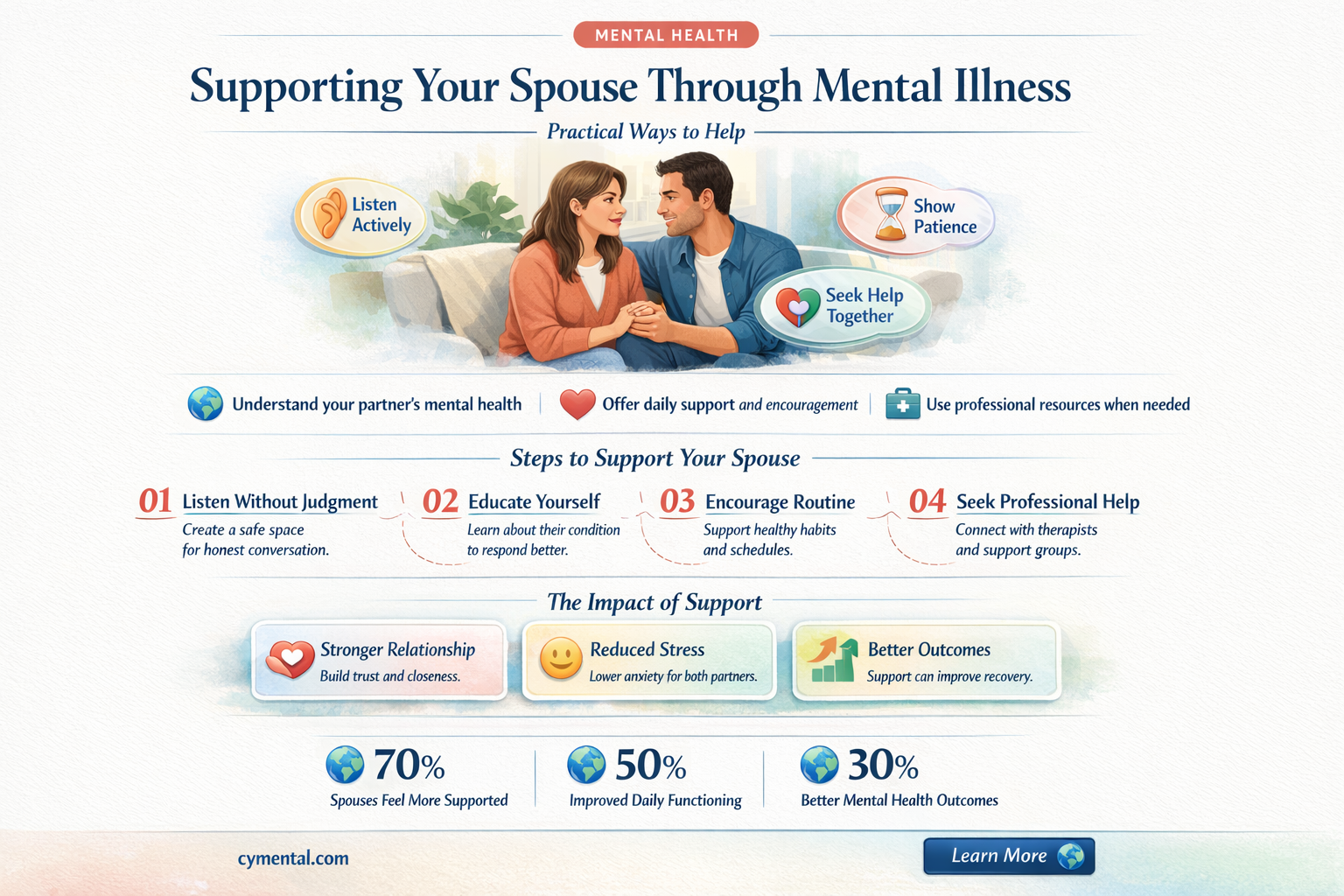
Supporting a spouse with mental illness requires patience, understanding, and proactive communication. It’s essential to educate yourself about their condition to better comprehend their experiences and challenges. Encourage open dialogue, creating a safe space for them to express their feelings without fear of judgment. Offer practical assistance, such as helping with daily tasks or accompanying them to appointments, while also respecting their independence. Prioritize self-care to avoid burnout, as your well-being is crucial for both of you. Seek professional guidance when needed, whether through couples therapy or support groups, and remember that your role is to be a compassionate partner, not a therapist. Small acts of love and consistency can make a significant difference in their journey toward healing.
Explore related products


What You'll Learn
- Educate Yourself: Learn about their illness, symptoms, and effective ways to offer support
- Encourage Treatment: Gently support therapy, medication, or other professional interventions
- Active Listening: Be present, non-judgmental, and validate their feelings and experiences
- Self-Care: Prioritize your well-being to avoid burnout and maintain support capacity
- Create Stability: Establish routines, reduce stress, and foster a calm home environment

Educate Yourself: Learn about their illness, symptoms, and effective ways to offer support
Understanding your spouse's mental illness begins with recognizing that knowledge is power. Mental health conditions, such as depression, anxiety, bipolar disorder, or schizophrenia, manifest uniquely in each individual. By educating yourself about their specific diagnosis, you can better grasp the nuances of their experiences. Start by consulting reputable sources like the National Institute of Mental Health (NIMH) or the World Health Organization (WHO). These platforms offer detailed insights into symptoms, triggers, and evidence-based treatments, equipping you with the foundation to provide informed support.
Once you’ve familiarized yourself with the basics, delve into the symptoms your spouse experiences. For instance, if they have generalized anxiety disorder, learn how it differs from everyday stress. Notice patterns: Do they avoid social situations? Do they experience physical symptoms like headaches or insomnia? Understanding these specifics allows you to respond empathetically rather than react with frustration or confusion. For example, instead of saying, “You’re overreacting,” you might say, “I see this is overwhelming for you. How can I help right now?”
Effective support often involves practical strategies tailored to their needs. If your spouse struggles with depression, research shows that maintaining a routine can be beneficial. Help them establish a daily schedule that includes small, achievable tasks, like a 10-minute walk or a shared meal. For those with PTSD, grounding techniques—such as deep breathing exercises or sensory objects—can be invaluable during episodes of distress. The key is to collaborate with your spouse, asking them what works best for them rather than imposing solutions.
However, educating yourself isn’t without challenges. Avoid the trap of becoming an armchair therapist or overstepping professional boundaries. While knowledge is essential, it’s equally important to acknowledge when expert intervention is needed. For instance, if your spouse’s symptoms worsen—such as suicidal ideation or severe mood swings—consult a mental health professional immediately. Your role is to be a supportive partner, not a substitute for clinical care.
Finally, remember that education is an ongoing process. Mental health conditions evolve, and new research emerges constantly. Stay updated by joining support groups for partners of individuals with mental illness or subscribing to mental health newsletters. By committing to continuous learning, you not only strengthen your ability to support your spouse but also foster a deeper connection built on understanding and compassion.
Exercise and Mental Health: Unlocking the Mind-Body Connection for Wellness
You may want to see also
Explore related products


Encourage Treatment: Gently support therapy, medication, or other professional interventions
One of the most effective ways to support a spouse with mental illness is to encourage professional treatment. This doesn’t mean forcing them into therapy or medication—it means creating an environment where seeking help feels safe and supported. Start by normalizing the conversation around mental health. Share stories of others who’ve benefited from treatment or casually mention how therapy has helped someone you both know. This reduces stigma and plants the idea that seeking help is a sign of strength, not weakness.
Encouraging treatment requires patience and sensitivity. Begin by expressing your concern in a non-confrontational way. For example, instead of saying, “You need therapy,” try, “I’ve noticed you’ve been struggling, and I think talking to someone might help.” Offer to help them find a therapist or accompany them to the first appointment. If medication is a possibility, research potential options together, focusing on benefits rather than side effects. For instance, antidepressants like SSRIs often start at a low dose (e.g., 10mg of escitalopram) and can be adjusted based on response, which can make the idea less intimidating.
A common barrier to treatment is fear of the unknown. Address this by explaining what therapy or medication typically involves. For therapy, describe it as a space to explore thoughts and feelings without judgment. For medication, emphasize that it’s often a trial-and-error process, and side effects are usually temporary. For example, mild nausea or headaches from starting an SSRI often subside within 1–2 weeks. Providing concrete information can alleviate anxiety and make treatment feel more approachable.
Finally, avoid making treatment a condition of your love or support. Instead, frame it as a collaborative effort to improve their well-being. Celebrate small steps, like scheduling an appointment or filling a prescription, and acknowledge their courage. Remember, your role is to guide, not control. By gently encouraging professional intervention, you’re not only helping your spouse but also strengthening your partnership in the face of mental illness.
Faith and Healing: Exploring Religion's Role in Mental Health Support
You may want to see also
Explore related products





Active Listening: Be present, non-judgmental, and validate their feelings and experiences
One of the most powerful tools you can offer your spouse struggling with mental illness is the gift of your undivided attention. Active listening goes beyond simply hearing their words; it’s about creating a safe, non-judgmental space where they feel truly seen and understood. This means putting away distractions like phones, making eye contact, and focusing solely on them. Avoid interrupting or planning your response while they speak. Instead, use verbal and non-verbal cues like nodding, saying “I see,” or gently touching their hand to show you’re fully present. This level of engagement communicates that their thoughts and feelings matter, fostering trust and encouraging openness.
Consider the difference between saying, “You’re overreacting,” versus “It sounds like this situation is really upsetting for you.” The first invalidates their experience, while the second acknowledges their emotions without judgment. Validation doesn’t mean you necessarily agree with their perspective, but rather that you recognize their feelings as real and understandable given their circumstances. Phrases like “That must be so hard,” or “I can imagine how frustrating that feels,” can go a long way in making them feel supported. Remember, mental illness often comes with a heavy dose of self-criticism and doubt; your validation can counterbalance these internal struggles.
Active listening also involves reflecting back what you’ve heard to ensure clarity and show you’re engaged. For example, “If I’m understanding correctly, you’re feeling overwhelmed by the workload and anxious about meeting deadlines?” This not only confirms your understanding but also gives them a chance to correct any misinterpretations. Be cautious, however, not to turn the conversation into a problem-solving session unless they explicitly ask for advice. Often, people with mental illness just need to be heard, not fixed. Resist the urge to offer solutions like “Have you tried meditation?” or “Maybe you should just take a break.” Instead, focus on empathizing and providing emotional support.
Finally, practice patience and consistency. Active listening isn’t a one-time act but an ongoing commitment. There may be days when your spouse struggles to express themselves or when their emotions feel overwhelming. Remain calm, even if their words are difficult to hear. Let them know it’s okay to feel however they feel and that you’re there for them, no matter what. Over time, this consistent presence and validation can help reduce their sense of isolation and strengthen your bond. It’s a small but profound way to show love and support in the face of mental illness.
Can Painkillers Alleviate Mental Pain? Exploring the Mind-Body Connection
You may want to see also
Explore related products

$9.99


Self-Care: Prioritize your well-being to avoid burnout and maintain support capacity
Supporting a spouse with mental illness is an act of love, but it’s also a marathon, not a sprint. Ignoring your own well-being in the process is a recipe for burnout, leaving you depleted and less able to provide the support your partner needs. Self-care isn’t selfish; it’s strategic. Think of it as putting on your own oxygen mask before assisting others on a plane.
Step 1: Establish Boundaries and Carve Out Time for Yourself
Set clear, non-negotiable boundaries to protect your mental and emotional energy. This might mean designating specific hours for personal time, whether it’s a daily 30-minute walk, a weekly therapy session, or a monthly weekend away. Use tools like a shared calendar to communicate these boundaries respectfully. For instance, if your spouse struggles with anxiety, explain that you need uninterrupted time to recharge so you can be fully present during their episodes.
Caution: Avoid the Guilt Trap
Caregiver guilt is real, but it’s counterproductive. Remind yourself that taking breaks doesn’t diminish your commitment; it sustains it. Research shows that caregivers who practice self-care report higher resilience and lower stress levels. If guilt arises, reframe it: “By taking care of myself, I’m ensuring I can be the best partner possible.”
Step 2: Build a Support Network Beyond Your Spouse
You don’t have to shoulder the burden alone. Cultivate relationships with friends, family, or support groups who understand your situation. Aim to connect with at least one person outside your household weekly. If in-person meetings are challenging, virtual check-ins work just as well. For example, joining a caregiver support group can provide both emotional validation and practical advice.
Analysis: The Role of Professional Help
While emotional support from loved ones is invaluable, it’s no substitute for professional self-care. Consider seeing a therapist individually to process your own emotions and develop coping strategies. Studies indicate that caregivers who engage in therapy experience reduced burnout rates by up to 40%. If cost is a barrier, explore sliding-scale clinics or online therapy platforms.
Incorporate small, consistent self-care practices into your routine. This could be as simple as journaling for 10 minutes daily, practicing deep breathing exercises, or setting aside time for a hobby. The key is consistency. Remember, self-care isn’t a luxury—it’s a necessity. By prioritizing your well-being, you’re not just preserving your own health; you’re ensuring you have the capacity to support your spouse effectively, day after day.
Addressing Mental Health: Are Our Efforts Truly Making a Difference?
You may want to see also
Explore related products


Create Stability: Establish routines, reduce stress, and foster a calm home environment
Living with a spouse who has a mental illness often means navigating unpredictable emotional landscapes. Creating stability through routines, stress reduction, and a calm home environment can act as an anchor, providing both of you with a sense of security and predictability.
Step 1: Build Predictable Routines
Start by establishing daily routines that include consistent wake-up times, meal schedules, and bedtime rituals. For example, a morning routine might involve 15 minutes of stretching together, followed by a shared breakfast. Use visual aids like a whiteboard or shared calendar app to outline the day’s plan, reducing anxiety about what’s next. Avoid overloading the schedule; leave buffer time between activities to accommodate unexpected emotional shifts.
Step 2: Identify and Minimize Stressors
Take an inventory of household stressors—loud noises, cluttered spaces, or overwhelming social obligations—and address them systematically. For instance, designate a "quiet hour" in the evening where screens are off, and soft music plays. If clutter is an issue, implement a "one-touch rule": handle mail or items once, either filing, discarding, or storing them immediately. For external stressors, like work demands, encourage your spouse to set boundaries, such as limiting email checks to specific times.
Step 3: Cultivate a Calm Physical Space
Transform your home into a sanctuary by focusing on sensory elements. Use soft, neutral colors for walls and decor, and incorporate natural light where possible. Add houseplants like snake plants or peace lilies, which improve air quality and create a soothing atmosphere. Keep noise levels low by using rugs to dampen sound and opting for quiet appliances. A diffuser with lavender or chamomile essential oils can also promote relaxation, but use sparingly—some individuals with mental illness may be sensitive to strong scents.
Cautions and Considerations
While routines are stabilizing, avoid rigidity. Allow flexibility for days when your spouse may need extra rest or space. Be mindful of overstepping; involve them in decisions about routines and stress-reduction strategies to avoid feelings of control or infantilization. Additionally, monitor your own stress levels—caregiver burnout is real. Schedule regular self-care, even if it’s just 20 minutes of alone time daily.
Creating stability isn’t about eliminating challenges but building a framework that makes them more manageable. By prioritizing routines, reducing stressors, and fostering a calm environment, you provide a foundation that supports both your spouse’s mental health and your shared well-being. It’s a process, not a destination—small, consistent steps yield the most lasting results.
Melodies of Healing: How Music Supports Mental Health Recovery
You may want to see also
Frequently asked questions
Educate yourself about their condition, be patient, listen without judgment, and encourage professional treatment while offering emotional and practical support.
Gently express your concerns, offer to accompany them to appointments, and seek guidance from a mental health professional or support group for strategies.
Prioritize self-care, set boundaries, seek your own support system, and remember that you cannot fix their illness alone—it’s okay to ask for help.
Stay calm, use a gentle tone, avoid arguing, and focus on validating their feelings while guiding them toward safety or professional assistance.
Encourage routines, help with tasks when needed, celebrate small victories, and foster a supportive, low-stress environment at home.