Madison Cole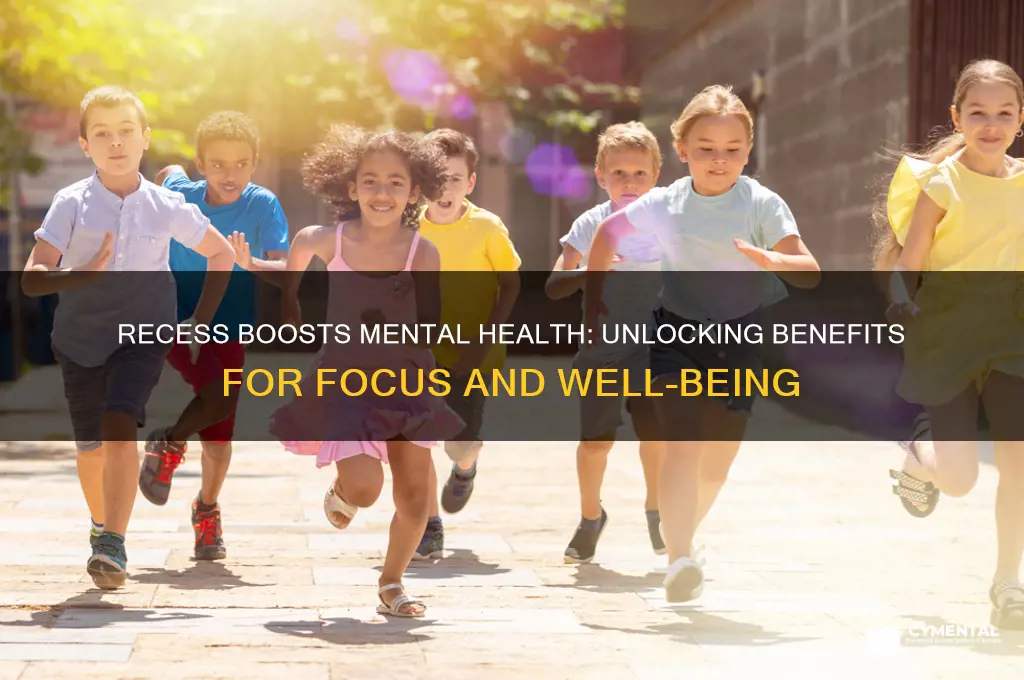
Recess, often seen as a simple break from academics, plays a crucial role in supporting children's mental health and well-being. Beyond its physical benefits, recess provides a vital opportunity for unstructured play, social interaction, and stress relief. During this time, children can engage in activities that foster creativity, problem-solving, and emotional regulation, which are essential for mental development. Additionally, recess allows students to decompress from the structured classroom environment, reducing anxiety and improving focus when they return to learning. By promoting social connections and emotional resilience, recess contributes significantly to a healthier and more balanced mental state for children.
| Characteristics | Values |
|---|---|
| Stress Reduction | Recess provides a break from academic pressures, allowing students to relax and reduce stress levels. Physical activity during recess triggers the release of endorphins, which are natural stress relievers. |
| Improved Mood | Outdoor play and social interaction during recess boost serotonin levels, enhancing mood and overall emotional well-being. |
| Enhanced Social Skills | Recess fosters peer interaction, teamwork, and conflict resolution, helping students develop essential social skills and empathy. |
| Increased Focus and Academic Performance | Short breaks like recess improve attention span and cognitive function, leading to better classroom engagement and academic outcomes. |
| Physical Health Benefits | Physical activity during recess contributes to better cardiovascular health, stronger muscles, and improved coordination, which positively impact mental health. |
| Creativity and Imagination | Unstructured play during recess encourages creativity, problem-solving, and imaginative thinking, supporting cognitive development. |
| Reduced Anxiety and Depression Symptoms | Regular physical activity and social interaction during recess can lower the risk of anxiety and depression in children. |
| Better Emotional Regulation | Recess provides an outlet for children to express and manage their emotions, promoting emotional resilience and self-regulation. |
| Increased Self-Esteem | Success in play and social interactions during recess can boost self-confidence and self-worth. |
| Support for ADHD and Other Neurodevelopmental Disorders | Recess offers a natural environment for children with ADHD to expend energy, improve focus, and reduce hyperactivity. |
Explore related products


What You'll Learn
- Stress Reduction: Physical activity during recess lowers cortisol levels, reducing stress and anxiety in students
- Social Skills: Interacting with peers fosters communication, teamwork, and conflict resolution, enhancing emotional intelligence
- Focus Improvement: Breaks during recess help reset attention, improving concentration and academic performance in classrooms
- Emotional Regulation: Play allows students to express emotions, promoting self-awareness and emotional stability
- Creativity Boost: Unstructured playtime stimulates imagination, problem-solving, and innovative thinking in children

Stress Reduction: Physical activity during recess lowers cortisol levels, reducing stress and anxiety in students
Physical activity during recess acts as a natural stress reliever for students by lowering cortisol levels, the body's primary stress hormone. Research shows that even 20–30 minutes of moderate-to-vigorous activity, such as running, jumping, or playing tag, can significantly reduce cortisol production. For elementary-aged children (ages 6–12), this is particularly impactful, as their developing brains are highly sensitive to stress. By incorporating structured or free play during recess, schools can provide a daily buffer against the academic and social pressures students face.
Consider the biological mechanism at play: when children engage in physical activity, their bodies release endorphins, often referred to as "feel-good" hormones, which counteract stress. Simultaneously, the repetitive nature of activities like skipping or climbing can induce a meditative state, calming the mind. For adolescents (ages 13–18), who often experience heightened stress due to hormonal changes and academic demands, recess offers a critical break. Schools can maximize this benefit by ensuring recess includes a mix of aerobic and playful activities, avoiding overly competitive games that might reintroduce stress.
A practical tip for educators and parents is to encourage activities that combine social interaction and movement, such as team sports or group challenges. For younger children, simple games like "Simon Says" or "Red Light, Green Light" can be effective. Older students might benefit from mindfulness-infused activities, such as yoga or tai chi, which blend physical movement with stress-reducing techniques. The key is to make recess engaging and accessible, ensuring all students participate regardless of fitness level.
However, it’s essential to balance structure and freedom. Overly rigid recess schedules can negate stress-reducing benefits, while complete lack of guidance may lead to inactivity or conflict. Schools should aim for a 15–20 minute window of unstructured play followed by 5–10 minutes of guided activities. Additionally, recess should be non-negotiable—even on rainy days, indoor alternatives like dance-offs or obstacle courses can keep cortisol levels in check. By prioritizing physical activity during recess, schools can equip students with a lifelong tool for managing stress and anxiety.
HR's Role in Supporting Employee Mental Health: A Comprehensive Guide
You may want to see also
Explore related products


Social Skills: Interacting with peers fosters communication, teamwork, and conflict resolution, enhancing emotional intelligence
Recess serves as a daily laboratory for social skills, offering children unstructured time to navigate peer interactions. Unlike classroom settings, where rules and adult guidance dominate, recess allows for spontaneous, self-directed communication. A study published in the *Journal of School Psychology* found that children who engaged in free play during recess demonstrated higher levels of verbal communication and active listening. For instance, negotiating who gets the next turn on the swing set requires clear expression of needs and attentive understanding of others’ perspectives—skills foundational to emotional intelligence.
Consider the mechanics of teamwork during a game of tag. Children must coordinate roles, adapt strategies, and rely on one another to achieve a common goal. This mirrors real-world collaboration, where success depends on mutual effort and trust. Research from the *American Journal of Play* highlights that group play during recess fosters a sense of collective responsibility, as children learn to balance their desires with the needs of the group. For parents and educators, encouraging participation in team-based activities during recess can amplify these benefits. A practical tip: suggest games like relay races or group obstacle courses to maximize teamwork opportunities.
Conflict resolution is another critical skill honed during recess. Disagreements over toys, rules, or roles are inevitable, but they provide teachable moments. A study in *Child Development* found that children who resolved conflicts independently during recess showed greater emotional regulation and problem-solving abilities six months later. To support this, adults can adopt a "step back, step in" approach: allow children to negotiate on their own, but intervene only if safety or fairness is at risk. For example, instead of immediately solving a dispute over a ball, ask guiding questions like, "What do you think would make this fair for both of you?"
The emotional intelligence developed during recess extends beyond the playground. Children who practice empathy, perspective-taking, and negotiation during free play are better equipped to handle social challenges in other areas of life. A longitudinal study from *Developmental Psychology* revealed that early social skills predict academic success, peer relationships, and mental health outcomes in adolescence. For maximum impact, ensure recess lasts at least 20–30 minutes daily, as shorter durations limit opportunities for meaningful interaction. Additionally, provide a variety of play materials (e.g., balls, jump ropes, blocks) to encourage diverse social scenarios.
Incorporating recess as a deliberate tool for social development requires intentionality. Schools can train recess monitors to facilitate rather than control play, fostering an environment where children feel safe to experiment with social dynamics. Parents can reinforce these skills at home by discussing recess experiences and asking open-ended questions like, "How did you feel when that happened?" or "What could you do differently next time?" By treating recess as more than just a break, we transform it into a vital space for building the emotional intelligence children need to thrive.
Effective Strategies and Tools to Help You Overcome Daily Challenges
You may want to see also
Explore related products





Focus Improvement: Breaks during recess help reset attention, improving concentration and academic performance in classrooms
The human brain is not designed for sustained focus. After approximately 25-30 minutes of concentrated effort, attention naturally wanes, a phenomenon known as "attentional fatigue." This is where recess steps in as a powerful tool for focus improvement. Short breaks, like those provided during recess, allow the brain to disengage from the demands of the classroom, replenishing attentional resources and preparing for the next period of concentration.
Think of it like recharging a battery. Just as a phone needs periodic charging to function optimally, the brain requires breaks to reset and maintain peak performance.
Research supports this analogy. Studies have shown that students who engage in physical activity during recess exhibit improved attention spans and on-task behavior in the classroom. A 2013 study published in the journal *Pediatrics* found that children who had more than 15 minutes of recess per day demonstrated better focus and reduced fidgeting compared to those with shorter or no recess periods. This suggests that the duration of recess plays a crucial role in its effectiveness for focus improvement.
For optimal results, aim for at least 20-30 minutes of unstructured recess time, allowing students to engage in free play and physical activity. This duration provides sufficient time for the brain to recharge and prepares students for the next learning session.
While the benefits of recess for focus are clear, it's important to consider the quality of the break. Recess should be a time for active play, not simply a passive transition between classes. Encourage activities that promote movement, social interaction, and creativity. Games like tag, jump rope, or imaginative play not only burn off excess energy but also stimulate different areas of the brain, further enhancing cognitive function.
By incorporating these principles into recess, educators can create a powerful tool for improving student focus and ultimately, academic performance.
Designing Wellness: Graphic Design's Impact on Mental Health and Healing
You may want to see also
Explore related products




Emotional Regulation: Play allows students to express emotions, promoting self-awareness and emotional stability
Play is a powerful tool for emotional regulation, offering students a safe space to navigate their feelings without judgment. During recess, children engage in unstructured activities that allow them to express emotions like frustration, joy, or sadness through movement, creativity, and social interaction. For instance, a child might channel anger into a spirited game of tag or process anxiety by building a fort with peers. This natural outlet helps them release pent-up emotions in a healthy way, reducing the risk of internalizing stress or acting out in disruptive manners.
Consider the developmental stages of children aged 6 to 12, where emotional expression is often more physical than verbal. Play provides a non-verbal language for emotions, enabling students to communicate feelings they might struggle to articulate. A study published in the *Journal of Pediatric Psychology* found that children who engaged in regular free play exhibited greater emotional resilience and lower levels of cortisol, a stress hormone. This suggests that recess isn’t just a break from academics—it’s a critical period for emotional development, fostering self-awareness as students learn to recognize and manage their emotional states.
To maximize the emotional benefits of recess, educators and parents can implement simple strategies. Encourage a mix of solitary and group activities to cater to different emotional needs. For example, provide access to art supplies for quiet reflection or organize team games that promote collaboration and conflict resolution. Additionally, model emotional language by discussing feelings before and after play. Phrases like, “How did it feel when your team won?” or “What did you do when you felt frustrated?” help students connect their experiences to emotional vocabulary, deepening their self-awareness.
However, it’s essential to balance structure and freedom. While unstructured play is ideal for emotional expression, some students may benefit from guided activities, especially those with emotional regulation challenges. For instance, a “calm corner” with sensory tools can help children who feel overwhelmed during play. Similarly, setting clear boundaries ensures that emotional expression remains safe and respectful for all participants. By striking this balance, recess becomes a transformative space where students not only release emotions but also learn to navigate them constructively.
In conclusion, recess serves as a vital emotional laboratory, equipping students with the skills to understand and manage their feelings. By embracing play as a legitimate form of emotional expression, schools can support mental health in a way that feels natural and engaging. For educators and parents, the takeaway is clear: protect and prioritize recess, not as a luxury, but as a cornerstone of emotional development. After all, a child who learns to regulate emotions through play is better prepared to face the complexities of life with resilience and self-awareness.
Mental Illness in Court: A Defense or Prosecution Tool?
You may want to see also
Explore related products




Creativity Boost: Unstructured playtime stimulates imagination, problem-solving, and innovative thinking in children
Unstructured playtime during recess isn’t just a break from academics—it’s a fertile ground for creativity. When children are given the freedom to play without rules or directives, their minds naturally gravitate toward imaginative scenarios. A child might transform a cardboard box into a spaceship, negotiate roles in a pretend game, or invent a new game with arbitrary rules. These activities aren’t frivolous; they’re exercises in divergent thinking, the cognitive process that generates multiple solutions to a problem. Research shows that children who engage in unstructured play exhibit higher levels of creativity, as measured by tests like the Torrance Tests of Creative Thinking. For parents and educators, the takeaway is clear: unstructured play isn’t a luxury—it’s a necessity for fostering imaginative minds.
Consider the mechanics of unstructured play: it forces children to solve problems on the fly. When a group of kids decides to build a fort using sticks and leaves, they must collaborate, negotiate, and adapt when their initial plan fails. This process mirrors real-world innovation, where failure is often a stepping stone to success. A study published in *Pediatrics* found that children who engaged in more unstructured playtime demonstrated better executive functioning skills, including problem-solving and cognitive flexibility. To maximize this benefit, aim for at least 30 minutes of unstructured play daily for children aged 5–12. Encourage environments with open-ended materials like blocks, sand, or water, which invite experimentation and creativity.
Persuasively, recess isn’t just about physical activity—it’s a mental workout for creativity. When children are left to their own devices, they naturally engage in activities that challenge their minds. For instance, a game of tag might evolve into a complex narrative involving spies and secret codes, requiring players to think creatively and strategically. This kind of play fosters innovative thinking, a skill increasingly valued in a rapidly changing world. Employers and educators alike emphasize the importance of creativity in solving complex problems, yet structured environments often stifle it. By advocating for recess as a non-negotiable part of the school day, we’re not just giving kids a break—we’re investing in their future ability to think outside the box.
Comparatively, structured activities like organized sports or academic clubs have their place, but they don’t offer the same creative benefits as unstructured play. In structured settings, rules and objectives are predefined, leaving little room for imagination. Unstructured play, on the other hand, is a blank canvas where children can explore, experiment, and invent. For example, a child might use a stick as a magic wand in one moment and a sword in the next, showcasing the fluidity of their thinking. To balance both, consider a 70/30 ratio of unstructured to structured playtime for optimal cognitive development. This approach ensures children reap the creativity-boosting benefits of recess while still gaining skills from organized activities.
Descriptively, recess is a symphony of creativity in motion. Picture a playground where one child is crafting a story about a dragon, another is designing a makeshift obstacle course, and a group is debating the rules of a new game. Each of these activities requires imagination, adaptability, and problem-solving—skills that are honed through unstructured play. The beauty lies in its spontaneity; there’s no right or wrong way to play, only endless possibilities. For parents, fostering this environment at home is simple: provide time, space, and materials, then step back and let creativity flourish. Whether it’s a backyard, a park, or a living room, unstructured playtime is a powerful tool for nurturing innovative thinkers.
Nutrition's Impact: How Balanced Diets Boost Mental Well-being
You may want to see also
Frequently asked questions
Recess provides a break from structured academic activities, allowing children to engage in physical play and social interaction, which releases endorphins and reduces cortisol levels, effectively lowering stress.
Yes, recess acts as a mental reset, giving children time to recharge. Physical activity during recess increases blood flow to the brain, enhancing cognitive function and improving attention span.
Recess allows children to socialize, solve conflicts, and express emotions freely. These interactions foster emotional resilience, self-confidence, and a sense of belonging, all of which are crucial for mental health.
Absolutely. Physical activity during recess triggers the release of neurotransmitters like serotonin, which helps regulate mood and reduce anxiety. Additionally, unstructured play provides a sense of control and autonomy, easing anxious feelings.
Recess encourages teamwork, communication, and problem-solving through peer interactions. These social experiences help children build empathy, manage emotions, and develop healthy relationships, all of which are vital for mental well-being.