Harper Lewis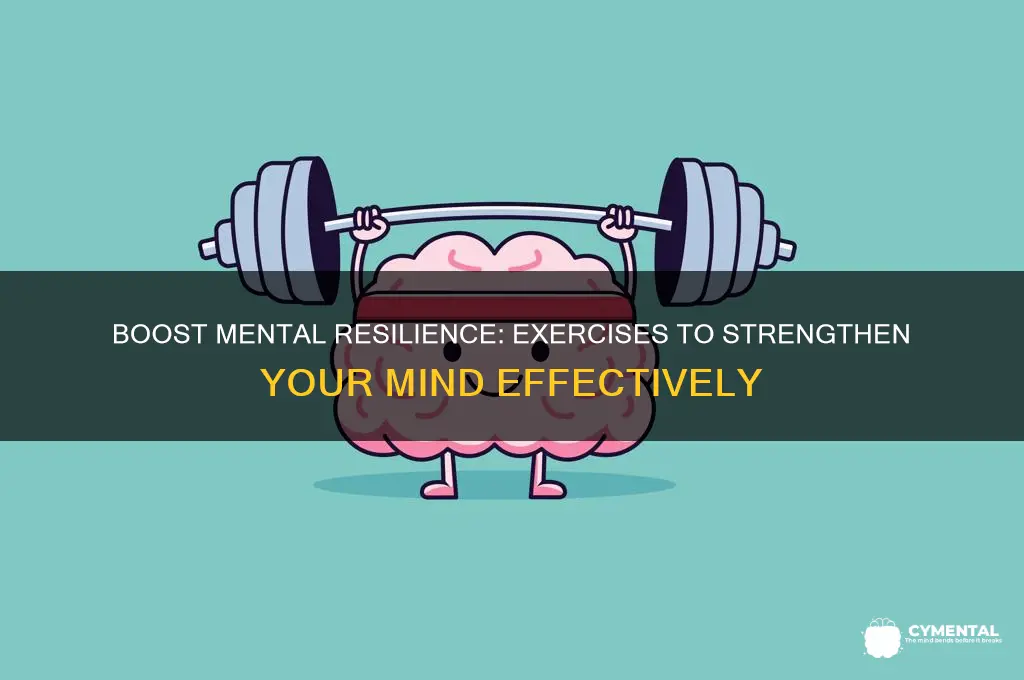
Building mental strength is just as crucial as physical fitness, and certain exercises can significantly enhance resilience, focus, and emotional well-being. Practices like mindfulness meditation cultivate present-moment awareness, reducing stress and improving decision-making, while journaling helps process emotions and track personal growth. Cognitive-behavioral techniques, such as reframing negative thoughts, empower individuals to challenge self-limiting beliefs. Physical activities like yoga and aerobic exercise release endorphins, boosting mood and mental clarity, while setting and achieving small, incremental goals builds confidence and discipline. Together, these exercises create a holistic approach to mental toughness, equipping individuals to navigate challenges with greater ease and adaptability.
Explore related products



What You'll Learn
- Mindfulness Meditation: Focus on present moment awareness to reduce stress and enhance mental clarity
- Gratitude Practices: Daily journaling of thankful thoughts fosters positivity and resilience against negativity
- Cognitive Reframing: Challenge negative thoughts by viewing challenges as opportunities for growth
- Emotional Regulation: Techniques like deep breathing help manage emotions and maintain composure
- Goal Setting: Clear, achievable goals build discipline, confidence, and a sense of purpose

Mindfulness Meditation: Focus on present moment awareness to reduce stress and enhance mental clarity
Stress, a pervasive modern affliction, often stems from dwelling on past regrets or future anxieties. Mindfulness meditation counters this by anchoring attention to the present moment, systematically dismantling the mental patterns that fuel stress. Unlike relaxation techniques that merely soothe symptoms, mindfulness targets the root cause: the mind’s tendency to wander into unproductive territory. Research shows that consistent practice—even 10 minutes daily—can reduce cortisol levels, the body’s primary stress hormone, by up to 14% over eight weeks. This physiological shift is accompanied by increased activity in the prefrontal cortex, the brain region responsible for decision-making and emotional regulation, fostering greater mental clarity.
To begin, find a quiet space and assume a comfortable seated position. Close your eyes and focus on your breath, observing its natural rhythm without attempting to alter it. When thoughts arise—and they will—acknowledge them without judgment and gently return your focus to the breath. This process of redirection is the core of mindfulness. For beginners, guided meditations or apps like Headspace or Calm can provide structure, offering prompts to keep attention anchored. Advanced practitioners may extend sessions to 20–30 minutes, deepening their ability to remain present even amid distractions. Consistency is key; daily practice yields more pronounced benefits than sporadic, longer sessions.
A common misconception is that mindfulness requires emptying the mind, a feat neither possible nor desirable. Instead, it cultivates a non-reactive awareness, allowing thoughts and emotions to arise without dominating consciousness. This detachment reduces the emotional charge of stressors, enabling clearer thinking and more deliberate responses. For instance, a study published in *Psychosomatic Medicine* found that participants who practiced mindfulness meditation reported 31% fewer stress-related symptoms compared to non-practitioners. The practice is particularly effective for age groups prone to high stress, such as working professionals (ages 25–55) and students (ages 18–24), who often juggle multiple demands.
Practical integration into daily life amplifies mindfulness’s benefits. Incorporate "micro-moments" of awareness, such as focusing on the sensation of water during a shower or the texture of food while eating. These small practices reinforce the habit of present-moment awareness, making it easier to engage in formal meditation. Caution should be exercised, however, by individuals with trauma or severe anxiety, as intense focus on the present may trigger distress. In such cases, consulting a mental health professional before starting mindfulness meditation is advisable.
In conclusion, mindfulness meditation is a potent tool for building mental strength by fostering present-moment awareness. Its structured approach to stress reduction and cognitive enhancement makes it accessible to individuals across age groups and lifestyles. By committing to regular practice and integrating mindful habits into daily routines, one can achieve lasting improvements in mental clarity and emotional resilience. The science is clear: mindfulness is not just a trend but a scientifically validated method for navigating life’s challenges with greater equanimity.
Supplements and Mental Health: Unlocking the Potential for Well-Being
You may want to see also
Explore related products


Gratitude Practices: Daily journaling of thankful thoughts fosters positivity and resilience against negativity
Gratitude journaling isn't just a feel-good trend; it's a scientifically backed tool for rewiring your brain towards resilience. Studies show that consistently recording moments of gratitude, no matter how small, physically alters neural pathways, strengthening areas associated with positive emotion regulation and weakening those linked to stress and negativity. Think of it as a mental workout, building emotional muscle to withstand life's inevitable challenges.
Just like any exercise, consistency is key. Aim for a daily practice, even if it's just jotting down three things you're grateful for. Keep a dedicated notebook by your bed, set a reminder on your phone, or integrate it into your existing journaling routine. The act of writing, rather than simply thinking, solidifies the positive associations and makes them more tangible.
Don't fall into the trap of grand gestures. Gratitude journaling thrives on specificity. Instead of "I'm grateful for my family," try "I'm grateful for the way my daughter's laughter fills the house in the morning." This specificity deepens the emotional connection and makes the practice more impactful.
Imagine your mind as a garden. Negativity is like weeds, constantly threatening to choke out the flowers of positivity. Gratitude journaling is the daily weeding, allowing joy, contentment, and resilience to flourish. It's not about ignoring life's difficulties, but about actively cultivating a mindset that acknowledges the good alongside the bad, building a mental fortress against the onslaught of negativity.
For maximum benefit, combine gratitude journaling with other mindfulness practices like meditation or deep breathing. This creates a synergistic effect, amplifying the positive impact on your mental well-being. Remember, mental strength isn't about never feeling negative emotions; it's about having the tools to navigate them with grace and resilience. Gratitude journaling is a powerful tool to add to your arsenal, one that can transform your perspective and ultimately, your life.
Recognizing the Signs: How to Encourage Mental Health Support
You may want to see also
Explore related products




Cognitive Reframing: Challenge negative thoughts by viewing challenges as opportunities for growth
Negative thoughts can be like weeds in the garden of your mind, choking out potential and resilience. Cognitive reframing is the mental herbicide that transforms these weeds into compost for growth. It’s not about ignoring difficulties but redefining them as stepping stones rather than roadblocks. For instance, instead of viewing a job rejection as proof of inadequacy, reframe it as a redirection toward a better fit or a signal to refine your skills. This shift in perspective doesn’t happen overnight; it requires practice, but the payoff is a mindset that thrives under pressure.
To implement cognitive reframing, start by identifying automatic negative thoughts. Keep a journal for a week, noting situations that trigger self-doubt or anxiety. Next, challenge these thoughts with evidence. Ask yourself: *Is this thought based on facts, or am I catastrophizing? What would I tell a friend in this situation?* Replace the negative thought with a growth-oriented alternative. For example, instead of “I’ll never succeed,” try “This is a chance to learn and improve.” Research shows that consistent reframing can rewire neural pathways, making positive thinking more automatic over time.
One practical technique is the “What If” exercise. When faced with a challenge, ask, *What if this is exactly what I need to grow?* This question flips the narrative from victimhood to empowerment. For instance, a student struggling with a difficult course might reframe it as an opportunity to develop discipline and problem-solving skills. Pair this with a daily affirmation like, “Challenges strengthen me,” to reinforce the mindset shift. Studies suggest that combining cognitive reframing with affirmations can increase resilience by up to 30% in adults aged 25–40.
However, cognitive reframing isn’t about toxic positivity—acknowledging pain is essential. Avoid dismissing emotions with phrases like “Just think positive.” Instead, validate your feelings while reframing the situation. For example, “I’m frustrated, but this setback could teach me persistence.” This balanced approach ensures authenticity and prevents emotional suppression. Additionally, be patient; reframing is a skill that improves with repetition. Start small, reframing one thought per day, and gradually increase as it becomes habitual.
In conclusion, cognitive reframing is a powerful tool for mental strength, but it requires intentionality and practice. By viewing challenges as opportunities, you not only survive adversity but emerge stronger. Pair this technique with journaling, affirmations, and self-compassion for maximum effectiveness. Remember, the goal isn’t to eliminate negative thoughts but to transform them into catalysts for growth. As you master this skill, you’ll find that resilience isn’t about avoiding storms but learning to sail through them.
Vygotsky's Impact: Empowering Physically Disabled and Mentally Impaired Children
You may want to see also
Explore related products


$18.11 $19.95


Emotional Regulation: Techniques like deep breathing help manage emotions and maintain composure
Emotional regulation is a cornerstone of mental strength, and deep breathing stands out as a simple yet powerful technique to manage emotions and maintain composure. When faced with stress, anxiety, or overwhelming emotions, the body’s fight-or-flight response often hijacks rational thinking. Deep breathing counteracts this by activating the parasympathetic nervous system, which calms the body and restores clarity. For instance, a 4-7-8 breathing exercise—inhale for 4 seconds, hold for 7 seconds, exhale for 8 seconds—can be practiced anywhere and takes less than a minute to reset your emotional state. This technique is particularly effective for adults and teens, though children as young as 6 can be taught simplified versions to manage tantrums or frustration.
The science behind deep breathing lies in its ability to reduce cortisol levels and increase oxygen flow to the brain, fostering a sense of control. Unlike mindfulness or meditation, which require sustained focus, deep breathing is accessible even in high-pressure moments. For example, athletes often use box breathing (inhale for 4 seconds, hold for 4 seconds, exhale for 4 seconds, pause for 4 seconds) to stay composed before competitions. The key is consistency; practicing deep breathing daily, even when calm, strengthens the neural pathways that activate it under stress. Start with 5 minutes a day, gradually increasing to 10-15 minutes for optimal results.
While deep breathing is effective, it’s not a one-size-fits-all solution. Individuals with respiratory conditions like asthma should modify techniques to avoid discomfort. Additionally, pairing deep breathing with grounding exercises—such as naming five things you see, four you touch, three you hear, two you smell, and one you taste—can enhance emotional regulation. This combination helps anchor the mind in the present, reducing the intensity of negative emotions. For those new to the practice, guided apps or videos can provide structure, though the goal is to internalize the technique for spontaneous use.
A common misconception is that emotional regulation suppresses feelings. In reality, it creates space to process emotions without being overwhelmed by them. Deep breathing acts as a bridge between raw emotion and thoughtful response, allowing for better decision-making. For instance, a manager using deep breathing during a tense meeting can avoid reactive outbursts and instead address issues constructively. The takeaway is clear: mastering deep breathing isn’t about eliminating emotions but about cultivating the resilience to navigate them effectively. With regular practice, it becomes a reliable tool in the arsenal of mental strength.
Supporting Mental Health: Practical Ways to Help Loved Ones Heal
You may want to see also
Explore related products

$19.45 $29.99

$13.5 $28


Goal Setting: Clear, achievable goals build discipline, confidence, and a sense of purpose
Setting clear, achievable goals is a cornerstone of mental strength, acting as a compass that directs your efforts and sharpens your focus. Without specific targets, your energy disperses, leaving you vulnerable to procrastination and self-doubt. For instance, instead of vaguely aiming to "get fit," define a measurable goal like "run a 5K in under 30 minutes within three months." This precision transforms abstract desires into actionable steps, fostering discipline as you commit to daily training and track progress. The act of setting and pursuing such goals rewires your brain to prioritize consistency, a key trait of mental resilience.
The process of achieving these goals builds confidence incrementally. Each milestone, no matter how small, reinforces your belief in your abilities. For example, completing a week of consistent training for your 5K goal not only brings you closer to the finish line but also proves your capacity to follow through. This cumulative confidence spills over into other areas of life, equipping you to tackle challenges with greater assurance. Studies show that individuals who set and achieve specific goals report higher self-efficacy, a psychological construct linked to resilience and success.
However, goal setting is not without pitfalls. Overly ambitious or vague goals can backfire, leading to frustration and burnout. For instance, aiming to "lose 20 pounds in a month" is neither realistic nor sustainable, setting you up for failure. To avoid this, use the SMART framework: ensure goals are Specific, Measurable, Achievable, Relevant, and Time-bound. Break larger objectives into smaller, manageable tasks—like running an extra half-mile each week—to maintain momentum and prevent overwhelm. This approach ensures that discipline is built gradually, not forced.
A sense of purpose emerges naturally when your goals align with your values and aspirations. For a teenager, this might mean setting academic goals that pave the way for a desired career, while a retiree could focus on mastering a new skill to stay mentally sharp. Purpose-driven goals provide intrinsic motivation, making setbacks less discouraging and successes more fulfilling. Research indicates that individuals with a clear sense of purpose exhibit greater emotional stability and resilience in the face of adversity.
In practice, integrate goal setting into your daily routine. Dedicate 10 minutes each morning to review your goals and plan actionable steps. Use tools like journals or apps to track progress, and celebrate small wins to reinforce positive behavior. For example, if your goal is to read 12 books in a year, mark each completed book with a sticker or note, visualizing your advancement. Remember, the goal is not just to achieve but to cultivate the mental fortitude that comes from disciplined, purposeful effort. By setting clear, achievable goals, you train your mind to thrive under pressure, transforming challenges into opportunities for growth.
Supporting Mental Wellness: Top Charities Making a Difference in Mental Health
You may want to see also
Frequently asked questions
Regular physical exercise, such as running, swimming, or yoga, has been shown to reduce stress, improve mood, and enhance mental resilience by increasing endorphin levels and promoting better sleep.
Mindfulness meditation helps build mental strength by improving focus, reducing anxiety, and increasing emotional regulation. Practicing mindfulness regularly can help individuals respond calmly to stressful situations.
Yes, cognitive-behavioral exercises, such as reframing negative thoughts and practicing gratitude, can rewire thought patterns, build mental toughness, and foster a more positive and resilient mindset.
Setting and achieving small, measurable goals can boost confidence, provide a sense of accomplishment, and develop mental strength by reinforcing the ability to overcome challenges and persevere through setbacks.