Harper Lewis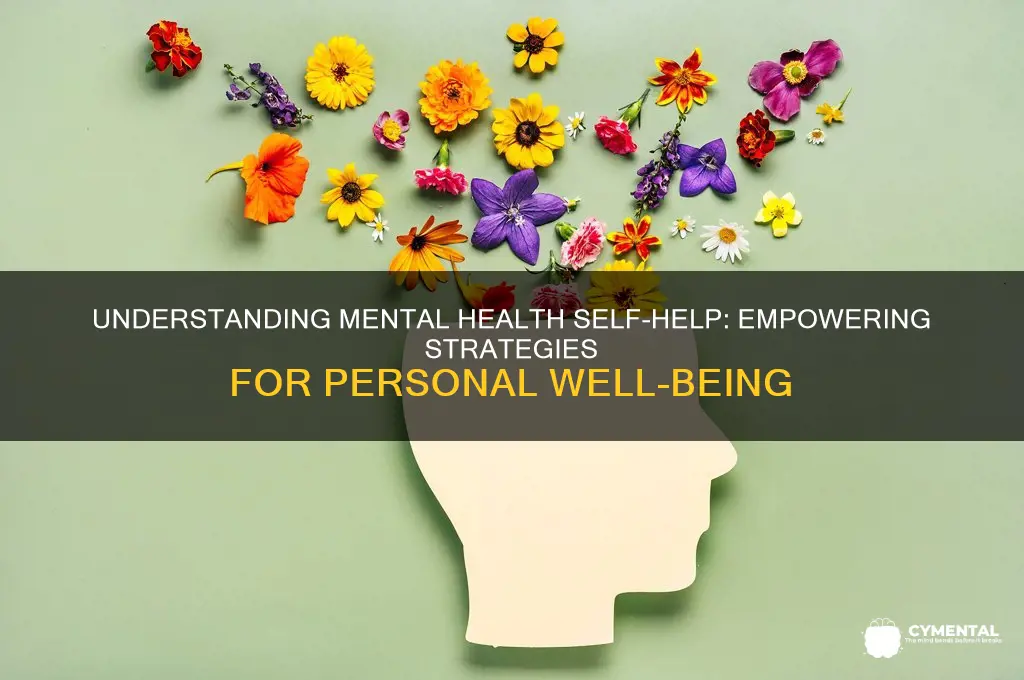
Mental health self-help refers to the practice of individuals taking proactive steps to manage and improve their own emotional, psychological, and social well-being without formal professional intervention. This can include a variety of strategies such as mindfulness, journaling, exercise, healthy eating, and engaging in activities that promote relaxation and stress reduction. Self-help also involves educating oneself about mental health conditions, recognizing personal triggers, and developing coping mechanisms to navigate challenges. While not a replacement for professional therapy or medication when needed, self-help empowers individuals to take control of their mental health, fostering resilience and a sense of autonomy in their journey toward emotional balance and overall wellness.
| Characteristics | Values |
|---|---|
| Definition | Self-directed activities or strategies to improve mental well-being. |
| Empowerment | Encourages individuals to take control of their mental health. |
| Accessibility | Widely available through books, apps, online resources, and support groups. |
| Cost-Effective | Often low-cost or free compared to professional therapy. |
| Flexibility | Can be tailored to individual needs and schedules. |
| Confidentiality | Allows for privacy without involving external parties. |
| Proactive Approach | Focuses on prevention and early intervention. |
| Complementary to Therapy | Can be used alongside professional treatment. |
| Evidence-Based Techniques | Incorporates methods like CBT, mindfulness, and journaling. |
| Community Support | Includes peer support groups and online forums. |
| Self-Awareness | Promotes understanding of emotions, thoughts, and behaviors. |
| Skill-Building | Teaches coping mechanisms and stress management skills. |
| Sustainability | Encourages long-term habits for mental health maintenance. |
| Personalized | Allows individuals to choose methods that resonate with them. |
| Stigma Reduction | Helps normalize mental health care and self-care practices. |
Explore related products


What You'll Learn
- Mindfulness Techniques: Practice present-moment awareness to reduce stress and improve emotional regulation
- Cognitive Restructuring: Identify and challenge negative thought patterns to foster a positive mindset
- Stress Management: Use relaxation methods like deep breathing or meditation to cope with pressure
- Healthy Habits: Prioritize sleep, exercise, and nutrition to support mental and physical well-being
- Social Support: Build and maintain relationships to combat loneliness and enhance emotional resilience

Mindfulness Techniques: Practice present-moment awareness to reduce stress and improve emotional regulation
Stress thrives on our tendency to dwell in the past or anxiously anticipate the future. Mindfulness techniques interrupt this cycle by anchoring us in the present moment, a space where stress loses its grip.
Consider this: When was the last time you truly focused on the sensation of your breath, the warmth of sunlight on your skin, or the sound of leaves rustling in the wind? These seemingly mundane experiences hold immense power. By consciously directing our attention to the here and now, we short-circuit the mental chatter that fuels stress and emotional reactivity.
Studies show that regular mindfulness practice, even for as little as 10 minutes daily, can significantly reduce cortisol levels, the hormone associated with stress.
One of the most accessible mindfulness techniques is mindful breathing. Find a quiet space, sit comfortably, and close your eyes. Focus your attention on the sensation of air entering and leaving your nostrils. Notice the rise and fall of your chest. When your mind wanders (and it will), gently bring your focus back to the breath. Don't judge yourself for getting distracted; simply acknowledge the thought and return to the present.
Start with 5-minute sessions and gradually increase the duration as you become more comfortable.
Mindfulness isn't about emptying your mind, but rather observing your thoughts and emotions without judgment. Imagine them as passing clouds in the sky – acknowledge their presence, but don't get caught up in their drama. This non-reactive stance fosters emotional regulation, allowing you to respond to challenging situations with greater clarity and composure.
Incorporating mindfulness into daily activities can further enhance its benefits. Pay close attention to the taste and texture of your food during meals. Notice the sensation of water on your skin while showering. Engage fully in conversations, truly listening to the speaker without planning your response. These micro-moments of mindfulness weave present-moment awareness into the fabric of your day, creating a more grounded and stress-resilient life.
Fasting and Mental Health: Unlocking the Mind's Potential Through Abstinence
You may want to see also
Explore related products




Cognitive Restructuring: Identify and challenge negative thought patterns to foster a positive mindset
Negative thoughts are like weeds in a garden—left unchecked, they choke out the potential for growth and beauty. Cognitive restructuring is the mental gardening tool that helps you uproot these weeds, replacing them with thoughts that nourish your mind. This technique, rooted in cognitive-behavioral therapy (CBT), involves identifying, challenging, and replacing harmful thought patterns with more balanced and constructive ones. It’s not about forcing positivity but about cultivating accuracy and fairness in how you perceive yourself and the world.
To begin, keep a thought journal for a week. Write down situations that trigger negative emotions, the thoughts you had in those moments, and the emotions that followed. For example, if you failed a test, did you think, “I’m a complete failure”? Notice how this all-or-nothing thinking amplifies distress. Next, analyze the evidence. Ask yourself: Is this thought factual, or am I jumping to conclusions? What would I tell a friend in this situation? Often, you’ll find that your thoughts are exaggerated or irrational. Replace the thought with a more realistic alternative, such as, “I didn’t do well this time, but I can study differently next time.” Practice this process daily, especially during moments of stress.
One common pitfall is trying to overhaul your thinking overnight. Cognitive restructuring is a gradual process, like retraining a muscle. Start with one or two recurring negative thoughts and focus on those. Over time, you’ll become more adept at spotting and challenging them. Another caution: avoid dismissing your emotions entirely. Negative thoughts often carry a kernel of truth or signal an unmet need. Instead of suppressing them, reframe them in a way that acknowledges your feelings while offering a constructive path forward.
The power of cognitive restructuring lies in its practicality. It’s a skill you can use anywhere, anytime, without needing external resources. For instance, if you’re anxious about a presentation, challenge the thought, “Everyone will judge me,” by asking, “Is there evidence for this, or is my anxiety exaggerating the risk?” Replace it with, “Some may have feedback, but most are here to learn from me.” This shift doesn’t eliminate nerves but reduces their grip on your mindset. With consistent practice, cognitive restructuring becomes second nature, fostering resilience and a more positive outlook on life.
Seeking Support: A Guide to Asking for Mental Health Help
You may want to see also
Explore related products


$7.84 $14.99

Stress Management: Use relaxation methods like deep breathing or meditation to cope with pressure
Stress is an inevitable part of life, but its management is a skill that can be cultivated. One of the most accessible and effective tools in this endeavor is the practice of relaxation techniques, such as deep breathing and meditation. These methods are not merely trendy wellness practices but are backed by scientific research, demonstrating their ability to reduce stress hormones and promote a sense of calm. For instance, deep breathing exercises, when done correctly, can lower cortisol levels, often referred to as the stress hormone, and increase oxygen supply to the brain, fostering a more relaxed state.
The Art of Deep Breathing: A simple yet powerful technique, deep breathing involves inhaling slowly through the nose, allowing the chest and lower belly to rise, and then exhaling slowly through the mouth. This process should be repeated for at least 5-10 minutes, ideally in a quiet space. For maximum benefit, aim for a pace of 5-6 breaths per minute, which has been shown to optimize heart rate variability, a key indicator of stress resilience. This practice is particularly useful in acute stress situations, providing an immediate tool to regain composure.
Meditation, on the other hand, offers a more sustained approach to stress management. It involves training the mind to focus and redirect thoughts, often using specific techniques like mindfulness or visualization. For beginners, guided meditations can be a great starting point, with numerous apps and online resources offering sessions as short as 5 minutes, suitable for all ages. Regular practice, ideally daily, can lead to long-term reductions in stress and improvements in overall mental well-being. A study published in the *Journal of the American Medical Association* (JAMA) Internal Medicine found that meditation programs can reduce symptoms of anxiety and depression, highlighting its efficacy as a self-help tool.
Incorporating Relaxation into Daily Life: The key to successful stress management is consistency. Integrating these relaxation methods into daily routines can be more effective than sporadic, longer sessions. For example, starting the day with a 10-minute meditation can set a calm tone, while deep breathing exercises during work breaks can prevent stress accumulation. For those with busy schedules, even 2-3 minutes of focused breathing can provide a quick reset. It's about finding what works for the individual and making it a non-negotiable part of their day.
While these techniques are generally safe and beneficial, it's important to note that they are not a replacement for professional help in severe cases of stress or anxiety disorders. However, as a self-help strategy, relaxation methods empower individuals to take control of their mental health, offering a natural and accessible way to cope with life's pressures. By understanding and utilizing these tools, one can build resilience and navigate stressful situations with greater ease.
Coconut Oil and Mental Health: Exploring Potential Benefits and Science
You may want to see also
Explore related products



Healthy Habits: Prioritize sleep, exercise, and nutrition to support mental and physical well-being
Sleep, exercise, and nutrition aren’t just pillars of physical health—they’re the bedrock of mental resilience. Research consistently shows that poor sleep disrupts emotional regulation, exercise reduces symptoms of anxiety and depression, and nutrient deficiencies can exacerbate mood disorders. Ignoring these habits isn’t just a physical oversight; it’s a mental vulnerability.
Step 1: Prioritize Sleep as a Non-Negotiable. Adults need 7–9 hours nightly, yet 35% fall short. Establish a "sleep hygiene" routine: dim lights 1 hour before bed, avoid screens, and keep the room cool (60–67°F). For shift workers or insomniacs, cognitive behavioral therapy for insomnia (CBT-I) offers evidence-based strategies to reset circadian rhythms.
Step 2: Move Your Body Intentionally. The American Psychological Association recommends 150 minutes of moderate exercise weekly to combat stress. Break it into 10-minute bursts if needed—a brisk walk, yoga, or even dancing counts. For teens and young adults, incorporating social activities like team sports can double the mental health benefits by fostering connection.
Step 3: Fuel Your Brain, Not Just Your Body. Omega-3s (found in salmon, walnuts), magnesium (spinach, almonds), and vitamin D (sunlight, fortified foods) are linked to reduced depression and anxiety. Limit processed foods, which spike blood sugar and cortisol. Pro tip: Pair carbs with protein (e.g., apple with peanut butter) to stabilize energy and mood.
Caution: Avoid the All-or-Nothing Trap. Perfectionism undermines progress. Missed a workout? Eat a donut? Reset tomorrow. Consistency, not rigidity, builds resilience. For those with chronic conditions or eating disorders, consult a professional to tailor habits safely.
Essential Oils: A Natural Ally in Mental Health and Wellness
You may want to see also
Explore related products


Social Support: Build and maintain relationships to combat loneliness and enhance emotional resilience
Human beings are inherently social creatures, and our connections with others significantly impact our mental well-being. Loneliness, often a silent companion in today's fast-paced world, can erode emotional resilience and contribute to various mental health challenges. Building and nurturing a strong support network is a powerful act of self-care, offering a buffer against life's stressors and fostering a sense of belonging.
The Power of Connection:
Imagine a safety net, woven from the threads of relationships, catching you when life's challenges threaten to overwhelm. This is the essence of social support. It involves cultivating a network of friends, family, or even community groups who provide emotional backing, practical help, and a sense of connection. Research suggests that social support can reduce the impact of stressful life events, lower the risk of depression, and even improve physical health. For instance, a study published in the *Journal of Health and Social Behavior* found that individuals with strong social ties have a 50% increased chance of survival, regardless of age, sex, or health status.
Building Your Support Network:
- Identify Your Tribe: Start by recognizing the people in your life who uplift and support you. These could be friends who listen without judgment, family members who offer practical help, or even online communities sharing similar interests or experiences.
- Initiate and Nurture: Relationships require effort. Reach out regularly, whether it's a weekly call, a monthly meetup, or daily messages. Share your thoughts and feelings, and be there for others in return. For instance, a simple text checking in on a friend can strengthen your bond.
- Diversify Your Connections: Different relationships serve various purposes. While close friends might provide emotional intimacy, colleagues could offer professional support, and community groups may provide a sense of shared purpose. Aim for a diverse network to meet various social needs.
Maintaining and Strengthening Bonds:
- Quality Over Quantity: It's not about having a vast network but rather fostering deep, meaningful connections. Regular, substantive interactions are key. For example, a weekly coffee date with a friend can be more beneficial than sporadic, superficial contacts.
- Be Present and Engaged: Active listening and genuine interest are vital. When spending time with loved ones, minimize distractions like phones. Show that you value their presence and thoughts.
- Offer Support: Relationships are a two-way street. Be there for others during their difficult times, just as you'd want them to be there for you. This reciprocity strengthens bonds and creates a culture of mutual care.
A Word of Caution:
While social support is invaluable, it's essential to recognize that not all relationships are healthy. Toxic or one-sided connections can drain your energy and negatively impact your mental health. Be mindful of relationships that consistently leave you feeling worse, and consider setting boundaries or seeking support to navigate these dynamics.
In the journey of mental health self-help, social support is a cornerstone, offering a sense of security and resilience. By investing time and energy into building and maintaining relationships, you create a powerful resource to combat loneliness and foster emotional well-being. This network becomes a source of strength, reminding you that you are not alone in facing life's challenges.
Breaking Barriers: Key Factors Influencing Mental Health Help-Seeking Behavior
You may want to see also
Frequently asked questions
Mental health self-help refers to strategies, techniques, and practices individuals use to manage and improve their own mental well-being without professional intervention. This can include activities like mindfulness, journaling, exercise, and setting personal boundaries.
Begin by identifying areas of your mental health you want to improve, such as stress, anxiety, or mood. Then, explore self-help tools like meditation, deep breathing exercises, or creating a daily routine. Consistency is key, so start small and gradually incorporate these practices into your life.
Yes, while self-help can be effective for mild to moderate mental health challenges, it is not a substitute for professional treatment in severe cases. If symptoms persist or worsen, it’s important to seek help from a mental health professional for proper diagnosis and support.