Noah Parker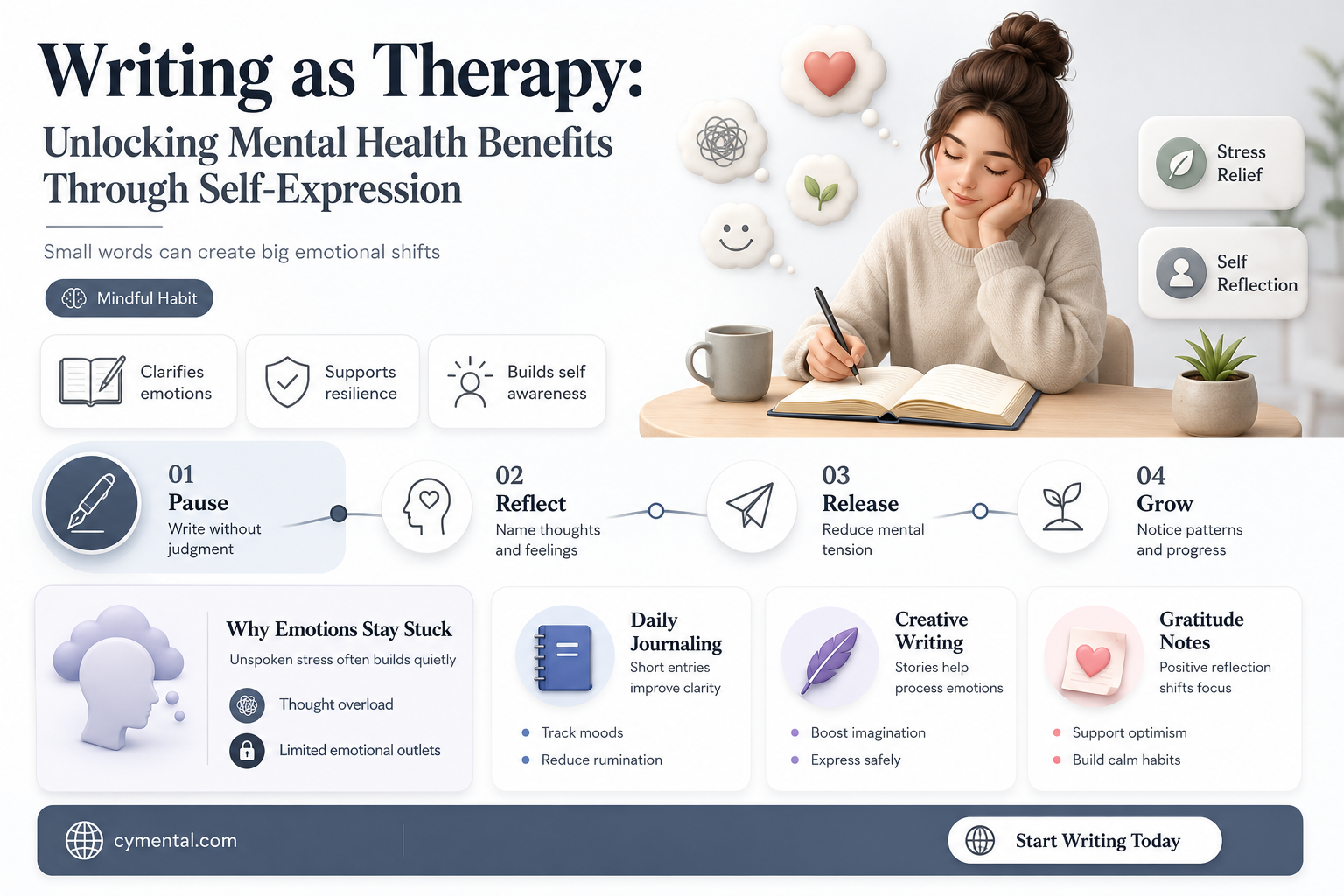
Writing has long been recognized as a powerful tool for self-expression and emotional release, and its impact on mental health is a topic of growing interest. Numerous studies suggest that engaging in writing, whether through journaling, creative expression, or even structured exercises, can significantly alleviate symptoms of anxiety, depression, and stress. By putting thoughts and feelings into words, individuals often gain clarity, process complex emotions, and foster a sense of control over their experiences. Additionally, writing can serve as a safe space for reflection, allowing people to explore their inner worlds without judgment. As mental health awareness continues to rise, the therapeutic potential of writing is increasingly being embraced as a complementary practice to traditional therapies, offering a simple yet profound way to nurture emotional well-being.
| Characteristics | Values |
|---|---|
| Stress Reduction | Writing about stressful events or emotions can help reduce physiological markers of stress, such as lowering blood pressure and improving immune function. |
| Emotional Processing | Expressive writing allows individuals to process and make sense of their emotions, leading to better emotional regulation and reduced symptoms of anxiety and depression. |
| Cognitive Clarity | Writing helps organize thoughts, improve focus, and enhance problem-solving abilities by externalizing internal mental processes. |
| Trauma Healing | Writing about traumatic experiences can aid in recovery by helping individuals confront and integrate painful memories, reducing their emotional impact over time. |
| Self-Reflection | Journaling encourages introspection, fostering self-awareness, personal growth, and a deeper understanding of one’s thoughts and behaviors. |
| Mood Enhancement | Regular writing, especially gratitude journaling, has been linked to improved mood, increased optimism, and higher levels of life satisfaction. |
| Coping Mechanism | Writing serves as a healthy coping strategy for managing difficult emotions, providing an outlet for expression and reducing reliance on maladaptive behaviors. |
| Memory Improvement | Writing down thoughts and experiences can enhance memory retention and recall, benefiting overall cognitive health. |
| Social Connection | Sharing written work (e.g., poetry, stories) can foster a sense of connection and reduce feelings of isolation. |
| Mindfulness Practice | Stream-of-consciousness writing promotes mindfulness by encouraging present-moment awareness and non-judgmental observation of thoughts. |
| Goal Setting & Accountability | Writing down goals and progress helps individuals stay motivated, track achievements, and maintain accountability. |
| Creativity Boost | Creative writing stimulates imagination, reduces mental blocks, and provides a sense of accomplishment and fulfillment. |
| Physical Health Benefits | Improved mental health through writing can positively impact physical health, reducing symptoms of conditions like asthma, arthritis, and migraines. |
| Long-Term Resilience | Consistent writing practices build emotional resilience, enabling individuals to better cope with future stressors and challenges. |
Explore related products


What You'll Learn
- Journaling for Stress Relief: Writing down thoughts reduces stress and promotes emotional clarity
- Creative Writing as Therapy: Expressing emotions through stories or poetry aids healing and self-discovery
- Gratitude Writing Benefits: Daily gratitude lists boost mood and foster a positive mindset
- Writing to Process Trauma: Helps organize chaotic thoughts and emotions after traumatic experiences
- Letter Writing for Closure: Unsent letters provide emotional release and help resolve conflicts

Journaling for Stress Relief: Writing down thoughts reduces stress and promotes emotional clarity
Writing down your thoughts isn't just a habit for poets and diarists; it's a scientifically backed method for stress relief. Studies show that expressive writing, particularly about stressful events, can significantly lower blood pressure, improve immune function, and reduce stress hormone levels. This isn't about crafting perfect prose; it's about unloading the mental weight onto paper. Even 15-20 minutes of journaling daily can act as a psychological release valve, allowing you to step back from overwhelming emotions and gain perspective.
Consider this: when you’re stressed, your mind often loops through the same worries, amplifying anxiety. Journaling interrupts this cycle. By translating abstract thoughts into concrete words, you externalize the problem, making it easier to analyze and manage. For instance, a study published in *Advances in Psychiatric Treatment* found that participants who wrote about traumatic experiences reported fewer stress-related doctor visits compared to those who wrote about neutral topics. The act of writing forces you to slow down, organize your thoughts, and often uncover patterns or solutions you might have missed in the chaos of your mind.
To start journaling for stress relief, set aside a specific time each day—morning to clear your head or evening to unwind. Use prompts like “What’s weighing on me today?” or “What’s one thing I can let go of?” to guide your writing. Don’t overthink grammar or structure; this is for your eyes only. If you’re new to journaling, begin with just 5 minutes and gradually increase to 15-20 minutes as it becomes more comfortable. Keep your journal in a place that’s easily accessible, like your bedside table or desk, to remove barriers to consistency.
While journaling is powerful, it’s not a one-size-fits-all solution. For some, revisiting painful emotions through writing can temporarily increase distress. If this happens, pair journaling with grounding techniques like deep breathing or take breaks as needed. Additionally, journaling is most effective when combined with other stress management strategies, such as exercise or therapy. Think of it as one tool in your mental health toolkit, not the entire kit itself.
The beauty of journaling lies in its simplicity and accessibility. It requires nothing more than a pen and paper, yet it can yield profound emotional clarity. Over time, you may notice recurring themes in your entries—perhaps certain people or situations consistently trigger stress. This awareness is the first step toward making meaningful changes. Journaling doesn’t erase stress, but it gives you a safe space to confront it, process it, and ultimately, move past it.
Shower Therapy: How Daily Showers Boost Mental Health and Well-being
You may want to see also
Explore related products


Creative Writing as Therapy: Expressing emotions through stories or poetry aids healing and self-discovery
Creative writing, whether through crafting stories or penning poetry, serves as a powerful tool for emotional expression and mental healing. Unlike journaling, which often focuses on factual accounts of daily life, creative writing allows individuals to explore and articulate complex emotions in a metaphorical or imaginative space. This distance can make confronting painful feelings more manageable, as it provides a layer of abstraction that reduces immediate emotional intensity. For instance, writing a poem about a storm to symbolize inner turmoil can help externalize and process grief or anxiety without directly reliving the experience.
To harness the therapeutic benefits of creative writing, start small and unstructured. Dedicate 10–15 minutes daily to free-writing, where the goal is not perfection but raw expression. Use prompts like “I wish someone understood that…” or “If my emotions had a color, they would be…” to guide your thoughts. For those new to this practice, structured exercises, such as writing a six-word story or crafting a haiku, can provide a framework that feels less daunting. Over time, gradually increase the duration and complexity of your writing to deepen self-reflection.
While creative writing can be profoundly healing, it’s essential to approach it with caution, especially for individuals dealing with trauma or severe mental health issues. Writing about distressing experiences without proper emotional grounding can sometimes exacerbate feelings of overwhelm. To mitigate this, pair writing sessions with grounding techniques, such as deep breathing or mindfulness, and consider working with a therapist who can provide support and guidance. Additionally, avoid self-judgment during the process; the goal is not to produce polished work but to create a safe space for emotional release.
The transformative power of creative writing lies in its ability to foster self-discovery. By crafting narratives or poems, individuals often uncover patterns, desires, or fears they weren’t consciously aware of. For example, repeatedly writing about characters seeking freedom might reveal a personal longing for autonomy. This insight can then be used as a starting point for personal growth or therapeutic exploration. Unlike traditional talk therapy, creative writing offers a non-verbal pathway to understanding oneself, making it particularly accessible for those who struggle to articulate their emotions verbally.
Incorporating creative writing into a mental health routine doesn’t require literary talent—only willingness and consistency. For maximum benefit, combine it with other self-care practices, such as exercise or meditation, to create a holistic approach to well-being. Keep a dedicated notebook or digital document for your writings, and periodically revisit earlier pieces to track progress and identify recurring themes. Over time, this practice can become a cherished ritual, offering both solace and insight into the intricate landscape of the mind.
Laughter Therapy: Unlocking Mental Health Benefits Through Joy and Humor
You may want to see also
Explore related products


Gratitude Writing Benefits: Daily gratitude lists boost mood and foster a positive mindset
Writing down what you're grateful for each day isn't just a feel-good exercise; it's a scientifically backed tool for improving mental well-being. Studies show that daily gratitude journaling can significantly increase happiness levels and life satisfaction. One study, published in the *Journal of Personality and Social Psychology*, found that participants who wrote down five things they were grateful for each week reported feeling more optimistic and had fewer physical health complaints compared to those who recorded hassles or neutral events. This simple practice rewires the brain to focus on the positive, counteracting the natural tendency to dwell on negatives.
To harness these benefits, start small. Dedicate just five minutes each morning or evening to jotting down three to five things you’re grateful for. These can be as simple as a warm cup of coffee, a kind word from a friend, or the sound of rain. The key is specificity—instead of writing "I’m grateful for my family," try "I’m grateful for the way my sister listened to me yesterday when I was stressed." This level of detail deepens the emotional connection to the gratitude, amplifying its impact. For maximum effect, consistency is crucial; make it a daily habit, even on days when gratitude feels hard to find.
While gratitude writing is powerful, it’s not a one-size-fits-all solution. Some individuals, particularly those dealing with severe depression or trauma, may find it challenging to identify positives in their lives. In such cases, pairing gratitude journaling with professional therapy can provide a more supportive framework. Additionally, avoid turning this practice into a chore. If listing gratitude feels forced, try shifting the focus to small, tangible moments rather than grand, abstract concepts. The goal is to cultivate mindfulness, not perfection.
Comparing gratitude writing to other mindfulness practices highlights its unique advantages. Unlike meditation, which requires quiet and focus, gratitude journaling can be done anywhere, anytime, with just a pen and paper. It’s also more structured than free-form journaling, providing a clear framework for reflection. For those who struggle with open-ended writing, this structure can make the practice more accessible and sustainable. Over time, the cumulative effect of daily gratitude lists can lead to a more resilient, positive mindset, even in the face of adversity.
Incorporating gratitude writing into your routine doesn’t require a fancy journal or app, though tools like guided gratitude journals or digital prompts can enhance the experience. The real value lies in the act of reflection itself. For families, this practice can be a shared activity, with each member contributing to a collective gratitude list. Schools and workplaces are also adopting gratitude exercises to foster positivity and connection. By making gratitude a daily habit, you’re not just recording moments of thankfulness—you’re actively training your brain to notice and appreciate the good in life.
Grayson Allen's Mental Health: Addressing Concerns and Seeking Support
You may want to see also
Explore related products




Writing to Process Trauma: Helps organize chaotic thoughts and emotions after traumatic experiences
Trauma shatters the mind’s ability to process experiences linearly, leaving survivors with fragmented memories, overwhelming emotions, and a sense of helplessness. Writing intervenes by forcing the brain to engage in a structured dialogue with itself. Research shows that expressive writing, particularly when done for 15-20 minutes daily over 3-5 consecutive days, helps consolidate traumatic memories into a coherent narrative. This process, known as *narrative integration*, reduces the intrusive, chaotic nature of traumatic recall by anchoring emotions to a timeline and context. For instance, a study published in *Psychological Science* found that participants who wrote about their deepest thoughts and feelings surrounding a trauma showed reduced activity in the amygdala—the brain’s alarm center—during subsequent trauma reminders.
To begin, create a safe, uninterrupted space where you can write freely without judgment. Start by jotting down disjointed thoughts, images, or sensations related to the trauma—no need for grammar or coherence. Over time, gradually weave these fragments into a story, even if it feels incomplete or nonlinear. For younger individuals (teens and young adults), incorporating metaphors or symbols can make the process less overwhelming. For example, describing trauma as a storm or a labyrinth allows for emotional distance while still engaging with the experience. Caution: Avoid forcing details or rushing the process; writing about trauma too soon or without proper support can retraumatize. Pairing this practice with grounding techniques, like deep breathing or sensory anchoring, can help manage distress.
Comparatively, while talk therapy relies on verbal communication, writing offers a unique advantage: it allows for revision and reflection. Unlike spoken words, which disappear into the air, written words can be revisited, edited, and reinterpreted over time. This iterative process mirrors the brain’s natural healing mechanisms, as it gradually recontextualizes trauma from a threat to a survivable event. For instance, a survivor might initially describe an experience as “unbearable” but later revise it to “challenging but survivable,” reflecting a shift in perspective. This act of rewriting not only changes the narrative but also rewires neural pathways associated with the trauma.
Persuasively, consider the case of James Pennebaker’s groundbreaking studies, which demonstrated that expressive writing significantly improves both mental and physical health outcomes for trauma survivors. Participants who wrote about traumatic experiences reported fewer stress-related doctor visits, improved mood, and better sleep quality within weeks. The key lies in specificity: writing about emotions and thoughts related to the trauma, rather than merely describing the event, yields the most benefits. For maximum efficacy, combine writing with professional therapy, as the latter provides a framework for processing what emerges on the page. Practical tip: If writing feels too daunting, start with bullet points or drawings—any form of externalization counts.
Descriptively, imagine writing as a container for emotional debris—a vessel that holds the shards of trauma until they can be reassembled into something whole. Each word acts as a thread, stitching together the torn fabric of memory. For survivors of complex trauma, this process may take months or even years, but the act of writing itself becomes a ritual of reclamation. Over time, the page transforms from a mirror reflecting chaos to a map charting recovery. Takeaway: Writing is not a cure, but a tool—one that empowers survivors to reshape their relationship with trauma, one sentence at a time.
Swimming's Soothing Effect: Reducing Stress and Boosting Mental Health
You may want to see also
Explore related products

$9.99 $14.99

$43.99


Letter Writing for Closure: Unsent letters provide emotional release and help resolve conflicts
Writing unsent letters is a therapeutic practice rooted in the principle of emotional catharsis. By putting unresolved feelings into words, individuals can externalize their inner turmoil, transforming abstract emotions into tangible expressions. This process, often referred to as "emotional release," allows the writer to confront and process pain, anger, or grief without the pressure of a recipient’s reaction. For instance, a person struggling with a past betrayal might write a letter detailing their hurt and disappointment, addressing the betrayer directly. Though the letter remains unsent, the act of writing provides a sense of validation and acknowledgment, which can be profoundly healing.
The structure of letter writing lends itself to closure by encouraging clarity and structure. Unlike journaling, which can be free-flowing and unfocused, letters require the writer to identify a specific recipient and articulate their thoughts in a coherent manner. This structured approach helps individuals organize their emotions, identify key issues, and often uncover insights they might not have recognized otherwise. For example, a teenager writing to a deceased parent might start with anger but end with gratitude, realizing the depth of their love and loss through the process. This shift in perspective is a critical step toward emotional resolution.
Practical implementation of this technique involves setting aside dedicated time in a quiet, distraction-free environment. Start by addressing the letter to the person or entity (even abstract concepts like "Fear" or "Grief" can be recipients). Write freely without editing, allowing emotions to flow naturally. Aim for 15–20 minutes per session, repeating over several days if needed. After completing the letter, consider a symbolic act of closure, such as burning or burying it, to reinforce the sense of release. For those hesitant to destroy their work, storing the letter in a sealed envelope can provide a sense of containment without the finality of destruction.
While unsent letters are powerful, they are not a one-size-fits-all solution. Individuals with severe trauma or unresolved PTSD may find the process retraumatizing without professional guidance. In such cases, integrating letter writing into therapy sessions can provide a safe space for exploration. Additionally, combining this practice with other therapeutic techniques, such as mindfulness or cognitive reframing, can enhance its effectiveness. For instance, a 2018 study published in *Psychology of Aesthetics, Creativity, and the Arts* found that expressive writing, including unsent letters, significantly reduced symptoms of depression and anxiety in participants over six weeks.
The beauty of unsent letters lies in their duality: they serve as both a tool for self-expression and a ritual of release. By engaging in this practice, individuals can reclaim agency over their emotional narratives, transforming unresolved conflicts into opportunities for growth. Whether addressing a living person, a memory, or an abstract emotion, the act of writing fosters introspection and healing. As a standalone practice or part of a broader mental health strategy, letter writing for closure remains a simple yet profound way to navigate the complexities of the human heart.
Boost Your Mental Health: Hobbies That Heal and Inspire
You may want to see also
Frequently asked questions
Yes, writing can significantly reduce stress and anxiety by allowing individuals to express and process their emotions, clarify thoughts, and gain perspective on their experiences.
Absolutely, writing, especially journaling or expressive writing, has been shown to boost mood, increase self-awareness, and foster a sense of emotional release and catharsis.
Yes, numerous studies have demonstrated that writing can improve mental health by reducing symptoms of depression, enhancing emotional regulation, and promoting psychological resilience.