Madison Cole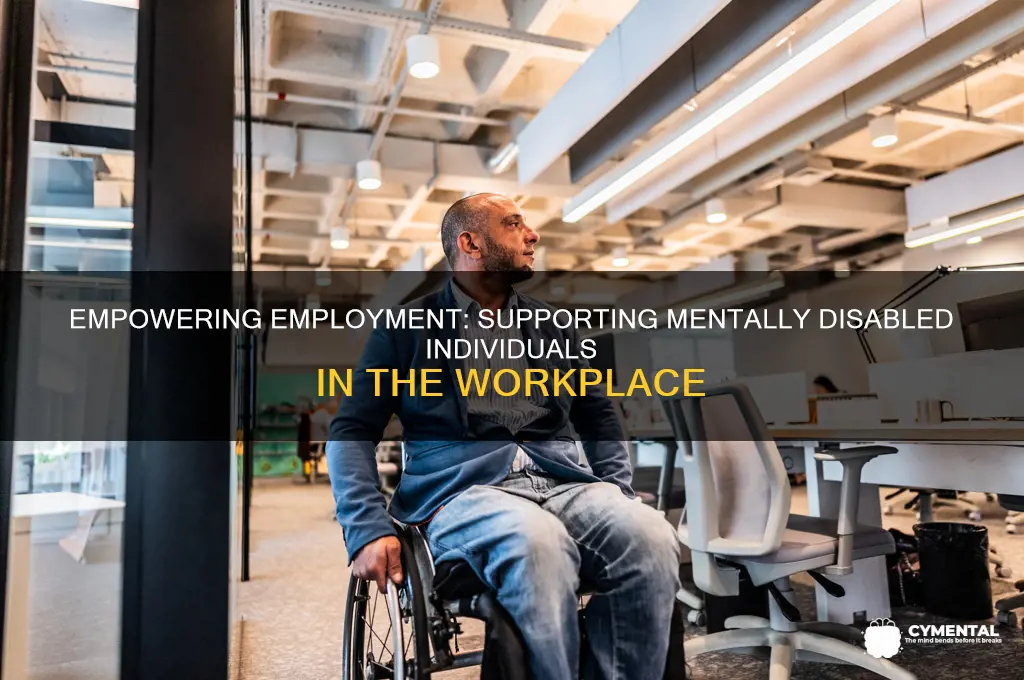
Supporting individuals with mental disabilities in the workplace is a crucial step toward fostering inclusivity and leveraging diverse talents. By creating an environment that prioritizes understanding, flexibility, and accessibility, employers can empower these individuals to thrive. This involves implementing reasonable accommodations, such as adjusted work hours or specialized tools, providing clear communication and consistent support, and fostering a culture of empathy and respect. Additionally, offering training programs tailored to their needs and partnering with organizations specializing in disability employment can further enhance their professional growth. Ultimately, helping mentally disabled individuals secure and succeed in jobs not only benefits them but also enriches the workplace with unique perspectives and skills.
Explore related products


What You'll Learn
- Provide clear, simple instructions to ensure tasks are understood and completed accurately
- Offer consistent support through regular check-ins and accessible communication methods
- Create a structured environment with routines and visual aids for stability
- Promote skill development through tailored training and hands-on learning opportunities
- Foster inclusivity by encouraging teamwork and celebrating individual strengths and achievements

Provide clear, simple instructions to ensure tasks are understood and completed accurately
Clear, concise instructions are the cornerstone of effective task completion for individuals with mental disabilities. Vague or complex directions can lead to confusion, frustration, and errors. Break down tasks into small, manageable steps, using simple language and avoiding jargon. For example, instead of saying, "Organize the shelves," say, "First, remove all items from the top shelf. Then, wipe the shelf clean. Next, place books back in alphabetical order." This granular approach ensures each step is understood and reduces cognitive overload.
Visual aids and demonstrations significantly enhance comprehension. Pair verbal instructions with diagrams, pictures, or physical demonstrations. For instance, when teaching a cashier how to operate a register, show the process step-by-step while explaining each action. Use color-coding or labels to highlight important buttons or areas. For someone with limited verbal communication, visual schedules or task boards can serve as constant reminders, reinforcing what needs to be done and in what order.
Repetition and consistency are vital for retention. Repeat instructions multiple times, especially for complex tasks, and encourage questions to confirm understanding. Establish consistent routines and use the same phrasing for recurring tasks. For example, if a janitorial task involves mopping floors, always use the same sequence of steps and language, such as "Fill the bucket halfway, add cleaner, and start mopping from the back of the room toward the door." This predictability builds confidence and independence.
Finally, provide immediate feedback and support. After giving instructions, observe the individual as they begin the task and offer gentle corrections or encouragement as needed. Avoid overwhelming them with multiple corrections at once; focus on one issue at a time. For example, if someone is folding laundry incorrectly, say, "Great job matching the socks! Now, let’s try folding the shirts by first smoothing them flat and then folding in half." This positive, incremental approach fosters learning and motivation.
Supporting Your Friend: Encouraging Mental Health Treatment with Compassion
You may want to see also
Explore related products


Offer consistent support through regular check-ins and accessible communication methods
Regular check-ins are the backbone of effective support for mentally disabled individuals in the workplace. These structured touchpoints provide a predictable framework that fosters trust and reduces anxiety. Aim for weekly or bi-weekly meetings, depending on the individual’s needs, with a clear agenda focused on progress, challenges, and goals. Use tools like shared calendars or reminder apps to ensure consistency, as unpredictability can disrupt routines that many rely on for stability.
Accessible communication methods are equally critical, as they bridge potential gaps in understanding or expression. For example, visual aids like charts or step-by-step guides can clarify tasks for those with cognitive disabilities, while text-to-speech tools benefit individuals with speech impairments. Tailor communication to the person’s preferences—some may thrive with email summaries, while others prefer face-to-face conversations. The key is to adapt, not assume, ensuring every interaction is inclusive and effective.
Consider the case of a neurodivergent employee who struggles with verbal communication during high-stress moments. A pre-established system, such as a color-coded card (green for "I’m okay," yellow for "I need a break," red for "I need help"), can provide a silent yet powerful way to express needs. This simple method not only empowers the individual but also minimizes disruptions for colleagues, creating a more harmonious work environment.
However, consistency doesn’t mean rigidity. Be prepared to adjust the frequency or format of check-ins based on evolving needs. For instance, during periods of high workload or personal stress, more frequent but shorter check-ins might be necessary. Conversely, once an individual gains confidence in their role, check-ins can become less frequent but remain a safety net. Flexibility within the framework ensures support remains relevant and non-intrusive.
In conclusion, consistent support through regular check-ins and accessible communication isn’t just about addressing challenges—it’s about building a foundation for long-term success. By prioritizing predictability, adaptability, and inclusivity, employers and support teams can create an environment where mentally disabled individuals not only survive but thrive in their roles.
Napping for Mental Wellness: Boosting Mood and Reducing Stress
You may want to see also
Explore related products



Create a structured environment with routines and visual aids for stability
Structured environments are foundational for individuals with mental disabilities, offering predictability that reduces anxiety and fosters independence. A consistent daily routine, for instance, can transform a chaotic workday into a manageable sequence of tasks. Start by mapping out a clear schedule: allocate specific times for arrival, breaks, tasks, and departure. Use visual aids like clocks with labeled activity periods or picture-based schedules to reinforce this structure. For example, a visual timer can signal when a task should transition, minimizing confusion and stress.
Consider the workspace itself—a cluttered, disorganized area can overwhelm. Implement visual aids such as color-coded storage bins for tools or materials, labeled workstations, and clear pathways. For someone with autism or ADHD, these cues act as silent guides, reducing cognitive load and enhancing focus. A study by the Journal of Vocational Rehabilitation found that employees with structured, visually organized workspaces demonstrated a 30% increase in task completion rates. Even small details, like placing a checklist at eye level, can make a significant difference.
Routines should extend beyond the physical space to include social and behavioral expectations. For instance, establish a morning check-in ritual where the individual reviews their schedule with a supervisor or uses a communication board to express readiness. Similarly, end-of-day routines, such as tidying up or reviewing accomplishments, provide closure. Consistency in these practices builds confidence and reduces the likelihood of meltdowns or disengagement. Tailor these routines to the individual’s needs—what works for one person may not work for another.
However, rigidity can backfire if not balanced with flexibility. Unforeseen changes, like a last-minute meeting or equipment failure, are inevitable. Prepare for these disruptions by incorporating "buffer" times into the schedule and teaching coping strategies, such as deep breathing or using a sensory tool. Visual aids like a "change card" can signal an unexpected shift, paired with a brief explanation to maintain trust. The goal is not to eliminate unpredictability but to equip the individual with tools to navigate it calmly.
Finally, regularly assess and adjust the structured environment as the individual grows in their role. What works during onboarding may become limiting after six months. Involve them in this process—ask for feedback, observe their interactions with the space, and adapt accordingly. For example, a visual aid that was once essential might become redundant as tasks become second nature. By evolving the structure, you ensure it remains supportive rather than restrictive, fostering long-term success in the workplace.
Supporting Friends in Crisis: Practical Steps for Mental Health Emergencies
You may want to see also
Explore related products


Promote skill development through tailored training and hands-on learning opportunities
Tailored training programs are essential for helping mentally disabled individuals develop job-specific skills. Unlike one-size-fits-all approaches, these programs assess each person’s strengths, challenges, and interests to create a customized learning path. For example, a person with autism who excels in pattern recognition might thrive in data entry or quality control roles, while someone with strong interpersonal skills could benefit from customer service training. Assessments should include cognitive, social, and physical capabilities, ensuring the training aligns with both the individual’s abilities and the job requirements.
Hands-on learning opportunities bridge the gap between theory and practice, allowing individuals to apply skills in real-world settings. Simulated work environments, internships, or job shadowing can provide a safe space to practice tasks under supervision. For instance, a mentally disabled person training for a retail job could spend 2–3 hours a day in a mock store setting, learning to operate a cash register, organize shelves, and interact with customers. These experiences build confidence and muscle memory, making the transition to actual employment smoother.
Instructors and employers must adopt a patient, iterative approach to skill development. Breaking tasks into smaller, manageable steps and repeating them over time reinforces learning. For example, teaching a complex assembly line process might involve focusing on one step per week, gradually integrating all components. Positive reinforcement, such as verbal praise or small rewards, can motivate progress. However, it’s crucial to avoid overwhelming the individual with too much information at once, as this can lead to frustration or disengagement.
Comparing traditional classroom training to hands-on methods highlights the latter’s effectiveness for mentally disabled learners. While classroom settings provide foundational knowledge, they often lack the contextual application needed for skill mastery. In contrast, hands-on training engages multiple senses and learning styles, catering to diverse cognitive profiles. A study by the National Institute for Intellectual Disabilities found that individuals who participated in hands-on training programs were 40% more likely to retain employment after six months compared to those in classroom-only programs.
To implement these strategies successfully, collaboration between training providers, employers, and support networks is key. Employers can offer on-site training spaces or mentor programs, while trainers should regularly communicate with caregivers or therapists to address challenges. Families can reinforce skills at home through structured activities, such as practicing time management or problem-solving scenarios. By creating a cohesive support system, mentally disabled individuals are better equipped to develop and maintain job-ready skills, fostering independence and long-term success.
Gym and Mind: How Physical Fitness Boosts Mental Well-Being
You may want to see also
Explore related products


$38.24 $44.99


Foster inclusivity by encouraging teamwork and celebrating individual strengths and achievements
Workplaces that thrive on inclusivity understand the power of collective effort. Mentally disabled employees often face isolation due to misconceptions about their abilities. To counteract this, design team-based projects that explicitly require diverse skill sets. For instance, pair a detail-oriented individual with a creative thinker to complete a marketing campaign. This not only leverages unique strengths but also fosters mutual respect and understanding. Research shows that such structured collaboration increases productivity by 20-30% in inclusive teams, proving that diversity is a strategic advantage, not a hurdle.
Celebration is a tool often overlooked in professional settings. Yet, acknowledging the achievements of mentally disabled employees—whether it’s mastering a new software or meeting a deadline—reinforces their value to the team. Use public platforms like team meetings or internal newsletters, but tailor the recognition to the individual’s comfort level. For example, someone with social anxiety might prefer a private email from leadership rather than a public announcement. The key is consistency; make it a monthly ritual to highlight at least one accomplishment per employee, ensuring no one feels invisible.
Inclusivity isn’t just about physical presence; it’s about psychological safety. Encourage team members to share their strengths during icebreakers or project kickoffs. For instance, a person with autism might excel in pattern recognition, a skill invaluable for data analysis. By normalizing the discussion of strengths, you dismantle stigma and create a culture where everyone feels empowered to contribute. Studies indicate that teams where members feel their strengths are utilized report 73% higher engagement levels, directly impacting retention and job satisfaction.
Finally, beware of tokenism. Assigning mentally disabled employees to teams without clear roles or expectations can do more harm than good. Instead, provide structured support, such as a buddy system or regular check-ins with supervisors. For example, a weekly 15-minute meeting to discuss progress and challenges ensures alignment while offering a safe space for feedback. This approach not only prevents feelings of marginalization but also builds a foundation for long-term success, turning inclusivity from a buzzword into a lived reality.
Seeking Mental Health Support: A Guide to Finding the Right Help
You may want to see also
Frequently asked questions
Effective strategies include providing vocational training tailored to their skills, offering job coaching, partnering with inclusive employers, and creating structured work environments that minimize stress and maximize support.
Employers can accommodate by offering flexible schedules, providing clear communication, assigning tasks that match the employee’s abilities, and fostering a supportive and inclusive work culture.
Resources include vocational rehabilitation programs, job training workshops, career counseling services, and organizations like the Arc or Goodwill that specialize in employment support for disabled individuals.
Families and caregivers can help by identifying the individual’s strengths and interests, assisting with resume building and interview preparation, connecting with local employment agencies, and providing ongoing encouragement and emotional support.