Lucas Bennett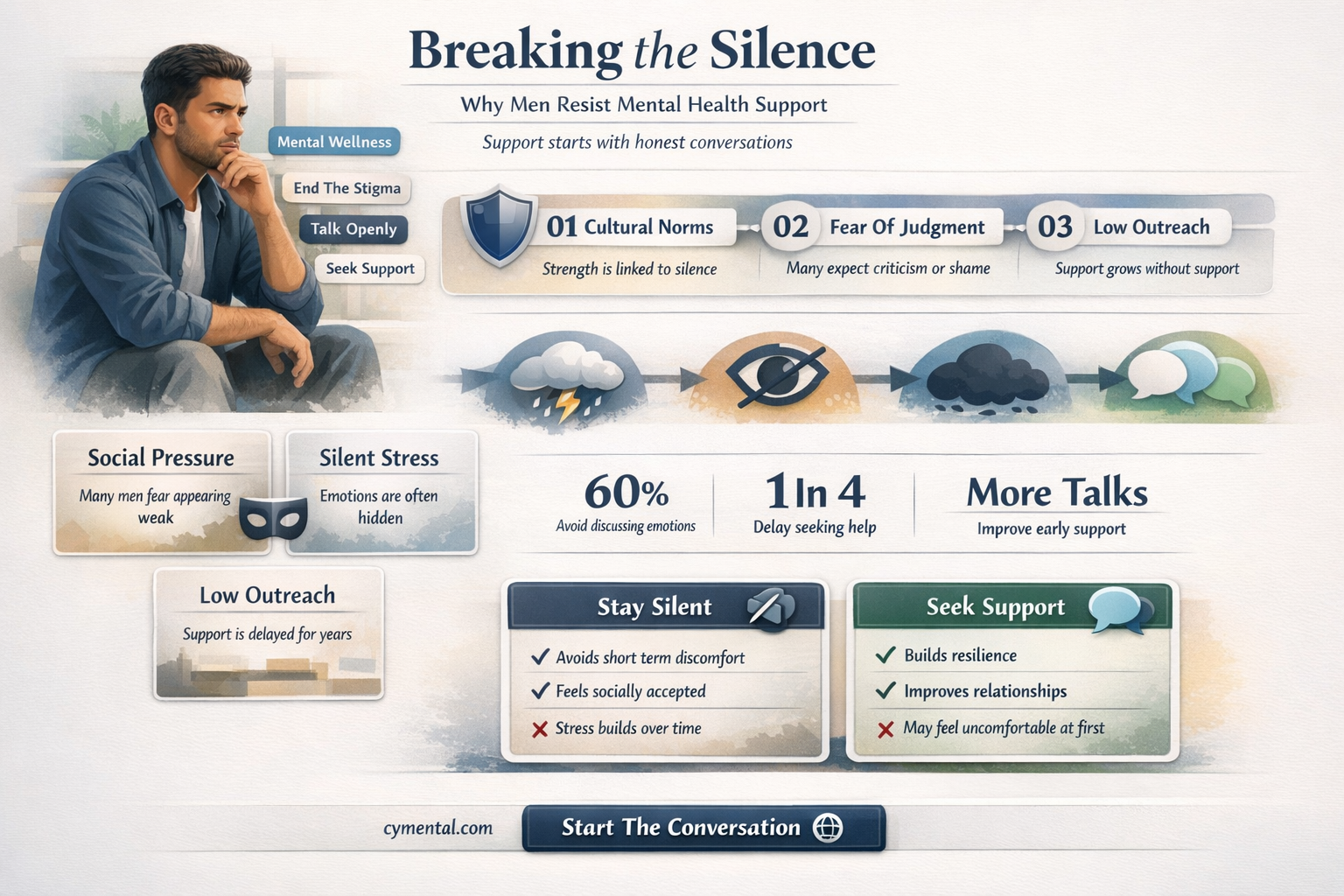
Men often avoid seeking help for mental health issues due to societal pressures, stigma, and traditional notions of masculinity that equate emotional vulnerability with weakness. Cultural expectations to tough it out or be strong can deter men from acknowledging their struggles or reaching out for support. Additionally, a lack of awareness about mental health resources and fear of judgment further contribute to this reluctance. As a result, many men suffer in silence, leading to untreated conditions, worsening symptoms, and, in severe cases, tragic outcomes like suicide. Addressing this issue requires destigmatizing mental health conversations, promoting gender-sensitive support systems, and encouraging a redefinition of masculinity that embraces emotional openness and self-care.
| Characteristics | Values |
|---|---|
| Prevalence of Avoidance | Men are less likely than women to seek professional help for mental health issues. Studies show that only 1 in 3 men who experience mental health problems seek professional support. |
| Reasons for Avoidance | 1. Stigma: Fear of being perceived as weak or less masculine. 2. Lack of Awareness: Men may not recognize symptoms or underestimate the severity of their mental health issues. 3. Reliance on Self-Reliance: Preference for handling problems independently. 4. Negative Attitudes Toward Help-Seeking: Beliefs that seeking help is a sign of failure or that mental health professionals won’t understand their struggles. 5. Practical Barriers: Cost, lack of access to services, and time constraints. |
| Mental Health Outcomes | Men are at higher risk of suicide, substance abuse, and untreated mental health conditions due to avoidance of help-seeking. |
| Cultural Influences | Traditional gender norms emphasizing stoicism, emotional restraint, and self-sufficiency discourage men from seeking help. |
| Age and Demographic Factors | Younger men and those from minority groups may face additional barriers due to cultural stigma or lack of culturally sensitive services. |
| Preferred Coping Mechanisms | Men are more likely to use maladaptive coping strategies such as substance abuse, anger, or withdrawal rather than seeking professional help. |
| Impact on Relationships | Avoidance of help-seeking can strain relationships, as partners or family members may bear the burden of untreated mental health issues. |
| Workplace Implications | Men may avoid addressing mental health issues at work, leading to decreased productivity, absenteeism, or job loss. |
| Recent Trends | There is a growing awareness and efforts to destigmatize mental health for men, with campaigns like Movember and increased male-focused mental health resources. |
| Effective Interventions | Male-friendly services, peer support groups, online therapy, and education to challenge gender stereotypes have shown promise in encouraging help-seeking. |
Explore related products

$8.44 $14.99


What You'll Learn
- Stigma and Masculinity: Societal expectations of men as strong, self-reliant, and unemotional discourage seeking help
- Fear of Judgment: Men worry about being perceived as weak or less masculine if they seek mental health support
- Lack of Awareness: Limited knowledge about mental health resources and symptoms leads to avoidance of help
- Cultural Barriers: Cultural norms in some communities stigmatize mental health issues, deterring men from seeking assistance
- Reluctance to Open Up: Men often struggle with vulnerability, making it hard to discuss emotional struggles

Stigma and Masculinity: Societal expectations of men as strong, self-reliant, and unemotional discourage seeking help
Men are three times more likely to die by suicide than women, a stark statistic that underscores a deeper issue: the reluctance to seek mental health support. This disparity isn’t rooted in biology but in societal conditioning. From childhood, boys are taught to "tough it out," to suppress emotions, and to equate vulnerability with weakness. Phrases like "man up" or "boys don’t cry" aren’t harmless clichés—they’re directives that shape how men perceive themselves and their struggles. This emotional straitjacket fosters a culture where admitting mental health challenges is seen as a failure of masculinity, leaving men isolated and unsupported.
Consider the workplace, a domain where traditional masculine ideals often dominate. Men are frequently expected to be stoic, decisive, and unflappable—traits that leave little room for admitting vulnerability. A 2019 study by the American Psychological Association found that 30% of men avoid seeking mental health treatment due to fears of being perceived as less competent or weak. This stigma doesn’t just harm individuals; it perpetuates a cycle of silence, where untreated mental health issues can escalate into more severe problems, including substance abuse and suicidal ideation. Employers can play a pivotal role here by fostering environments that normalize mental health conversations and provide accessible resources without judgment.
The media also reinforces these harmful stereotypes, often portraying men who seek help as flawed or unmasculine. Think of the countless films and TV shows where the "strong, silent type" prevails, while characters who express vulnerability are ridiculed or marginalized. This narrative seeps into real life, making men hesitant to reach out. To counter this, media creators must diversify their portrayals of masculinity, showcasing men who seek help as courageous and resilient. For instance, public figures like Dwayne "The Rock" Johnson openly discussing their struggles with depression can dismantle stigma by humanizing mental health issues.
Breaking this cycle requires intentional action. Start by redefining masculinity to include emotional intelligence and vulnerability. Encourage open conversations about mental health within families, schools, and peer groups. For parents, this means validating boys’ emotions rather than dismissing them. For friends, it’s about creating safe spaces where vulnerability isn’t met with ridicule but with empathy. Practical steps include promoting mental health screenings tailored for men, offering anonymous support hotlines, and integrating mental health education into workplace training programs.
Ultimately, the stigma surrounding men’s mental health is a societal problem that demands collective effort. By challenging outdated notions of masculinity and fostering environments where seeking help is seen as a strength, not a weakness, we can begin to close the gap in mental health outcomes. Men’s lives depend on it.
Arrested or Assisted: Mental Illness and the Justice System's Dilemma
You may want to see also
Explore related products



Fear of Judgment: Men worry about being perceived as weak or less masculine if they seek mental health support
Men often hesitate to seek mental health support due to a pervasive fear of being judged as weak or less masculine. This stigma is deeply rooted in societal expectations that equate emotional vulnerability with inadequacy. For instance, phrases like “man up” or “boys don’t cry” reinforce the idea that expressing emotions or asking for help is a sign of failure. Such messaging, often internalized from a young age, creates a mental barrier that discourages men from reaching out, even when they desperately need support.
Consider the workplace, where men are frequently expected to embody traits like stoicism and self-reliance. Admitting to struggling with mental health issues in this environment can feel like admitting defeat. A 2019 study by the American Psychological Association found that 35% of men avoid seeking mental health treatment because they fear it will make them appear less competent or capable. This fear is not just personal; it’s systemic, perpetuated by cultural norms that prioritize toughness over emotional well-being.
To combat this, it’s essential to reframe vulnerability as a strength rather than a weakness. Practical steps include normalizing conversations about mental health in male-dominated spaces, such as sports teams, fraternities, or workplaces. For example, organizations like the Movember Foundation have launched campaigns specifically targeting men, encouraging them to “talk, listen, and act” when it comes to mental health. These initiatives provide actionable advice, such as starting conversations with open-ended questions like, “How are you really doing?” instead of relying on superficial small talk.
Another effective strategy is to highlight role models who openly discuss their mental health struggles. Public figures like Dwayne “The Rock” Johnson or Prince Harry have shared their experiences with anxiety and therapy, challenging outdated notions of masculinity. By seeing strong, successful men seek help, others are more likely to follow suit. Additionally, workplaces can implement policies that encourage mental health days and provide confidential resources, reducing the fear of professional repercussions.
Ultimately, dismantling the fear of judgment requires a collective effort to redefine what it means to be a man. It’s not about suppressing emotions or suffering in silence; it’s about recognizing that seeking help is a courageous act of self-care. Men must be reminded that their worth is not tied to their ability to endure pain alone. By fostering a culture of empathy and understanding, we can create an environment where seeking mental health support is seen as a sign of strength, not weakness.
Can You Force Someone to Get Mental Help? Ethical and Legal Considerations
You may want to see also
Explore related products

$9.79 $17.99


Lack of Awareness: Limited knowledge about mental health resources and symptoms leads to avoidance of help
Men often struggle to recognize the signs of mental health issues, mistaking symptoms like irritability, fatigue, or withdrawal as mere stress or personal weakness. Unlike more overt physical ailments, mental health symptoms can be subtle and easily dismissed. For instance, a man experiencing persistent sadness might attribute it to a “rough patch” rather than depression. This lack of awareness stems from societal conditioning that equates emotional expression with vulnerability, leaving many men unequipped to identify when they need help. Without this foundational understanding, seeking assistance becomes an abstract, unnecessary step.
Compounding this issue is the widespread ignorance of available mental health resources. Many men are unaware of the variety of support options, from therapy and counseling to helplines and community groups. For example, only 30% of men in a 2021 UK survey knew about local mental health services, while 60% admitted they wouldn’t know where to start if they needed help. This knowledge gap is particularly pronounced in rural areas or among older age groups, where access to information is limited. Without clear pathways to support, men are more likely to avoid addressing their mental health altogether.
Education plays a critical role in bridging this awareness gap. Schools, workplaces, and media campaigns must prioritize mental health literacy, teaching men not only to recognize symptoms but also to understand the resources available. Practical steps include integrating mental health modules into corporate training programs or distributing resource guides in public spaces like gyms and barbershops. For instance, Australia’s *Man Up* campaign successfully used relatable male figures to normalize conversations about mental health, increasing helpline calls by 40% within six months. Such initiatives prove that targeted education can dismantle barriers to seeking help.
However, awareness alone isn’t enough; it must be paired with actionable steps. Men need to know not just *that* help exists, but *how* to access it. This includes providing clear instructions, such as “Call this number for a free consultation” or “Visit this website to find a therapist near you.” Additionally, offering low-stakes entry points, like anonymous online chats or peer support groups, can reduce the intimidation factor. By demystifying the process and lowering perceived risks, men are more likely to take the first step toward getting help.
Ultimately, addressing the lack of awareness requires a multi-faceted approach. It starts with normalizing conversations about mental health, ensuring men understand that emotional struggles are not a sign of failure. Simultaneously, resources must be made visible, accessible, and tailored to male-specific needs. Without this dual focus, the cycle of avoidance will persist, leaving countless men to suffer in silence. Awareness isn’t just about knowing—it’s about empowering men to act.
Creatine's Surprising Role in Boosting Mental Health and Well-Being
You may want to see also
Explore related products

$13.16 $16.99


Cultural Barriers: Cultural norms in some communities stigmatize mental health issues, deterring men from seeking assistance
In many cultures, mental health struggles are seen as a sign of weakness, a belief that disproportionately affects men. This perception is deeply rooted in traditional gender roles that equate masculinity with strength, self-reliance, and emotional stoicism. For instance, in some African communities, men are expected to be the family’s pillar, and showing vulnerability is often met with ridicule or shame. Such cultural norms create an invisible barrier, leaving men to battle their mental health issues in silence rather than seeking the help they need.
Consider the case of Latino communities, where *machismo*—a cultural expectation for men to be dominant, self-sufficient, and emotionally reserved—often discourages open discussions about mental health. A 2019 study published in the *Journal of Racial and Ethnic Health Disparities* found that Latino men were significantly less likely to seek mental health services compared to their female counterparts, citing fear of appearing weak as a primary reason. This reluctance isn’t just a personal choice; it’s a response to societal expectations that prioritize toughness over well-being.
To address this, culturally sensitive interventions are essential. For example, community-based programs that involve male role models sharing their mental health journeys can help normalize seeking help. In Indigenous communities in Australia, initiatives like *The Man Cave* engage young men in workshops that challenge toxic masculinity and encourage emotional expression. Similarly, in the U.S., organizations like *Movember* use campaigns tailored to specific cultural groups, emphasizing that seeking help is a sign of strength, not weakness.
However, breaking cultural barriers requires more than awareness campaigns. It demands systemic change. Healthcare providers must be trained to understand and respect cultural nuances, offering services that align with men’s values and beliefs. For instance, incorporating faith-based counseling in communities where religion plays a central role can make mental health support more accessible. Additionally, policymakers should fund research to identify culturally specific barriers and develop targeted solutions, ensuring that no man is left behind due to societal stigma.
Ultimately, dismantling cultural barriers to mental health care for men is a collective responsibility. It starts with acknowledging that masculinity is not a monolith and that emotional vulnerability is a universal human experience. By fostering environments where men feel safe to express their struggles without fear of judgment, we can begin to bridge the gap between cultural expectations and mental health needs. After all, seeking help isn’t a failure—it’s a step toward healing.
Reporting Mental Health Associations: When Help Falls Short, What Next?
You may want to see also
Explore related products


Reluctance to Open Up: Men often struggle with vulnerability, making it hard to discuss emotional struggles
Men are four times more likely to die by suicide than women, a stark statistic that underscores a deeper issue: their reluctance to seek help for mental health struggles. This disparity isn’t rooted in a lack of need but in a cultural expectation of stoicism. From a young age, boys are taught to suppress emotions, to equate vulnerability with weakness. Phrases like “man up” or “boys don’t cry” reinforce this toxic narrative, creating a barrier to emotional expression. When vulnerability is stigmatized, seeking help becomes an admission of failure rather than an act of self-care.
Consider the workplace, a domain where men often feel pressured to embody strength and control. Admitting to anxiety, depression, or burnout can be perceived as a threat to professional competence. A 2019 study found that 60% of men feared negative career consequences if they disclosed mental health issues. This fear isn’t unfounded; workplaces often lack policies that encourage openness, leaving men to navigate their struggles in silence. Practical steps, such as implementing confidential mental health programs and training managers to recognize signs of distress, could begin to dismantle this barrier.
The reluctance to open up also stems from a lack of male-friendly resources. Traditional therapy settings, often centered on emotional exploration, can feel alienating to men socialized to avoid such conversations. Peer support groups, however, have shown promise. For example, organizations like Men’s Shed in the UK provide spaces where men can connect through shared activities like woodworking, gradually fostering trust and openness. These environments bypass the pressure of direct emotional disclosure, allowing vulnerability to emerge naturally.
Breaking the cycle requires reframing vulnerability as a strength, not a flaw. Role models play a crucial role here. Public figures like Dwayne “The Rock” Johnson and Prince Harry have openly discussed their mental health struggles, challenging stereotypes and normalizing the conversation. At a personal level, partners, friends, and family can encourage openness by creating safe, nonjudgmental spaces. Simple actions, like asking open-ended questions and actively listening without offering immediate solutions, can make a significant difference.
Ultimately, addressing men’s reluctance to open up demands a cultural shift. It’s about redefining masculinity to include emotional intelligence and self-compassion. Schools, workplaces, and media must actively promote this new narrative. Until then, men will continue to suffer in silence, not because they don’t need help, but because they’ve been conditioned to believe asking for it is a sign of defeat. The takeaway is clear: vulnerability isn’t weakness—it’s the first step toward healing.
Texas State Services for Mentally Disabled Individuals: Available Resources and Support
You may want to see also
Frequently asked questions
Men often avoid seeking help due to societal pressures that equate asking for help with weakness, fear of stigma, and internalized beliefs about masculinity that discourage emotional vulnerability.
Yes, men are more likely to ignore symptoms of depression, anxiety, and PTSD, often masking them with anger, substance use, or risky behavior instead of seeking professional support.
Stigma creates a fear of judgment or being labeled as "weak," leading men to downplay their struggles or avoid seeking help altogether, even when they are in distress.
Raising awareness, normalizing vulnerability, promoting male role models who speak openly about mental health, and creating safe, non-judgmental spaces for men to seek help can encourage them to take action.