Madison Cole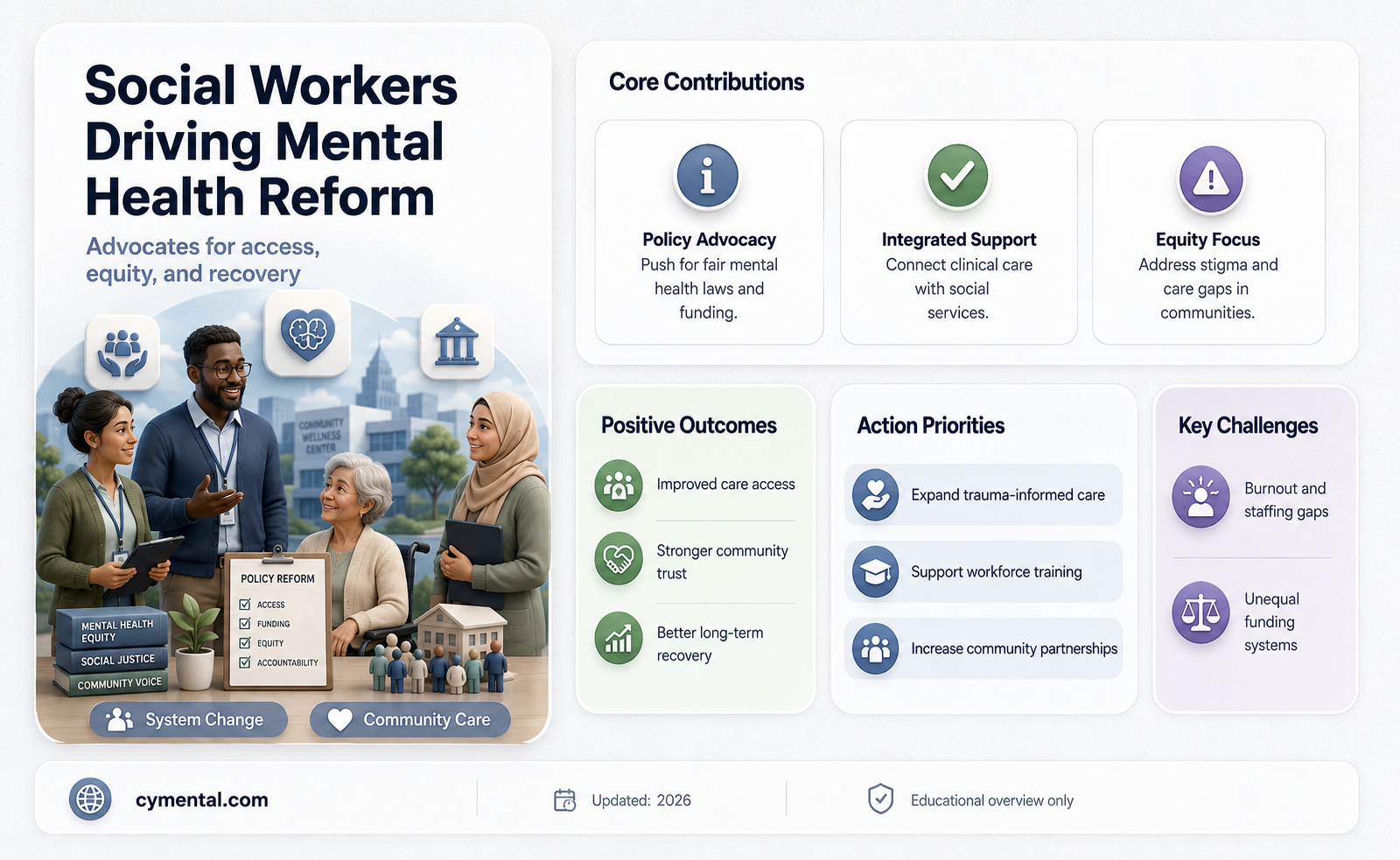
Social workers are playing a pivotal role in reforming the mental health system by addressing systemic gaps, advocating for policy changes, and providing direct, client-centered care. Through their holistic approach, they bridge the divide between individuals and resources, ensuring marginalized communities have access to culturally competent services. By collaborating with healthcare providers, policymakers, and community organizations, social workers are dismantling stigma, promoting prevention strategies, and pushing for equitable funding. Their emphasis on trauma-informed care and social determinants of health is reshaping how mental health is understood and treated, fostering a more inclusive and effective system.
Explore related products


What You'll Learn
- Advocacy for Policy Changes: Pushing for laws that improve mental health care access and funding
- Community-Based Interventions: Implementing local programs to reduce stigma and provide early support
- Integrated Care Models: Collaborating with healthcare systems to combine mental and physical health services
- Crisis Intervention Training: Equipping professionals to handle mental health emergencies effectively and compassionately
- Client-Centered Approaches: Empowering individuals to lead their treatment and recovery processes

Advocacy for Policy Changes: Pushing for laws that improve mental health care access and funding
Social workers are increasingly leveraging their expertise to advocate for policy changes that expand mental health care access and secure sustainable funding. By engaging with legislators, drafting bills, and mobilizing communities, they are dismantling systemic barriers that prevent individuals from receiving timely and effective care. For instance, the National Association of Social Workers (NASW) has championed initiatives like the Mental Health Access Improvement Act, which aims to include licensed clinical social workers as Medicare providers, thereby increasing the pool of eligible practitioners and reducing wait times for patients.
Consider the step-by-step process social workers use to drive policy reform. First, they identify gaps in mental health care access by conducting needs assessments and analyzing data on underserved populations, such as rural communities or racial minorities. Next, they collaborate with lawmakers to draft legislation that addresses these gaps, often proposing solutions like telehealth expansion or increased Medicaid reimbursement rates. Finally, they mobilize grassroots campaigns, leveraging social media, public forums, and partnerships with advocacy groups to build public support and pressure policymakers to act. This methodical approach ensures that advocacy efforts are both evidence-based and impactful.
A comparative analysis reveals the stark differences in mental health care access between states with robust social work advocacy and those without. In California, for example, social workers successfully lobbied for the passage of the Mental Health Services Act, which allocates millions of dollars annually to community-based programs. As a result, California has seen a 30% increase in access to mental health services for low-income individuals since 2005. In contrast, states with weaker advocacy efforts, such as Mississippi, continue to struggle with provider shortages and inadequate funding, leaving many residents without care. This disparity underscores the critical role social workers play in shaping policy outcomes.
Persuasive arguments for increased funding often highlight the economic benefits of investing in mental health care. Social workers emphasize that every dollar spent on prevention and early intervention saves $4 in future healthcare and criminal justice costs. For example, school-based mental health programs, which social workers frequently advocate for, reduce absenteeism and improve academic performance, yielding long-term societal gains. By framing mental health care as a sound financial investment, social workers make a compelling case to policymakers who prioritize fiscal responsibility.
Practical tips for social workers entering policy advocacy include building relationships with local legislators, mastering the art of storytelling to humanize data, and staying informed about pending legislation. For instance, sharing a client’s success story can be more persuasive than citing statistics alone. Additionally, social workers should join coalitions with other healthcare professionals and community organizations to amplify their voice. By combining these strategies, social workers can effectively push for laws that not only improve mental health care access but also ensure equitable funding for all populations.
Seeking Support: A Guide to Finding Help When You Need It Most
You may want to see also
Explore related products

$33.9 $52.99


Community-Based Interventions: Implementing local programs to reduce stigma and provide early support
Social workers are increasingly leveraging community-based interventions to address mental health challenges at the grassroots level. These programs, rooted in local contexts, aim to dismantle stigma and ensure early support for individuals before their conditions escalate. By fostering trust and accessibility, community initiatives create safe spaces where people feel understood and empowered to seek help.
Consider the Mental Health First Aid (MHFA) program, a widely adopted model that trains community members to identify and respond to mental health crises. Similar to traditional first aid, MHFA equips participants with skills to offer initial support until professional help arrives. Studies show that communities with higher MHFA participation rates experience reduced stigma and increased help-seeking behaviors. For instance, a 2020 evaluation found that 70% of MHFA-trained individuals felt more confident intervening in mental health emergencies. Implementing such programs requires collaboration with local schools, workplaces, and faith-based organizations to maximize reach.
However, community-based interventions are not without challenges. One critical issue is ensuring cultural sensitivity. Programs must be tailored to reflect the unique needs and beliefs of the communities they serve. For example, in Indigenous communities, incorporating traditional healing practices alongside Western approaches can enhance engagement and effectiveness. Social workers must also address resource limitations, such as funding and trained personnel, by advocating for policy changes and securing grants. Without these adaptations, even well-intentioned programs risk alienating the very populations they aim to support.
To maximize impact, social workers should adopt a multi-pronged strategy. First, peer support programs can be particularly effective, as they leverage shared experiences to build trust and reduce isolation. For instance, youth-led mental health initiatives in urban areas have shown promising results in normalizing conversations around mental health. Second, public awareness campaigns that use local influencers or community leaders can help reframe mental health as a collective responsibility rather than an individual failing. Finally, integrating mental health services into existing community hubs, such as libraries or recreation centers, can lower barriers to access.
In conclusion, community-based interventions represent a powerful tool in the social worker’s arsenal for mental health reform. By addressing stigma and providing early support, these programs not only improve individual outcomes but also foster resilient, compassionate communities. Success hinges on cultural relevance, resourcefulness, and a commitment to collaboration. As social workers continue to innovate in this space, their efforts remind us that meaningful change often begins at the local level.
Bilingual Brains: Can Language Learning Aid Mental Health Disorders?
You may want to see also
Explore related products


Integrated Care Models: Collaborating with healthcare systems to combine mental and physical health services
Social workers are increasingly advocating for and implementing integrated care models that bridge the gap between mental and physical health services. This approach recognizes the inextricable link between the two, addressing the whole person rather than siloed symptoms. By collaborating with healthcare systems, social workers are dismantling barriers to comprehensive care, ensuring individuals receive holistic treatment that improves overall well-being.
One successful example is the Collaborative Care Model (CoCM), a team-based approach where social workers, primary care providers, and psychiatric consultants work together to manage mental health conditions within primary care settings. This model has demonstrated significant improvements in depression and anxiety outcomes, particularly for underserved populations. A 2019 study published in *JAMA Internal Medicine* found that CoCM participants experienced a 48% greater reduction in depression symptoms compared to usual care.
Implementing integrated care requires careful planning and collaboration. Social workers play a crucial role in this process by:
- Identifying and addressing social determinants of health: Factors like housing instability, food insecurity, and lack of transportation significantly impact both physical and mental health. Social workers assess these needs and connect individuals to community resources, ensuring a more comprehensive approach to care.
- Facilitating communication and coordination: They act as liaisons between healthcare providers, ensuring seamless information sharing and coordinated treatment plans. This prevents duplication of services and promotes a unified approach to patient care.
- Providing psychotherapy and counseling: Within integrated care teams, social workers offer evidence-based therapies like cognitive-behavioral therapy (CBT) and motivational interviewing, addressing mental health concerns alongside physical health management.
Despite its benefits, integrated care faces challenges. Financial constraints, limited provider availability, and resistance to change within healthcare systems can hinder implementation. Social workers must advocate for policy changes that support integrated care models, such as reimbursement structures that incentivize collaborative care and increased funding for training and workforce development.
The future of mental health reform lies in breaking down the artificial divide between mind and body. Integrated care models, championed by social workers, offer a promising path forward, ensuring individuals receive the holistic care they deserve. By addressing the complex interplay of physical and mental health, social workers are not just treating symptoms, they are transforming lives.
Gatorade and Mental Health: Hydration's Role in Cognitive Well-being
You may want to see also
Explore related products


Crisis Intervention Training: Equipping professionals to handle mental health emergencies effectively and compassionately
Social workers are increasingly at the forefront of mental health reform, and one of their most impactful contributions is through Crisis Intervention Training (CIT). This specialized training equips professionals—including law enforcement, emergency responders, and social workers themselves—with the skills to de-escalate mental health emergencies effectively and compassionately. By bridging the gap between crisis situations and appropriate care, CIT programs are reducing harm, preventing unnecessary hospitalizations, and fostering trust between communities and service providers.
Consider the scenario of a 911 call involving a person experiencing a psychotic episode. Without CIT, the response might escalate into a traumatic encounter, potentially involving restraints or even force. However, a CIT-trained officer would approach the situation differently. They would employ active listening, validate the individual’s distress, and use non-threatening language to build rapport. For instance, instead of demanding compliance, they might say, “I see you’re feeling overwhelmed. Can we sit down and talk about what’s happening?” This approach not only de-escalates the crisis but also connects the individual to mental health resources, such as mobile crisis teams or outpatient services.
The effectiveness of CIT lies in its structured curriculum, which combines classroom instruction with role-playing scenarios and collaboration with mental health professionals. Participants learn to recognize symptoms of mental illness, such as agitation in schizophrenia or suicidal ideation in depression, and practice strategies like verbal de-escalation and crisis negotiation. For example, a key technique is the “3 R’s”—recognize, respond, and refer. Recognize the signs of mental distress, respond with empathy and patience, and refer the individual to appropriate care. Studies show that CIT-trained officers are significantly less likely to use force and more likely to divert individuals to treatment rather than arrest.
However, implementing CIT is not without challenges. Training requires time and resources, and its success depends on ongoing collaboration between law enforcement, mental health providers, and community organizations. For instance, in Memphis, Tennessee, the CIT program’s success is attributed to its partnership with local mental health agencies, which provide real-time support during crises. To sustain such programs, funding must be prioritized, and agencies must commit to regular refresher training. Additionally, CIT should be tailored to the specific needs of diverse populations, including youth, veterans, and culturally marginalized communities.
In conclusion, Crisis Intervention Training is a powerful tool in the social worker’s arsenal for mental health reform. By equipping professionals with the skills to handle emergencies compassionately, CIT not only saves lives but also transforms the way society responds to mental health crises. As these programs expand, they offer a blueprint for a more humane and effective mental health system—one where crisis is met with care, not coercion.
Reading for Resilience: How Books Support Mental Health and Healing
You may want to see also
Explore related products


Client-Centered Approaches: Empowering individuals to lead their treatment and recovery processes
Social workers are increasingly adopting client-centered approaches to mental health treatment, fundamentally shifting power dynamics by placing individuals at the helm of their recovery journeys. This paradigm rejects the traditional, paternalistic model where professionals dictate care plans, instead fostering collaboration and autonomy. For instance, a social worker might use motivational interviewing techniques to help a client identify their own goals and values, ensuring treatment aligns with their unique needs and aspirations. This approach not only enhances engagement but also improves long-term outcomes by building intrinsic motivation.
Consider the case of a 28-year-old with generalized anxiety disorder who feels overwhelmed by prescribed medication side effects. A client-centered social worker would explore alternative strategies, such as cognitive-behavioral therapy or mindfulness practices, allowing the individual to choose the path that resonates most with them. This process involves shared decision-making, where the social worker provides evidence-based options and the client evaluates them based on personal preferences and lifestyle. For example, a client might opt for a 10-minute daily mindfulness exercise over medication, with the social worker offering guidance on techniques like diaphragmatic breathing or progressive muscle relaxation.
Empowerment in this context extends beyond treatment selection to include self-advocacy and system navigation. Social workers often teach clients how to articulate their needs to healthcare providers, access community resources, and challenge stigma. For a teenager struggling with depression, this might involve role-playing conversations with school counselors or drafting a mental health accommodation request. Practical tools, such as symptom tracking apps or crisis planning worksheets, further equip individuals to manage their conditions proactively. A study published in *Social Work in Mental Health* found that clients who participated in such empowerment-focused interventions reported higher levels of self-efficacy and treatment satisfaction.
However, implementing client-centered approaches requires careful consideration of potential challenges. For example, individuals with severe mental illness may face barriers to decision-making due to symptom acuity. Social workers must balance respect for autonomy with ethical responsibilities to ensure safety. In these cases, a phased approach might be employed, starting with small, manageable choices (e.g., selecting therapy session times) and gradually expanding to more complex decisions as capacity improves. Additionally, cultural humility is essential; a social worker must recognize and adapt to the client’s cultural beliefs about mental health, ensuring that empowerment strategies are inclusive and respectful.
Ultimately, client-centered approaches represent a transformative shift in mental health care, prioritizing individual agency and dignity. By fostering partnerships built on trust and mutual respect, social workers not only improve treatment outcomes but also challenge systemic inequities. For practitioners, this means investing time in building rapport, actively listening, and continually reassessing the client’s evolving needs. For clients, it means reclaiming control over their lives, one informed decision at a time. This model is not just a methodology—it’s a commitment to honoring the humanity of every person seeking support.
Supporting Mental Health: Practical Ways to Help Loved Ones Heal
You may want to see also
Frequently asked questions
Social workers are actively involved in advocating for policy reforms that prioritize mental health accessibility, funding, and equitable care. They collaborate with lawmakers, participate in advocacy campaigns, and use their expertise to shape legislation that addresses gaps in mental health services, reduces stigma, and ensures comprehensive support for vulnerable populations.
Social workers are key in bridging the gap between mental health and primary care by providing on-site counseling, case management, and referrals within healthcare settings. They help identify mental health needs early, coordinate care, and ensure holistic treatment that considers both physical and emotional well-being.
Social workers focus on culturally competent care, community outreach, and tailored interventions to address systemic barriers faced by marginalized groups. They work to reduce stigma, increase awareness, and provide resources in underserved areas, ensuring mental health services are accessible and relevant to diverse populations.


![The Art of Advocacy: Briefs, Motions, and Writing Strategies of America's Best Lawyers [Connected eBook] (Aspen Coursebook)](https://m.media-amazon.com/images/I/71nFTPUXCiL._AC_UL320_.jpg)


![A Practical Guide to Appellate Advocacy: [Connected eBook] (Aspen Coursebook Series)](https://m.media-amazon.com/images/I/811nfMmBU6L._AC_UL320_.jpg)