Noah Parker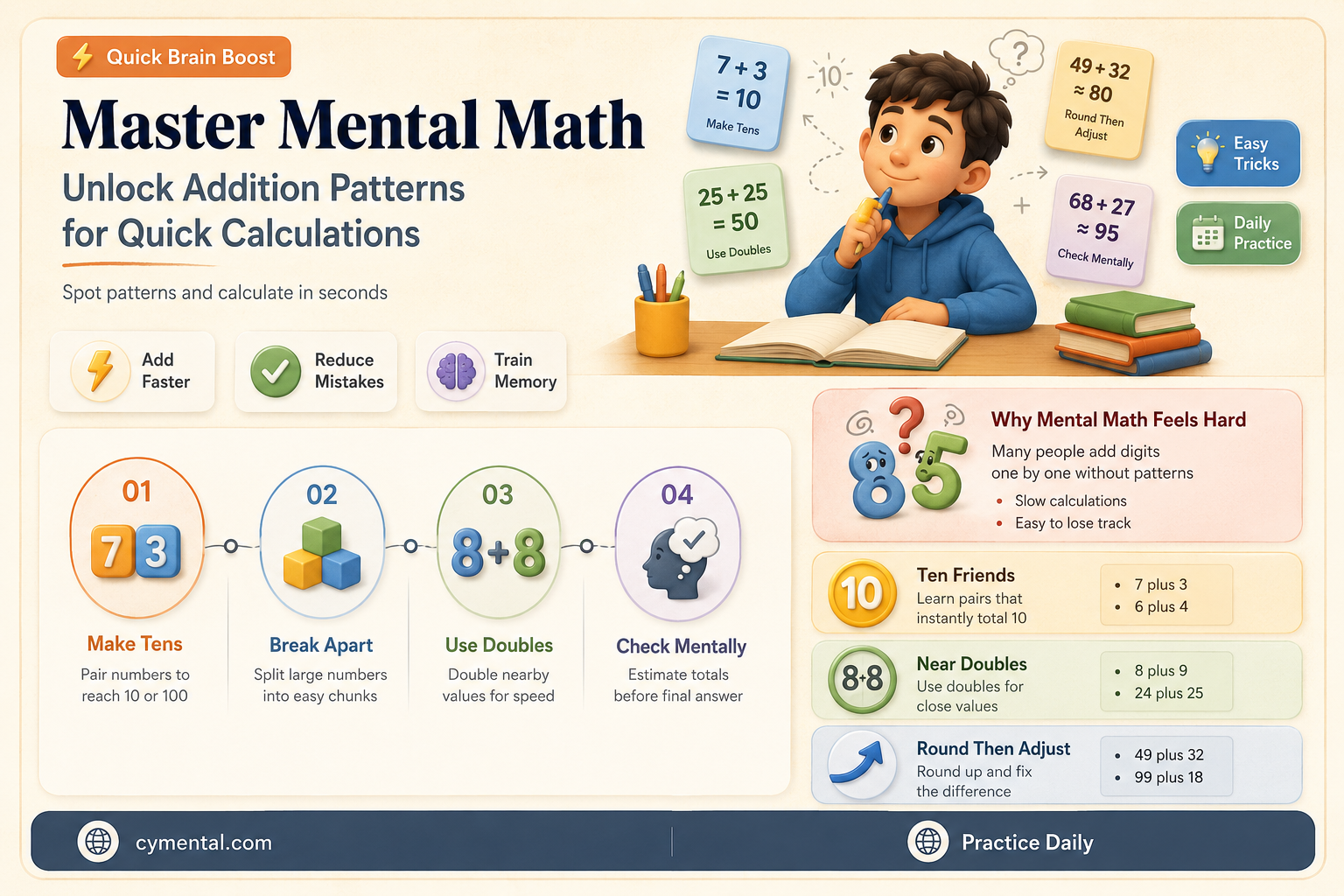
Addition patterns are a powerful tool for mental math, as they allow you to recognize and leverage recurring relationships between numbers. By identifying patterns such as doubles (e.g., 3 + 3 = 6), near-doubles (e.g., 4 + 5 = 9), or adding multiples of 10, you can simplify complex additions into manageable steps. For instance, breaking down 27 + 35 into 27 + 30 + 5 makes it easier to compute mentally. These patterns not only speed up calculations but also build a deeper understanding of number relationships, making mental addition more intuitive and efficient.
| Characteristics | Values |
|---|---|
| Number Sense | Enhances understanding of numbers and their relationships, making mental addition more intuitive. |
| Efficiency | Allows for quicker calculations by recognizing patterns rather than relying on step-by-step addition. |
| Flexibility | Enables multiple strategies for solving addition problems, adapting to different situations. |
| Memory Aid | Patterns like "making tens" (e.g., 8 + 7 = 8 + 2 + 5 = 15) reduce the need to memorize numerous addition facts. |
| Decomposition | Breaks numbers into easier-to-add components (e.g., 17 + 28 = 17 + 20 + 8 = 45). |
| Compensation | Adjusts numbers to simplify addition (e.g., 37 + 18 = 37 + 20 - 2 = 55). |
| Visual Representation | Patterns can be visualized (e.g., number lines or arrays), aiding in mental calculation. |
| Consistency | Provides a systematic approach to addition, reducing errors and increasing accuracy. |
| Scalability | Patterns can be applied to larger numbers or more complex problems with practice. |
| Confidence | Builds confidence in mental math skills through repeated use of reliable patterns. |
Explore related products


What You'll Learn
- Recognizing number bonds – Quickly recall pairs of numbers that add up to 10, 20, etc
- Using doubles and near-doubles – Leverage known doubles (e.g., 4+4) to solve similar problems
- Breaking numbers into tens and ones – Split numbers for easier mental addition (e.g., 37 = 30 + 7)
- Compensating with 10 – Adjust one addend to make a round number, then balance the difference
- Adding in chunks – Group numbers into friendly sums (e.g., 15 + 5 + 5 = 25)

Recognizing number bonds – Quickly recall pairs of numbers that add up to 10, 20, etc
Mastering number bonds is a cornerstone of mental addition, offering a shortcut to fluency in basic arithmetic. A number bond is simply a pair of numbers that add up to a specific target, such as 10 or 20. For instance, recognizing that 7 + 3 = 10 allows you to instantly recall the pair (7, 3) whenever you encounter a problem involving 10. This skill is particularly useful for children aged 5–8, as it builds a foundation for more complex math, but it benefits learners of all ages by reducing reliance on counting. Start by memorizing bonds for 10, then expand to 20, 50, or even 100, depending on your needs.
Consider the practical application of number bonds in everyday scenarios. If you’re splitting a bill of $20 and one person pays $13, knowing the bond 13 + 7 = 20 lets you instantly calculate the remaining amount without reaching for a calculator. Similarly, in cooking, if a recipe calls for 50 grams of sugar and you’ve already added 37 grams, recalling that 37 + 13 = 50 saves time and prevents errors. To reinforce this skill, practice with flashcards or games that pair numbers to their target sums. Over time, these bonds become second nature, streamlining mental calculations.
While number bonds are powerful, they require deliberate practice to master. Begin by focusing on bonds for 10, such as (1, 9), (2, 8), (3, 7), and so on. Once these are solid, move to bonds for 20, like (10, 10), (12, 8), or (15, 5). A cautionary note: avoid overwhelming yourself by trying to memorize too many bonds at once. Instead, tackle them in small, manageable groups. For instance, spend a week mastering bonds for 10 before progressing to 20. This incremental approach ensures retention and builds confidence.
The true value of recognizing number bonds lies in their versatility. They’re not just for addition; they also aid in subtraction, as subtracting a number from the target sum naturally reveals its bond pair. For example, knowing 10 – 4 = 6 reinforces the bond 4 + 6 = 10. This dual utility makes number bonds a high-yield skill for mental math. To maximize their effectiveness, incorporate them into daily routines—whether shopping, cooking, or solving puzzles. By doing so, you’ll transform number bonds from abstract concepts into practical tools that enhance your numerical intuition.
Supporting Mental Health: Effective Ways to Help Someone in Need
You may want to see also
Explore related products


Using doubles and near-doubles – Leverage known doubles (e.g., 4+4) to solve similar problems
Doubles, such as 4+4 or 7+7, are foundational in mental math because they create predictable patterns. Memorizing these pairs (e.g., 1+1=2, 2+2=4, 3+3=6, etc.) builds a mental framework for solving more complex problems. For instance, knowing 8+8=16 instantly gives you the answer to 16+16, as it’s simply doubling the result. This strategy is particularly effective for children aged 6–9, who are solidifying their understanding of basic arithmetic, but it remains a powerful tool for adults tackling quick calculations in daily life.
Consider the problem 7+8. Instead of adding from scratch, recognize it as a near-double of 7+7=14. Since 8 is one more than 7, add 1 to 14, yielding 15. This method breaks down unfamiliar sums into manageable steps. Similarly, for 9+10, think of 9+9=18, then add 1 to get 19. The key is to anchor the problem to a known double and adjust incrementally. Practice this by pairing numbers close to doubles (e.g., 6+7, 5+6) and refining the adjustment step, which becomes almost instinctive with repetition.
While doubles are straightforward, near-doubles require precision in the adjustment step. A common pitfall is misjudging the increment, such as adding 2 instead of 1 to 14 in the 7+8 example. To avoid this, explicitly state the adjustment in your mental dialogue: “7+7 is 14, plus one more is 15.” Another caution is over-relying on this method for larger numbers, where patterns become less intuitive. For sums like 15+16, breaking them into smaller near-doubles (e.g., 10+10 + 5+6) may be more efficient.
In conclusion, using doubles and near-doubles transforms mental addition into a game of recognition and adjustment. By anchoring problems to known pairs, you reduce cognitive load and increase speed. Start by mastering doubles up to 10, then practice near-doubles within the same range. Gradually expand to larger numbers, combining this strategy with other patterns for versatility. Whether budgeting, cooking, or solving puzzles, this technique ensures you’re never more than a quick mental hop from the answer.
Psychology's Role in Healing: Can Studying the Mind Aid Mental Health Recovery?
You may want to see also
Explore related products


Breaking numbers into tens and ones – Split numbers for easier mental addition (e.g., 37 = 30 + 7)
Breaking numbers into tens and ones is a powerful strategy for simplifying mental addition, especially when dealing with two-digit numbers. By decomposing a number like 37 into 30 and 7, you create smaller, more manageable parts that are easier to work with in your mind. This method leverages the structure of the base-10 number system, allowing you to focus on adding tens and ones separately before combining the results. For instance, to add 28 and 15, split them into (20 + 8) and (10 + 5), add the tens (20 + 10 = 30) and the ones (8 + 5 = 13), then combine for a total of 43. This step-by-step approach reduces cognitive load and minimizes errors.
Consider the practical application of this technique in everyday scenarios, such as calculating a total bill or estimating distances. For example, if you’re adding 42 and 29, break them into (40 + 2) and (20 + 9). Adding the tens first (40 + 20 = 60) and then the ones (2 + 9 = 11) gives you a sum of 71. This method is particularly useful for children in elementary school, as it aligns with foundational math concepts like place value. However, it’s equally valuable for adults who want to perform quick calculations without pen and paper. Practice this technique with numbers under 100 to build fluency, gradually increasing the complexity as you become more comfortable.
While splitting numbers into tens and ones is effective, it’s important to be mindful of potential pitfalls. One common mistake is forgetting to carry over when the sum of the ones exceeds 9. For example, adding 38 and 25 involves (30 + 8) and (20 + 5). If you add the ones first (8 + 5 = 13), you must carry the 1 to the tens place, resulting in 30 + 20 + 1 = 51, plus the remaining 3, for a total of 63. Another caution is over-relying on this method for larger numbers, as it may become cumbersome. Instead, use it as a stepping stone to more advanced mental math techniques, such as rounding or front-end estimation.
To maximize the effectiveness of this strategy, incorporate it into daily routines. For instance, when grocery shopping, estimate the total cost by breaking down each item’s price into tens and ones. If an apple costs $1.49 and a loaf of bread costs $2.75, split them into ($1 + 0.49) and ($2 + 0.75), add the dollars first ($1 + $2 = $3), and then the cents (0.49 + 0.75 = 1.24), for a total of $4.24. This not only sharpens your mental math skills but also enhances your ability to make quick, informed decisions. With consistent practice, breaking numbers into tens and ones becomes second nature, transforming complex additions into effortless calculations.
Empower Yourself, Lift Others: Balancing Self-Preservation and Compassion
You may want to see also
Explore related products


$9.99 $13.99


Compensating with 10 – Adjust one addend to make a round number, then balance the difference
Mental addition becomes smoother when you leverage the power of round numbers. The human brain processes them more efficiently, making calculations faster and less error-prone. "Compensating with 10" is a clever technique that taps into this cognitive advantage. It involves adjusting one of the numbers in your addition problem to a nearby multiple of 10, then balancing the difference to arrive at the correct sum. This method is particularly useful for adding numbers that don’t naturally align with round figures.
Consider the problem 37 + 28. Instead of adding these numbers directly, which can be mentally cumbersome, adjust one of the addends to make a round number. For instance, change 28 to 30, a multiple of 10. Now, you’re adding 37 + 30, which equals 67. However, since you increased 28 by 2 to make it 30, you must subtract 2 from your adjusted sum to balance the difference. Thus, 67 - 2 = 65, the correct answer. This technique simplifies the mental process by breaking it into two manageable steps: adjusting to a round number and correcting for the change.
The beauty of compensating with 10 lies in its adaptability. It works for a wide range of addition problems, especially those involving numbers in the 20s, 30s, 40s, and so on. For example, to solve 42 + 17, adjust 17 to 20 (the nearest multiple of 10), add 42 + 20 to get 62, and then subtract the 3 you added (20 - 17) to arrive at 59. This method is particularly effective for children aged 8–12, as it reinforces their understanding of place value and number relationships while building mental math confidence.
A practical tip for mastering this technique is to practice with pairs of numbers that are close to multiples of 10. Start with simpler problems like 38 + 19, adjusting 19 to 20, and gradually move to more complex ones. Use visual aids, such as number lines or grids, to help visualize the adjustments. Over time, this method becomes second nature, allowing you to perform additions swiftly and accurately without relying on pen and paper.
While compensating with 10 is powerful, it’s essential to avoid over-adjusting. For instance, turning 28 into 40 instead of 30 would complicate the balancing step unnecessarily. Keep adjustments minimal, focusing on the nearest multiple of 10. Additionally, ensure you consistently account for the difference in the final step—forgetting to balance the adjustment is a common pitfall. With practice, this technique becomes a reliable tool in your mental math arsenal, streamlining calculations and boosting efficiency.
Seeking Mental Health Support: A Guide to Finding the Right Help
You may want to see also
Explore related products




Adding in chunks – Group numbers into friendly sums (e.g., 15 + 5 + 5 = 25)
Breaking down complex additions into manageable chunks is a mental math strategy that leverages the brain's natural ability to process smaller, more familiar numbers. Consider the problem 15 + 5 + 5. Instead of tackling each number sequentially, group them into "friendly sums." Here, 5 + 5 equals 10, a number most people recognize instantly. Adding this to 15 gives you 25. This method reduces cognitive load by replacing multiple steps with a simpler, two-part process. It’s particularly useful for quick calculations in everyday scenarios, like tallying costs or measuring ingredients.
The effectiveness of this technique lies in its reliance on number patterns and familiarity. For instance, pairing numbers that sum to 10 (e.g., 7 + 3, 8 + 2) is a common pattern taught in early math education. By grouping numbers into such pairs, you’re essentially leveraging pre-existing mental shortcuts. Take 28 + 6 + 4. Group 6 + 4 to make 10, then add it to 28, resulting in 38. This approach not only speeds up calculations but also builds confidence in mental math, especially for learners who struggle with multi-step addition.
While adding in chunks is intuitive, it requires practice to become second nature. Start by identifying "friendly" numbers—those that combine easily in your mind, like multiples of 5 or 10. For example, in 37 + 8 + 2, group 8 + 2 to form 10, then add it to 37 for a total of 47. Caution against overcomplicating the grouping; stick to simple pairs or triples that you can compute instantly. For larger numbers, break them down further—for instance, 49 + 6 + 4 can be split into 40 + 9 + (6 + 4), simplifying to 40 + 9 + 10, then 49 + 10, and finally 59.
The beauty of this method is its adaptability across age groups and skill levels. Elementary students can use it to reinforce basic addition facts, while adults can apply it to real-world problems like budgeting or time management. For instance, if you’re planning a schedule and need to add 45 minutes + 15 minutes + 15 minutes, grouping the two 15s into 30 makes the total 75 minutes (1 hour, 15 minutes) instantly clear. By mastering this technique, you not only save time but also develop a deeper understanding of number relationships, making mental math a more accessible and enjoyable skill.
Supporting Mental Health: How to Effectively Help Someone Struggling with Illness
You may want to see also
Frequently asked questions
Addition patterns are consistent relationships between numbers that make it easier to add mentally. For example, knowing that 5 + 5 = 10 helps you quickly add 7 + 5 by thinking of it as 7 + (5 + 5 - 5) = 12. Patterns simplify calculations by breaking them into familiar parts.
Numbers ending in zero can be added by focusing on the tens place. For example, 30 + 40 can be mentally calculated as 3 tens + 4 tens = 7 tens, or 70. This pattern works for any multiples of ten.
Yes, addition patterns are useful for numbers close to multiples of ten. For example, to add 17 + 18, think of it as (10 + 7) + (10 + 8) = 20 + 15 = 35. Breaking numbers into tens and ones simplifies the process.
Doubles (e.g., 4 + 4 = 8) and near doubles (e.g., 4 + 5) are common patterns. For near doubles, add 1 to the double. For example, 4 + 5 = 4 + 4 + 1 = 9. This pattern speeds up mental addition for small numbers.
Yes, addition patterns can be applied to larger numbers by breaking them into smaller, manageable parts. For example, to add 245 + 178, think of it as (200 + 40 + 5) + (100 + 70 + 8) = 300 + 110 + 13 = 423. This method uses patterns to simplify the calculation.